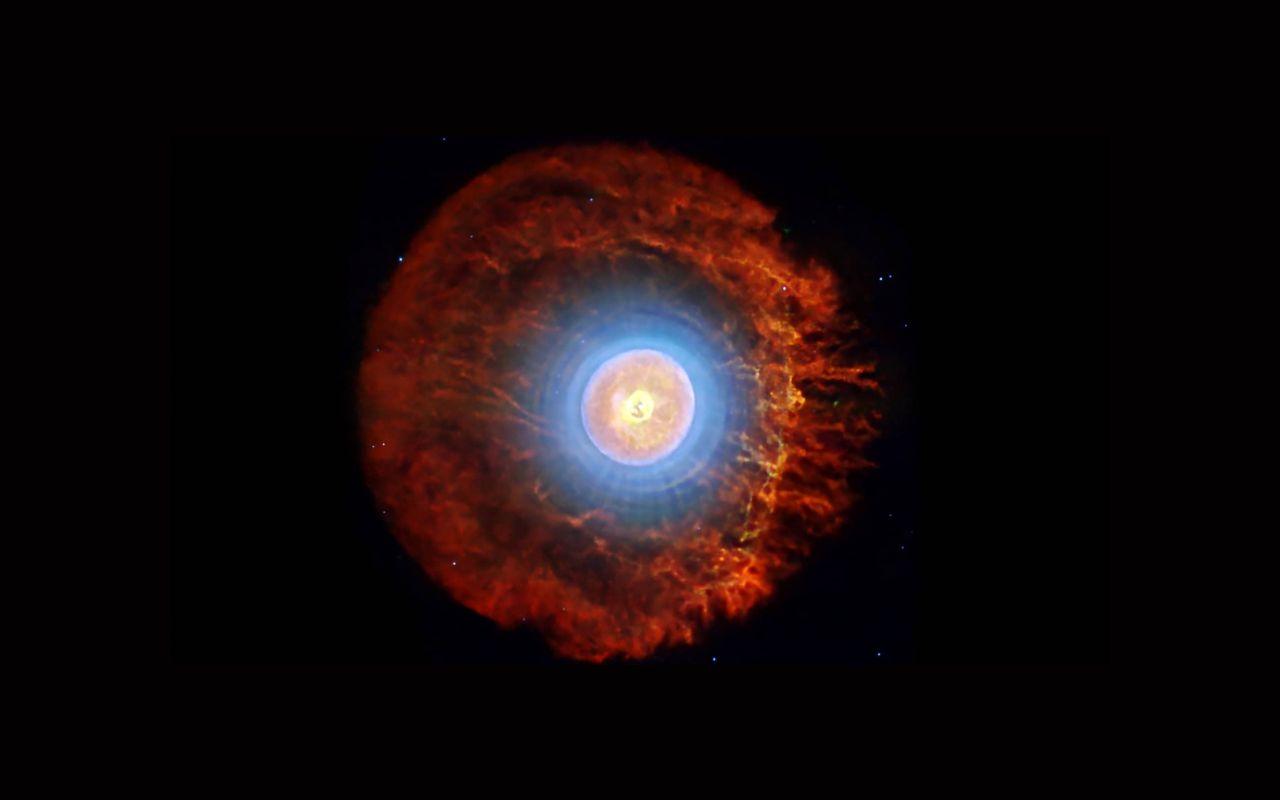


The James Webb telescope captured unprecedented images of a dying star. Understand the mysterious structures discovered and the impact on space science.
The Tc 1 nebula, located approximately 10,000 light-years away in the constellation Ara, has become the stage for a fascinating discovery about the evolution of the cosmos.
Using its advanced infrared technology, the James Webb telescope recorded the “agony” of a star that, upon exhausting its fuel, ejected its outer layers into space.
At the center of this scene, a white dwarf remained — an extremely hot stellar core that, although no longer performing nuclear fusion, emits intense radiation enough to illuminate the gases and dust around it.
-
$12 Billion Invested in AI Data Centers in Semi-Desert Mexican State, But 17 of 18 Municipalities Now Face Water Shortages, Residents Receive Water Only 3 Days a Week

-
How Much Does Starlink Satellite Internet Cost for Cars, Trucks, and RVs? Prices for Antenna, Accessories, and Plans

-
Scientists Convert Food Waste into Aviation Fuel, Successfully Test 50% Blend with Conventional Kerosene to Cut Emissions and Promote Sustainable Flights
-
OnePlus N6 Smartphone to Launch in India with 8,000mAh Battery and 45W SuperVOOC Charging, Lasting Up to Three Days




The mystery of the space “footballs” captured by the James Webb telescope in the dying star
One of the mission’s most significant findings was the detailed identification of carbon molecules known as buckyballs (or buckminsterfullerenes).
These structures, which have a spherical and hollow shape similar to a football, are composed exclusively of carbon atoms and exhibit impressive stability.
The James Webb telescope revealed that these molecules appear to be organized in a spherical layer around the central white dwarf.
Below, see some crucial points about these molecular structures identified in the nebula:
- Extreme Environments: The buckyballs were detected in regions of high radiation and low density, challenging previous physical models.
- Connection with Life: As they belong to the class of polycyclic aromatic hydrocarbons, these molecules may be linked to the chemical processes that give rise to life.
- Universal Distribution: Besides dying stars, fullerenes have already been found in meteorites, interstellar clouds, and regions of new star formation.
Infrared technology and the physics of the system
The success of this observation was only possible thanks to the technological leap that the James Webb represents compared to the old Spitzer telescope.
With a larger mirror and more sensitive sensors, the Webb can capture subtle chemical variations and ultra-high-resolution images.
In the captured image, the colors indicate different thermal states: blue represents the hottest gas, while red signals the colder material.

On the other hand, the behavior of these molecules when emitting infrared light still intrigues researchers, such as Jan Cami and Morgan Giese.
Current theoretical models cannot fully explain the data recorded by the James Webb telescope, suggesting that the physical interactions around a dying star are much more complex than previously imagined.
The future of chemical evolution in the Universe
In the long term, the study of the Tc 1 nebula serves as a laboratory to understand how fundamental elements spread across galaxies. By expelling its mass, the star fertilizes space with carbon and other compounds that, in the future, may integrate new planetary systems.
Therefore, observing the end of an ancient star is essentially observing the recycling of the matter that makes up the Universe. The team of scientists plans to use the James Webb telescope to investigate other similar planetary nebulae.
The ultimate goal is to unravel how the radiation emitted by the central white dwarf shapes the chemistry of the environment and influences the evolution of molecules in the vacuum of space, revealing the secrets of how the basic building blocks of life are distributed throughout the cosmos.
SEE THE OFFICIAL STATEMENT HERE
With information from Olhar Digital