Portuguese
  Spanish


WASP-103b is a deformed exoplanet due to its star, with an orbit of less than 24 hours and an unusual shape that challenges science.
The exoplanet WASP-103b, located about 1,225 light-years from Earth, has caught the attention of the scientific community for its unusual and elongated shape, a result of the intense gravitational force exerted by its star. Initially discovered in 2014 and analyzed with greater precision in 2022, the celestial body orbits its star in less than 24 hours, causing continuous deformations in its structure. The observation was made possible thanks to the combination of data from space telescopes, allowing researchers to measure, for the first time, the distortion of an exoplanet outside the Solar System.
WASP-103b: exoplanet with an unusual shape challenges known patterns
Unlike most known planets, which have a spherical shape, WASP-103b has an elongated structure, resembling an American football or rugby ball. This deformation occurs due to the extreme proximity to its host star, which exerts an intense gravitational force on the exoplanet.
This phenomenon, known as tidal force, is responsible for significantly altering the shape of the celestial body. On Earth, this effect is perceived subtly, influencing ocean tides due to the Moon’s action. However, in the case of this exoplanet, the impact is much more intense and visible throughout its structure.
-
Tourist Discovers Forgotten Joaquín Sorolla Painting Worth Up to 60,000 Euros While Strolling in Seville

-
Brazil’s Fernando de Noronha Boasts World’s Most Beautiful Beach, Accessible Only by Descending 208 Cliffside Steps and With No Food Vendors Allowed

-
Brazilian Startup Converts Tucumã Seeds into Bioplastic for Bicycle Pedals, Cups, and Construction Materials

-
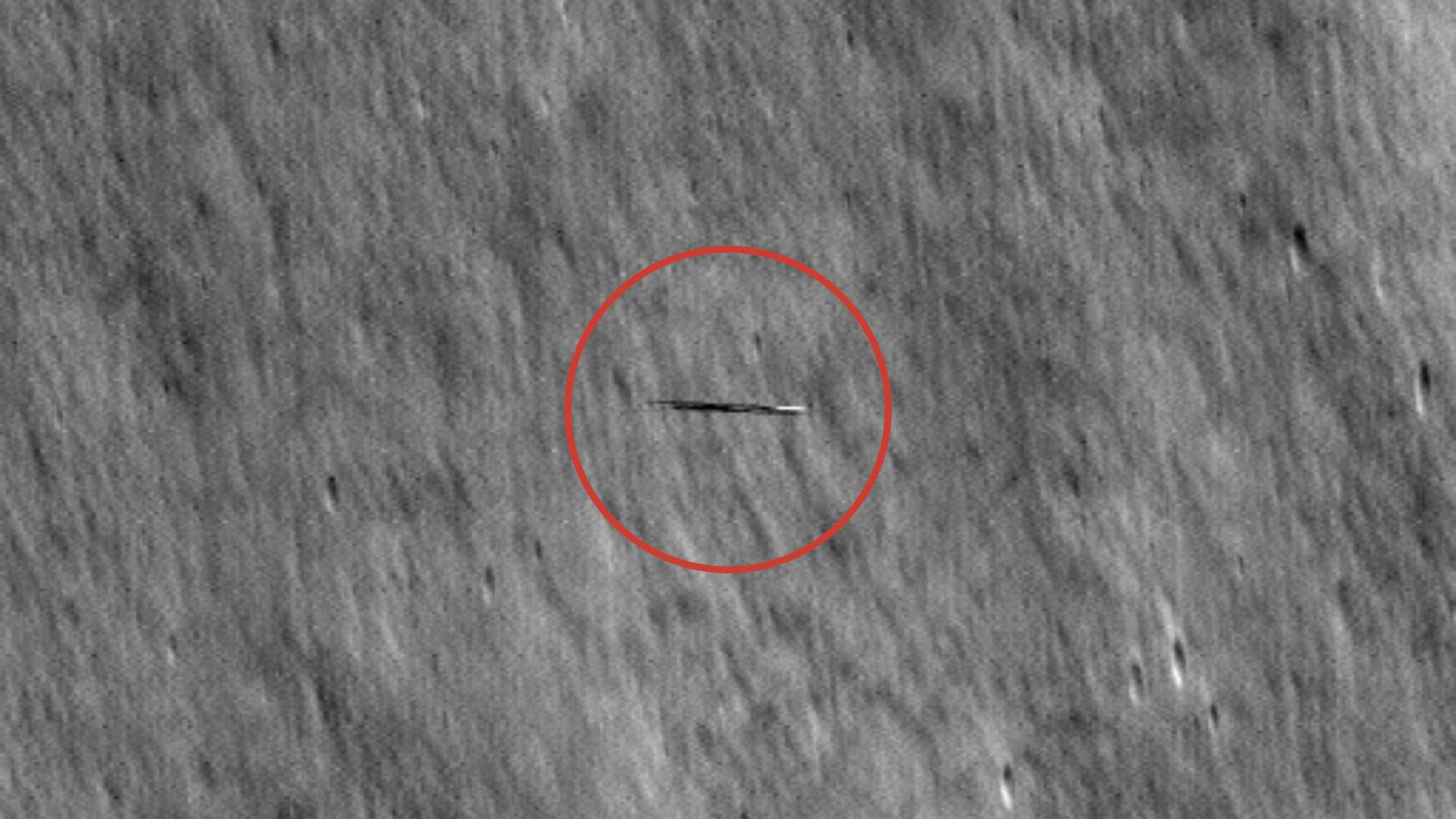
NASA Captures Rare Encounter of South Korean “Surfboard” Spacecraft Crossing Lunar Orbit at Over 11,000 km/h



Accelerated orbit and extreme heat explain the deformation
The short distance between WASP-103b and its star is one of the main factors for its unusual characteristics. The exoplanet is about 50 times closer to its star than Earth is to the Sun, resulting in an extremely fast orbit, completed in less than a terrestrial day.
Additionally, the star is approximately 1.7 times larger than the Sun and about 200 degrees hotter. This combination generates high temperatures on the exoplanet, contributing to its inflated state and predominantly gaseous structure.
For this reason, WASP-103b is classified as an “ultra-short hot Jupiter,” a category that includes giant gas exoplanets that orbit very close to their stars.
Space technology allowed measuring the shape of the exoplanet
The confirmation of the elongated shape was only possible thanks to the combined use of three important space telescopes:
- Hubble
- Spitzer
- CHEOPS (from the European Space Agency)
These instruments analyzed variations in the brightness of the star when the exoplanet passed in front of it — a technique known as the transit method. From these small changes in light, scientists were able to reconstruct the shape of the exoplanet with unprecedented accuracy.
The study was published in the journal Astronomy & Astrophysics in 2022, marking the first time the deformation of an exoplanet was measured and confirmed.

WASP-103b and the advancement in the understanding of exoplanets
The analysis of this exoplanet has opened new possibilities for astrophysics. By observing how its structure reacts to extreme forces, scientists can infer details about its internal composition.
In the case of WASP-103b, the data indicates that it is predominantly gaseous, similar to Jupiter. However, the intense heat and gravity from the star cause its atmosphere to expand, continuously altering its shape.
According to researcher Babatunde Akinsanmi, co-author of the study, measuring the deformation represents a scientific milestone: “After observing several so-called ‘transits,’ we were able to measure the deformation. It’s amazing that we managed to do this — it’s the first time such an analysis has been done.”
Despite the discoveries, WASP-103b still exhibits behaviors that intrigue scientists. Normally, massive exoplanets orbiting so close to their stars tend to get closer and closer, until they are eventually swallowed.
However, current measurements suggest an unexpected behavior: the exoplanet may be moving away from the star, instead of approaching it. This possibility raises new questions about the gravitational dynamics of these systems.
Researcher Yann Alibert highlighted that the existence of intense tides was already expected, but there had been no confirmation until then.
Other deformed exoplanets and the rarity of the phenomenon
Although exoplanets known as “hot Jupiters” are relatively common in discoveries, cases of visible deformation like that of WASP-103b are extremely rare.
A similar example is WASP-121b, which also shows signs of deformation due to its proximity to its star. Still, the detailed measurement obtained for WASP-103b represents a significant advance.
Researcher Monika Lendl emphasized that this type of study contributes to comparing extreme exoplanets with the gas giants of the Solar System, broadening the understanding of their structural differences.
Future observations may reveal new details
With the advancement of space technologies, scientists intend to deepen the investigation into WASP-103b and other similar exoplanets. New observations may clarify:
- The internal composition with greater precision
- The orbital behavior over time
- The intensity of tidal forces
- The existence of other deformed exoplanets
These studies are fundamental to understanding how exoplanets form and evolve in extreme environments.
The analysis of WASP-103b reinforces the idea that the Universe is much more diverse than imagined. The existence of exoplanets with non-spherical shapes shows that spatial conditions can generate structures completely different from traditional patterns.


Furthermore, the combined use of space telescopes demonstrates how technology has expanded observation capabilities, allowing previously invisible details to be studied with precision. Thus, WASP-103b not only challenges established concepts but also paves the way for new discoveries about distant exoplanets and their unique characteristics.
With information from Gazeta de SP