






 Portuguese
  Spanish


Guidelines from the International Academy of Astronautics guide scientists to verify signals before announcing aliens, protect researchers, and avoid responses without international consultation. The protocol on intelligent life, disclosed by g1 on 06/09/2026, also considers deepfakes, misinformation, technosignals, and instant social media in global scientific communication in the face of candidate signals.
A new protocol on aliens defines how scientists should act if they detect possible signals of intelligent life beyond Earth. The update requires independent verification, provides for international consultation before any message, and considers risks of deepfakes, misinformation, and global panic.
The guidelines were approved in 2026 by the Committee on Search for Extraterrestrial Intelligence of the International Academy of Astronautics and detailed in an article published by g1 on 06/09/2026. The text guides researchers, scientific institutions, and international organizations to handle candidate signals with caution before any public announcement.
Protocol attempts to prepare humanity before a possible contact

The idea of encountering aliens often appears in cinema as an explosive moment, with scientists running, screens flashing, and an immediate revelation to the world. In real science, however, the situation tends to be much slower, technical, and difficult to confirm.
-
Kazakhstan’s Torysh Valley Holds Thousands of Giant Stone Spheres, Intriguing Scientists with Ancient Oceanic “Cannonballs”

-
Egypt Discovers 18 Ancient Tombs with Gold Tongues, Unveiling Unusual Funeral Rituals and Amulets Believed to Give Voice to the Dead

-
Nigeria Dumps 120 Million Tons of Sand into Atlantic to Build Massive City with 8.4 km Sea Wall for Protection Against Ocean Waves and Erosion
-
German Engineer Developed Diesel Engine Running on Vegetable Oil Decades Before Electric Cars Became Popular; Can This Forgotten Idea Work in 2026?





The new protocol starts exactly from this difference between fiction and reality. Instead of treating any strange signal as proof of intelligent life, the guidelines emphasize that the first reaction of scientists should be to test, review, and try to disprove their own hypothesis before any public announcement.
Strange signal does not mean confirmed discovery
According to the logic of the update, a possible indication of extraterrestrial technology may appear as a weak anomaly in astronomical data. It could be an unusual radio signal, an unexpected energy signature, or another technosignal without immediate explanation.
But this is not enough to announce aliens. The protocol dictates that the candidate discovery be authenticated by different organizations using independent instruments. Only after scientific consensus should the case be presented to the public as something truly reliable.
Deepfakes and social networks have changed the risk of discovery
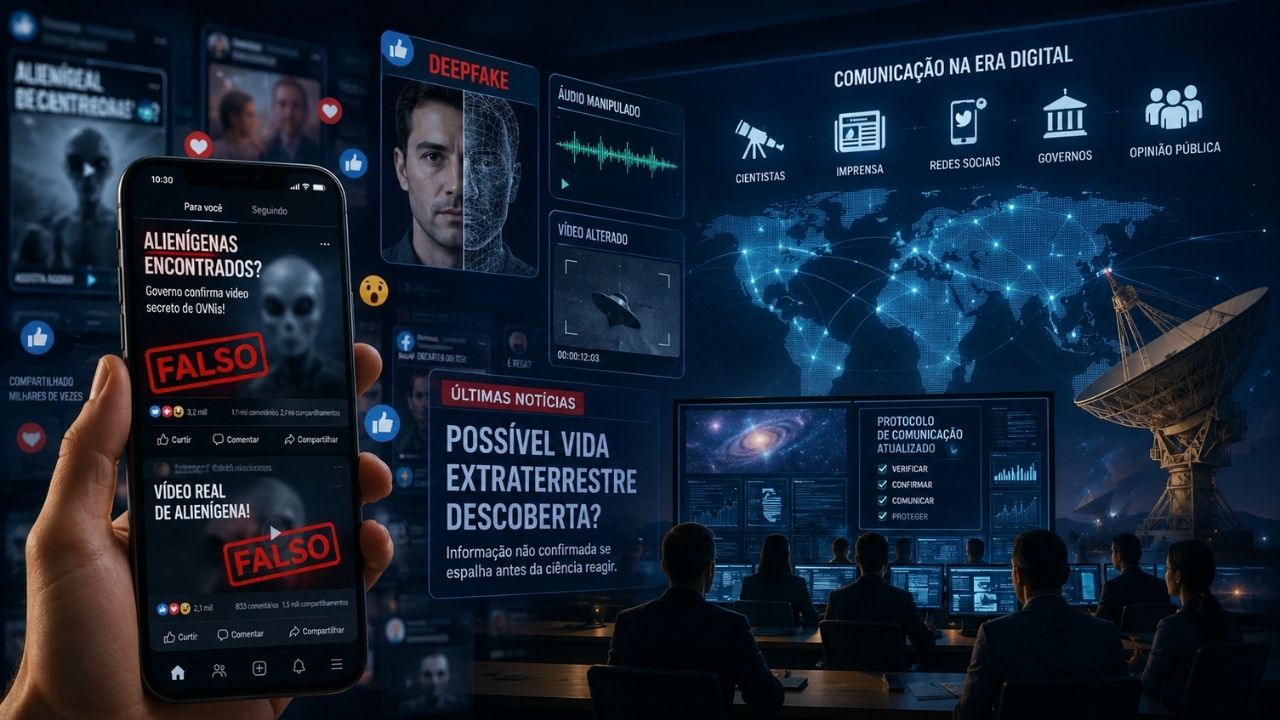
The previous version of the principles was adopted in 2010, when the digital environment was very different. Since then, social networks have grown, the spread of rumors has become faster, and technologies for manipulating images, audio, and video have created new risks for scientific communication.
In an era of deepfakes, a poorly verified claim could spread before science can react. Therefore, the new protocol treats information as a central part of the problem. The discovery of possible aliens would involve not only telescopes but also the press, digital platforms, governments, and public opinion.
Transparency should only come after verification
The updated text does not advocate permanent secrecy. On the contrary, the rule is that after confirmation, the data, analysis methods, and codes used in the research should be made available to the global scientific community and the public.
The difference lies in the timing of disclosure. While verification is ongoing, there is no obligation to expose each step to the public. The logic is to prevent a preliminary error from turning into an international crisis, conspiracy theory, or misleading headline about aliens.
Scientists are also protected by the protocol
One of the novelties of the 2026 declaration is the concern for the safety of researchers. Scientists involved in high-profile discoveries may become targets of harassment, digital attacks, exposure of personal data, and professional pressures.
Therefore, the guidelines advise institutions to protect teams involved in candidate signals. The measure recognizes that a possible discovery about aliens would have a huge social impact and could place researchers at the center of public, political, and digital disputes even before scientific conclusions are reached.
Human interference can confuse the search in space
Another important point is radio frequency interference. The signals used by projects searching for extraterrestrial intelligence can be contaminated by human technologies, such as mobile networks, radars, poorly shielded electronic devices, and mega constellations of satellites.
This technical pollution makes verification even more delicate. A suspicious signal may seem promising and later reveal itself to be a product of human infrastructure. Before talking about aliens, scientists need to eliminate the possibility of noise created by Earth.
Humanity should not respond alone
The most sensitive part of the protocol involves sending messages to possible civilizations outside Earth. The guidance is clear: no response should be sent without broad international consultation. The decision would not belong to an observatory, researcher, company, or isolated country.
The justification is simple and profound. If a message represents Earth to potential aliens, it should reflect a collective decision of humanity. The text points out that such consultation should occur through the United Nations or other widely representative multilateral bodies.
Search for technosignatures has increased the size of the challenge
The modern search for extraterrestrial intelligence is no longer limited to listening to radio signals from a few stars. Current projects observe different parts of the electromagnetic spectrum and look for possible signs of advanced technology, known as technosignatures.
This includes artificial signals, unusual emissions, and even indirect signs of technological structures. The broader the search becomes, the greater the chance of confusing natural phenomena, instrumental failures, or human interference with alien signals.
Next steps include scientific debate and possible UN analysis
The revised declaration was formally adopted by the Board of Trustees of the International Academy of Astronautics. The plan is to forward the framework to other organizations throughout the year and present it to the scientific community at the International Astronautical Congress in Turkey in August 2026.
There is also an expectation that the new protocols will be analyzed and considered by the UN. The creation of a permanent Post-Detection Subcommittee reinforces this concern, bringing together not only astronomers but also experts in ethics, law, communication, and social sciences.
If a really strange signal were detected tomorrow, do you think scientists should disclose everything immediately or wait for full confirmation before telling the world? Leave your opinion in the comments.


