






 Portuguese
  Spanish
  4 min of reading
  0 comments


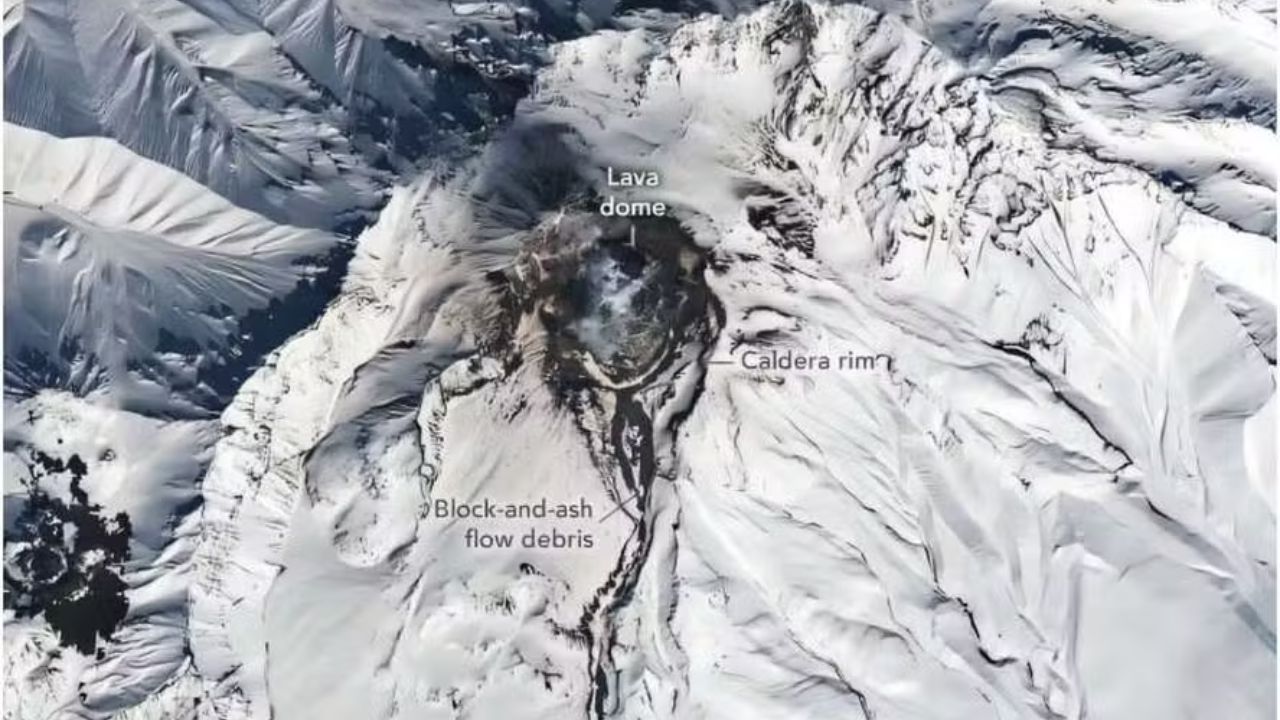
Russia’s Shiveluch volcano continues its continuous eruption with a growing lava dome recorded by the Landsat 9 satellite. The structure repeatedly collapses and rebuilds, generating a constant risk of ash explosions and debris flows.
One of the most active volcanoes on the planet is in continuous eruption — and satellites monitor its activity almost every day. The Shiveluch volcano, located north of the Kamchatka peninsula in Russia, once again drew the attention of the scientific community after the Landsat 9 satellite recorded, on April 23, detailed images of the effects of volcanic activity on the snowy landscape around the mountain.
According to information published by Revista Galileu, the records show ash deposits, debris, and temperature anomalies in the region — signs that the volcano remains fully active, closely monitored by the Kamchatka Volcanic Eruption Response Team (KVERT).
What satellite images show of the Shiveluch volcano
The captures made by Landsat 9 reveal a series of ongoing phenomena within and around the volcano’s caldera — the large circular depression at the top of the geological formation, where much of the activity is concentrated.
-
Helicopter Drops 180 Tons of Sand and Gravel on Swedish River to Revive Ecosystem Damaged by Decades of Exploitation

-
Brazilian Company Launches Retro Smartphone with 48 MP Camera, T9 Keyboard, and Privacy Features for Social Media-Free Use

-
Self-Taught Chinese Farmer Builds 5-Ton Submarine from Scrap, Launches It in Anhui River
-
Invisible Induction Technology Enables Wireless Power for Blenders, Coffee Makers, and Air Fryers, Reducing Countertop Cables





Among the main elements identified in the images are:
- Ash deposits scattered across the snowy landscape
- Volcanic debris accumulated around the caldera
- Thermal anomalies detected within the caldera and near the lava dome
- Elevated temperatures on the Earth’s surface, even amidst the cold environment of the region
- A growing lava dome — visible as a dark patch in the caldera
Other satellites besides Landsat 9 have also consistently identified these thermal changes in recent months.
The lava dome that grows in the shape of spines
One of the most monitored phenomena at Shiveluch volcano is precisely the lava dome. It is a mass of magma that is slowly expelled by the volcano and accumulates in the caldera in formations resembling spines or irregular protuberances.

According to KVERT reports, this structure has been growing progressively in recent months. On the day the images were captured by Landsat 9, the team confirmed that the “explosive-extrusive” eruption remained active — even after months of uninterrupted monitoring. The activity is also accompanied by the constant emission of gases and vapors.
Shiveluch volcano in 2023: when the mountain collapsed
The current eruption is not an isolated event. In April 2023, Shiveluch recorded one of its most significant eruptions in recent years.
On that occasion, the side of the geological structure collapsed, releasing lava flows that descended the slope and destroyed vast stretches of forest around the base of the mountain.
Traces of that eruption are still visible: large deposits and channels formed by the lava flows remain marked on the landscape to this day.
Why are lava domes so dangerous?
Lava domes are not just a geological curiosity — they are sources of real and recurrent danger. These structures undergo continuous cycles of growth and collapse, and it is precisely during collapses that the most intense explosive ash eruptions occur.
Furthermore, the flows generated by these domes produce thick deposits with a high capacity to retain heat for long periods — which means they can melt snow in winter even months or years after an eruption.

Another associated risk is ash avalanches: when debris slides down the structures radiating from the caldera — called “avalanche channels” — they can trigger what geologists call “block-and-ash flows”, composed of coarse fragments of cooled volcanic rocks mixed with pulverulent ash.
“It repeatedly collapses and rebuilds”
Geologist Janine Krippner described Shiveluch’s behavior in a statement: “Shivelyuch is an incredible volcano that has collapsed repeatedly, on various scales, from huge flank collapses to more modest dome collapse events. It goes through cycles of collapse, but then repeatedly rebuilds through constant volcanic activity.”
The statement perfectly summarizes the unique character of this volcano: unlike many formations that erupt episodically, Shiveluch operates in a state of almost permanent activity — destroying and rebuilding its own structure in a cycle that satellites record, practically, day after day.


Source: Revista Galileu





-

1 person reacted to this.