Portuguese
  Spanish


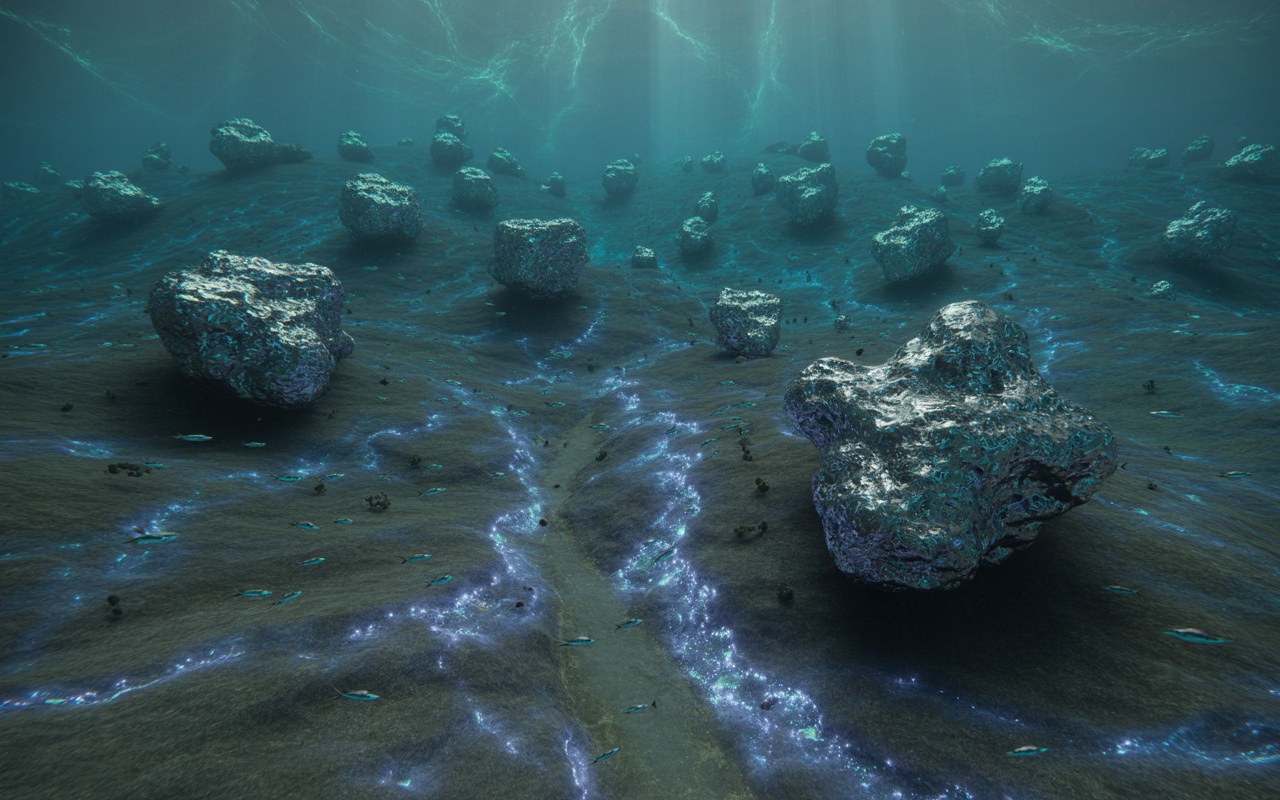

Polymetallic Nodules on the Ocean Floor Hold Billions of Tons of Cobalt, Nickel, and Manganese, Vital Minerals for the Tech Industry.
Thousands of meters deep, in dark and inhospitable regions of the Pacific Ocean, lies one of Earth’s greatest secrets: vast fields covered by polymetallic nodules, rounded black stones that, at first glance, seem worthless. But within them lies one of the largest reserves of strategic minerals ever discovered, capable of sustaining global battery production, electric vehicles, and technological devices for generations.
These nodules are especially concentrated in the Clarion-Clipperton Zone (CCZ), a remote area between Mexico and Hawaii, covering about 4.5 million km² — larger than the European Union. There, the seabed is a true mosaic of minerals essential for the future of energy transition.
How Metal Nodules Form
Polymetallic nodules are not common rocks. They form over millions of years, layer by layer, as metals like manganese, iron, nickel, cobalt, and copper precipitate from seawater and accumulate around small fragments, such as fossil shells or rock debris.
-
Giant 142 kg Emerald from Brazil’s Bahia Region Auctioned with Starting Bid of Nearly $16 Million

-
Study Reveals 97% of Pregnant Munduruku Women in the Brazilian Amazon Have Mercury Levels Above Safe Limits, 90% of Newborns Contaminated by Gold Mining
-
China could reduce iron ore imports from 80% to 50% of consumption by 2030, while its share in global steel production falls from 52% to 46%, in a shift that could reshape the global market, says CMRG.
-
Brazil is sitting on one of the largest lithium reserves in the world, in the Jequitinhonha Valley, but national mining has almost become an appendage of China: 97% of the metal’s export goes to a single country, which also dominates refining.


Each nodule grows only a few millimeters per million years, making them geological records of entire eras. The slow process contrasts with the strategic value they hold today.
A Mine of Technological Wealth

Inside each of these nodules is a perfect combination for the modern world:
- Cobalt and Nickel – essential for electric vehicle and mobile device batteries;
- Manganese – used in metal alloys and steel production;
- Copper – essential for electrical and electronic systems.
It is estimated that the Clarion-Clipperton Zone alone contains billion tons of these minerals, surpassing in volume many of the known land reserves. For the industry, it is like finding a “submerged Eldorado” in the middle of the ocean.
The Global Race for the Pacific
It is no surprise that this treasure has sparked a real international race. Countries like China, the United States, Japan, and Russia, along with major private conglomerates, have already applied for exploration licenses from the International Seabed Authority (ISA), a UN body responsible for regulating activities in international waters.
While companies design robotic vehicles to vacuum the seabed and collect the nodules, environmentalists warn of the risks of a new cycle of predatory exploitation.
The Environmental Cost of the Technological Future
If, on one hand, the nodules could reduce dependence on land mining, which is marked by severe social and environmental impacts, on the other hand, seabed extraction threatens practically unknown ecosystems.
The deep ocean floor is home to fragile and poorly studied organisms. Any disturbance can have irreversible impacts, destroying habitats that took millions of years to form.
Scientists fear that seabed mining will release plumes of sediments that spread for hundreds of kilometers, suffocating marine life.
A Crossroads for Humanity
The existence of these nodules places humanity at a historic decision point. They can provide the minerals needed to accelerate energy transition and reduce carbon emissions. But they can also trigger a new type of extractive race, with unknown risks for the oceans and the balance of the planet.
Governments and companies argue that not exploring would mean losing a strategic opportunity. Environmentalists advocate for a moratorium until the impacts are fully understood. In the midst of this clash is the climate urgency: the world needs batteries and clean technologies — and it needs them fast.
The Treasure and the Warning
The polymetallic nodules of the Pacific are more than just simple black stones. They are a reflection of our time: technologies that promise a sustainable future depend on complex decisions about how we use the planet’s resources.
In the silence of the depths, this geological treasure reminds us that every human advance has a price. The question that remains is: how far are we willing to pay that price, and what will be the impact for future generations?