






 Portuguese
  Spanish




LiquidPiston Develops New Rotary Engine That Promises to Revolutionize the Automotive Industry, Being Up to 5 Times More Powerful Than Existing Diesel Models in the Market.
The rotary engine is one of the most fascinating and innovative inventions in the history of internal combustion engines. However, it has some disadvantages such as high fuel consumption, low torque, high emissions, and complex lubrication. Despite these challenges, there are ways to overcome these limitations and create a new generation of rotary engines that can surpass conventional engines in the automotive industry.
LiquidPiston Rotary Engine Weighs Less Than 20 kg


Liquid Piston is the company developing and manufacturing the new rotary engine called X-Engine. It is a pistonless engine that operates on a patented thermodynamic cycle called high-efficiency hybrid cycle (HC).
Unlike conventional engines, the X-Engine uses a single rotor that performs both the compression and expansion of the working fluid, resulting in higher efficiency and lower emissions.
-
Suzuki Jimny Nomade 5-Door: A Rugged Family SUV with 1.5L Engine and 4WD, Priced Around $18,000 in Brazil

-
Suzuki XL6: Affordable Premium Minivan in India Offers Seating for Six, Hybrid Engine, and Impressive Fuel Efficiency

-
Banco do Brasil and Uber Launch Cashback Program Offering Up to 3.5 Loan Installments Back, Drivers Gain Access to New Cars Worth Up to $30,000 Through Move Brasil Initiative

-
Looking for a Car for Dirt Roads? Fiat Uno, Strada, and Volkswagen Gol Offer Durability and Affordability




The company claims that its new XTS 210 is a breakthrough in rotary engine technology for the automotive industry that addresses the efficiency, lubrication, and fuel type issues of conventional Wankel rotary engines.
The XTS 210 is a supercharged, liquid-cooled two-stroke engine that claims to have five times the power of a diesel engine of equivalent size or weight and three times the torque. It is intended for commercial military and aerospace applications where high power density, fuel efficiency, and the ability to use multiple fuel types are important.
The new rotary engine is approximately the size of a basketball, weighs 19 kg, and has a displacement of 210 cm³. It can operate on several types of fuel, including diesel and jet fuel.
How the New Rotary Engine Works?
The company aims for about 20 kW and 29.4 Nm of torque, both at 6,500 Revolutions Per Minute. According to Liquid Piston, these numbers are comparable to the 18.8 kW and 63 Nm peak of the diesel engine coler KDW 13E 536A, which is approximately five times the physical size of the XTS 210 and more than four times its weight.
The design of the XTS uses only two main moving parts, a rotor and a shaft. The rotor has a trilobular shape that fits inside a housing with two lobes, creating three combustion chambers that go through the four stages of the HC cycle, namely intake, compression, power, and exhaust.
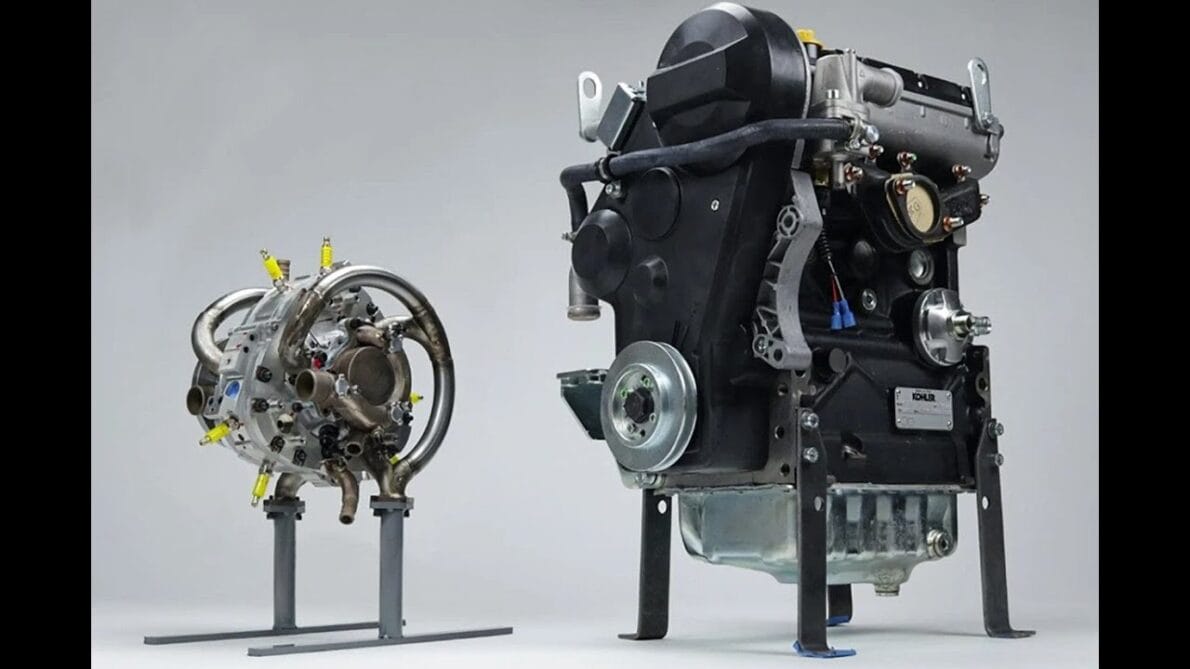
The shaft is connected to the rotor by a planetary gear system that allows the rotor to spin at a different speed than the shaft, optimizing the performance of the new rotary engine in the automotive industry.
In the XTS 210, the combustion chamber remains stationary and has a rounded shape. This design has a unique advantage, making it possible to achieve high compression simply by making the chamber smaller. Moreover, since the chamber does not move, it is possible to inject fuel directly into it, a feature that the Wankel engine could not offer.
Rotary Engine Expected to Hit the Market in 2024
What is truly remarkable is its versatility to run on a variety of fuels, including diesel, gasoline, hydrogen, and propane.
Currently, Liquid Piston is focusing on perfecting the new rotary engine with a specific emphasis on its compatibility with jet fuel JP8, which is of great importance in the defense and aerospace sectors.
A significant milestone in Liquid Piston’s journey is its recent contract with the United States Army, totaling a substantial amount of 9 million dollars.
This contract has raised its total earnings from military contracts beyond the impressive mark of 30 million dollars. With this new support, Liquid Piston is preparing to commercialize the new rotary engine, and we can expect the delivery of a prototype in 2024.





Pistões opóstos irá mais longe, esse tipo de motor rotativo sempre teve problemas