






 Portuguese
  Spanish


There are almost 14 million square kilometers of ice, enough water to raise the sea by dozens of meters if it melted. But it is far away, frozen and outside the cycle that supplies rivers and wells. The paradox exposes an uncomfortable truth: there is a lack of water where people live, not on the planet as a whole.
It may seem contradictory, but the planet has plenty of fresh water and, at the same time, billions of people suffer from its scarcity. The largest reserve of fresh water on Earth is locked in the ice of Antarctica and does not quench anyone’s thirst, because less than 1% of all the fresh water in the world is actually available for human use, revealing that the water crisis is a problem of access, not quantity.
The data were gathered in a report published by the Times of India in June 2026, compiling estimates from leading institutions in the study of water and ice, such as the United States Geological Survey, USGS. According to this survey, the Antarctic ice sheet, combined with Greenland’s, holds more than 68% of all the fresh water on the planet, but in a form and place that make it practically unreachable. Below, we explain how Earth’s water is distributed, why polar ice does not quench thirst, and where the fraction that actually sustains life is located.
The largest fresh water reserve on the planet
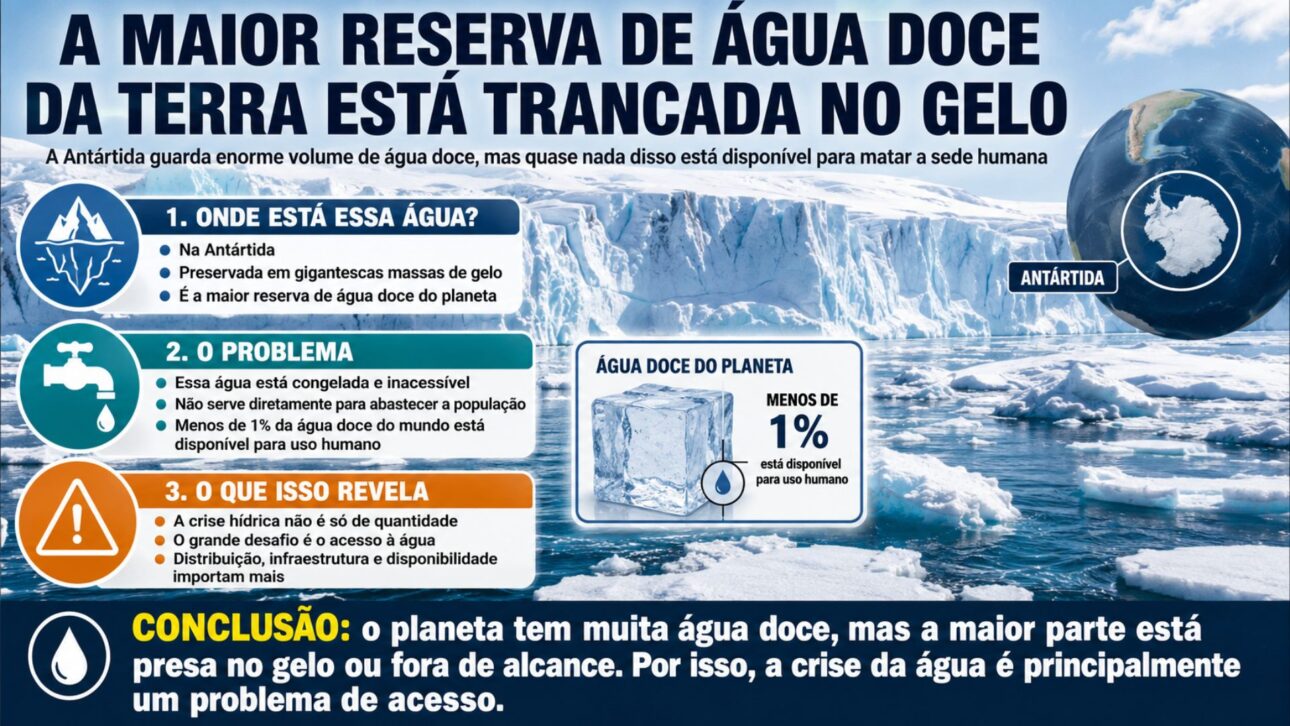
The Antarctic ice sheet, the largest fresh water reserve in the world, covers almost 14 million square kilometers, an area equivalent to the continental United States combined with Mexico, and contains something between 26.5 and 30 million cubic kilometers of ice, with sections reaching almost 5 kilometers in thickness.
-
Former Brazilian street cleaner overcomes challenges to become a lawyer, now advocates for workers’ rights.

-
Retired Historian in Brazil Restores Over 100 Sewing Machines, Including One from 1875 New York Broadway

-
El Niño Set to Raise Temperatures Above 30°C in Southeastern Brazil by Late July as Cold Wave Ends

-
Brazilian Government Challenges Drug Trafficking Claims Linked to Social Program with Study by Fiocruz and Harvard



To get an idea of the scale, if all this ice melted, sea levels would rise by about 58 meters, according to estimates from institutions like the United States National Snow and Ice Data Center and NASA cited in the report.
Alone, Antarctica holds about 90% of all the Earth’s ice mass. These are colossal numbers, representing a gigantic reserve of fresh water, but completely out of reach for the billions of people who today live with scarcity.
How Earth’s water is divided
Understanding the distribution of water helps to dispel the illusion of abundance. Of all the water on Earth, including oceans, ice, rivers, lakes, groundwater, and atmospheric moisture, only about 2.5% is fresh, not salty, and of this small portion, the majority, around 68.7%, is trapped in glaciers and polar ice caps, according to USGS data reproduced in the report, mainly in Antarctica.
Another approximately 30% of all fresh water is groundwater stored in aquifers, many of which are too deep to be extracted at a viable cost or are being withdrawn faster than nature can replenish. Surface water, from rivers, lakes, and swamps, which is what most people think of when they imagine fresh water, represents less than 1% of the entire stock of fresh water. In other words, what seems abundant is, in practice, extremely limited.
Why frozen ice doesn’t quench thirst
Having water is not the same as being able to use it. The ice in Antarctica is in the most remote part of the planet, at temperatures that make large-scale extraction unfeasible with any current technology, and it is in a hydrologically inert state, meaning it does not feed rivers, recharge aquifers, or circulate through the atmosphere in a way that humans can use, contrary to what many people imagine.
The only connection of this ice with the water cycle in the short term is the slow melting at its edges, and this water ends up in the Antarctic Ocean, raising sea levels, instead of supplying the regions that need it. Worse: with global warming, Antarctica is losing mass at an accelerated pace, which increases ocean salinity and sea levels, worsening global climate problems. Melting the ice, therefore, would not quench anyone’s thirst, it would only bring consequences even worse than the water crisis itself.
The problem of groundwater


Aside from the ice, there is hope in aquifers, but it also has limits.
Groundwater represents about 30% of the planet’s freshwater and, in theory, would be the most suitable for human use, as it can be pumped and treated, but much of it is too deep to be economically exploited or is being depleted faster than natural recharge can keep up, according to scientific reviews on the subject.
In many regions, such as the Middle East, North Africa, and parts of the United States, aquifers are being exploited at a rate that will make them unusable in a few decades.
In several cases, it is ancient water, accumulated over thousands of years under wetter climates, that will not be replenished on any human time scale.
India, which is home to about 18% of the world’s population, has only about 4% of the planet’s water resources, a clear example of the mismatch between population and available water.
Where is the water that truly sustains life
After discounting ice and deep waters, very little is left.
The fraction of freshwater that is liquid and accessible, present in lakes, rivers, swamps, and shallow aquifers, in addition to rain that can be captured, represents less than 1% of all the Earth’s freshwater, according to figures from the United States Environmental Protection Agency and National Geographic cited in the report, and it is this small portion that keeps humanity alive.
And this tiny slice is not distributed fairly.
Freshwater resources are concentrated in a few regions, such as the Amazon basin, parts of sub-Saharan Africa, northern Europe, and the far eastern Russian region, while large areas of South Asia, the Middle East, North Africa, and the southwestern United States face chronic shortages.
Climate change deepens this inequality, altering rainfall patterns, intensifying droughts, and reducing mountain snow that supplies rivers in various countries.
Existing is not the same as being accessible
This is where the most important lesson of this whole story lies.
The Antarctic ice sheet is indeed the largest mass of freshwater on Earth, but this fact is almost irrelevant to a city that rations water, to a farmer who sees the well dry up, or to a community that depends on a depleting aquifer, because water security is a matter of access, infrastructure, distribution, and governance, not planetary availability.
According to the report, a peer-reviewed study published in the Annual Review of Environment and Resources, authored by researchers Peter Gleick and Heather Cooley, points out that the growing gap between human demand and available freshwater is causing shortages that affect agriculture, industry, and people’s well-being in an increasingly larger part of the world.
The planet has enough fresh water in aggregate, but the question of who can access it, at the right time and in the right place, has been receiving increasingly worse answers.
The story of the world’s largest fresh water reserve, frozen and inaccessible in Antarctica, is a powerful portrayal of a paradox that defines the century: there is no lack of water on the planet, but there is a lack of water where and when people need it.
While two-thirds of all fresh water remain locked in polar ice and most of the rest is hidden in deep aquifers, it is less than 1% of the total that life on Earth depends on.
Understanding this difference between existing and being accessible is essential to face the water crisis as it truly is, a management challenge, distribution, and care with the resources we have at hand.
And you, have you ever stopped to think that most of the world’s fresh water is out of our reach? What do you think can be done to tackle the access water crisis? Leave your comment, share your opinion, and help spread the article to those interested in the environment, water, and the planet’s great challenges.


