






 Portuguese
  Spanish
  5 min of reading
  0 comments


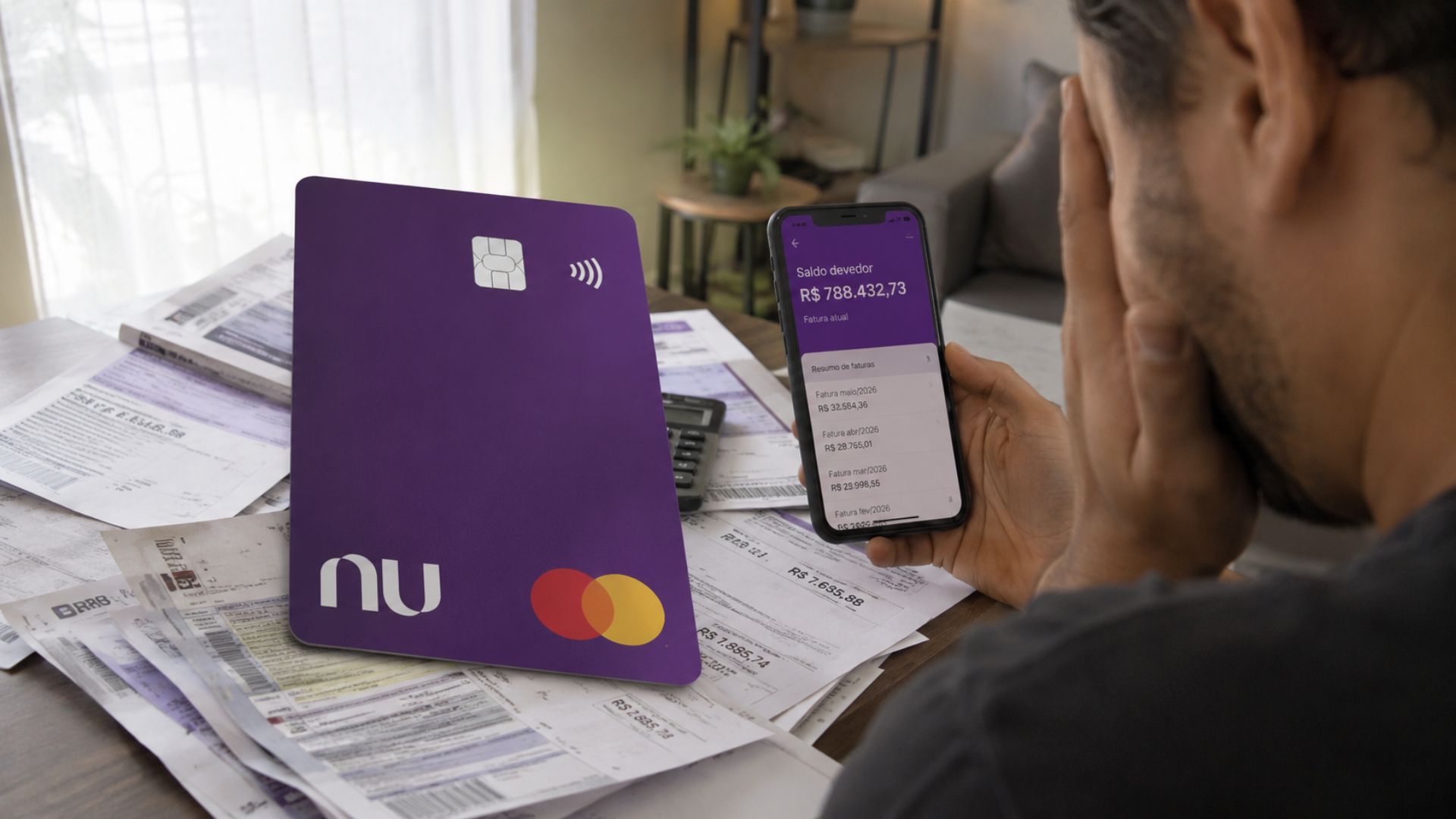
Debt multiplied in four years led consumer protection agency to demand explanations from Nubank about interest, charges, revolving credit, and invoice installment, in a case involving a client from the Federal District that may result in new administrative measures.
The Consumer Secretariat of the Federal District notified Nubank to explain how it calculates interest, financial charges, revolving credit, and invoice installment, after receiving the case of a client whose credit card debt went from R$ 12.3 thousand to R$ 788 thousand in four years.
According to the data sent to the agency, the charge multiplied the initial debt by about 65 times, which led the department to request more transparency about the practices adopted by the digital bank in credit operations and renegotiation.
Sent on Monday (25), according to the portal Metrópoles, the notification questions which rates are applied in the card’s revolving credit, what methodology guides the calculation of interest, and how Nubank presents these conditions to consumers.
-
FIRJAN’s mega plan of R$ 526.3 billion for Rio de Janeiro aims to revive Brazil’s largest industry, with two-thirds of the investments going to oil and gas.

-
China signals an increase in beef imports, Brazil has already consumed 70% of the 1.106 million ton quota and seeks to renegotiate the tariff that jumps from 12% to 55%, while demand from the US also skyrockets.
-
Food inflation rose 302% in 20 years in Brazil, but the supermarket changed: purchasing power yielded 87% more mortadella and 31% less fruit, and ultra-processed foods took over the cart.
-
Petrobras sells the first batch of 3,800 m³ of aviation fuel made with certified soy, capable of reducing emissions by up to 70%, in an unprecedented project that anticipates the aviation sector’s requirements expected for 2027.



In addition to the rates, the agency also demanded information about financial charges and rules used when there is an invoice installment, a modality that can alter the evolution of the outstanding balance over time.
The case reached the secretariat after the complaint of a resident of the DF who accumulated a debt of R$ 12.3 thousand on the credit card in January 2022.
With the incidence of interest and other charges during the period, the amount reported to the agency reached R$ 788 thousand, according to the investigation published on the case.
Nubank’s charge comes under the scrutiny of the consumer protection agency
By analyzing the situation, the Consumer Secretariat seeks to verify if there was abusive practice, lack of contractual clarity, or charge incompatible with the rules applicable to the credit offered to the consumer.
Although it does not represent immediate punishment, the notification opens a deadline for the financial institution to present documents, explain the criteria used, and demonstrate how it informs its clients about the evolution of the debt.
In the evaluation of the Consumer Secretary of the DF, Samuel Konig, credit operations need to respect the dignity of the consumer and cannot transform financial contracts into mechanisms of indebtedness without clear understanding.
The head of the department stated that the bank will have the opportunity to explain, prove, and adjust its practices before any potential administrative sanction.
“The dignity of the consumer must be above any collection model. Today it is a notification, but if the conduct is not corrected, tomorrow it could be a fine,” said Konig, commenting on the department’s actions in the case.
According to the secretary, “credit cannot become a trap” and no consumer should be “crushed by interest rates, charges, or contracts they cannot understand.”
In addition to the specific episode, the department reported receiving 77 complaints against Nubank in 2026, while the entire year of 2025 totaled 211 reports involving the financial institution.
Credit card revolving credit remains among the most sensitive points


Activated when the consumer does not pay the full amount of the bill by the due date, revolving credit finances part of the debt and can quickly increase the outstanding balance when there is no full payment.
In this modality, interest rates are usually among the highest in the financial system, a situation that makes renegotiation and clarity of information decisive factors to avoid worsening the debt.
Since January 2024, new rules have limited interest and charges on revolving credit and bill installment for debts incurred from the effective date of the regulation.
According to the Central Bank’s rules, the amount charged in interest and costs in these modalities cannot exceed 100% of the principal amount, meaning that a debt of R$ 100 cannot exceed R$ 200, excluding IOF.
Even so, the application of the rule depends on the analysis of when the debt entered revolving credit, subsequent operations, and how the balance was renegotiated or parceled.
For this reason, the department asked Nubank to clarify the formula used in the case and detail the criteria applied over the billing period.
The charge of R$ 788,000, attributed to the incidence of interest on a debt of R$ 12,300 started in January 2022, made the case relevant for administrative oversight.
With the investigation ongoing, the department wants to understand if the increase resulted from rules in effect before the 2024 cap, new debts, successive installments, or another financial mechanism adopted by the institution.
Nubank talks about renegotiation and financial education
Sought for comment, Nubank stated, through a note, that it continuously evaluates alternatives for customers with overdue credits to regularize their financial situation.
According to the institution, renegotiation conditions may include discounts and installments, always according to the profile of each customer.
The bank also informed that these conditions can be consulted directly through the app, customer service channels, or partners.
In the same statement, the company declared that it maintains permanent financial education initiatives, with its own content and educational features incorporated into the products.
“Nubank is constantly evaluating and seeking to offer customers with overdue credits alternatives to regularize their financial situation,” the institution stated.
According to the position, the bank’s actions focus on debt prevention, financial inclusion, and digital security.
However, the released excerpt does not detail the formula used to calculate the debt pointed out by the consumer nor does it inform which rates were applied to the specific case.
These responses must be presented to the Consumer Secretariat within the scope of the administrative notification sent to the bank.
Secretariat demands transparency on interest and invoice installment
Among the central points of the investigation are the transparency of the information provided to the customer, the rate effectively applied to the revolving credit, and the methodology used in the evolution of the outstanding balance.
Also under analysis are the financial charges, the installment of the invoice, and any renegotiation mechanisms offered to the consumer throughout the contractual relationship.
The agency’s action does not mean, by itself, that Nubank has committed any irregularity.
As a formal step in demanding explanations, the notification allows the bank to present documents and defend the legality of the practices adopted.
If the Consumer Secretariat understands that there has been a violation of consumer protection norms, the institution may be subject to administrative measures.
Among the possibilities mentioned by the secretary is the application of a fine, if the conduct is considered irregular and there is no correction.
For now, the case remains focused on the clarification phase, with the secretariat awaiting responses on calculations, rates, and the form of communication with the customer before deciding whether to adopt new administrative measures.




Be the first to react!