






 Portuguese
  Spanish


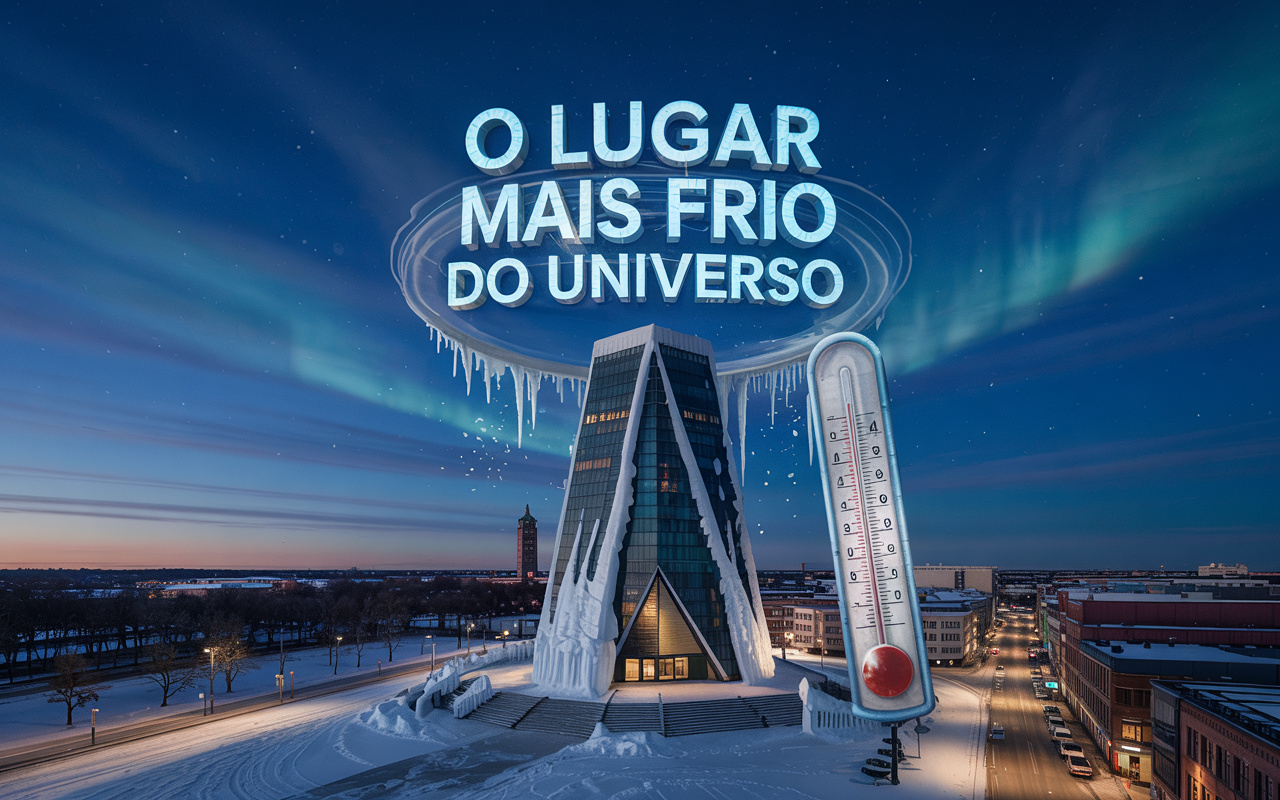

German Scientists Reached Record Temperatures Using a Free-Fall Tower, Making Bremen the Coldest Place in the Universe for 2 Seconds in Historic Experiment.
In August 2018, the city of Bremen in northern Germany became the coldest place in the universe — at least for two seconds. The feat occurred in the free-fall tower at the Center of Applied Space Technology and Microgravity (ZARM), which stands 146 meters tall and dominates the skyline of the local technology park.
Within a free-fall capsule, scientists cooled a Bose-Einstein condensate (BEC) to an incredible 38 picokelvins (38 trillionths of a billionth of a Kelvin) above absolute zero, breaking known records for low temperatures and surpassing the chilly environment of the Boomerang Nebula, located 5,000 light-years from Earth, which records -272.15 °C.
What Is Bose-Einstein Condensate and Why Is It Important
BEC is known as the fifth state of matter (beyond solid, liquid, gas, and plasma) and occurs when atoms are cooled to extremely low temperatures, causing their particles to behave as a single quantum entity, with unique characteristics.
-
China Surpasses U.S. and Russia Combined in Submarine Production

-
Xiaomi Unveils Smart Glasses in Brazil with 12MP Camera, 4K Video, and AI Features, Challenging Ray-Ban Meta

-
Volkswagen Unveils Bold Strategy to Compete with Chinese Automakers in Brazil, Featuring 5,000 Parts, 76% Localization, and a Surprising Turnaround
-
Three Teens Win Global Prize for Low-Cost AI Microscope Diagnosing Malaria Species in Seconds for Remote Villages


Extreme cooling reduces the speed of particles, allowing for high-precision measurements and new advancements in quantum physics and measurement technologies.
How The Free-Fall Tower Allowed The Cold Record
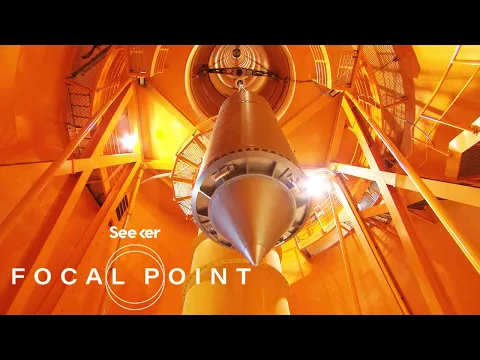
The Bremen free-fall tower was designed to simulate microgravity conditions for short periods. By creating a vacuum within the tube and using a catapult to launch the research capsule, researchers extended the free-fall state from 4.75 to 9.5 seconds, creating ideal conditions for experiments that require almost total weightlessness.
During the fall, the atoms in the condensate were cooled to near absolute zero temperatures, maintaining the state for two seconds, long enough for observations that would not be possible in a lab under Earth’s gravity, where the BEC lasts only 22 milliseconds before dissipating.

The Scientific Collaboration Behind The Experiment
The experiment was conducted by ZARM as part of the QUANTUS project, in collaboration with the German Aerospace Center and researchers from Leibniz University Hannover, Humboldt University of Berlin, and Johannes Gutenberg University Mainz.
The goal was to study the propagation of ultracold atomic clouds under microgravity, advancing the development of navigation technologies and ultra-precise measurement sensors.
Potential For Future Applications
The creation and control of BEC under microgravity conditions can enable extremely precise navigation systems, atomic interferometers, and gravity-sensitive measurement instruments, essential in space exploration and fundamental physics studies.
The technology used in the free-fall tower can also be adapted for experiments aboard satellites or the International Space Station (ISS). In preliminary experiments on the ISS, another type of BEC was observed for one second.
Bremen researchers believe that the methods used could expand the 2 seconds of microgravity from the tower to up to 17 seconds in orbit, enhancing studies in zero-gravity environments.
The Record And The Future Of Research In Extreme Temperatures
The achievement in Bremen illustrates how Germany and its advanced facilities, such as the free-fall tower, remain at the forefront of particle physics research and space technology. Creating the coldest place in the universe for 2 seconds represents not only a milestone in temperature but also advances knowledge about quantum states of matter.
Measuring these ultralow temperatures is only possible with sensors capable of monitoring the movement of the atoms themselves, as temperature is nothing more than the vibration of particles in a material.
At such extreme cold levels, particles practically cease their movements, allowing scientists to study quantum properties in a previously unexplored regime.
An Example Of How Science Transforms Challenges Into Advancements
Earth’s gravity cannot be turned off, but it can be “circumvented” for short periods through free fall, transforming places like Bremen into true cutting-edge laboratories.
With these experiments, Germany reaffirms its position in the development of scientific technologies, expanding knowledge about the limits of cold and its applications for the future of space exploration and particle physics.


