Portuguese
  Spanish



Technology Enables Creation of Meat Without Animal Slaughter, With Texture and Flavor Similar to Traditional Chicken, According to Scientists Involved in the Project
In a laboratory in Tokyo, an unexpected breakthrough could change the way we eat meat. A team of scientists has managed to create complete chicken muscle, with structure and texture similar to that of natural meat. The secret lies in an innovative system that mimics the function of blood vessels.
The Challenge of Keeping Cells Alive
Producing cultivated meat has been possible for years. Since 2013, when the first lab-grown burger was presented, companies around the world have been seeking ways to enhance this technology. The problem is not in cultivating cells, but in keeping them alive and organized like in real tissue.
Without a way to transport nutrients throughout the tissue, the cells die, and what could be a steak ends up becoming an amorphous mass. Nature does this naturally, with blood vessels. Replicating this in the lab has always been the biggest hurdle.
-
She spent 73 years breathing inside an iron lung, survived the aftereffects of polio, and became the last woman in the United States dependent on the equipment before dying at 78 years old.

-
Brazilian students created a $1 filter using pine bark, cotton, and 3D-printed parts to clean cassava wastewater, reduce the toxicity of a hazardous waste, and transform contaminated water into biofertilizer.

-
Astronaut from Artemis II steps down after mission to the Moon and decision surprises after a record of 406,771 km, a historic 10-day journey, and an unprecedented achievement for Canada.

-
A fossil kept for years in a small museum in Montreal concealed 450-million-year-old soft tissue, a discovery that has only happened once before in history.


A System That Mimics the Body
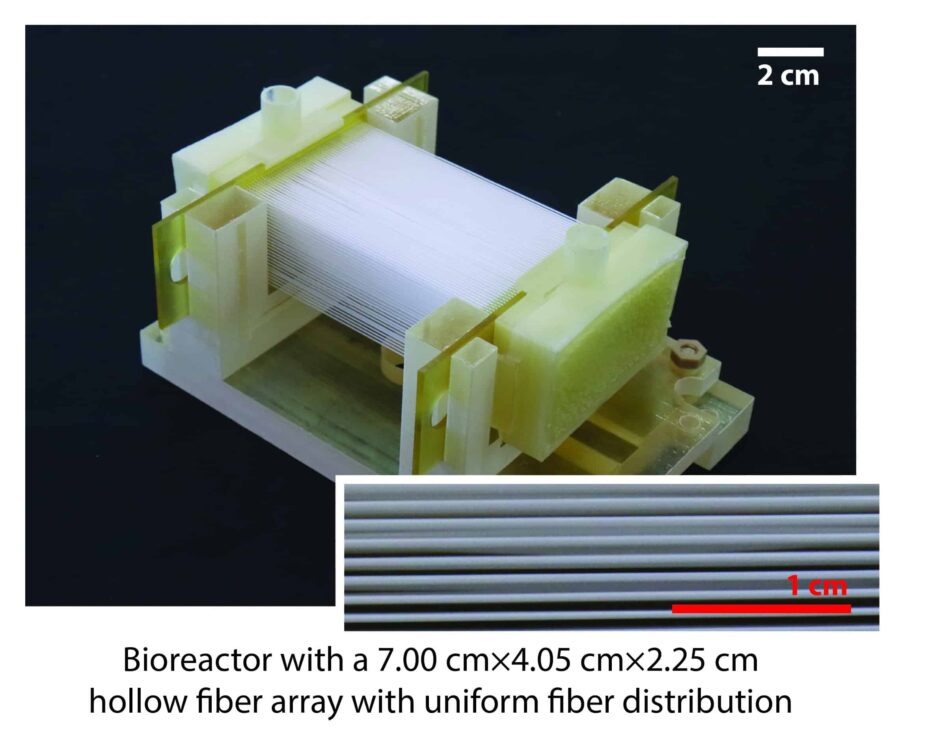
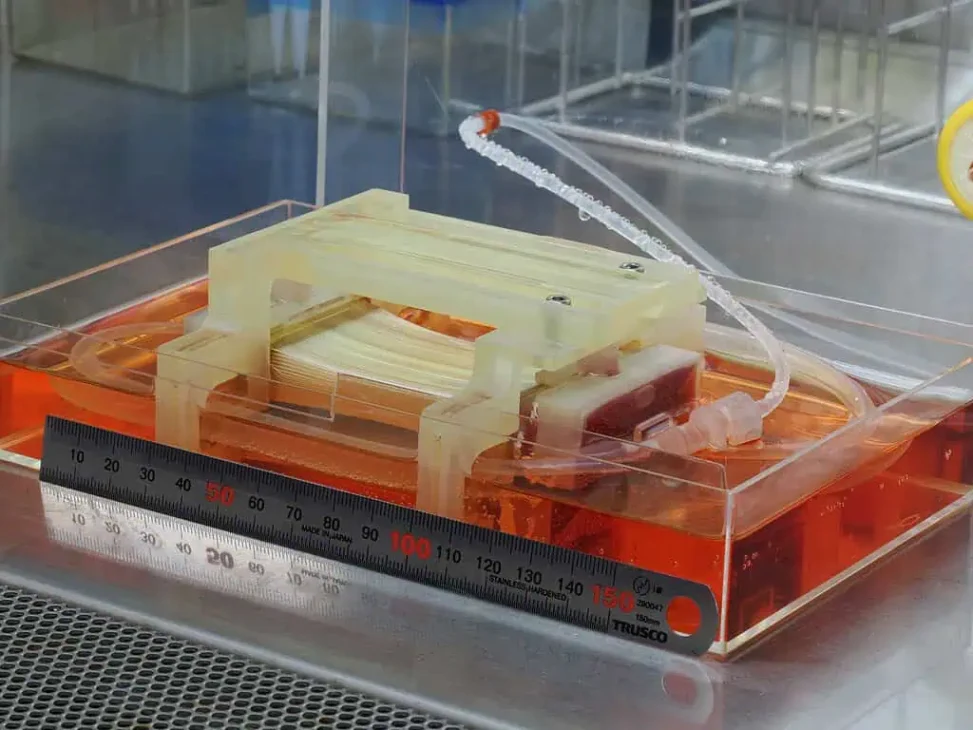
Now, scientists from Japan have presented a solution. They used a bioreactor that simulates a circulatory system. With it, they managed to cultivate chicken muscle with alignment, texture, and even contraction.
The study was published in the journal Trends in Biotechnology and presents an important advance so that whole cuts of meat can be produced in the laboratory with quality and structure similar to conventional meat.
Hollow Fiber Bioreactor: The Heart of Innovation
The equipment used, called Hollow Fiber Bioreactor (HFB), was developed by a team led by Professor Shoji Takeuchi, from the University of Tokyo. It allows oxygen and nutrients to circulate among the cells through hollow fibers, similar to blood vessels.
These fibers are already used in water filters and dialysis machines. Now, they also show potential for building artificial tissues — and perhaps even organs in the future.
Takeuchi explains that this method is scalable and can be used not only in food production but also in regenerative medicine, drug testing, and biohybrid robotics.
Cultivated Meat With Real Texture and Flavor
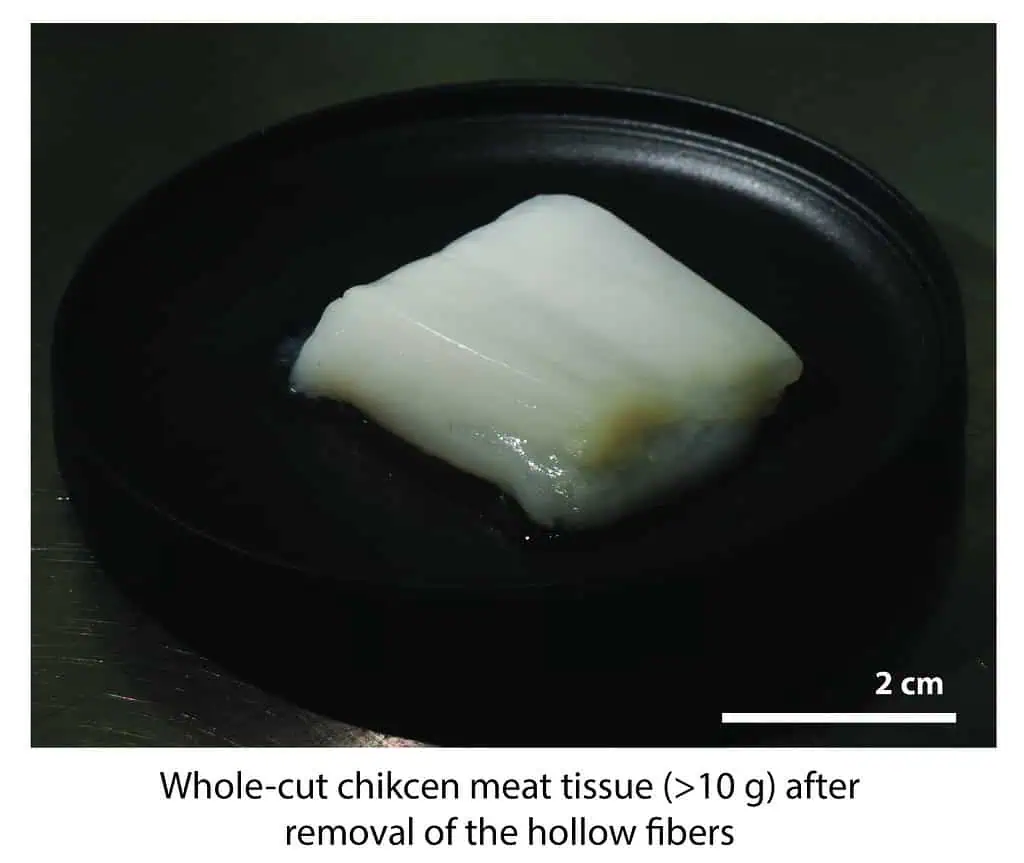
Unlike common cultivated meats, which usually resemble ground meat, the chicken produced in the HFB has the shape and consistency of real meat. More than 10 grams of chicken muscle were cultivated, with muscle contraction and composition similar to natural meat.
When electrically stimulated, the tissues contracted, indicating maturation. The scientists also analyzed the texture and profile of free amino acids — responsible for characteristics such as umami flavor.
The results were promising. The cultivated meat exhibited characteristics comparable to conventional meat, exceeding the quality and flavor criteria.
Challenges of Scale and Cost
Even with advances, the challenge of scaling up remains. As the tissue grows, it becomes more difficult to uniformly distribute oxygen. The pressure within the system must be precise: too low, and the cells die; too high, and the structure may rupture.
Moreover, cost is still a barrier. The first lab-grown burger cost more than US$ 300,000. Today, prices have dropped significantly. Some companies claim to produce cultivated chicken for less than US$ 10 per portion.
It is still not cheap enough to compete with traditional meat. But the landscape is changing. With improvements in bioreactors and cellular techniques, prices continue to fall.
The Future of Meat Without Slaughter
The Japanese team is now seeking to perfect the process. One of the goals is to use edible hollow fibers, eliminating the need for removal after growth. Another idea is to develop artificial blood substitutes to further improve oxygenation.
These improvements could make the process more efficient, safe, and economical. Lab-grown meat, which seemed distant a few years ago, may soon become a common part of the menu in restaurants and fast-food chains.
Lab Chicken Coming Soon to the Plate
The chicken muscle created with the new Japanese system is a decisive step toward the production of more sustainable and ethical meats. There are still obstacles, but innovation is already underway.
It is expected that soon this technology will reach consumers. Lab-grown chicken, with real flavor and texture, may soon be available in restaurants. The question remains how the public will react. But technically, the future has already begun.
With information from ZME Science.