Portuguese
  Spanish


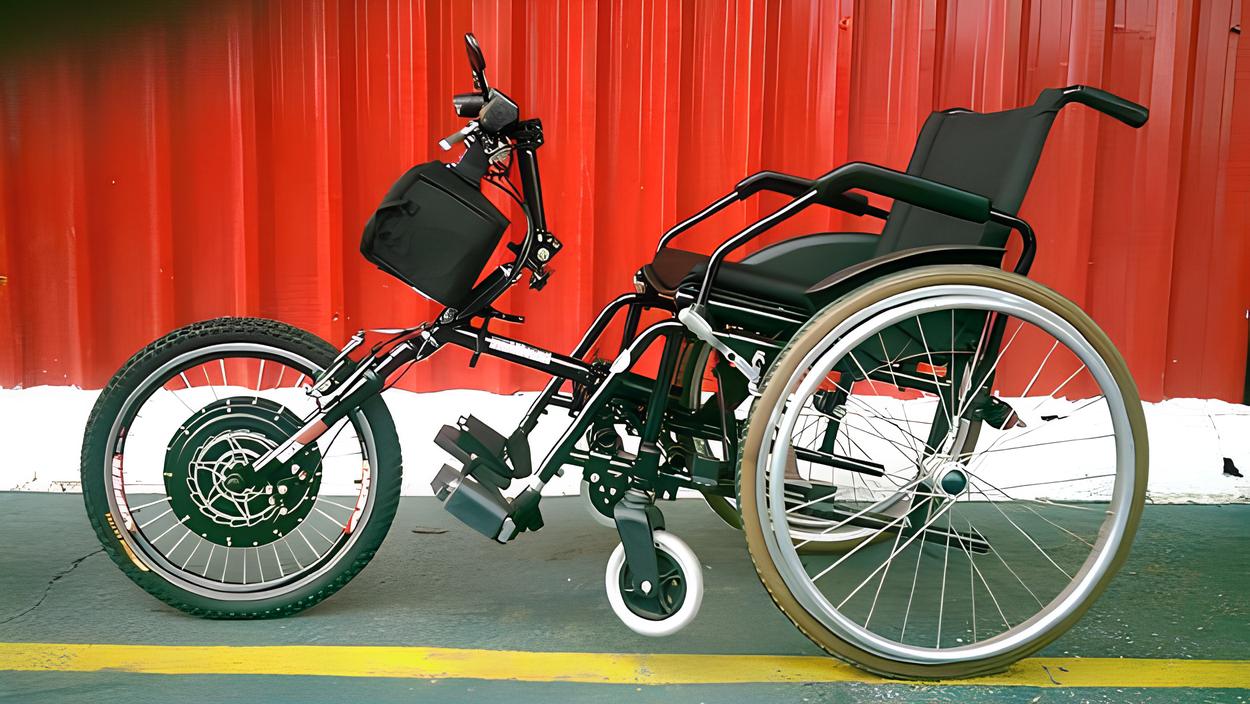

Brazilian Researchers Create the Kit Livre, An Innovation That Transforms Regular Wheelchairs Into Electric Tricycles With Up to 25 km of Autonomy. The Technology Is Affordable, Practical, and Does Not Require a Driver License. Understand How It Works.
For those who use a wheelchair, traveling long distances can be exhausting. Climbing a hill, avoiding potholes, or just getting to the market can become a daily challenge. Now, imagine if you just had to attach a motor, twist the throttle, and simply move forward effortlessly. This is exactly what a group of researchers from UNESP in São José dos Campos (SP) has made a reality with the Kit Livre project: a portable, smart, and transformative device that converts manual wheelchairs into electric tricycles with a range of up to 25 km — and best of all, without the need for a driver’s license or permanent adaptations.
What Is the Kit Livre?
The Kit Livre is a motorized front attachment that transforms any conventional wheelchair into a three-wheeled electric vehicle, with integrated handlebars, brakes, battery, and throttle.
The person sitting in the wheelchair effectively becomes the driver of an electric tricycle — with controlled speed, real autonomy, and the freedom to navigate sidewalks, parks, quiet streets, and even uneven terrains.
-
4,000-Year-Old Child’s Skull Unveils Ancient Burial in 7,500-Year-Old Norwegian Rock Shelter, Impressing Archaeologists

-
Norway Defeats Brazil in World Cup but Invests Billions to Preserve the Amazon, Strengthens Amazon Fund, and Joins Brazil in Leading Global Effort Against Tropical Deforestation

-
Denmark Constructs Its Largest Breakwater with 175 Concrete Blocks and World’s Largest Excavator to Combat 8-Meter Waves, at a Cost of $156 Million

-
Swedish Company Develops Offshore Wind Turbine That Eliminates the Need for Cranes and Simplifies Maintenance





Developed since 2012 with the support of FAPESP and academic incubation, the project has gone through several improvements to become an affordable commercial product, available in various cities across Brazil.
How Does It Work?
The operation is simple and efficient:
- The user approaches the Kit Livre with their wheelchair
- Attaches the mount to the front structure of the wheelchair (without complex tools)
- The handlebars with electric motor and front wheel connect automatically
- A motorcycle-type throttle allows speed control with the thumb
- The system is rechargeable, with standard dual voltage input and independent brakes
The installation takes less than two minutes. The disassembly is equally quick, making the kit ideal for daily urban use or outdoor activities.
Technical Specifications
- Average Range: up to 25 kilometers on a single charge
- Maximum Speed: around 20 km/h, electronically controlled
- Battery Type: rechargeable lithium
- Compatible Terrains: urban areas, grassy fields, dirt paths, pavements
- Weight of the Kit: approximately 20 kg
- Charging Time: about 4 hours
A Brazilian Project With Direct Social Impact
The Kit Livre was born at a public university and is one of the biggest proofs of how Brazilian science can generate innovation with real impact for the population. It was conceived by Henrique Lisboa, an engineer graduated from UNESP, and gained notoriety for its inclusive, sustainable, and transformative proposal.
The idea emerged during a visit to an adapted cycling event, where Henrique noticed that wheelchair users often had to rely on assistance from others or heavy, expensive motors. From there, the mission became clear: to create a solution that is lightweight, practical, accessible, and can be used without bureaucracy or dependence on others.
As a result, the Kit Livre began to be distributed at fairs, hospitals, NGOs, and inclusion programs throughout the country. In many cases, municipalities and social assistance foundations subsidize part of the cost for low-income users.
Driver License? Not Required!
One of the biggest questions for those who see the Kit Livre in action is: Do you need a license to use it? And the answer is no.
As it is considered an assistive individual mobility device, rather than a conventional motor vehicle, the Kit Livre does not require a driver’s license, nor does it emit pollutants or reach speeds that characterize traffic on fast roads.
It can be used in public areas, parks, sidewalks, and bike lanes, respecting local coexistence and safety regulations. This makes it a practical solution for daily life, including for the elderly, individuals with temporary reduced mobility, or permanent wheelchair users.
Accessible Urban Mobility: A Silent Revolution
While large cities struggle to make their transportation more inclusive, the Kit Livre already shows how technology can overcome physical and social barriers with simplicity. With it, a person with reduced mobility:
- No longer depends on drivers or caregivers for small trips
- Begins to visit open spaces independently
- Reduces the physical effort needed to climb ramps or face long distances
- Gains quality of life, self-esteem, and freedom of choice
And all of this without needing to change wheelchairs, pay vehicle taxes, or deal with bureaucracy from the DMV.
Where Is It Being Used?
The Kit Livre is already being used in several cities in Brazil, including in public programs for:
- Motor and social rehabilitation
- Inclusive education schools
- Parks and accessibility circuits
- Sports and adapted leisure events
There are even reports of use in ecological trails, technology fairs, and as the primary mode of transportation for those living in flat, urban areas.
A Model for the World
Although it was born in Brazil, the Kit Livre has already attracted interest from institutions abroad, especially in Latin America and Africa, where motorized wheelchairs are expensive and difficult to maintain.
The great advantage of the kit is its modularity and low cost: it transforms the wheelchair that the person already has, avoiding expensive replacements or adaptations.
The Kit Livre is not just a device — it is a symbol of what Brazil can achieve when it invests in research, inclusion, and accessible urban mobility. It shows that it’s not necessary to reinvent everything from scratch to transform lives: sometimes, you just need to attach a motor and return control to those who need it.
With a range of 25 km, easy use, affordable price, and 100% national development, the Kit Livre is one of the greatest social innovations in the country — and a silent yet powerful step towards a future where everyone can go further.