






 Portuguese
  Spanish


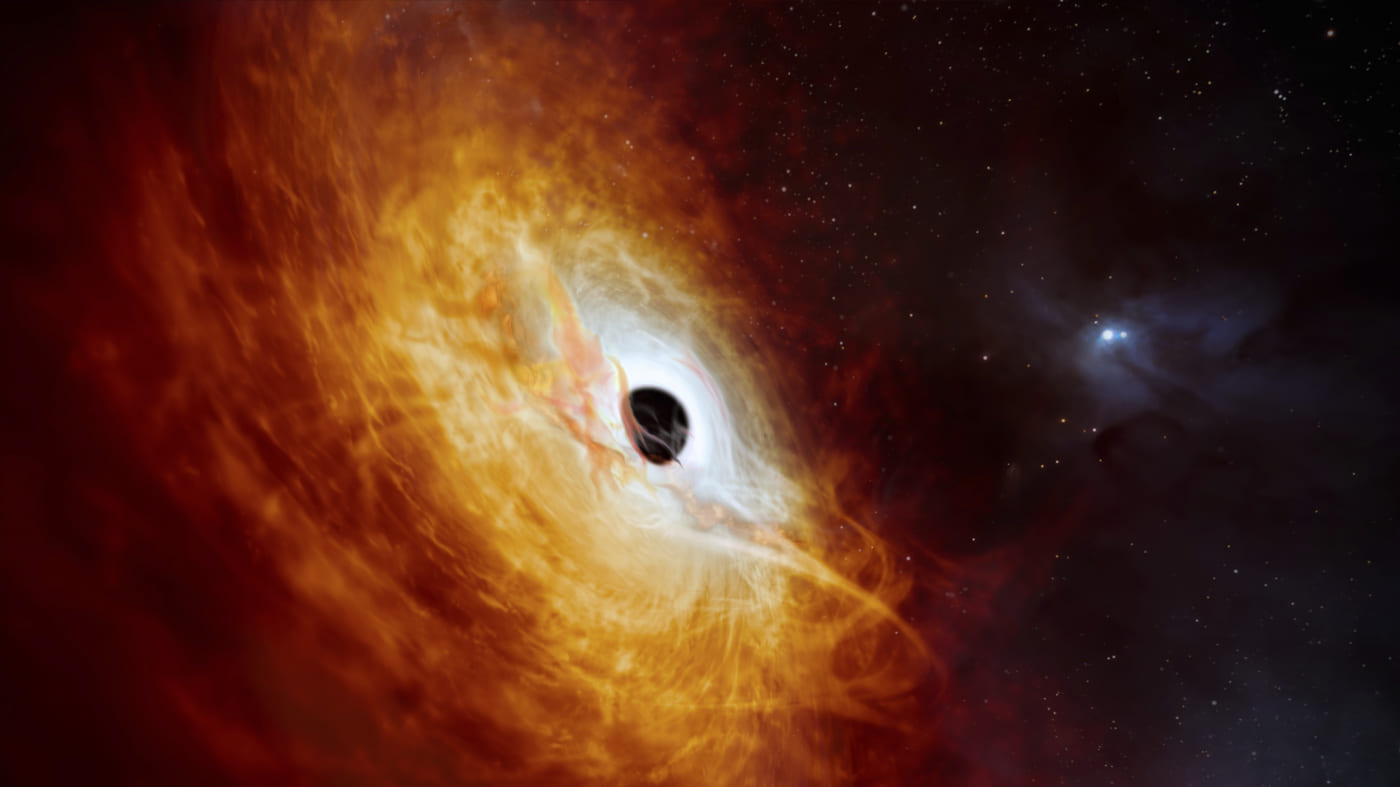


Impressive Discovery: The Oldest Black Hole Ever Found Has a Mass 800 Million Times Greater Than the Sun!
With the great advancement of technology, astronomers are making even more impressive discoveries. Recently, the oldest known supermassive black hole was identified, located in the quasar ULAS J1342+0928.
According to scientists’ data, this gigantic black hole has a mass 800 million times greater than our Sun and existed only 690 million years after the Big Bang, at a time when the universe was just 5% of its current age.
The ability to identify such a large black hole at such an early time in the history of the universe has sparked great interest among researchers. This discovery may provide valuable information about how these black holes managed to achieve such colossal sizes.
-
IBM Breaks 1-Nanometer Barrier with 0.7 nm Chip Featuring Nearly 100 Billion Transistors and 3D Architecture, Promising AI Revolution

-
Apple Raises MacBook and iPad Prices as Memory Costs Surge by Up to 98%, Losing Edge Over Rivals and Highlighting AI Boom’s Impact on Consumers
-
China Establishes State Centers to Train Humanoid Robots, While the West Lags Behind with Makeshift Solutions
-
The Trap of Modern Technology: How Screen Overload and Digital Connections Can Impact Your Mental Health and Well-being




Supermassive Black Holes
At the heart of galaxies, supermassive black holes silently govern.
With masses millions or billions of times greater than that of the Sun, these cosmic colossi consume matter and release intense emissions of light. This brightness feeds quasars, some of the most luminous and distant objects in the universe.
Recently, scientists discovered ULAS J1342+0928, the oldest quasar ever recorded. Located 13.1 billion light-years away, it reveals details of an era close to the Big Bang. Its light took billions of years to reach us.
An Accelerated and Intriguing Growth
How did such massive black holes form so early in the history of the universe?
Eduardo Bañados, an astrophysicist at the Carnegie Institution for Science, led the team that unraveled part of this mystery. These quasars, although rare, are precious for understanding the mechanisms of black hole growth and their influence on cosmic evolution.
A Cosmic Transitional Era
After the Big Bang, the universe was dark, filled with neutral hydrogen.
The first stars and galaxies emitted ultraviolet light, ionizing the hydrogen and making the universe transparent. This period, known as reionization, marked the end of the “cosmic dark ages.”
ULAS J1342+0928, found in the midst of this transition, helps astronomers understand the process.
Rarity and Impact
The hydrogen around the quasar is still largely neutral. This means that the black hole existed at a critical moment of reionization.
This data may clarify whether stars or black holes were primarily responsible for this transformation.
Each discovery like this is a window into the primordial universe.
The Future of Exploration
Bañados pointed out that the rarity of quasars makes the work challenging. However, their luminous properties help to unravel the early chapters of cosmic history.
The discovery of ULAS J1342+0928 renews hopes of understanding how supermassive black holes formed so rapidly.
Science continues to explore, revealing the secrets of a universe that still holds many surprises.








Não acredito no bigbang
Acredito na ocorrência de diversos bigbang’s. Acredito na ciência e me delito com as atuais descobertas, e acredito que a ciência irá concluir que esse universo se recria eternamente.
Como uma estrela explode em supernova não será possível um buraco negro explodir em hiperrnova
E recriar outro “universo”?
O que haverá depois do infinito?
O que havia antes do bigbang?
O que veremos com o próximo telescópio?
O presente é maravilhoso.
O universo nos fez para que ele pudesse se enxergar.
ESTÁ BOM DE OS ASTRONAUTA DESCOBRIR NO ESPAÇO SIDERAL AONDE ESTA LOCALIZADO O REINO DE DEUS SE É QUE ESTÁ NO 3.TERCEIRO CÉU!!! SERÁ QUE O TELESCÓPIO CONSEGUE LOCALIZAR O REINO DE DEUS