






 Portuguese
  Spanish
  3 min of reading
  0 comments


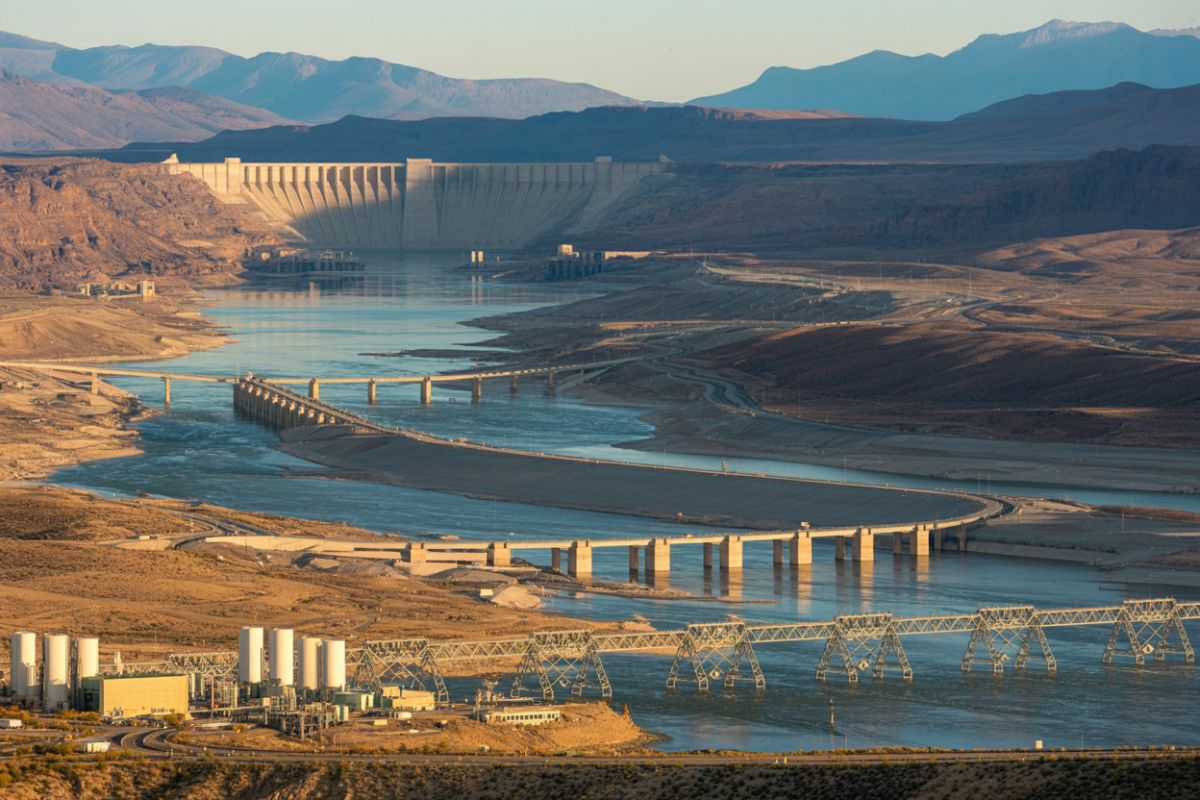
Designed To Reshape The Continent, NAWAPA’s $1 Trillion Plan Wanted To Transport Billions Of Liters Of Water From The Frozen North To Arid Deserts
Imagine a system that captures entire rivers in Alaska and northwestern Canada, directing this water—divided by a trillion dollars and nearly four decades of construction—to irrigate deserts in the southwestern U.S. and northern Mexico. This was the proposal of NAWAPA (North American Water and Power Alliance), envisioned in the 1960s by Ralph M. Parsons, with technical support from the U.S. Army Corps of Engineers.
Population Growth And Inflation In Water Use
In the post-war era, the U.S. experienced two phenomena: a baby was born every second (76 million between 1946–64), and industry doubled its output. To give an idea, water consumption increased from 180 to 270 billion gallons per day in the 1950s. Arid states like California, Arizona, and Nevada, along with northern Mexico, felt this surge in demand firsthand.
How The Project Would Work
NAWAPA Consisted Of:
-
A man went to the supermarket in China with the salary of a single day’s work, and what he put in the cart will make any Brazilian question why they pay so much to eat so little.

-
The La Galerie Nortis, a real estate launch by developers Cyrela and Nortis in Moema, São Paulo, arrives with apartments featuring 4 suites ranging from 283 to 416 square meters, an estimated gross development value of R$ 765 million, and the proposal to redefine the high standard in the region.
-
Man creates floating islands in a lake of more than 20,000 square meters and releases 10,000 baitfish.

-
Father said it was impossible, and a storm buried the first crop overnight, but today a young Chinese man harvests alfalfa up to six times a year on 1,530 hectares of the Taklimakan Desert.


- Diverting rivers like the Yukon, Liard, and Peace;
- Building a 500-mile reservoir in the Rocky Mountain Trench;
- Distributing this water by gravity or pumping to Montana, Colorado, Utah, Nevada, Arizona, California, and northwestern Mexico;
- Complementing the diversion by sending water to the Great Lakes, stabilizing their levels;
- Estimating 369 works over 30 years—using 200 million bags of cement, 30 million tons of steel, 100 thousand tons of copper/aluminum—creating 4 million jobs and 3.8 GW of energy (enough for 3 million homes).
Complicated Calculations
By the 1960s, the estimated cost was $100 billion—the equivalent of more than $1 trillion today, approaching the budget of the interstate highway system. Parsons estimated the investment could be paid back in 50 years by monetizing water and energy.
Conservative and progressive politicians supported the idea. Congressman Jim Wright stated that “NAWAPA has almost unlimited potential if we have the courage and vision”; Senator Frank Moss praised it for its scope in his book The Water Crisis; and then-Canadian Prime Minister Lester Pearson identified the project as one of the most important initiatives in Canadian history.
Environmentalism And Sovereignty In Conflict
By the 1970s, with laws like NEPA requiring in-depth studies, the project faced significant criticism. Experts warned that dams on the Yukon would impact salmon migration, ecosystems, and Indigenous communities — including the city of Prince George (BUC) potentially being displaced. Hydrologist Luna Leopold described the project in harsh terms, stating that “the environmental damage caused by it cannot even be described.” Authorities labeled it the “hydrological antichrist.” Historian William deBuys noted it fell victim to its own grandeur.
Moreover, there was a lack of trilateral coordination and protection for the rights of Indigenous peoples in Canada and the U.S.
Modern Renaissance?
Although buried in historical limbo, the idea resurfaced in 2012 with NAWAPA XXI, promoted by the Lyndon LaRouche group, which expanded its scope to 42 GW of surplus energy and doubled the irrigable area in the southwestern U.S. Its representative, Michael Kirsch, advocated for funding through a return to a national credit system. Still, critics argue that the initiative overlooks environmental impacts and lacks real sustainability.
Global Comparisons And Limits Of The Model
China has shown that mega-water projects can succeed, with works like the South–North Water Transfer Project and the Three Gorges Dam, but with more stringent environmental controls.
However, the climate has changed: extreme droughts and more intense rainfall challenge fixed systems. Studies from Frontiers in Environmental Science warn that these combinations make single matrix projects risky and ecologically vulnerable.
Is It Worth Resurrecting NAWAPA?
- Technology: Viable?
Yes. The techniques for dams, channels, and pumping were already mastered in the 60s. - Financially: Justifiable?
Maybe. Long-term revenue could cover costs, but it would depend on trilateral political stability. - Environmentally and Socially: Sustainable?
No, unless the project is restructured with ecological protections and respect for communities.

Leave a comment with your opinion: are we ready to face water challenges with grand ideas or should we reinvent local solutions? If you liked the text, share it and forward the debate!





-

-

4 people reacted to this.