






 Portuguese
  Spanish


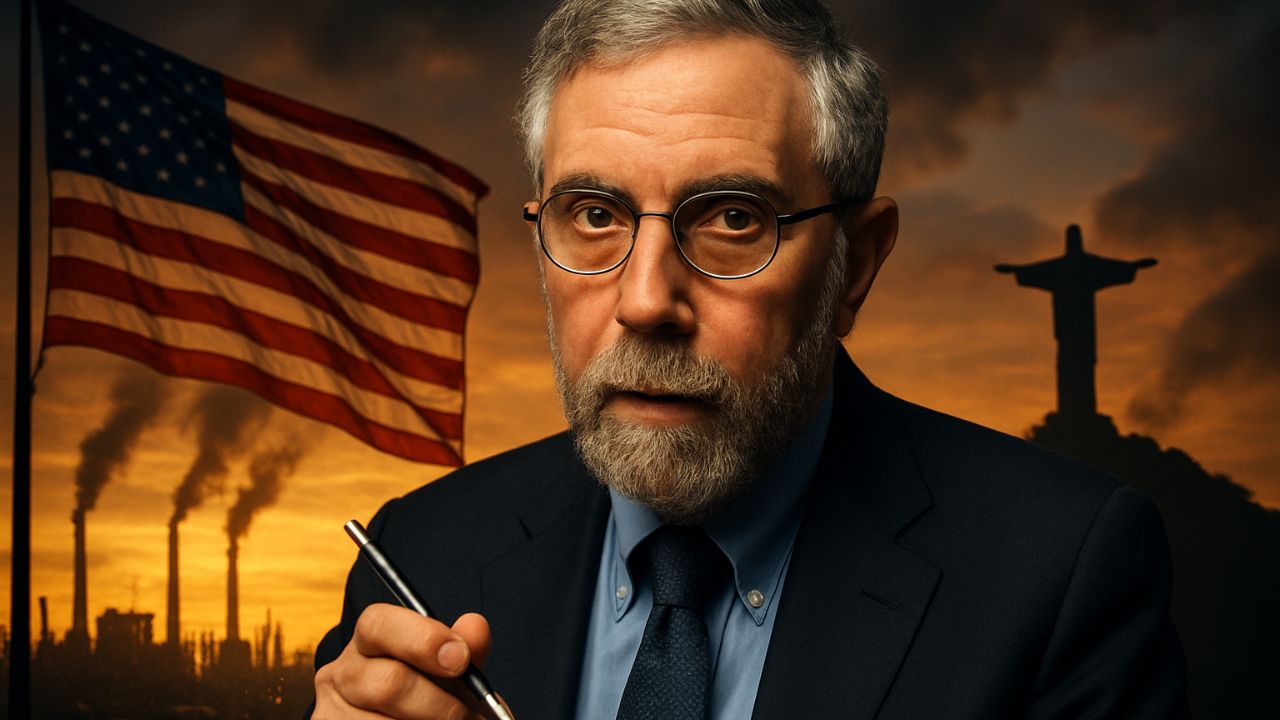


Nobel Prize in Economics Details to Bloomberg Television Why Trump’s Tariffs Reduce Living Standards and How “Uncertainty” Is the Biggest Economic Damage.
Nobel laureate economist Paul Krugman warned that the long-term impact of Trump’s tariffs will reduce the GDP of the United States by approximately half a percentage point (0.5%). In a detailed analysis for Bloomberg Television, Krugman, known for his work on trade patterns, classified the policy as “clearly negative” for the American standard of living, forcing the country to produce goods internally that are made more efficiently abroad, which inevitably raises costs for consumers.
While the economist considers this direct impact “bad” and harmful to U.S. credibility by breaking international agreements, he emphasized that the deeper damage is not the percentage itself. According to Krugman, the real problem is the “total and complete chaos” generated by unpredictability, where rules change at the “whim of the president.” This instability, he says, paralyzes business investments, which fear to invest capital without knowing what trade rules will be in the coming months.
Why Tariffs Fail to Protect Jobs?
Krugman directly confronted Donald Trump’s stated goal of using trade barriers to bring back manufacturing jobs. The economist explained on Bloomberg Television that the strategy is flawed, using the automotive industry as the primary example. He argues that there is no “U.S. automotive industry” isolated; the sector is a complex North American industry, deeply integrated with Canada and Mexico.
-
At 14 years old, she worked in a factory in Hong Kong, studied economics abroad, and then entered the Chinese real estate market, which helped change the landscape of Beijing.

-
While NATO secured more than $10 billion in missiles and space surveillance at a single forum, Brazil still spends 1.1% of its GDP on defense and is stalling its own anti-aircraft system.

-
Corn ethanol attracts R$ 23 billion in 21 new plants and prepares for a nearly 50% jump in Brazilian production by 2027, even with high interest rates.
-
A newly opened terminal in the middle of the Amazon has begun transporting soy and corn through Amapá, eyeing the queue of ships that is congesting the ports in the South.


Components of a single vehicle, according to the analysis, can cross borders “seven or eight times” before the car is ready. Tariffs on steel and aluminum, essential inputs for cars, therefore end up increasing costs for American manufacturers themselves. Krugman pointed out the irony that, by pushing up costs, the policy may accelerate automation. Companies may be forced to invest more in robots to offset costs, creating “more jobs for robots, but not for human workers”.
The True Cost: Chaos and the Breakdown of Supply Chains
The Nobel laureate was emphatic in differentiating the impact of a consistent tariff from the current policy. “Consistent tariffs are bad, but not as bad as the legend says,” he stated to Bloomberg Television, dismissing the idea that they alone cause depressions. The 0.5% GDP estimate would be the damage of a stable rate. However, Krugman was harsh in criticizing the method: “What we’ve never had before are tariffs where no one knows what the tariffs will be next month… It’s total and complete chaos.”
This environment of unpredictability, according to the economist, “causes havoc in business”. He explains that any investment a company makes now has a “good chance of becoming a really bad investment” if tariff rules suddenly change. The current world is not like it was 100 years ago, but rather a “world of complicated supply chains”. Many of Trump’s tariffs are actually being levied on inputs that the U.S. industry needs to make its products, increasing their operating costs.
Who Really Pays the Tariff Bill?
During the interview with Bloomberg Television, Krugman debunked the notion that foreign exporters would be absorbing the cost of tariffs. “We have independent data on the prices actually charged by foreign countries… and they have not fallen,” he said. The majority of the immediate cost, so far, seems to be absorbed by U.S. companies themselves, who try not to alienate consumers.
However, this absorption is temporary. Krugman observed that many companies anticipated and “rushed imports” before the tariffs took effect, and others hesitate to pass on prices due to uncertainty about whether the tariffs are permanent. In the end, he warns, companies will not be able to absorb these costs: “In the end, [the bill] will go to consumers”.
The Long-Term Damage to U.S. Credibility
Beyond the immediate impact on GDP and prices, Krugman expressed greater concern over the “permanent long-term effects”. He recalled that the United States built the global trading system based on rules and laws (such as GATT, the General Agreement on Tariffs and Trade) over the past 90 years, since the Roosevelt era. “We have just torn up an entire system of trade agreements”, he lamented.
The economist emphasized that even if a future president reverses all Trump’s tariffs on the first day, the damage to reputation is already done. “The United States will never be trusted again”, he stated. He recalled that in past administrations (such as Reagan’s, where he worked), if a proposal violated international agreements, it was simply discarded. “This administration does not care”, he concluded.
Paul Krugman’s analysis on Bloomberg Television paints a picture where Trump’s tariffs, while having a direct impact on GDP estimated at 0.5%, cause a much greater damage through instability, breakdown of international trust, and rising costs that will inevitably reach the consumer.








