






 Portuguese
  Spanish


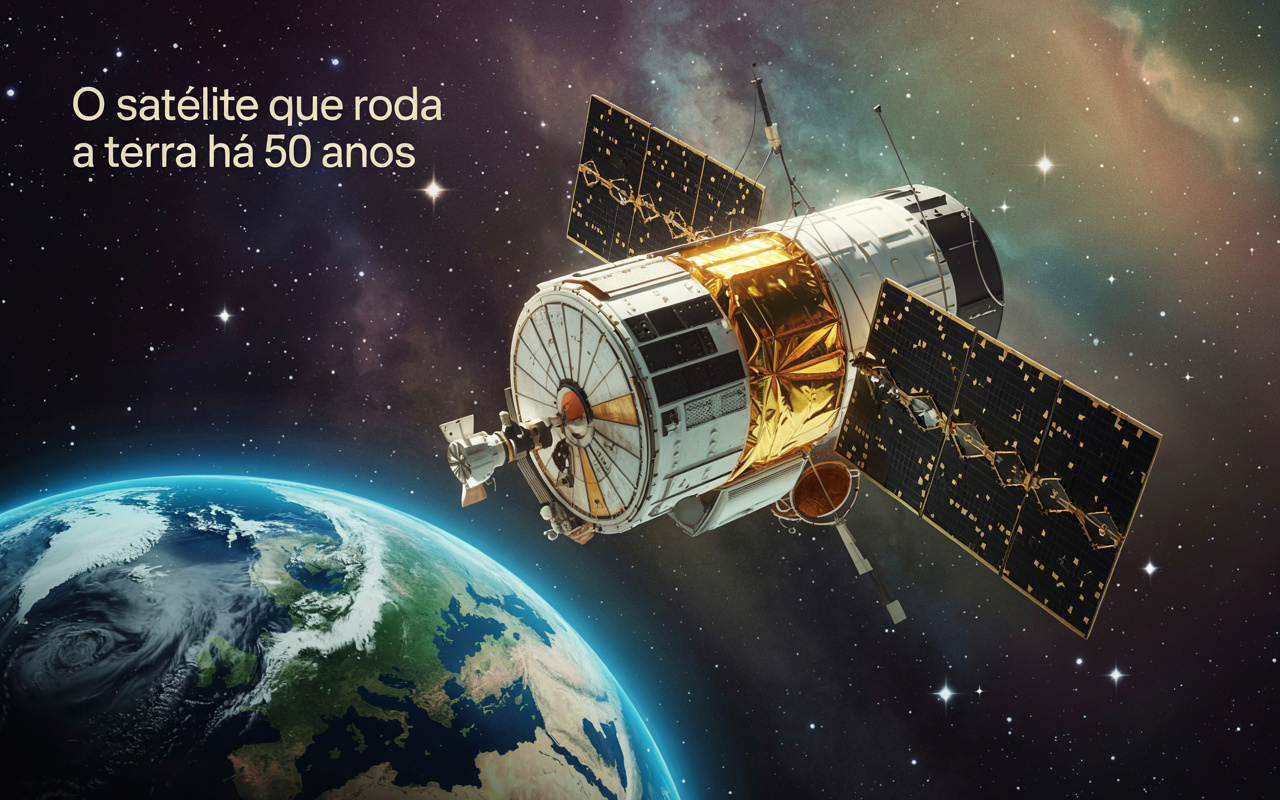


Even With the Mission Ended Decades Ago, Some Satellites Remain Active and Surprise Scientists by Sending Signals from Space. Learn About the Impressive Cases of LES1 and the Legendary Voyager 1.
In a universe where most satellites have a lifespan of a few years, some equipment defies time and continues to function even after being abandoned by their creating agencies. They are silent structures, often forgotten, that still orbit the planet or traverse deep space, emitting signals that no one expected to hear again.
Two examples stand out: LES1, a military satellite from the 1960s, and the legendary Voyager 1, launched in 1977. Both continue transmitting, even with their missions having ended decades ago, proving that past technology, in some cases, can be surprisingly resilient.
The Military Satellite That Woke Up After 46 Years
The LES1 (Lincoln Experimental Satellite 1) was launched in 1965 by the United States as part of a military communications project. But something went wrong: the launch stage did not separate correctly, and the satellite entered an unpredictable orbit.
-
Canada Makes Historic Decision to Purchase New German Submarines in $70 Billion Defense Program, Replacing Aging Victoria-Class Fleet by 2033

-
4,000-Year-Old Stone Circle Discovered Near Belfast, Unveiling Prehistoric Ritual Complex in Irish Countryside

-
Brazilian Innovator Transforms 1962 Mercury Comet with Nissan Leaf Electric Motor, Achieving 125 km Range for Under $6,000
-
China Tests Giant 582-Ton Magnets to Contain Plasma Hotter Than the Sun’s Core, Aiming to Cut Superconductor Costs and Generate First Electricity from “Artificial Sun” by 2030


Without operational function, it was considered lost and its mission declared over. No one expected anything more — until, in 2013, almost half a century later, a British amateur radio operator picked up a continuous signal coming from a specific point in the sky. It was LES1.
What happened? Apparently, the satellite remained functional, but its antenna was only positioned favorably to Earth when its natural rotation axis finally stabilized. Since then, it has emitted intermittent signals, like a technological echo from an era that seemed buried.
“Zombie Satellite”
LES1 has become a symbol of what many call a “zombie satellite” — equipment that is technically dead but still has active circuits and can transmit signals.
These satellites defy time not because they were made to last so long, but because of an unlikely combination of:
- Robust components by the standards of the time
- Lack of sophisticated software, which reduces the risk of logical failures
- Stable exposure to the Sun, ensuring that solar panels still power basic systems
This is the case with LES1, which today no longer serves military communications but has become a valuable object of study for engineers and scientists who monitor the behavior of technologies over long periods of space exposure.
Voyager 1: Over 45 Years Crossing the Void and Still Sending Data
If LES1 is impressive for having come back to life, Voyager 1 is even more extraordinary. Launched in 1977 aimed at the outer solar system, the mission of the probe was already ambitious: to visit Jupiter and Saturn. But it went beyond — and remains alive today, over 24 billion kilometers from Earth.


Even in an extremely hostile environment, with temperatures close to absolute zero and exposed to cosmic radiation, Voyager 1 still transmits signals to NASA. And not just signals — but scientific data.
The energy comes from radioisotope thermoelectric generators (RTGs), which convert the heat from plutonium decay into electricity. This system, with minimal losses over the decades, still provides enough power to keep some instruments functioning and an active antenna.
In 2024, even after brief communication failure periods, the team managed to partially restore control and data reception. It’s like talking to an electronic ghost traveling through infinity.
What Can These Satellites Still Teach Us?
Much more than just curiosity, the continuous operation of LES1 and Voyager 1 is of immense scientific and technical importance:
- Allows for the study of electronic component degradation in space
- Helps test the longevity of materials and systems in extreme conditions
- Provides insights into how to build more durable probes and satellites for future missions
- Inspires projects for maintenance of abandoned satellites, something increasingly relevant in light of the saturation of Earth’s orbit
Furthermore, the case of LES1 raised important questions about monitoring space debris. If it resumed transmission after 46 years, how many other “dead” satellites are still silently out there, ready to reappear?
Communication Beyond Time
In an era marked by planned obsolescence, seeing equipment from 1965 or 1977 still functioning defies contemporary logic. This reinforces a fundamental point: classical engineering, even with its limitations, can exceed expectations and leave lasting legacies.
Both LES1 and Voyager 1 are part of a technological lineage that valued resilience and robustness, with few automated systems and minimal dependence on software. This has paradoxically become an advantage in resisting time.
‘Zombie’ Satellites and Survivors
With the explosion of private and commercial satellite launches in recent years, it is estimated that over 3,000 inactive satellites are currently in orbit around Earth. Most will simply become debris — but some, like LES1, may surprise us in the future.
There is also a growing interest in reactivating or repurposing “abandoned” satellites, either for research or to integrate new low-cost missions. Remote reprogramming and the use of space robots for maintenance are already being discussed in agencies like NASA, ESA, and JAXA.
LES1 and Voyager 1 are not just machines in orbit — they are silent messengers from the past, reminding us that human engineering can create legacies that transcend generations.
These satellites continue circling, emitting signals, overcoming failures, and surviving the void of space — even when everyone had already given up on them. In times of accelerated innovation, they invite us to look back and acknowledge that, sometimes, what seems obsolete can actually be eternal.







SNSA🛰️ WiFi
R$300