






 Portuguese
  Spanish
  5 min of reading
  2 comments





With More Than 2 Meters in Height and Explosive Running, the Terror Bird Was the Most Lethal Predatory Bird in Prehistory, Dominating Continents for Millions of Years.
For tens of millions of years, long before modern felines occupied the top of the food chain, a group of giant, flightless birds dominated vast regions of the planet as supreme predators. Commonly known as Terror Birds, these birds not only replaced carnivorous mammals in various ecosystems but also developed a rare combination of height, speed, strength, and aggression that turned them into true terrestrial hunting machines. They were not an isolated evolutionary curiosity but a highly successful lineage capable of surviving and thriving for over 60 million years.
What Were the Terror Birds and Where Did They Live
The Terror Birds belong to the scientific family Phorusrhacidae, a group of predatory birds that emerged after the extinction of non-avian dinosaurs. They originated in South America when the continent was still isolated and quickly became the dominant terrestrial carnivores in the region.
Over time, some species also spread to North America, especially after the formation of the Isthmus of Panama, during the so-called Great American Biotic Interchange.
-
While scientists test giant balls on the seabed, a startup wants to sink concrete and steel tanks held by cages filled with stones up to 700 meters deep to transform compressed air into an invisible underwater battery.

-
Former NASA engineer transforms drones into “seed helicopters” capable of firing 300 balls per minute, targeting degraded areas with half-meter precision, and planting up to 40 million trees per year in a new race for aerial reforestation.

-
Brazil deploys drones to scatter seeds on nearly inaccessible slopes and attempts to transform degraded hills into forests with aerial planting up to 100 times faster, in a green offensive launched in Rio de Janeiro.
-
Second half of June brings more intense cold, polar air mass, and above-average rainfall in Brazil







These birds inhabited diverse environments, including open savannas, sparse forests, coastal plains, and semi-arid regions. The diversity of habitats shows that the Terror Birds were not fragile specialists, but versatile predators capable of adapting to different climates and prey.
Height, Weight, and Anatomy That Intimidated Any Prey
The largest species of Terror Birds easily exceeded 2 meters in height, with some individuals estimated to be between 2.5 and even 3 meters from the ground to the head. Weight varied by species, but many ranged from 100 to 150 kilograms, a figure comparable to that of a large African lion.
The body was supported by long, thick, and extremely muscular legs, designed for quick bursts of speed.
Unlike modern running birds, such as the ostrich, the Terror Birds combined running with direct aggression. The wings were reduced and incapable of flight, but not useless: they were believed to help with balance during running and in subduing prey.
The neck was rigid and powerful, functioning like a mechanical arm capable of transmitting force directly to the skull during frontal attacks.
The Most Feared Weapon: The Axe-Shaped Beak
The greatest symbol of the Terror Bird was its gigantic, curved, and extremely robust beak. Unlike the delicate beak of modern birds, it functioned like a true bony blade.
Biomechanical studies indicate that the beak was not only made for piercing but for delivering repeated vertical strikes, crushing bones, rupturing internal organs, and causing lethal damage in a matter of seconds.

The most accepted attack method among paleontologists involves a brutal combination: the bird would knock down the prey with body impact or initial pecks, and then execute precise downward strikes to the skull or thorax, using the body’s weight and neck strength as leverage.
This hunting style made the Terror Bird efficient against a wide range of prey, from small mammals to medium and large animals.
Extreme Speed as an Evolutionary Advantage
Although the intimidating size draws attention, one of the Terror Birds’ greatest assets was speed. Anatomical modeling suggests that some species could reach speeds of 50 to 60 km/h over short distances. This burst of acceleration was enough to catch practically any terrestrial prey of their time.
The hip and knee joints indicate a long and powerful stride, more akin to that of a sprinter than a distance runner. This means that the Terror Bird did not need to chase its prey for long periods: a short and violent burst was enough to end the hunt.
Main Species and Variations Within the Group
The group of Terror Birds was not made up of a single animal, but of dozens of species distributed over millions of years. Some of the most well-known include:
Phorusrhacos longissimus, one of the first described species, standing about 2.5 meters tall.
Kelenken guillermoi, famous for having one of the largest skulls ever recorded among predatory birds.
Titanis walleri, which lived in North America and even coexisted with the continent’s first great felines.
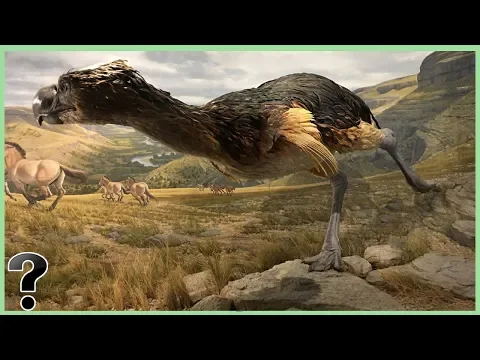
This diversity shows that the Terror Birds were not a failed experiment in evolution, but a highly adaptable and dominant lineage.
Why a Bird Was Able to Replace Large Mammalian Predators
In isolated South America, carnivorous mammals were relatively small and not highly specialized. This opened the way for predatory birds to take the top of the food chain.
Without large felids or canids competing for millions of years, the Terror Birds evolved without direct pressure, honing their terrestrial hunting skills.
When more efficient mammalian predators finally arrived on the continent, the balance began to shift.
The Decline and Extinction of the Terror Birds
The extinction of the Terror Birds did not happen abruptly, but gradually. The arrival of large mammalian predators, such as saber-toothed cats and robust canids, brought direct competition. These new hunters had advantages such as continuous biting, increased stamina in long pursuits, and group hunting strategies.
Climate changes, alterations in vegetation, and the reduction of suitable prey also contributed to the disappearance of these giant birds. By about 1.8 million years ago, the last Terror Birds disappeared completely.
A Predator That Redefined the Role of Birds on Earth
The Terror Bird proves that birds are not inherently fragile or passive. In certain ecological contexts, they can become the most efficient predators on the planet.
With a height greater than that of a human, strength comparable to that of large felines, and an anatomy designed for killing, these birds dominated entire continents for a longer period than many famous mammals.
If they existed today, few terrestrial animals would dare to share territory with them. The Terror Bird was not just a giant bird, it was an extreme reminder of how far evolution can go when it removes limits and competitors from the path.







Gostei da matéria. As aves do terror ja foram o topo da **** alimentar em diversas partes das américas. Até hj temos exemplos de remanescentes menores cujos bicos e patas são usadas de forma terrivelmente eficaz para a defesa e para a caça. As aves sempre foram animais fantásticos.
Rapaz, o pais mergulhado no MAR DA CORRUPCAO INSTITUCIONALIZADA, metade da populacao recebendo esmolas do governo para mascarar o desemprego e o cara vem com uma materia ABOUT BIRDS. pre historicos….**** que pariu!!!