






 Portuguese
  Spanish
  4 min of reading
  0 comments


Known as “Steel Iceberg”, Shell’s colossal gas platform is the most complex structure ever moved by humans, but its operation faces extreme risks.
It floats like a mountain of steel, costing $12 billion and operating in one of the most hostile seas on the planet. This is the Prelude FLNG, Shell’s colossal gas platform and the largest floating facility ever built. Positioned 475 km off the coast of Australia in the Browse Basin, it was designed to be an autonomous gas processing city, eliminating the need for pipelines to the mainland.
The Prelude is an engineering marvel, capable of producing millions of tons of liquids per year and designed to withstand the most severe cyclones. However, the same complexity that makes it revolutionary also exposes it to severe internal risks. An incident in 2021 revealed how the “one-size-fits-all” design can fail catastrophically, putting the crew in extreme danger.
The 600,000-Ton Titan
The analogy of the “steel iceberg” is physically accurate. With 488 meters in length (longer than the Empire State Building) and 74 meters in width, the hull of the Prelude displaces 600,000 tons when fully loaded. According to the Offshore Technology portal, over 260,000 tons of steel were used in its construction. The facility is not just an extraction platform; it is a complete floating refinery.
-
In Sweden’s Jukkasjärvi, Artists Transform the Frozen Torne River into the Icehotel, a Seasonal Ice Structure That Melts Back into Nature

-
Innovative Heat Storage Tower in Finland Uses 2,000 Tons of Crushed Soapstone to Warm Cities
-
17-Year-Old Homeschooler from the Bahamas Solves 40-Year-Old Math Puzzle, Earns Direct PhD Admission
-
Giant South American Tree Stores Water in Its Trunk, Survives for Years in Dry Regions


The aim of this colossal gas platform is to “unlock” stranded gas fields that are too remote to justify underwater pipelines. The Prelude extracts gas, processes it, and cools it to -162°C to convert it into Liquefied Natural Gas (LNG). Offshore Technology details its annual production capacity: 3.6 million tons of LNG, 1.3 million tons of condensate, and 0.4 million tons of LPG, all stored in cryogenic tanks on board before being transferred to offshore tankers.
Engineering Against Chaos: Designed for Cyclones
The Prelude operates in the “cyclone alley” of Western Australia, a region prone to severe storms. To survive, its design was taken to the limit. The central specification, as reported by Offshore Technology, is that the facility must withstand a Category 5 cyclone, which includes waves up to 30 meters. It was designed for a 1-in-10,000-year storm.
The platform does not have its own engines. It is held in place by a mooring system of 16 massive chains, anchored to a depth of 250 meters. The key component is a 93-meter internal tower, which allows the 600,000-ton structure to rotate 360 degrees. This system, called “weathervaning”, ensures that the platform always points its bow (the narrowest part) into the wind and waves, drastically minimizing the impact of the storm.
The Most Complex Move in History
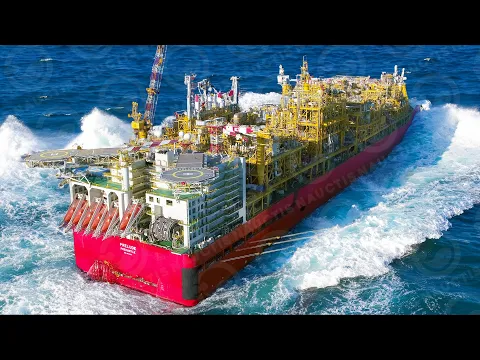

Built in South Korea, moving the Prelude to Australia was considered the most complex tow in history. The journey of 5,800 kilometers (3,600 miles) was documented by logistics sources as an operation that took over a month. A specialized fleet of tugboats was required to pull the unpowered structure.
The ocean journey was made at an average speed of 5 knots, described as “the pace of a brisk walk”. According to reports from the operation, a crew of 160 people was aboard the Prelude throughout the tow, managing the systems. The final “hook-up” maneuver of the 16 mooring lines offshore, battling currents, solidified this logistical feat.
The Risk Density Paradox
The idea that the platform “operates on its own” does not mean automation. In fact, it requires a constant crew of 220 to 240 people. The term “on its own” refers to its “self-contained” design. On land, a power plant is miles away from the storage tanks. On the Prelude, hydrocarbon processing, power generation, and crew accommodations are mere meters apart.
This risk density has proven almost catastrophic. The Official NOPSEMA Report (the Australian regulator) on the December 2021 incident is frightening. A small fire in a battery room (UPS) caused a cascading failure, leading to a total loss of power. The main generators, emergency generators, and batteries failed, plunging the platform into darkness.
The NOPSEMA report details the human cost. Without power, the ventilation system (HVAC) failed. Temperatures inside the sealed steel accommodations soared to 40-45°C, with extreme humidity. Seven crew members needed treatment for heat stress, with four requiring intravenous hydration. To make matters worse, the emergency communication systems also failed. The fortress designed to withstand cyclones was nearly defeated by a small internal fire.
A Paradox of Steel
The Prelude FLNG is a paradox of steel. It is undoubtedly a monument to human engineering, validating its fame as the $12 billion “steel iceberg”. It proved it can withstand the most hostile forces of the external environment. However, its troubled operation and the incident of 2021 highlight a critical vulnerability to its own internal complexity. The world’s largest colossal gas platform is a marvel that has redefined what is possible, but also a sobering reminder that in such a dense ecosystem, a single failure can cascade and put everything at risk.
What do you think of this level of complexity? Do you believe that the engineering benefits of “one-size-fits-all” projects like the Prelude outweigh the extreme risks to the crew? Leave your opinion in the comments.


-

-

-

6 people reacted to this.