





 Portuguese
  English
  Spanish
  5 min of reading
  0 comments


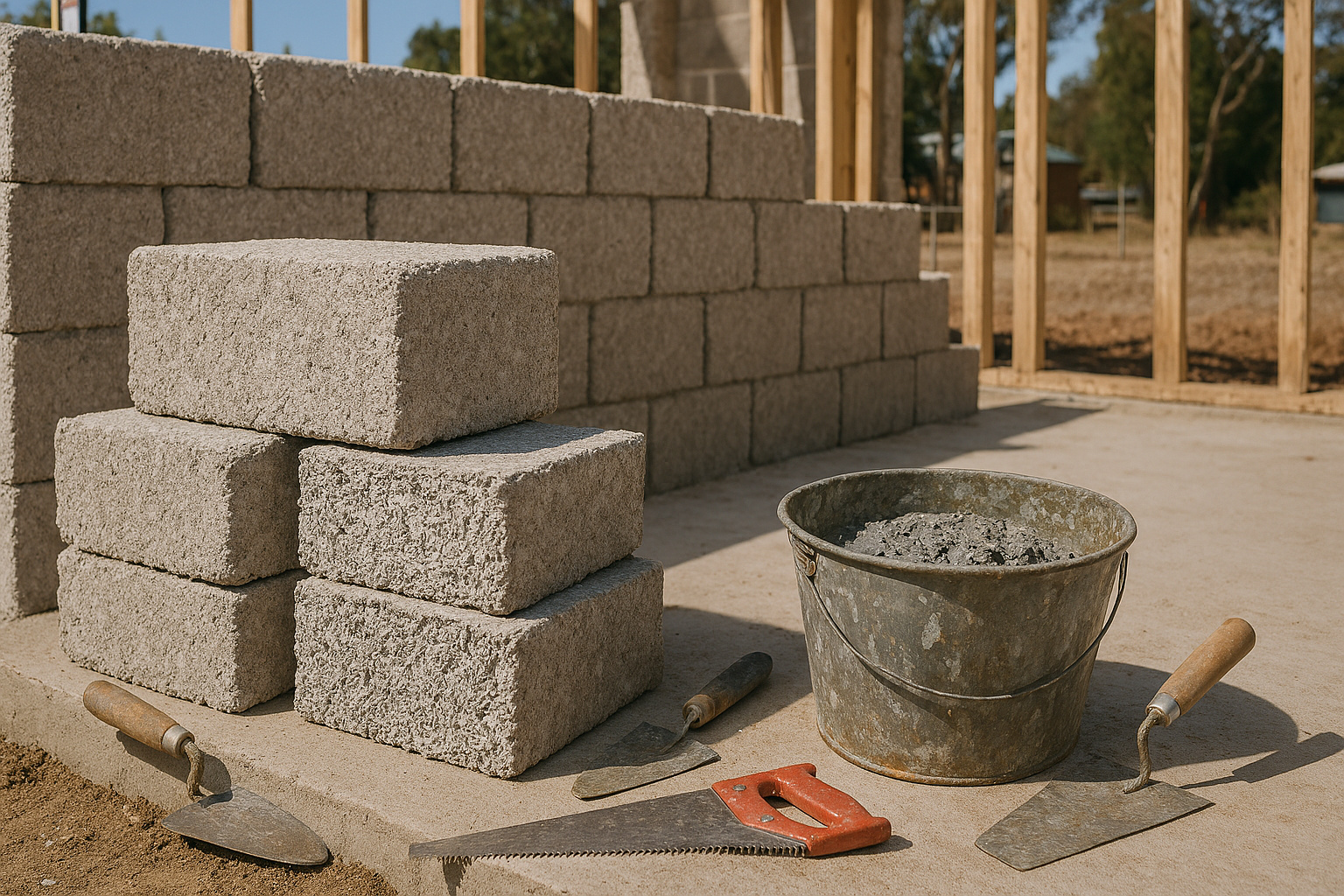
Papercrete Replaces Traditional Blocks: Mixture of Recycled Paper, Water, and Cement Creates Lightweight, Insulating Walls Used in Real Constructions in the USA and Australia.
When we talk about alternative building materials, the most common image is of sophisticated materials, such as SIP panels, advanced composites, or ultra-high-performance concrete. However, there is a simple, inexpensive, and surprising material that has been gaining ground for decades in sustainable building niches: papercrete, a mixture of shredded paper (mainly newspaper), water, cement, and sometimes sand or hydrated lime. The result is a material that resembles lightweight concrete, with thermal insulation above the conventional, much lower density than traditional masonry, and sufficient structural capacity for non-load bearing walls, especially in dry climates.
This type of construction has existed for more than 70 years and has been used in real projects in the United States (mainly in New Mexico and Arizona) and in regions of Australia, where the combination of dry climate, alternative architecture, and interest in recycling has favored its expansion.
What Is Papercrete and Why Is It Named That
The name “papercrete” comes from the combination of paper + concrete. Although it is not concrete in the traditional sense (as paper replaces fine aggregate in much of the mixture), it retains Portland cement as a binder, forming a rigid and porous matrix.
-
African country launched a $145 million project to rehabilitate 35 dams and drill deep wells seeking water stored for millennia beneath the desert, a plan that Captain Ibrahim Traoré’s government presents as a path to the country’s water sovereignty.

-
An eight-story railway colossus with a 16,500-ton roof, Chongqing East Station was built in 38 months with the help of robots and has become one of the largest passenger terminals in the world, with 15 platforms and 29 tracks.
-
More than 20 billion dollars and 600 km of railway were built in record time in Africa to extract the hidden iron ore from Simandou from the forest, now the first ships are arriving in China and the IMF predicts a 25% jump in Guinea’s GDP.
-
A new plastic tile that perfectly mimics traditional clay ones is gaining popularity on Brazilian roofs, being lighter, quicker to install, and capable of reducing both construction time and the weight on the house structure all at once.
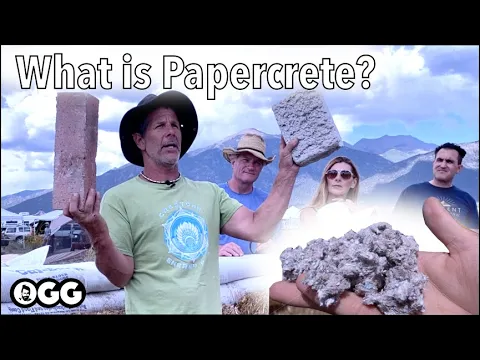

The typical composition is:
- 50–70% of newspaper or shredded recycled paper
- 20–40% of Portland cement
- 0–20% of sand or hydrated lime
- enough water to create a paste-like mass
Once dried, the mass hardens and forms blocks, panels, or monolithic walls, depending on the technique. The material can be shaped by hand, using wooden molds or even poured as a floor slab, and then dried in the sun.
Technical Properties That Explain the Interest
The main technical difference of papercrete is its reduced density, usually between 300 and 700 kg/m³, while common concrete varies between 2,200 and 2,400 kg/m³. This means that papercrete can weigh about 1/4 of conventional concrete, making transport, handling, and assembly easier.
Other relevant properties:
Thermal Insulation
Tests show thermal conductivity in the range of ~0.08–0.10 W/m·K (depending on the recipe), superior to traditional concrete (~1.4 W/m·K) and close to artificial insulators like EPS (~0.035 W/m·K), although with lower acoustic performance.
Stiffness and Strength
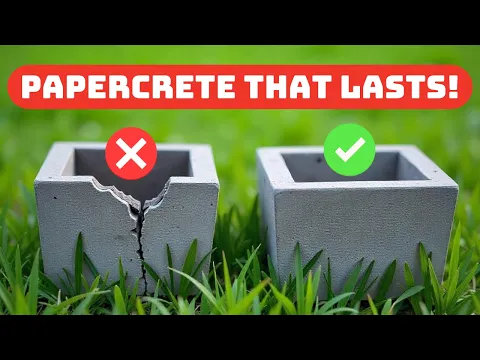
Although it is not a structural substitute, independent measurements indicate compressive strengths between 0.5 and 2.5 MPa, which is sufficient for enclosure walls, but not for columns or beams.
High Permeability and Porosity
Being porous, it allows for wall breathing, reducing condensation, but requires external barriers against heavy rain, especially in humid climates.
Recycling Potential
It uses an abundant waste (newspaper and cellulose) and has thus gained a reputation as a low primary impact ecological material.
These characteristics help explain why it has appeared in academic publications and sustainability projects over the decades.
Where This Technique Emerged and How It Evolved
The first consistent records of material use emerged in the United States in the 1940s, when independent inventors used recycled paper to create lightweight bricks. However, it was only in New Mexico and Arizona, between 1980 and 1990, that the material was reborn as an alternative architectural solution.
These two states have a long tradition of earth architecture, adobe, superadobe, and alternative construction, creating a favorable environment for experimentation.
With advances in sustainable materials engineering in the 2000s, universities and laboratories began testing the microstructural composition of papercrete, classifying it as a cellulosic cement composite material.
This placed it in the same family of studies investigating the partial replacement of natural aggregates with waste.
In Australia, its use emerged primarily in rural communities and low-impact environmental architects, due to the climate and culture of self-building.
How the Material Is Produced in Practice
Manufacturing can occur in two ways:
Mechanical Mixing with Industrial Blenders
In this technique, drums with blades chop the paper with water until it turns to pulp. Then, cement and sand are added.
Manual Mixing in Tanks or Buckets
More common in self-build projects, with paper soaked for hours before mixing.
Once ready, the material can be:
- poured into molds to dry in the sun, creating blocks
- applied directly to walls as monolithic
- printed as panels between wooden trusses
The longest stage is drying, which can take a week or more, depending on the thickness of the block and the humidity in the air. Arid regions tend to be ideal.
How It Is Used in Constructions
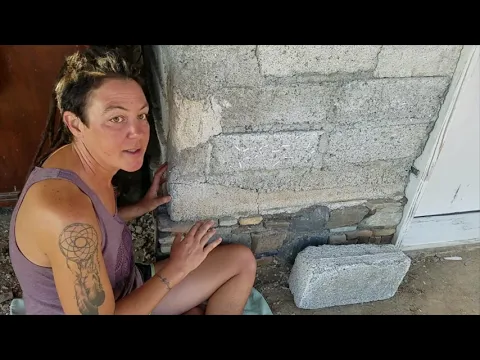
The material does not replace structural pillars, but works very well in:
- enclosure walls
- internal panels
- insulating covers
- acoustic walls
- lightweight coatings
In some projects in New Mexico, houses with papercrete use wood, steel, or bamboo posts as a skeleton, while the material serves as filling between these structures. Architects highlight three functional advantages:
• thermal insulation – useful for deserts and semi-arid regions
• lightweight – facilitates manual construction
• recycling urban waste – creates circular economy
Practical Advantages and Limitations
Not all alternative materials are a magic solution. Papercrete has strengths and weaknesses that define when it is worth using.
Main Advantages:
• reduces the use of structural wood
• recycles abundant urban waste
• provides thermal comfort
• is very lightweight and easy to mold
• allows for low-cost self-building
Main Limitations:
• is not load-bearing
• can absorb water if not protected
• is not suitable for extremely humid environments
• lacks international normative standardization
For this reason, most constructions occur in dry or temperate regions, and with engineers who understand the hygrothermal behavior of the material.
Real Application Examples
In the United States, there are communities with dozens of houses built with papercrete in the southwest, particularly in:
- New Mexico
- Arizona
- Oregon
- Colorado
In Taos, New Mexico, the material appears in the walls of studios, offices, and eco-houses, often combined with superadobe, adobe, and wood frame.
In Australia, small alternative architecture projects have utilized papercrete in states such as:
- Victoria
- Queensland
- New South Wales
In these cases, the choice was made for the combination of thermal insulation + recycling + artisanal construction.
What Researchers and Architects Are Saying
Academic research reports that paper, when mixed with cement, creates a fibrous matrix, increasing toughness and tensile strength, similar to fiber reinforcement.
At the same time, cellulose creates a highly porous texture, which reduces density and increases insulation.
This combination creates a class of materials that some researchers informally call “biosynthetic cementitious”, as the fiber is of organic origin while the binder is mineral.
Architects emphasize that the material is not only ecological but programmable: it can be literally shaped by hand, like clay, allowing for aesthetic freedom.
Three factors could define its growth:
- global demand for sustainable construction
- increasing cost of mineral aggregates
- abundance of cellulosic urban waste
Today, the world produces millions of tons of paper and cardboard. Transforming part of this chain into alternative building material seems like a logistically and environmentally smart solution, especially in countries with dry climate and a culture of self-building.






Be the first to react!