






 Portuguese
  Spanish


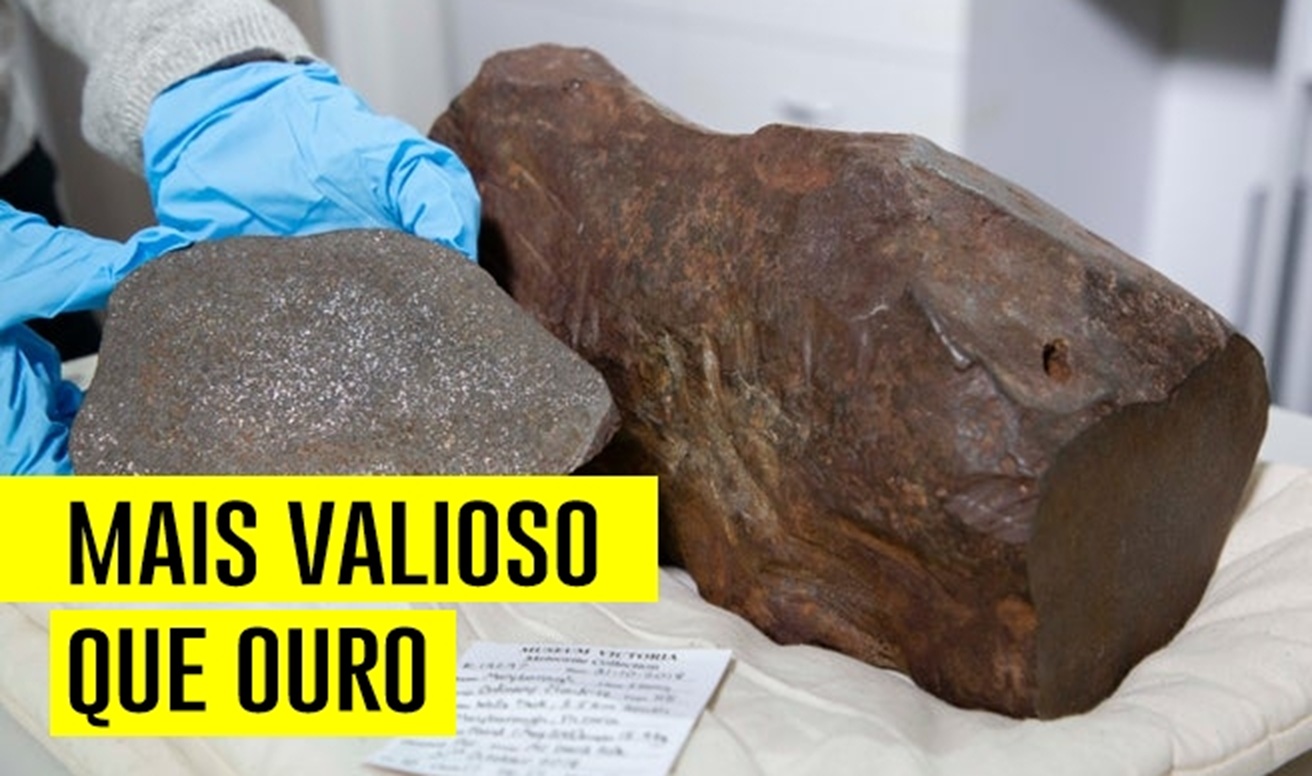


Sometimes, the Most Common Stone in Your Backyard Can Become a Cosmic Treasure Worth More Than Gold. After Years Keeping a Stone Believing It Was Gold, a Man Discovered It Was Something Much Rarer and More Valuable, Surprising Experts and Collectors
For years, a peculiar stone was kept with the hope of containing gold, fueling dreams of wealth and prosperity. However, when the owner finally decided to investigate further, the discovery was surprising: that stone, far from being gold, turned out to be something much rarer and more valuable.
In 2015, what seemed like just another common stone found by a treasure hunter turned out to be an astronomical discovery. David Hole, who was exploring the Maryborough Regional Park in Australia with his metal detector, found a heavy reddish stone on a layer of yellow clay. Initially, Hole believed he had found a nugget of gold.
Being a nugget of gold would make sense in a region famous for its gold rush in the 19th century. However, what appeared to be a simple rock proved to be one of the rarest meteorites ever found.
-
College Dropout Turned Window Cleaner Builds $1 Million Cleaning Business with Subscription Model After 18 Years of Door-to-Door Work

-
North Korean Soldier Risks Crossing One of the World’s Most Dangerous Borders, Detained in South Korea

-
Stingless Bee Honey from Brazil Can Cost Up to $120 a Liter, Surprises with Flavors of Wood, Citrus, and Even Cheese
-
Woman Claims to Have Spotted a Technical Pattern in Recent FIFA Tournaments, Predicts Possible World Cup Winner


Museums Victoria )
The Search for the Meteorite
After several attempts to open the rock using a saw, grinder, and even acid, no fissures were made. But his persistence led him to seek confirmation from the Melbourne Museum about what had been found.
The geologist Dermot Henry, after examining it, confidently stated that the rock was indeed a rare meteorite, with a peculiar formation that occurs when space objects enter the Earth’s atmosphere, melt on the outside, and acquire a sculpted texture.
The discovery, named the Maryborough meteorite, is 4.6 billion years old and weighs an impressive 17 kilograms. When cut, researchers found its composition rich in iron, characteristic of H5 ordinary chondrite meteorites.
Additionally, the meteorite contains small crystals of metallic minerals known as chondrules, which provide valuable clues about the formation of the Solar System.

PRSV , 2019)
The Scientific Value of the Discovery
This meteorite is more than a rare piece of rock. For scientists, it is a time capsule, carrying fundamental information about the origins of our Solar System and even about Earth.
Meteorites like this have the ability to reveal how stars form and evolve, and may even contain organic molecules like amino acids, the building blocks of life.
Although it is still unknown exactly where the meteorite came from, it is believed to have been expelled from the asteroid belt between Mars and Jupiter after collisions between asteroids.
Dating suggests it arrived on Earth between 100 and 1,000 years ago, with sightings of meteors between 1889 and 1951 that may coincide with its arrival.

This meteorite is only the 17th found in the state of Victoria, making it extremely rare, especially compared to gold, which continues to be found in large quantities in the region.
For researchers, it is a valuable find, not only for science but for the history of our planet and the universe. In the end, Hole, unknowingly, was responsible for bringing to light a relic from another time, something that will likely continue to be studied by generations.
Now, who knows, it might be the perfect time to take a look at the stones you have at home – maybe you too have a piece of space waiting to be discovered.




Ou seja não vale **** nenhuma mas muito valiosos pra ciência 😂🖕
Eu tenho uma pedra assim de 3 kg
Eu tenho também uma pedreira lá está cheia de pedras