






 Portuguese
  Spanish


Researchers Discover An Impressive Dinosaur Footprint On A British Beach, Offering New Clues About The Prehistoric Giants That Lived There
A dinosaur footprint from the species Iguanodon, over 100 million years old, was discovered on the Isle of Wight, England. The find was made by paleontologist Joe Thompson, a guide for fossils from Wight Coast Fossils, during a walk on the beach.
Thompson reported that he found the footprint while exploring the area. The island’s terrain is known to be conducive to fossil discovery. “The geology is perfect for this,” he said in an interview.
The paleontologist walked for about two hours when he spotted a purple object in the mud. Upon closer examination, he saw that it was a fossilized footprint. “It turned out to be an absolutely huge Iguanodon footprint,” he explained.
-
China Develops Custom 140-Ton Electric Mining Truck with 770 kWh Swappable Battery, Deploys 290 Units in Xinjiang’s Largest Zinc Mine

-
Meta to Launch Arena, a New Prediction App Targeting 3.56 Billion Users, Competing with Polymarket and Kalshi

-
Scientist Challenges Famous Human Evolution Theory, Argues Homo Sapiens Evolved Gradually Over Thousands of Years
-
15-Year-Old American Builds Ocean Generator with PVC Pipe and 3D-Printed Propeller for $12, Wins National Prize, Presents at White House, and Makes Forbes 30 Under 30 List




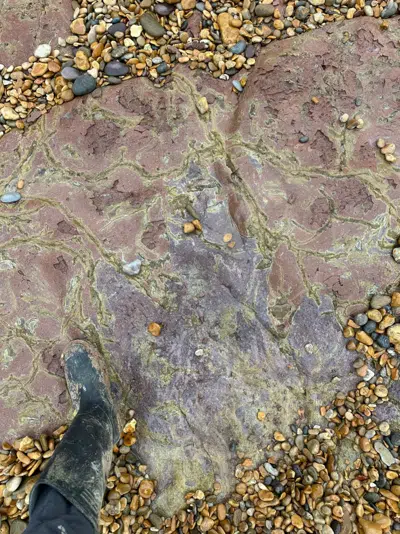
The Giant Footprints Of The Iguanodon: An Impressive Find
Iguanodon fossils are often common around the world. They have been found in various parts, including Utah and Colorado in the United States. The Isle of Wight is particularly rich in fossils from the Cretaceous period.
Famous dinosaurs such as the Triceratops and Patagotitan are not found on the island. Instead, fossils of species like the Iguanodon are common in the region. “They are just incredible beasts,” Thompson said.
He pointed out that these animals could reach lengths of 32 to 36 feet (approximately 10 to 11 meters) and traveled in large groups feeding on vegetation.
The size of the discovered footprint is what impresses the most. “This footprint was absolutely huge—almost a meter long. So, a very large Iguanodon, much bigger than almost all other Iguanodon footprints found in that section of the coast,” he stated.
Possible New Species Of Dinosaur?
Thompson speculates that the giant dinosaur footprint may belong to a yet-unknown species of Iguanodon. This is due to the fact that it is larger than others already found on the island. However, he emphasizes that only new fossils in the same rock layers can confirm this hypothesis.
The constant erosion of the coast leads to regular fossil discoveries on the Isle of Wight. This attracts tourists and researchers specifically looking for traces of the past. Thompson leads expeditions for Wight Coast Fossils, where he teaches visitors how to identify fossils.
Recently, he founded South Coast Fossils, a company that offers tours focused on the search for shark fossils and ancient shells. He explains that direct excavation is prohibited, but loose fossils washed away by water can be collected by visitors.
Other Finds On The Island
This is not Thompson’s first significant discovery. He has already found a fossilized jaw of a mammal about 30 million years old. The origin of the fossil is still uncertain, but it may have belonged to a small predator that fed on rodents.
Despite the importance of the giant Iguanodon footprint, its preservation is uncertain. Thompson highlights that the rock where the footprint was found is soft, which may cause it to disappear quickly due to erosion.
“The soft nature of the rock it is preserved in means it probably won’t last long,” he said. “So the likelihood is that it will probably not be visible or accessible anymore, which is a shame.”
For him, this factor makes the discovery even more special. “It makes it quite special this way, that it is just a fleeting glimpse of this amazing footprint that will likely never be seen again. So I was very fortunate to catch it in time.”
With information from New York Post.






Insightful post — I’d be interested in a follow-up on advanced topics.
I never thought about it this way before. Your post gave me a fresh perspective.
This was a pleasant surprise — high-quality content and useful tips.