






 Portuguese
  Spanish


A group of fishermen found a mysterious object in the middle of the ocean which, according to information, belongs to a top-secret program of the United States Army.
A group of fishermen had an unusual surprise during an expedition: they spotted a mysterious object floating in the middle of the ocean. Initially, they thought it was common debris or some type of nautical buoy, or a capsized boat, but the strange metallic structure and signs of wear caught their attention.
After a more detailed inspection and information from authorities, they discovered that the object found in the ocean was linked to a top-secret program of the United States Army, carrying markings that indicated its military origin and a possible involvement in high-tech operations.
Great Discovery in the Ocean
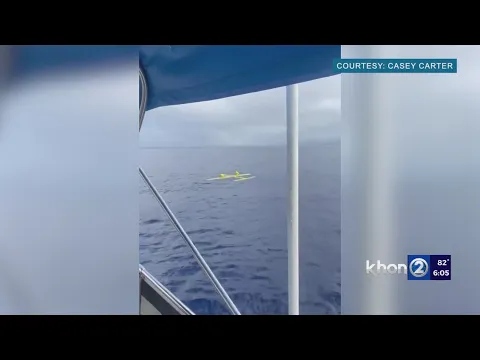
What started as a simple fishing trip on August 30 turned into an unexpected and fascinating discovery for two fishermen from Hawaii. Max Bishop and Casey Carter, navigating about three kilometers off the coast of Waikiki, spotted something unusual floating in the ocean.
-
China Surpasses U.S. and Russia Combined in Submarine Production

-
Xiaomi Unveils Smart Glasses in Brazil with 12MP Camera, 4K Video, and AI Features, Challenging Ray-Ban Meta

-
Volkswagen Unveils Bold Strategy to Compete with Chinese Automakers in Brazil, Featuring 5,000 Parts, 76% Localization, and a Surprising Turnaround
-
Three Teens Win Global Prize for Low-Cost AI Microscope Diagnosing Malaria Species in Seconds for Remote Villages


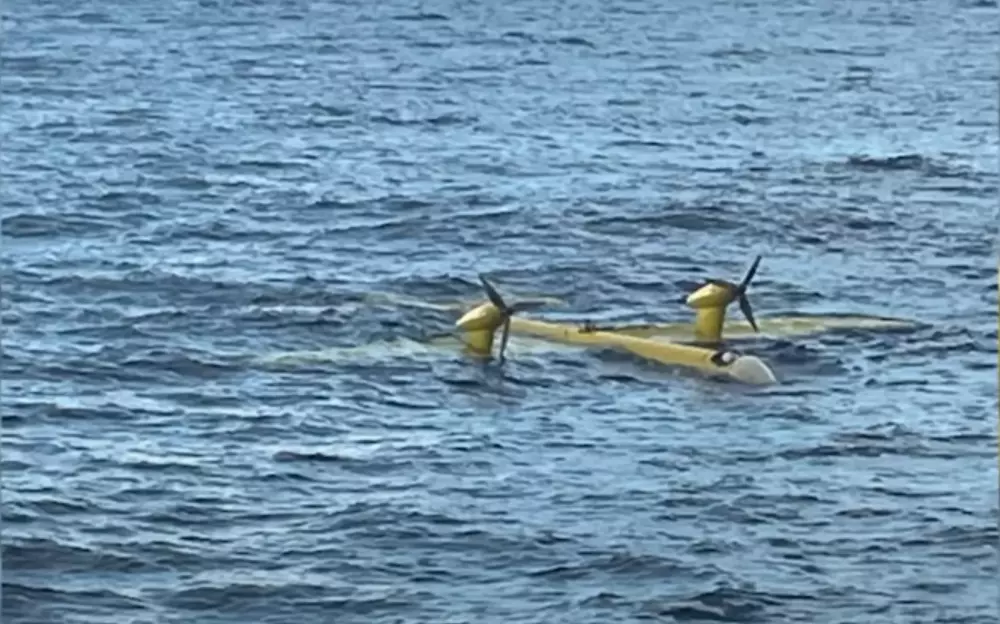
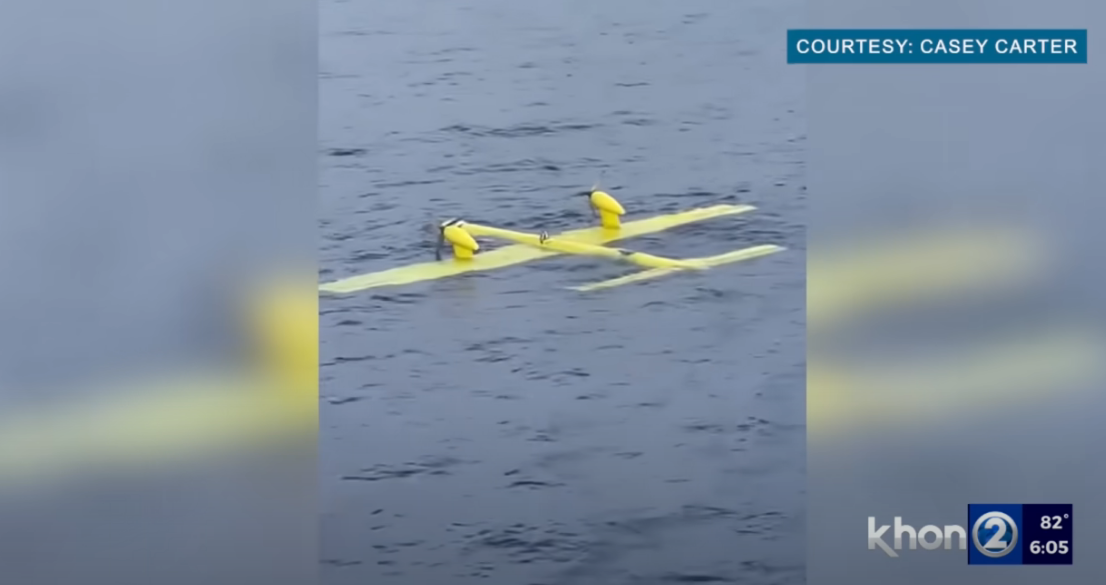
The object, with a bright yellow color and sleek appearance, was initially mistaken for a capsized boat. However, as they got closer, the fishermen realized they were in front of something much more intriguing: an unmanned underwater vehicle (UUV) classified, later identified as part of the secret program “Manta Ray” of the Defense Advanced Research Projects Agency (DARPA).
The Discovery and Confirmation
After notifying local authorities, the find was confirmed by the United States Coast Guard. According to an official statement, the drone belongs to PacMar Technologies, a company based in Honolulu, and was part of a research and development program by DARPA.
The company clarified that the vehicle was a “government research drone” and emphasized that it did not carry any armaments on board. Despite this, PacMar did not disclose additional details about the drone’s mission or the specific objectives it sought to achieve in the waters near Waikiki.
The fishermen, who recorded the discovery on video, captured images of an astonishingly advanced design. With long, thin wings, horizontal stabilizers, and tilted propellers, the drone exhibited characteristics more associated with aerial vehicles than traditional submarines.
This configuration raised speculations about transmedia capabilities, meaning the ability to operate efficiently both in the air and in the water, an advancement that promises to redefine the use of vehicles in multi-domain environments.
The Manta Ray Program
The vehicle found is part of the “Manta Ray” program, initiated by DARPA to develop long-duration autonomous UUVs. The main objective of the program is to create underwater vehicles capable of operating in dynamic maritime environments for extended periods without the need for maintenance or refueling.
Since its official announcement in 2021, the program has attracted significant attention, being conducted by two main contractors: Northrop Grumman and PacMar Technologies.
According to public information released by DARPA, the program’s prototypes were designed to perform a wide range of functions, such as intelligence, surveillance, reconnaissance, mine countermeasures, and even anti-submarine operations.
Additionally, one of the stated goals of the program is exploring renewable energy collection technologies, utilizing ocean currents as a power source to extend the vehicles’ autonomy.
In February and March 2024, Northrop Grumman conducted successful tests with its “Manta Ray” prototype off the southern coast of California. These tests confirmed the feasibility of the vehicle’s modular design, which can be transported and assembled quickly in the field before deployment.
Meanwhile, PacMar Technologies continued to conduct experiments with its energy collection system, which includes the prototype found by the fishermen from Waikiki.

Innovative Design and Capabilities
Although DARPA officially describes the “Manta Ray” program as focused on underwater operations, the design of the spotted drone suggests its capabilities may be much broader. The wings and stabilizers of the vehicle indicate a potential for aerial operations, raising the hypothesis that the program is developing transmedia technologies.
This innovative approach would combine underwater navigation skills with flight capabilities, providing unprecedented versatility.
The technical details of the PacMar Technologies prototype, captured on video, highlight notable differences compared to previously presented prototypes. In contrast to the conventional submarine design, the drone found in Waikiki features a structure that appears optimized for maneuverability and efficiency in multiple environments.
This technological evolution raises questions about the true extent of advancements achieved by the program.
Interestingly, Northrop Grumman’s “Manta Ray” prototype shares visual similarities with the X-47B, an unmanned combat air vehicle demonstrator.
While the drone’s design from Northrop is less pronounced, the similarities suggest that both companies are exploring concepts related to transmedia operation.
Implications and Future Possibilities
The development of transmedia vehicles, capable of operating both in the air and in the water, represents a significant milestone in defense technology. Such vehicles have the potential to revolutionize military missions, offering greater flexibility in surveillance, rapid response, and data collection in hard-to-reach environments.
Furthermore, the advanced capabilities of these drones may also benefit scientific and environmental research, such as monitoring marine ecosystems and ocean exploration.
If DARPA has indeed achieved—or is close to achieving—a substantial breakthrough in transmedia technology, it will open new operational possibilities for unmanned vehicles. The ability to switch between aerial and aquatic environments would make these drones an indispensable tool for both defense and scientific exploration.
The Enigma in Waikiki
Despite the official explanations, the sighting of the drone in Waikiki raises more questions than answers. Why was such an advanced prototype floating so close to shore? What is the true scope of the “Manta Ray” program? And, more importantly, what other capabilities may these vehicles possess beyond those publicly stated?
As these questions remain unanswered, the incident highlights the rapid pace of innovation in defense technology. DARPA, known for developing revolutionary technologies like the internet and GPS, continues to push the boundaries of what is possible in autonomous and multi-mission vehicles.
Reactions of the Fishermen with the Find in the Ocean
For Max Bishop and Casey Carter, the encounter with the military drone was both intriguing and surreal. In an interview with KHON, Bishop joked about the possibility of selling the drone: “We thought it was something from NOAA or a civil research. When we found out it was from the Department of Defense, we thought: ‘Who knows? Maybe we can tow it and sell it on Craigslist.’”
The episode also sparked public interest, generating discussions about the role of defense technology and the interaction between secret programs and accidental discoveries.
The limited transparency surrounding the “Manta Ray” program only heightens curiosity about what else may be developed out of the public eye.
The fishermen’s discovery in Hawaii symbolizes not only a fortuitous encounter but also a glimpse into the future of defense technology and exploration.
As the “Manta Ray” program quietly advances, its implications could be profound, redefining the concept of multi-mission vehicles and broadening the horizons of technological innovation.
The mystery surrounding the Waikiki drone reflects the challenges and opportunities of an era marked by ever-accelerating technological discoveries.
While DARPA continues to guard the details of its projects, the potential impact of these innovations could be transformative, influencing both global security and exploration of the natural world. For the fishermen who stumbled upon a piece of the future, however, it all began with an ordinary day at sea.


