Portuguese
  Spanish


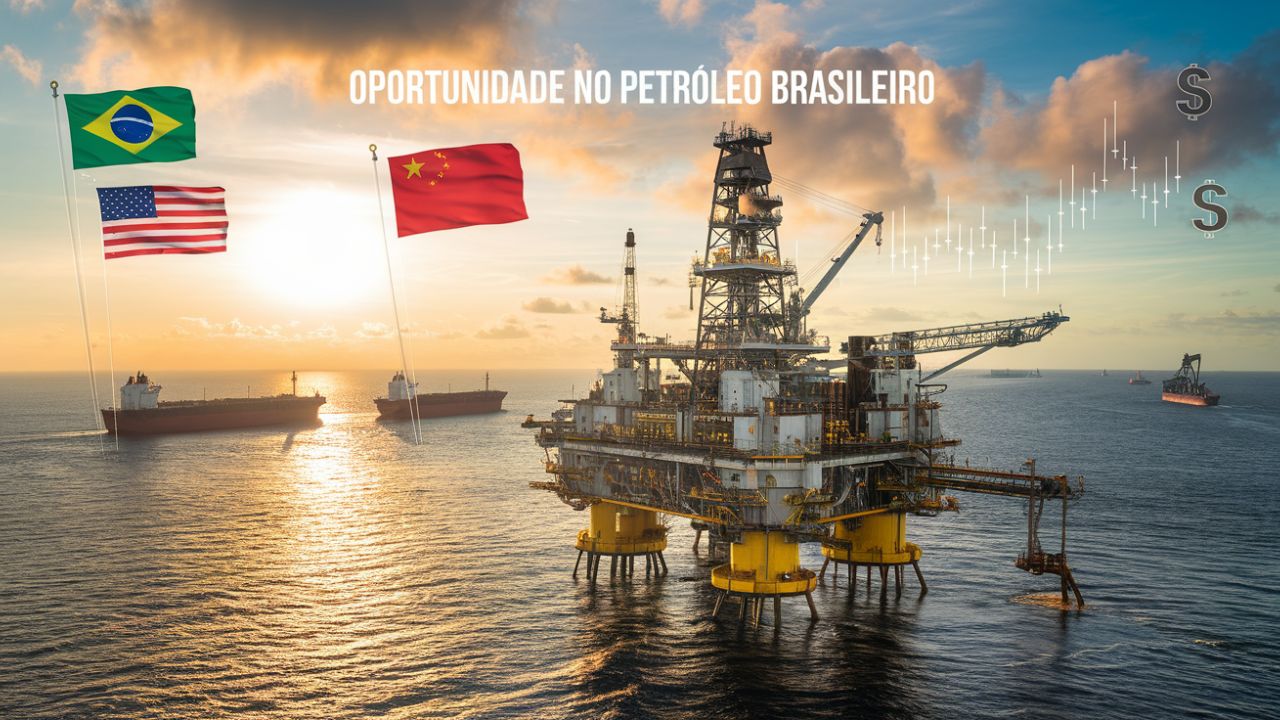


With the BRICS Summit in Brazil and the Trade War Between China and the USA, Brazilian Oil May Gain Space as a Global Strategic Supplier. The Country Already Exports 1.9 Million Barrels/Day and Has Superior Quality, Low Sulfur Content, and Lower CO2 Emissions. Will This Be the Chance to Dominate the Market and Strengthen the Economy?
The Brazilian oil industry is facing a crucial moment. With the BRICS summit approaching and the trade dispute between China and the United States heating up, Brazil’s exports may gain new momentum. According to the president of the Brazilian Institute of Oil and Gas (IBP), Roberto Ardenghy, this scenario opens space for the country to further consolidate itself as a strategic supplier in the global market.
But what does this mean in practice? Can this movement really benefit Brazil? Let’s break it down.
The Role of Brazil in Global Energy Security
While much of the major oil-producing regions are marked by conflict and political instability, Brazil emerges as a reliable alternative. After all, we have no war next door, we are far from geopolitical tensions, and we still have an open Atlantic Ocean to export our production without major risks.
-
Petrobras Sets Record with 2.66 Million Barrels Per Day in Brazil’s Pre-Salt Oil Production

-
Petrobras to Double Natural Gas Supply in Northeastern Brazil with New Investment
-
Petrobras Approves $1.2 Billion Refinery in Brazil to Produce Aviation Fuel and Diesel from Plants
-
Petrobras Secures $2.2 Billion Contract to Build and Operate Four Support Vessels for Brazil’s Offshore Oil Fields


Today, Brazil exports about 1.9 million barrels of oil per day, with China and India as its main buyers. And, let’s be honest, these countries increasingly need secure suppliers, which puts Brazil in a privileged position.
With the BRICS summit scheduled for July in Rio de Janeiro, the expectation is that Brazil will further strengthen its trade relations with the other ten member countries. By the way, it is worth noting that BRICS now consists of 11 countries and together they produce 42 million barrels of oil per day, almost half of the world’s production.
China and India still rely heavily on coal, which, let’s face it, pollutes much more than oil. If these countries start to swap some coal for Brazilian oil, the impact on decarbonization could be enormous.
The Trade Dispute Between China and the USA and Its Impact on Brazilian Oil

The trade dispute between China and the USA has entered a new chapter recently: Beijing imposed a 10% tariff on oil imported from the United States. And then comes the question: if China is going to reduce its oil purchases from the USA, who will it buy from?
Well, someone will have to meet this demand, and Brazil has everything to fill this gap. Oil will not stop being consumed just because the two largest economies in the world are exchanging barbs.
The United States exports large volumes of oil to China, but now, with the tariff barriers, this dynamic may change. If Brazil knows how to take advantage of the opportunity, it can significantly expand its share in this market.
To summarize? Brazil has oil, China needs to buy, and the USA is having difficulties selling. The math adds up.
Brazilian Oil and the Global Energy Transition
If there is still room for oil in the energy transition, and it seems there is, Brazilian oil needs to be in the game. The reason? Simple: it is of high quality, has low sulfur content, and emits less CO2 compared to other types of oil.
The IBP emphasizes that, since the world will not rid itself of oil anytime soon, it would be more logical to prioritize the kind that causes less environmental impact. And that’s where Brazil has an advantage.
The COP30, which will take place in 2025 in Belém, will be another chance to advocate for the importance of Brazilian oil in the global energy matrix. The IBP, along with specialized consultancies, wants to show that the sector can indeed be sustainable and remain relevant in the global economy.
The issue here is not simply to stop exploring oil, but to understand how to do it strategically, efficiently, and with less pollution.
Exploration of New Oil Frontiers: A Strategic Necessity
If Brazil wants to maintain its prominent position in the sector, it needs to find new reserves. The pre-salt still has momentum, but exploration in regions like the Equatorial Margin and the Pelotas Basin is already on the radar to ensure the future of production.
Without new discoveries, production may enter a decline in the coming decades, which would weaken the country on the global stage. And no one wants to lose relevance in this game, right?
The oil industry is reinventing itself, and this is not just talk. There are already technologies to reduce the carbon footprint of the sector, such as carbon capture and storage (CCUS), hydrogen, and electrification of platforms.
According to Eixos, Brazil has a clean energy matrix and can use this to its advantage by combining efficient oil extraction with more sustainable practices.
The Future of Energy: Integration Between Oil and Renewables
The oil and gas sector can and should walk hand in hand with renewable energies. The idea of installing offshore wind turbines in areas where oil platforms already exist could be a smart and economical solution.
Old platforms that would be retired can be repurposed to generate wind energy, reducing costs and making Brazil even more competitive in the energy sector.
And there’s more: in countries like Norway, it is already common to electrify active platforms with offshore wind energy, drastically reducing emissions in the oil and gas sector.