






 Portuguese
  Spanish


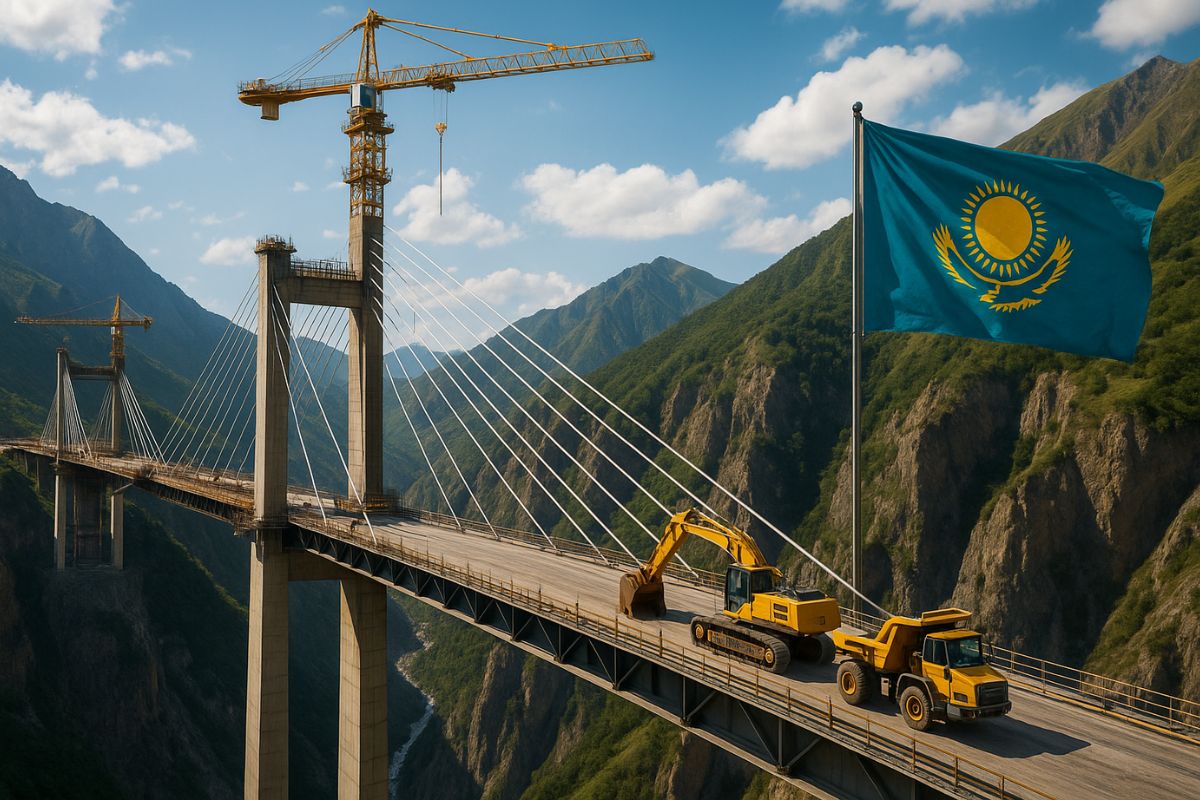


New Bridge Over the Pikhtovka Gorge Integrates Kazakhstan, Improves Transportation, Strengthens the Local Economy, and Connects the Entire Altai Region.
The construction of the bridge in the Pikhtovka gorge, in eastern Kazakhstan, is progressing towards completion, with delivery expected in 2026. The bridge, which receives investment of approximately 13.2 billion tenge, is considered the highest mountain bridge in the country and was designed to resolve a historical bottleneck in mobility in the Altai region, where steep terrain and unstable soil have hindered vehicle traffic year-round. The central word of this project is bridge, and it appears as the axis of road integration to connect strategic areas of the country.
In addition to being an impressive bridge in size, over 40 meters high and 175 meters long, the project was designed to increase safety. By replacing a winding and dangerous section with a direct crossing, the work will reduce the risk of accidents, facilitate the transport of goods, and allow for faster travel, which creates an immediate effect on the regional economy.
Bridge Will Change Logistics in the Altai Region
The new bridge will shorten the travel distance by about four kilometers, and this makes a difference in logistics. Less distance means less time on the road, lower transportation costs, and more competitiveness for local companies.
-
Brazil’s Famous Blue Lagoon Cave Set to Reopen to Tourists in 2026 After 23-Year Closure

-
Tourist Train in São Paulo’s Serra do Mar Takes Passengers to a 19th-Century English Railway Village, Showcasing the Historic Santos-Jundiaí Railway’s Role in Coffee Transport

-
After a 4-year journey across the Americas, couple settles in southern Brazil, transforms rusted shipping container into a home, facing real risks and close calls along the way.
-
Rio de Janeiro Resident Transforms Home with Green Roof, Cutting Indoor Temperature by Up to 15°C and Offering a Simple Solution to Extreme Heat



The current section is marked by sharp curves that, during adverse weather, make passage slower and riskier. With the bridge, this obstacle will cease to exist.
Another relevant point is integration. The bridge serves not only the local residents but also strengthens the flow between different areas of Kazakhstan and expands the possibilities for the circulation of goods year-round.
With a more stable route, the transport of perishable and high-value products becomes more predictable, which tends to attract investments and new logistics operations to the region.
Engineering Challenges Required Solutions
The bridge will only reach its final phase in 2026 because the terrain has not made it easy. During construction, irregular soils were found, which forced the teams to increase the foundation depth from about four to over ten meters.
This structural reinforcement was essential to ensure stability in a location with climatic variations and delicate geological characteristics.
To deal with the fragile soil, construction methods had to be adapted, and the concrete in the foundations was reinforced.
There was also constant monitoring of the bedrock to avoid structural risks.
This explains why a project that began in 2017 extends for almost a decade: it is not just about erecting a bridge but securely anchoring it in a mountainous environment.
Ongoing Oversight Ensures Safety
The bridge construction is monitored by the National Center for Road Asset Quality, which conducts frequent inspections at all stages.
Each part of the process undergoes concrete testing, material analysis, and assessment of the stability of the structure. This type of oversight ensures the durability of the bridge and the safety of users after its inauguration.
With this technical vigilance, the project maintains high standards and avoids improvisation, which is essential in large-scale works over challenging terrains.
The bridge is therefore born with a defined quality protocol, which is a differentiator for an infrastructure that intends to operate year-round.
Nearly a Decade of Work Will Boost the Economy
When completed in 2026, the bridge over the Pikhtovka gorge will deliver more than just a crossing.
It will enable continuous circulation, reduce displacement costs, and create a more favorable environment for commerce and tourism.
With the improved route, local companies can expand operations, the government enhances access to services, and the region becomes more attractive to new investments.
Another expected effect is the creation of direct and indirect jobs, both during the final phase of construction and in the operational phase when the flow of vehicles and goods increases.
In terms of integration, the bridge also strengthens Kazakhstan’s role in international infrastructure corridors, as it improves connectivity with neighboring countries and broader transportation initiatives.
In the end, it is about a bridge that solves an old problem, leverages an already fully allocated investment, and delivers a shorter, safer, and more modern route for the entire region.
What do you think will be the most immediate impact of this bridge when it opens in 2026: safety on the roads or economic growth?





Parabéns ao Cazaquistão! Cá no Brasil os políticos embolsam a metade do dinheiro das obras e serviços em pouco tempo apresenta defeito. Triste é vergonhoso para nós Brasileiros.
Oss dois vão ser . beneficiar juntos!
A