Portuguese
  Spanish


A student from Rio Grande do Norte created a low-cost system to store rainwater using recyclable materials and took the solution to an international science fair.
A student from Mossoró, in Rio Grande do Norte, developed an inexpensive system to capture and store rainwater in rural communities of the semi-arid region of Potiguar.
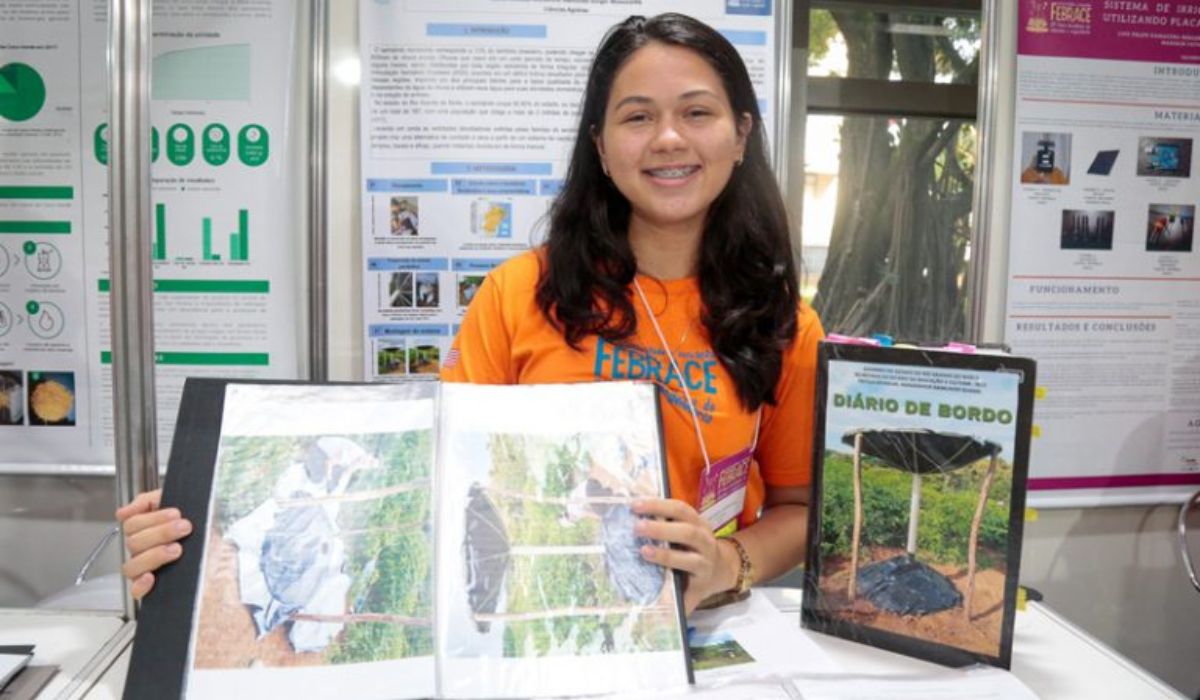
The project was created by Vitória Sabrina Leite, a student at the State School Monsenhor Raimundo Gurgel, and gained prominence at the 21st edition of the Brazilian Science and Engineering Fair, FEBRACE.
The initiative was selected for the International Science and Engineering Fair, ISEF, held in the United States from May 14 to 19, 2023, according to information from FEBRACE and Ufersa.
-
Italy Considers Next-Gen Nuclear Reactors for Warships, Aiming to Boost Naval Autonomy and Join Elite Maritime Powers

-
Extreme Heat in Antarctica Sets Record 15.4°C at Esperanza Base in June, Raising Concerns Among Scientists with Temperatures 20°C Above Normal, Rain Instead of Snow, and Unusual Melting Transforming the White Continent’s Landscape
-
UFG’s Innovative Use of Air Conditioner Drip Saves 400 Liters of Water Daily in Brazilian Public Building
-
China Builds Underwater Wall After Discovering Technology That Could Shift Military Balance in the Pacific, Study Reveals Why the Asian Power Reacted Now


Low-cost system to capture rainwater
The project was born from a concrete difficulty.
In rural communities like the Pedra Branca settlement in Mossoró, families face supply problems because they do not always have cisterns or regular access to piped water.
The solution proposed by Vitória starts with a simple question: how to store rainwater spending little and using materials available in the community itself?
The answer came in the form of a homemade collection system.
The student proposed digging reservoirs with a capacity of about 500 liters, lining the structure with tetrapak sheets and tarpaulin, and using a satellite dish partially covered by tarpaulin to direct the rainwater.
The proposal draws attention because it reuses materials that would often be discarded.
Milk and juice boxes, tarpaulins, and old satellite dishes become part of a mechanism aimed at coping with periods of little rain.
In tests conducted at the Pedra Branca settlement, the system managed to capture three to five liters of water per millimeter of rain, according to FEBRACE.
The same source reports that this performance can equate to about 25 liters of water in a rain considered weak.
Science made for a real need
The project’s differential lies in the direct relationship between school science and social problems.
Vitória did not start from an idea distant from the local reality.
She observed a difficulty experienced by communities in the semi-arid region and sought a simple, low-cost solution that could be replicated.
This type of initiative helps to show that scientific research does not need to start with expensive equipment.
Often, it arises from the observation of an everyday problem, the adaptation of common materials, and practical field testing.
In the case of the capture system, the logic is to better utilize the water that falls during rains.
In semi-arid regions, the challenge is not just to wait for rain, but to be able to store some of this water safely for later use.
Therefore, social technologies for capture and storage play an important role in coping with drought.
The project by the student from Rio Grande do Norte fits into this context by proposing a complementary alternative, not a complete replacement of public supply policies.
The solution can help families in specific situations, but it does not eliminate the need for permanent infrastructure, adequate cisterns, and regular water supply.
How the structure created by Vitória works
The strategy devised by the student combines capture and storage.
The satellite dish functions as an inclined surface to receive rainwater and direct it to the reservoir.
The tarp helps to expand the collection area and directs the water to the storage point.
The tetrapak sheets and tarp used in the reservoir act as protective layers.
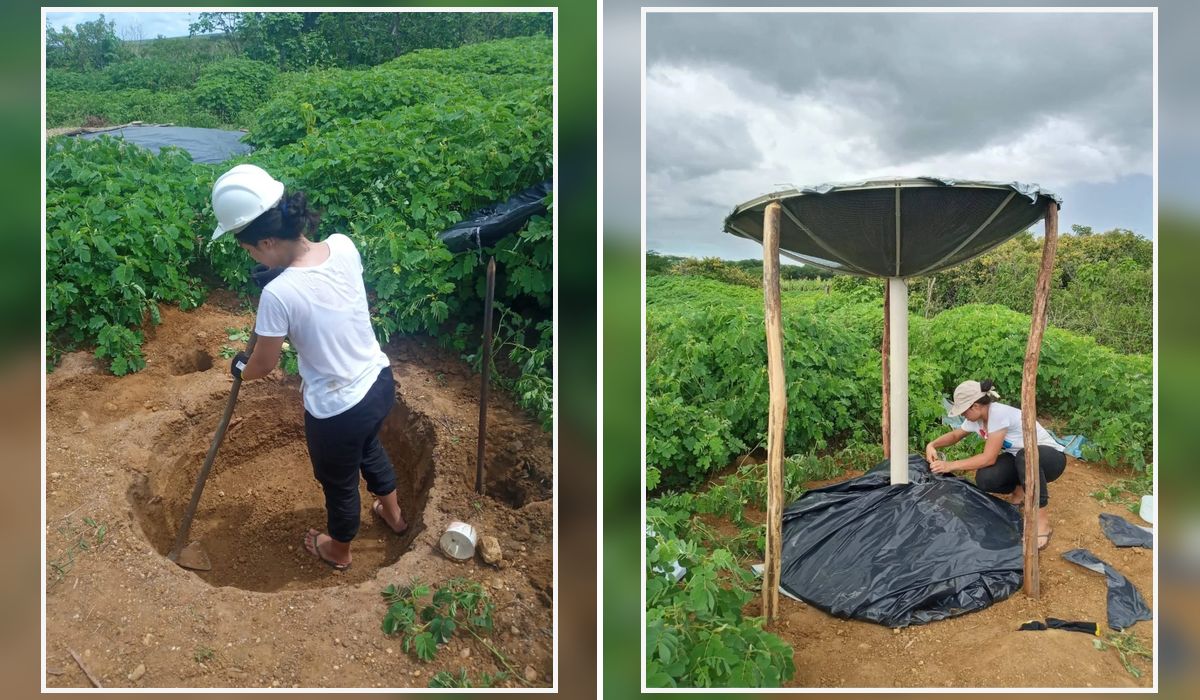
They help reduce losses and prevent the water from coming into direct contact with the soil.
The capacity of 500 liters shows that the proposal was designed to accumulate a significant amount during rainy periods, although the volume collected depends on the intensity and duration of the rain.
This dependency is important.
The system does not produce water and does not solve droughts on its own.
It improves the utilization of available rain, which can make a difference in places where every stored liter matters.
The simplicity of the materials also facilitates understanding of the project.
An antenna that is no longer used for television, long-life boxes, and tarpaulin can gain a new function when organized in a planned structure.
Project reached ISEF in the United States
The selection for ISEF placed the Mossoró proposal on an international stage.
FEBRACE reported that the project was chosen in the 21st edition of the Brazilian fair to participate in the exhibition in the United States.
Ufersa recorded that Vitória was in her third year of high school and developed the proposal under the guidance of Professor Serginaldo Oliveira.
The university also reported that the student participated in the ISEF held from May 14 to 19, 2023.
This detail is important to avoid treating the case as if it happened this year.
The international participation has already occurred, but the initiative remains relevant by showing how public school students can create solutions applied to real problems.
Ufersa itself recorded a statement from Vitória about the impact of the experience.
“I did not expect to get this opportunity. There [USA] it was far beyond my expectations. I had no idea of the size of the event. I only understood when I was there, with people speaking in various languages with projects from all over. It was a unique experience,” said the student, according to the university.
The statement helps to gauge the reach of the experience for a young researcher from the interior of Rio Grande do Norte.
At the same time, it reinforces how science fairs can bring Brazilian students closer to global debates on technology, sustainability, and social development.
Why the idea remains current
Although the project was presented in 2023, the theme remains current.
The lack of water in rural areas of the semi-arid region is not a one-off problem.
It involves climate, infrastructure, income, storage, and access to technologies suitable for the local reality.
Therefore, low-cost solutions still spark interest.
They help broaden the debate on how communities can better cope with drought periods and make more efficient use of available rainfall.
Vitória’s proposal also connects to a larger movement of valuing science conducted in public schools.
When students develop projects based on the territory where they live, the research gains concrete utility.
In the case of Mossoró, the system was not designed for an abstract scenario.
It was tested in the Pedra Branca settlement, in a community that precisely represents the type of reality that motivated the creation of the solution.
This connection makes the project more understandable to the general public.
The technology does not appear as something distant, but as a possible response to a difficulty known by many families.
Recyclable materials and social technology
The use of recyclable materials is a central part of the proposal.
Tetrapak, for example, combines layers of paper, plastic, and aluminum, which helps explain its resistance and its potential for reuse in simple solutions.
In the project, this material appears as part of the reservoir’s protective structure.
The satellite dish also has a symbolic role.
With changes in media consumption habits and the advancement of new transmission technologies, many old antennas have lost their function in some homes.
In the system created by Vitória, this object gains another use.
It ceases to be just an abandoned piece of equipment and starts to function as a water collection component.
This reuse logic reduces costs and can facilitate the replication of the idea in resource-poor communities.
Even so, any system intended for water storage needs to consider cleanliness, protection against contamination, and proper use.
These precautions are essential to avoid health risks.