






 Portuguese
  Spanish


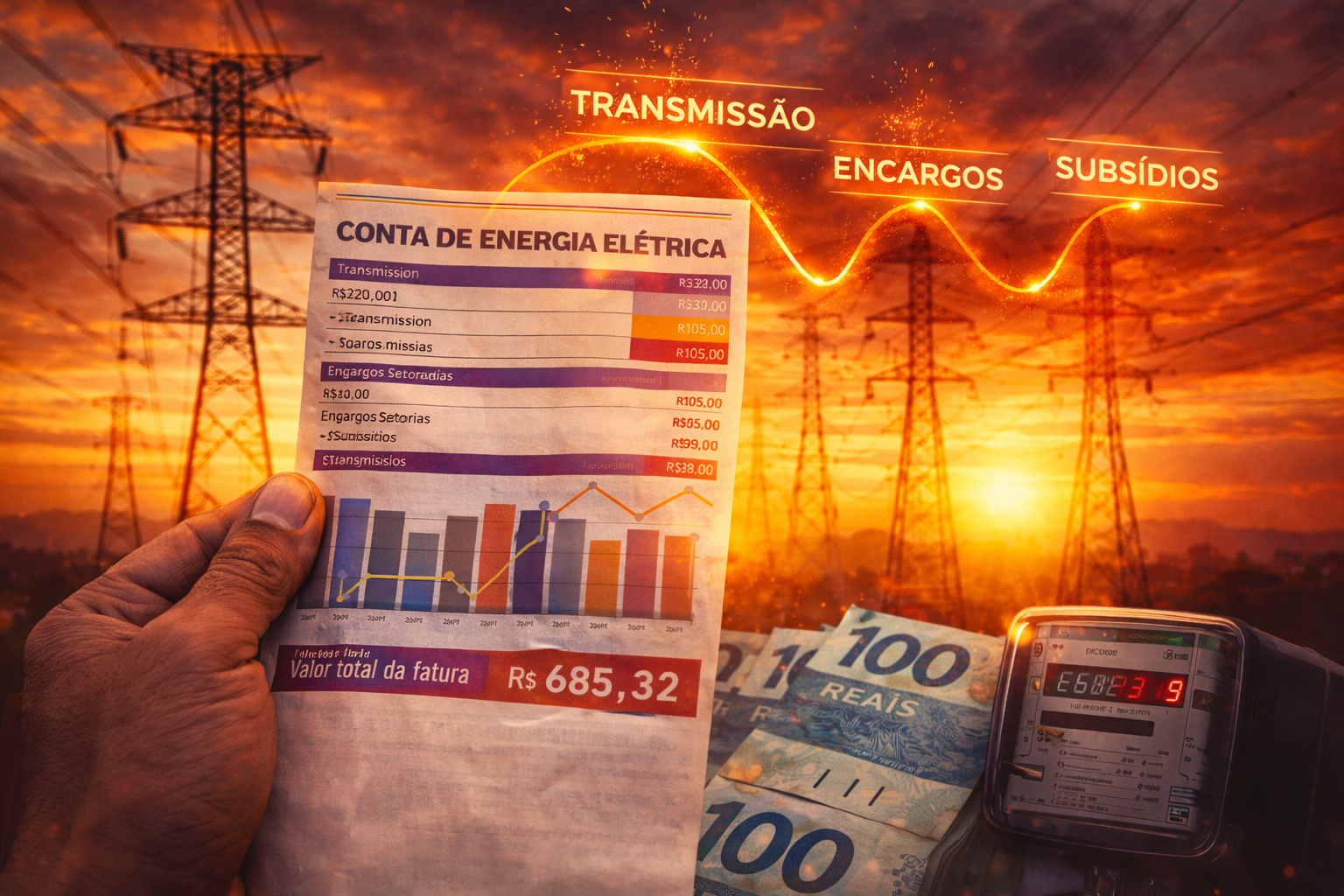

Expensive Transmission, Cross Subsidies, and Opaque Charges Explain Why the Consumer Does Not See the Price Fall
Brazil is breaking successive records in renewable energy generation. Hydropower, wind, and solar sources account for over 80% of the country’s electricity — a number that many wealthy countries still dream of achieving.
Even so, the electricity bill for Brazilians remains heavy, rising year after year and putting pressure on family budgets.
The question is inevitable:
if energy is clean, abundant, and “cheap” to produce, why doesn’t the bill go down?
-
World’s Largest Engie Solar Plant in Brazil Highlights Billion-Dollar Energy Waste Issue: Company Considers Batteries and Bitcoin Mining to Avoid Wasting Production

-
Air Products Cancels $2.9 Billion Clean Hydrogen Megaproject in Louisiana, Shuts Down Arizona Unit, Highlighting High Costs of U.S. Energy Transition
-
Over 60 Tractors Take to the Streets in Lopera as Solar Parks Compete with Olive Groves, Affecting 13,000 to 100,000 Trees According to Conflicting Reports

-
Green Hydrogen Projects in Northeastern Brazil Stalled for 18 Months Awaiting Government Decree, Delaying Billions in Investments


The answer is far from the power plants. It hides in invisible costs, poorly understood charges, and a system that transfers expenses among consumers.
The Problem Is Not Just in Generation — But in the Path of Energy
Producing energy is just one part of the bill.
Delivering that energy to homes, businesses, and industries is expensive — and that cost is continually rising.
Transmission: Energy Travels Thousands of Kilometers
A large part of Brazil’s renewable energy is generated far from major consumer centers:
- hydropower plants in the North region;
- wind farms in the Northeast;
- solar plants in remote areas.
To reach the Southeast and South, this energy travels through gigantic transmission lines, which require:
- billion-dollar projects;
- constant maintenance;
- towers, cables, and substations.
These costs do not appear as “transmission” on the bill, but are embedded in the final price of the kWh.

Cross Subsidies: When Some Pay the Bill for Others
Another little-known factor is the so-called cross subsidy.
It works like this:
- certain sectors, regions, or groups receive discounts or benefits;
- the cost of these benefits does not disappear;
- it is redistributed to other consumers.
In practice, part of your electricity bill may be covering:
- incentives for specific sources;
- discounts for large consumers;
- public policies embedded in the tariff.
The result is a system where those who do not receive benefits end up paying more.
Sector Charges: The Most Confusing Part of the Bill
If there is something that almost no one understands in the electricity bill, it is the sector charges.
They include funds and fees created over decades to:
- fund energy policies;
- finance specific programs;
- cover risks in the electricity system.
The problem is that these charges:
- accumulate;
- are rarely eliminated;
- grow silently.
In many cases, the charges weigh more than the energy consumed itself.

Clean Energy Does Not Mean Cheap Energy at the End
Even with records in renewable generation, the final price of energy depends on:
- expensive infrastructure;
- complex regulatory model;
- political and economic decisions.
In other words:
Brazil has clean and abundant energy, but a costly system to deliver it to the end consumer.
Who Feels It Most in Their Pockets
The impact is greater for:
- low-income families, who spend more of their income on energy;
- small businesses;
- residential consumers with no access to benefits or self-generation.
Meanwhile, large consumers can negotiate contracts and reduce costs — amplifying the feeling of inequality in the bill.
Why Is the Electricity Bill Still a Structural Problem
The high electricity bill in Brazil is not the result of a single villain, but of a sum of factors:
- long and expensive transmission;
- poorly transparent cross subsidization;
- accumulated charges;
- a model that dilutes costs and makes it difficult for consumers to understand.
As long as these points are not addressed clearly, energy will remain clean at the source — and expensive on the bill.








