Portuguese
  Spanish


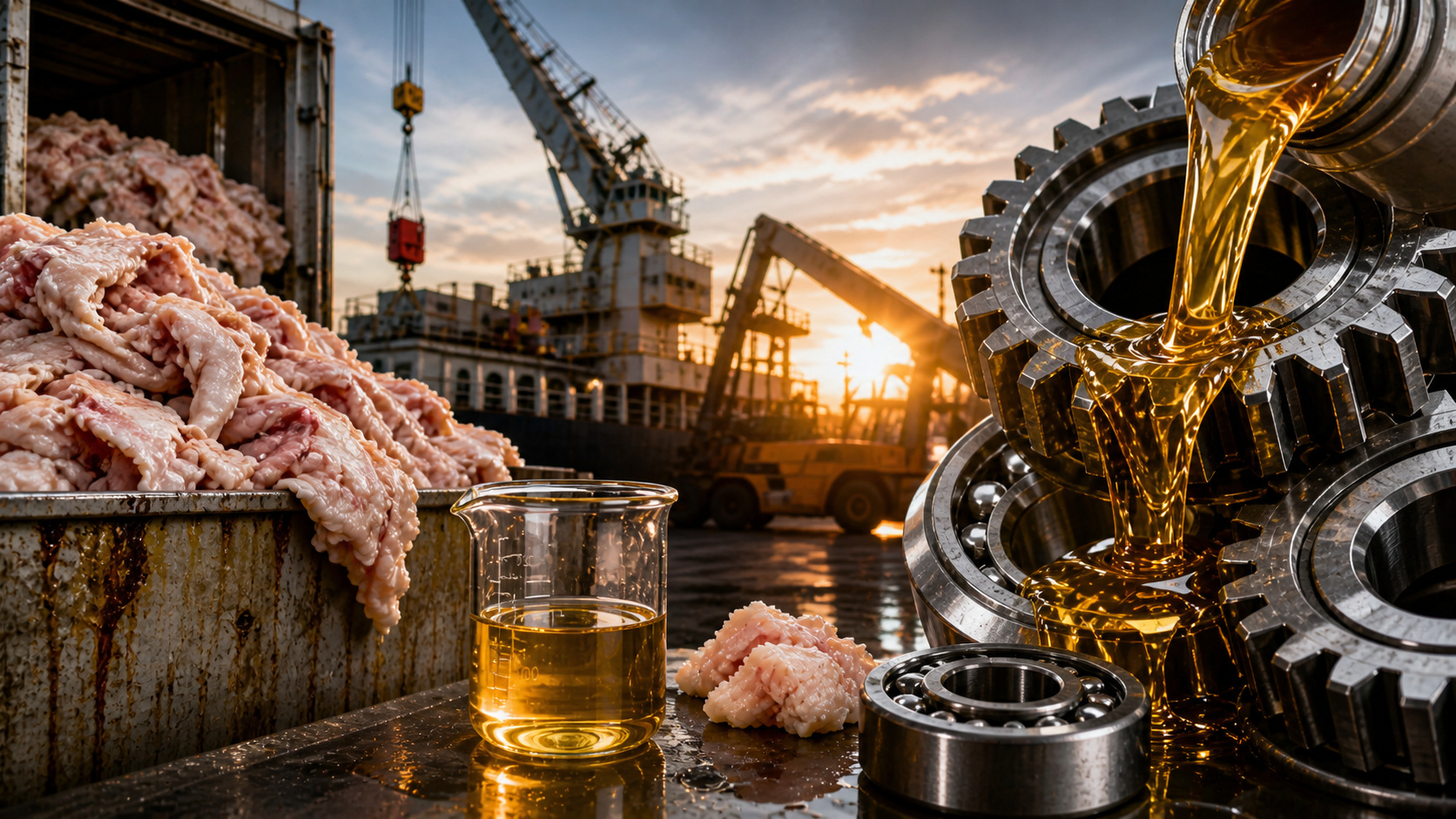

Brazilian study shows that biolubricant made from residual fatty acids, including animal fat from slaughterhouses, reduced friction by 54% compared to mineral oil and can transform agro-industrial waste into a higher-value industrial product.
According to the Journal of the Brazilian Society of Mechanical Sciences and Engineering, a study published in January 2025 evaluated the feasibility of synthesizing biolubricants from residual fatty acids, still underutilized industrial byproducts that include animal fat processed in slaughterhouse operations. The synthesized product, called BIOLUB by the researchers, showed a friction coefficient approximately 54% lower than commercial mineral oil in tribological tests, an area that measures friction, wear, and lubrication between contacting surfaces.
In the thermal stability analysis, BIOLUB maintained a 50% mass loss temperature of 341.68°C in an inert atmosphere and 285.33°C in an oxidative atmosphere, ranges compatible with real industrial applications. According to the authors, the results indicate that the synthesized product has the potential to be used as a base oil for biolubricants, adding value to an industrial residue and offering a viable path to transform it into a higher value-added product.
The global market for industrial and automotive lubricants moves between US$60 billion and US$150 billion per year, depending on the calculation methodology, and is still almost entirely dependent on petroleum-derived mineral oils. The animal fat left over from the slaughter line of the world’s largest animal protein complex alone does not solve this market, but it can become one of the cheapest, most abundant, and most neglected raw materials in the Brazilian bioeconomy.
-
Ancient Mines in Spain Reveal Tools and Metals That May Explain Bronze Age Trade with Scandinavia

-
Facing a housing shortage, Hong Kong uses prefabricated concrete modules to construct a 12-story public building with the help of massive cranes and trucks.
-
Brazilian City Innovates Waste Collection with Underground Vacuum System
-
Amsterdam Repurposes Retired Boats and Plants to Restore Contaminated Industrial Land Instead of Removing All Polluted Soil


Why animal fat can work as an industrial biolubricant
The link between animal fat and lubrication is not new. Before petroleum, wagon axles were lubricated with beef tallow, European mill gears used whale blubber, and wooden ships applied lard to masts to reduce rope friction. The industrialization of petroleum replaced these materials with cheaper, more uniform, and scalable mineral oils, not because the physics of animal lubrication was inferior.
The reason why animal fats and vegetable oils work as lubricants lies in the molecular structure of triglycerides, formed by glycerol linked to three fatty acid chains. These long carbon chains naturally adhere to metal surfaces, forming a protective layer that reduces direct metal-to-metal contact, a property known as lubricity.
This lubricity causes vegetable oils and animal fats to exhibit, under many conditions, lower friction coefficients than mineral oils. In the case of pork fat, the 2025 Brazilian study documents a composition dominated by palmitic acid, with approximately 43% by weight, and oleic acid, with about 35%, a combination chemically favorable for industrial lubrication.
The challenge for biolubricants is stability, not friction reduction capability
The historical problem with biolubricants is not lubricity, but stability. Vegetable oils and animal fats oxidize on contact with air, degrade more quickly than mineral oils under high temperatures, and can solidify at low temperatures. PTherefore, biolubricant research in recent decades seeks to chemically modify these raw materials without losing biodegradability and friction reduction capability.
The study published in the Journal of the Brazilian Society of Mechanical Sciences and Engineering did not use pure lard as a lubricant. The researchers used residual fatty acids from an industrial process, which include components of animal origin, as a raw material to synthesize a chemically modified compound.

The process evaluated was esterification, a reaction that converts free fatty acids into esters, molecules with better oxidative stability and less tendency to solidify than the original triglycerides.
The logic is similar to that used in biodiesel, but the objective is different: while biodiesel seeks calorific value and flammability, the biolubricant seeks viscosity, lubricity, and thermal stability.
BIOLUB reduced friction by 54% and showed thermal stability in laboratory tests
The result was BIOLUB, a final product whose properties were measured in three main categories. In tribology, the strongest data point was the friction coefficient 54% lower than commercial mineral oil, a result that makes the material relevant for applications where friction and wear reduction is essential.
In thermal analysis, stability up to 341.68°C in an inert atmosphere indicates that the product can withstand industrial applications with significant heat without immediate degradation. In an oxidative atmosphere, the 50% mass loss temperature was 285.33°C, still within a range compatible with industrial uses.


In physicochemical characterization, the measured viscosity properties were comparable to the requirements for medium-grade industrial lubricants. The study does not prove immediate commercial application, but demonstrates a promising technical route to transform slaughterhouse waste into higher-value base oil.
Brazil has an advantage in biolubricants due to the scale of its animal protein industry
To understand why this research matters to Brazil, one must consider the scale of the national animal protein industry. The country is the world’s largest exporter of beef and the second largest of pork, with an agro-industrial complex that processes hundreds of millions of animals per year.
Each process of swine slaughter and industrialization generates fat by-products, such as bacon, cover fat, and adipose tissue residues. Today, part of this material goes into animal feed, cosmetics, soaps, or other lower-value uses, while another part can represent a management cost for slaughterhouses.
The value of these by-products in the feed and waste market is much lower than the potential value of a processed industrial biolubricant. The chain explored by Brazilian researchers is that of the circular bioeconomy: transforming cheap waste into a higher-value product without requiring new raw material.
Biolubricants market grows, but animal fats are still underexplored
The global biolubricants market was valued between US$ 2.16 billion and US$ 3.1 billion in 2024, depending on the source, with growth projections to US$ 10 billion or more by 2033 and a compound annual growth rate close to 14%. This market is currently dominated by biolubricants derived from vegetable oils, such as soy, canola, sunflower, and palm.
Vegetable oils account for about 88% of the segment, while animal-derived biolubricants, including beef tallow, pork fat, and fish oil, account for approximately 12%. This difference is not necessarily due to technical inferiority, but to the greater organization and capitalization of the vegetable oil chain.
Animal fat still needs to overcome technical and industrial obstacles to compete at scale. Even so, Brazil has a clear structural advantage: abundant raw material, a consolidated slaughterhouse chain, and research centers capable of developing chemical routes for industrial use.