






 Portuguese
  Spanish


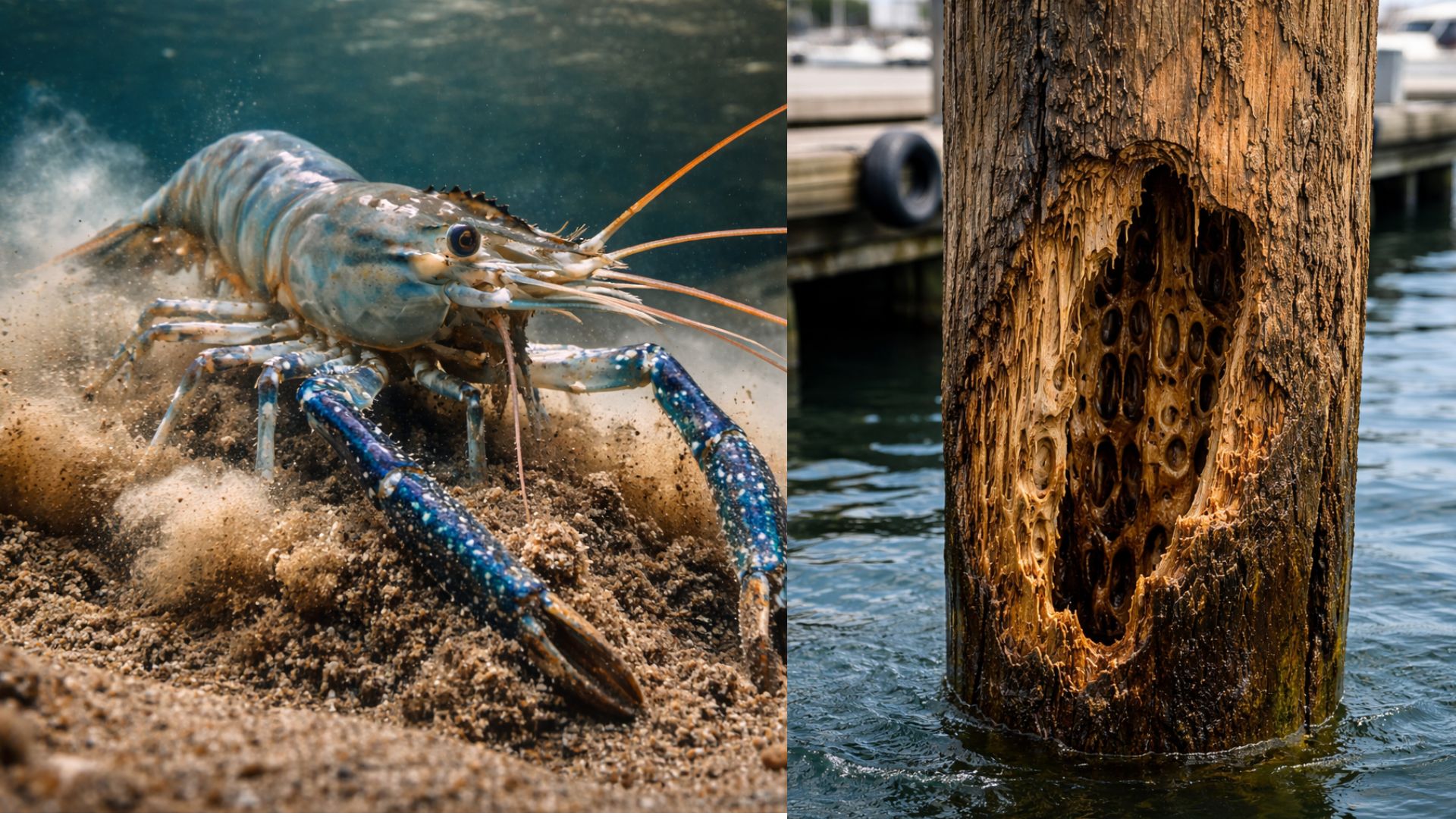


Little Visibility of Teredo Navalis Causes Wood Structures to Fail Without Warning, Increasing Maintenance Costs and Operational Risk in Ports and Marinas.
Under the waterline, where most inspections are difficult and decomposition becomes routine, there is a silent enemy of wooden structures that does not need storms to cause damage.
The Teredo navalis, internationally known as naval shipworm and often called shipworm, is a highly modified marine bivalve that burrows into submerged wood and creates internal galleries capable of compromising piles, platforms, old hulls, buoys, docks, and even parts of walls and coastal works that use wood as a structural element.
Although the nickname suggests a worm, it is a mollusk from the family teredinids, related to clams and oysters.
-
Project Daedalus: The 190-Meter Spacecraft Aiming to Reach Another Star with Nuclear Fusion and a 50-Year Fuel Supply

-
Giant 2.2 km Device Sweeps Plastic from Pacific Ocean, Cleaning an Area the Size of a Football Field Every 5 Seconds to Contain World’s Largest Ocean Garbage Patch
-
Brazil’s Public Health System Launches Study on Semaglutide’s Impact on Obesity
-
NASA’s Giant “Space Flower” to Unveil Earth-like Planets by Blocking Distant Stars’ Light




The difference is that, over the course of evolution, the animal has reduced its shell to two small pieces at the anterior end of its body and has begun to use them as tools, scraping and grinding wood fibers to move forward.
On the outside, a post or beam may seem intact for some time; on the inside, the material may be riddled with tunnels, losing the strength that supported the weight and pressure of the sea.
The structural risk is exacerbated by a basic detail of this organism’s behavior: it lives within the tunnel it digs.
In other words, the destructive action occurs “encapsulated” in the wood, with little immediate evidence on the surface.

When the problem appears, it usually emerges as fastening failure, pile breakage, displacement of pieces, and deformations that require preventive closure, replacement of components, and project reviews in areas with a constant presence of the burrower.
Global Distribution and Presence in Ports and Estuaries
The Teredo navalis is described by reference bases as one of the most widespread wood-boring species on the planet, associated with damage to vessels, port structures, and wooden coastal elements.
The same source notes that the species can withstand wide variations in temperature and salinity, which helps explain why it can establish itself in estuaries, coastal waters, and ports with very different environmental conditions, even in areas where other boring species would be less efficient.
The global distribution of the shipworm also carries an aspect that catches researchers’ attention: the native origin of Teredo navalis is not considered resolved.
In regions where navigation and the use of wood at sea are old, it is difficult to separate what is historical from what has been transported through trade routes over time.
Even so, records compiled by scientific institutions classify the animal as introduced in certain coasts and countries, including Brazil, in addition to noting its wide presence across different continents.
Historical Cases and Economic Impact on Maritime Infrastructure
Maritime history offers examples that help understand why the issue is not just biological, but also engineering and economic.
Documents and studies on the Dutch coast describe an episode in the 18th century in which wooden components used for coastal protection suffered extensive damage attributed to shipworms, triggering technical responses and debates about materials for defending against the sea.
In practical terms, the issue went beyond “pests on ships”: it involved the reliability of barriers and protections that cushioned the force of waves and protected low-lying areas from flooding.

In another frequently cited case in scientific compilations, the arrival of Teredo navalis in San Francisco Bay, United States, was associated with severe destruction of wooden structures along port and industrial areas.
The record gathers historical references and points to damage estimates that exceeded US$ 500 million in 1995 values, based on surveys and technical literature from the period.
This number is noted precisely because it translates, in currency, the effect of a small organism on infrastructure built to last decades.
Where Wood Is Still Vulnerable in the Marine Environment
The logic is simple but difficult to accept at first glance: submerged wood, no matter how good it seems, can become a continuous target for biological boring.
In ports and marinas, this involves foundation piles, fenders, walkways, and auxiliary structures.
In coastal areas, it may involve components of containment works, breakwaters, coatings, and old protective structures that still rely on wood, whether due to historical heritage or cost and local availability.

Protection Measures, Materials, and Inspection Routines
When the topic reaches the table of managers and engineers, the discussion usually migrates quickly from “what is” to “how to avoid.”
The literature gathered by scientific databases records that, historically, hulls and wooden components have been protected with solutions such as metal coatings and the application of materials like tar, in addition to the use of woods more resistant to attack.
In fixed infrastructure, the confrontation involves design and maintenance choices:
- replace wood with steel, concrete, or composites where feasible
- physically isolate the surface with barriers and protective covers
- adopt treated wood when permitted
- conduct underwater monitoring at critical points
The presence of Teredo navalis also forces a conversation about prevention and vigilance because maritime transport moves structures, hulls, and materials between regions.
As borers can settle in driftwood, piles, and submerged pieces, control does not only depend on recognizing the animal in a laboratory, but on creating inspection routines that detect galleries and weakening before failure becomes an accident or operational disruption.
In practice, what turns the shipworm into recurring news in different countries is not an isolated event, but rather the combination of three factors: wood is still used in marine environments; the organism acts continuously and discreetly; and the consequence often appears in the form of costly and urgent maintenance, often under tidal pressure, waves, and port operation.





Concordo plenamente com os comentários do colega Dr. Hélcio. Me parece que a irresponsabilidade do site não reside apenas na confusão de imagens, o que demonstra falta de critério na seleção e revisão dos textos, colocados por geradores de conteúdo, que não possuem afinidade com o tema, nem mesmo sabem diferenciar um crutáceo de um molusco. Lamentável.
Sou o Helcio.Marques pesquisador científico do Instituto de Pesca de SP e especialista em camarões de água doce. Há alguns dias esse mesmo site publicou uma notícia mentirosa a respeito do camarão Macrobrachium rosenbergii que foi refutada por mim e outros colegas. Agora, para ilustrar uma matéria sobre um molusco petfurador, o site coloca a foto do mesmo camarão. Não pode ser coincidência. Parece que o site está sendo cooptado por alguém ou por algum grupo interessado em demonizar essa espécie de camarão. Gostaria que alguém responsável pelo site entrasse em contato comigo para debatermos com argumentos sérios e responsaveis essa série de ataques coordenados contra a espécie em questão.
O que tem haver um camarão “crustáceo ” da foto com esse ****???