





Entry configuration of the Frontier preserves the off-road proposal created in 2005, combines superior comfort in the rear suspension and delivers a package aimed at work, leisure, and off-road use
The Nissan Frontier Attack remains the entry-level version of the brand’s mid-size pickup in Brazil, yet delivers a mechanical set capable of placing it among the most balanced configurations in the category. The version features a 2.3 biturbo diesel engine with 190 hp, 4×4 traction, a seven-speed automatic transmission, and a rear suspension that differentiates it from most competitors.
According to information from Nissan Brazil, the Attack version was born in September 2005 as a limited special series of the previous generation of the Frontier. At that time, the proposal was to offer a pickup with a sportier appearance, darkened details, and greater appeal for off-road use. Commercial success ensured its permanence until 2008. Later, in 2011, the configuration returned to the catalog definitively and became part of the manufacturer’s regular lineup.
The Frontier’s journey began aimed at the North American market. In various countries in Europe and Asia, the model was named Navara. In Brazil, the pickup gained relevance by becoming the first Nissan vehicle produced nationally, in São José dos Pinhais, Paraná, starting in 2002. Later, production intended for the Brazilian market went through Argentina before migrating to Mexican factories.
-
Melting Glaciers Uncover Ancient Tools, Preserved Mummies, and Strategic Minerals in the Arctic and European Mountains
-
Melting Glaciers Uncover Ancient Tools, Preserved Mummies, and Strategic Minerals in the Arctic and European Mountains
-
Melting Glaciers Uncover Ancient Tools, Preserved Mummies, and Strategic Minerals in the Arctic and European Mountains
-
Public School Student Develops Biodegradable Fiber from Sugarcane Waste, Secures Admission to 7 Brazilian Universities Including USP and UFRJ
Darkened visual reinforces the adventurous proposal of the Frontier Attack
In the current lineup, the Attack preserves visual characteristics that have accompanied it since its launch. The absence of chrome is one of the most striking elements. The matte black front grille, widened fenders, darkened bumpers, and graphics spread across the body reinforce the exclusive identity of the version.
Handles, running boards, roof rack, roll bar, and external moldings follow the same darkened visual pattern. The headlights feature a black mask and daytime running lights in a “C” shape. The 17-inch wheels use All Terrain 255/65 tires, enhancing the pickup’s capability on uneven surfaces.
In dimensions, the Frontier Attack measures 5.26 meters in length, 1.85 meters in width, 1.87 meters in height, and 3.15 meters in wheelbase. The cargo bed offers a capacity of 1,054 liters and supports up to 1,027 kilograms of load. The fuel tank holds 73 liters.
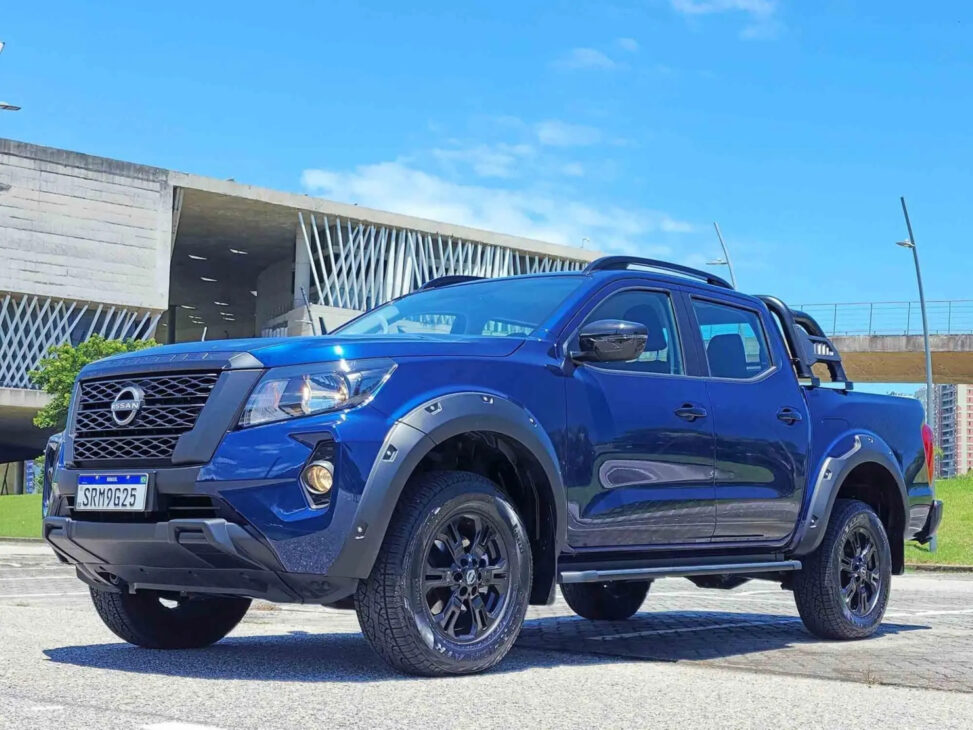
2.3 biturbo engine and 4×4 traction support performance at work and off-road
Under the hood is the well-known 2.3 biturbo diesel engine, capable of delivering 190 horsepower and 45.9 kgfm of torque. The set works in partnership with the seven-speed automatic transmission and the all-wheel-drive system.
According to data released by Nissan, the Frontier Attack accelerates from 0 to 100 km/h in 11.3 seconds and reaches a top speed of 180 km/h. The torque appears at low revs, a characteristic that favors both cargo transport and driving on more demanding terrains.
The driving modes allow adapting the pickup’s behavior to different situations. The driver can select the Standard, Sport, Off-Road, and Tow programs, which complement the traction options 4×2, 4×4 High, and 4×4 Low.
According to Inmetro data, the Frontier’s consumption is 9.3 km/l in the city and 11 km/l on the highway. With a full tank, the range can reach close to 800 kilometers.
The equipment list includes traction and stability controls, differential lock, ABS brakes with EBD, hill start assist, hill descent control, rearview camera, and electronic brake control.
Multilink suspension makes comfort a differential of the mid-size pickup
One of the biggest highlights of the Frontier is the rear multilink suspension with independent coil springs. While many rivals use a rigid axle with leaf springs, the solution adopted by Nissan provides a more comfortable behavior.
The result is especially noticeable when the bed is empty. Under these conditions, the pickup better absorbs irregularities and transmits less impact to the occupants. The feeling at the wheel is similar to that found in many SUVs.
The double cabin accommodates up to five occupants. The seats use Zero Gravity technology, developed from studies inspired by NASA. The goal is to reduce muscle fatigue and increase comfort on longer journeys.
The interior space is also among the strong points of the version. Rear seat passengers have dedicated air conditioning vents, a USB port, and ample space for legs and shoulders.
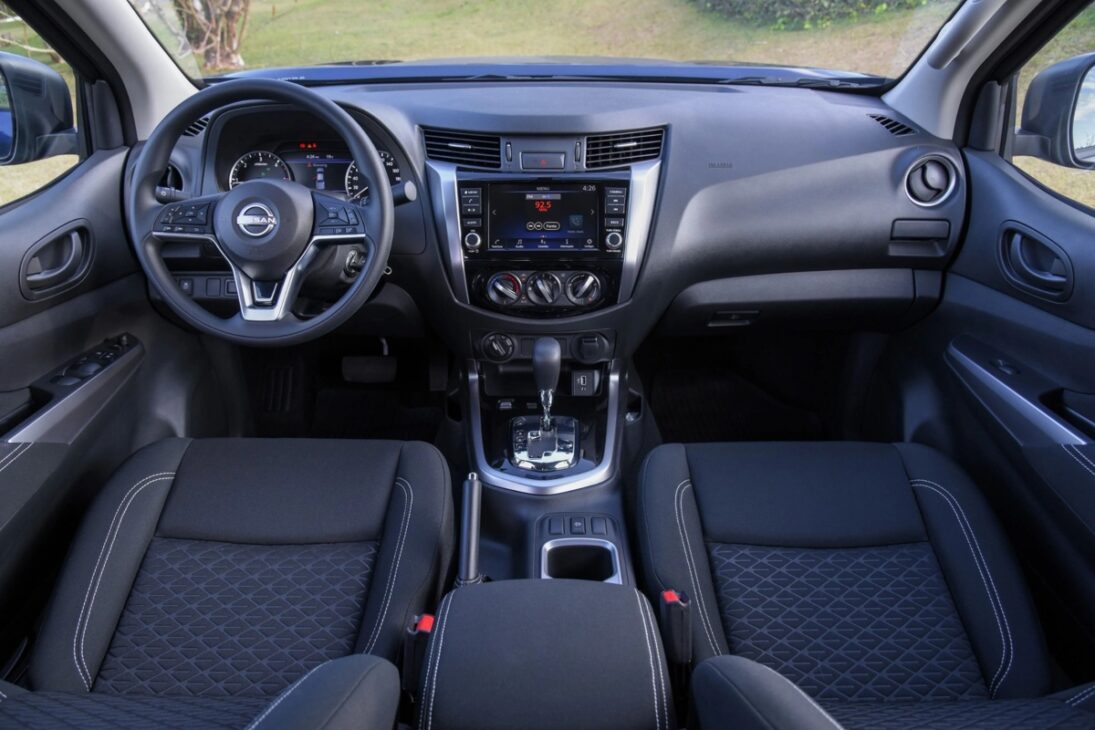
Attack Version Plays Strategic Role Within the Frontier Line
The multimedia center uses an 8-inch screen compatible with wireless Android Auto and Apple CarPlay. The instrument panel features a configurable 7-inch TFT screen, allowing quick access to the vehicle’s main information.
Currently, the Frontier is sold in three versions in the Brazilian market. The Attack occupies the entry-level position, with a reported price of R$ 277,590. Above it are the Pro-4X and Platinum versions, both announced at R$ 317,990.
Over two decades, the Attack version has consolidated its own identity within the Frontier family. The combination of robust design, biturbo diesel engine, 4×4 traction, multilink suspension, and good load capacity explains why the configuration remains one of the most recognized in Nissan’s lineup.
After all, how many entry-level pickups can combine SUV comfort, heavy-duty capability, and true off-road vocation in a single package?


