






 5 min of reading
  0 comments


Researchers at TU Graz have created reusable brick walls that can be dismantled and reconstructed in another location, reducing construction waste and cutting emissions by up to 60% over three usage cycles.
The brick outlives the building.
The phrase seems simple, but it sums up one of the biggest paradoxes of modern construction. A building can be demolished in 10 or 20 years, while its materials could potentially last much longer. It was precisely this contradiction that researchers at Graz University of Technology, TU Graz, decided to tackle with a system of reusable brick walls.
The project, called Re-Use Ziegelwand, was developed in partnership with wienerberger, an Austrian manufacturer of ceramic materials. The proposal is not to sell loose blocks for anyone to build a house like a toy, but to create prefabricated, dismantlable wall elements that can be reassembled in another location.
-
The legendary oak that, according to the story, hid Robin Hood from the Sheriff of Nottingham, died at the impressive age of 1,200 years in England, and the first chilling sign of its end was that no leaves sprouted on the tree this spring.

-
While the world looks at forests, the UN warns that the Earth is also threatened by the silent degradation of natural grasslands and savannas, ecosystems that cover half of the planet, support billions of people, and can exacerbate water, food, and climate crises.
-
The future of computers may change sooner than expected: Amazon bets on commercial quantum computing within seven years, while qubits, the Ocelot chip, AI, and scientific simulations take center stage in the new race among big techs.
-
Cheaper than new HB20, Onix, and Argo, this German sedan offers a 510-liter trunk, a 2.0 naturally aspirated engine, a 6-speed Tiptronic automatic transmission, and well-known mechanics; the 2016 Volkswagen Jetta Comfortline still draws attention in the used car market.

The most striking data comes from TU Graz itself: considering three usage cycles, the system can reduce CO₂ emissions by about 60% compared to conventional methods. In a sector known for high resource consumption and the mountain of waste generated in demolitions, this changes the conversation.
Dismantlable walls tackle a giant problem in construction
The construction industry produces an enormous amount of waste. According to the European Commission, construction and demolition waste accounts for more than one-third of all waste generated in the European Union. Data from Eurostat reinforces the magnitude of the problem: in 2022, the sector accounted for 38.4% of the total waste produced in the bloc.
This scenario helps explain why the idea of dismantling, instead of demolishing, has gained traction. Today, much of a building’s materials end up broken, crushed, or discarded because the structure was made to remain fixed until the end. When the building is no longer useful, the wall is also treated as if it has ended.
TU Graz is trying to reverse this logic. Instead of designing walls that can only be destroyed, the system was designed so that the elements can be removed with minimal damage and reused in another construction.
How reusable bricks work in practice
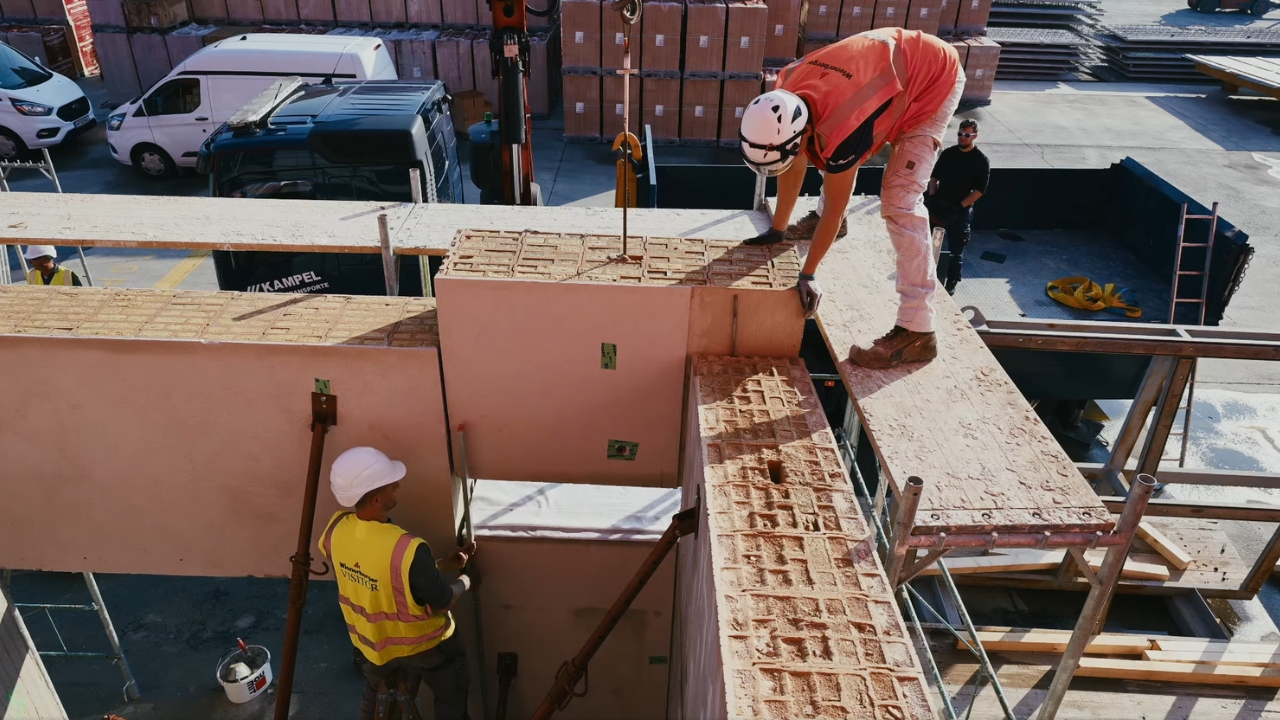
The central point of the technology lies in the reversible joints. Unlike conventional mortar, which permanently binds the bricks, the system uses connections that allow the wall to be dismantled without destroying the elements.
The walls are 44 centimeters thick and the bricks include insulating wool to improve thermal performance. According to TU Graz, the elements can also leave the factory already plastered, which reduces some of the work on the construction site.
The technical study of the project describes typical pieces about 4 meters long by 3 meters high. They are mechanically connected, dry-mounted, and designed for a non-destructive dismantling process. In the pilot, approximately 66 m² of reusable wall surface was used.
To ensure stability, the structure can work with a roof heavy enough to lock the assembly or with vertically pretensioned threaded rods that pass through the bricks. In other words, the system preserves the visual idea of assembly but relies on precise structural engineering.
The test that dismantled and rebuilt the same structure
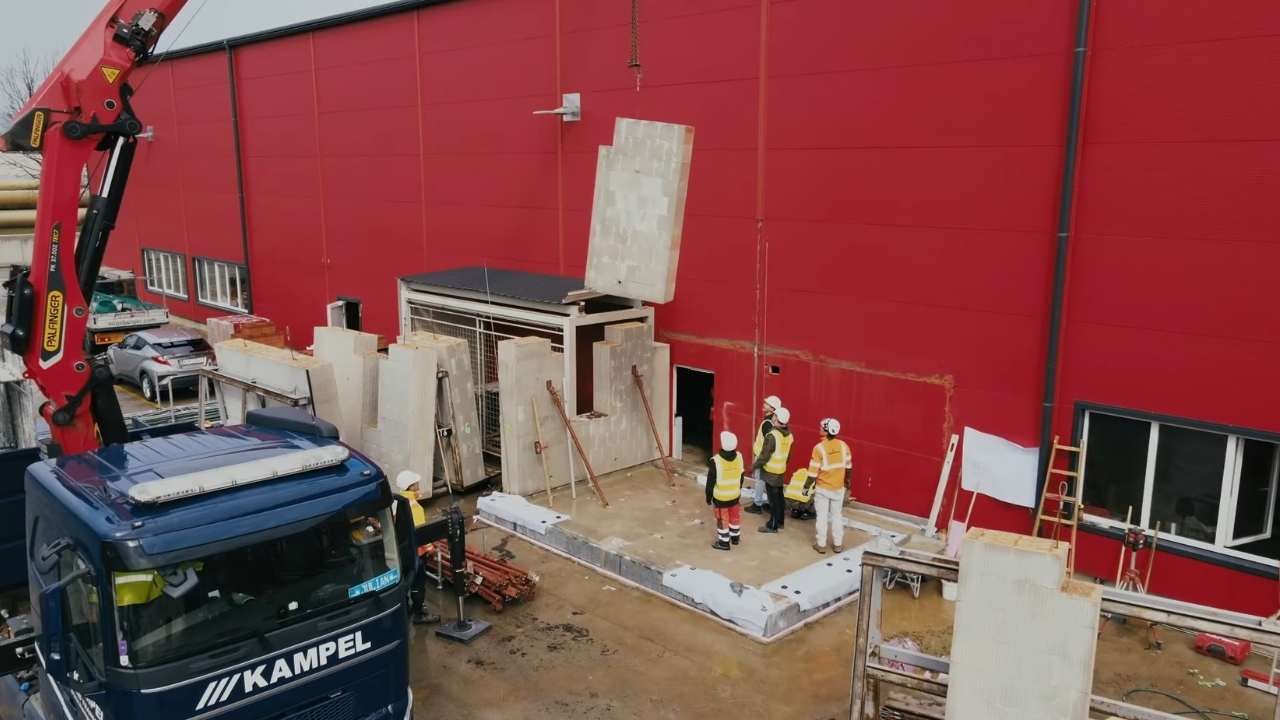
The technology was put to the test in a demonstrator building. The structure was built, dismantled, and rebuilt elsewhere. According to TU Graz, the walls remained functional and in good condition after the process.
This detail is important because the challenge is not only to create an ecological wall on paper. It needs to withstand transportation, dismantling, reassembly, and continue fulfilling its sealing, insulation, and stability functions.
Hans Hafellner, project manager at the Institute of Building Physics, Services and Construction at TU Graz, appears as one of the central references of the research. Andreas Trummer, from the Institute of Structural Design at the university, followed the structural part and highlighted the technical feasibility of the demonstrator.
Emissions decrease when the wall gains a second life
The life cycle assessment compared the Re-Use wall with a conventional prefabricated concrete wall with EPS insulation. At the component level, the reusable wall presented 99.5 kg of CO₂ equivalent per square meter, against 105.5 kg of CO₂ equivalent per square meter in the conventional system.
The difference becomes stronger when the material is used more than once. The study shows that from the second cycle onwards, the emissions linked to the production of the elements decrease because the external walls do not need to be manufactured from scratch again.
Another technical number helps to understand the leap: the conventional wall’s disassembly potential indicator was 0.11, while the Re-Use system reached 0.96. In practice, this shows that the wall was designed from the start to be removed, transported, and reused.
The greatest potential is in short-lived buildings
Although the idea resembles houses that can be reassembled, the strongest use may be in commercial constructions. TU Graz itself cites buildings used for periods of 10 to 20 years, such as supermarkets, warehouses, stores, shopping centers, and depots.
In these cases, the problem is even more evident. A structure can lose its function due to a change in business, expansion, relocation, or complete renovation, even when the materials are still far from the end of their useful life.
With detachable walls, construction ceases to be thought of as a disposable product. It starts to function as a materials bank, where parts of the building can circulate between different projects.
The construction industry seeks circularity, but there are still limits
The project also connects to a larger context. The European Commission states that the built environment requires large quantities of materials and represents about 50% of all extracted material. Meanwhile, UNEP/GlobalABC points out that buildings and construction consume 32% of global energy and account for 34% of global CO₂ emissions.
Even so, the technology does not eliminate all emissions. Foundations, roofs, transportation, interiors, assembly, and end of life continue to weigh on the environmental calculation. The progress is in preventing a still-useful wall from becoming debris just because the original building no longer exists.
In the end, TU Graz’s reusable bricks show that the next construction revolution may not be in building faster, but in demolishing less. When a wall can leave a site whole and be reborn at another address, the building ceases to be a final point and becomes just a stage in the materials cycle.








Be the first to react!