






 Portuguese
  Spanish


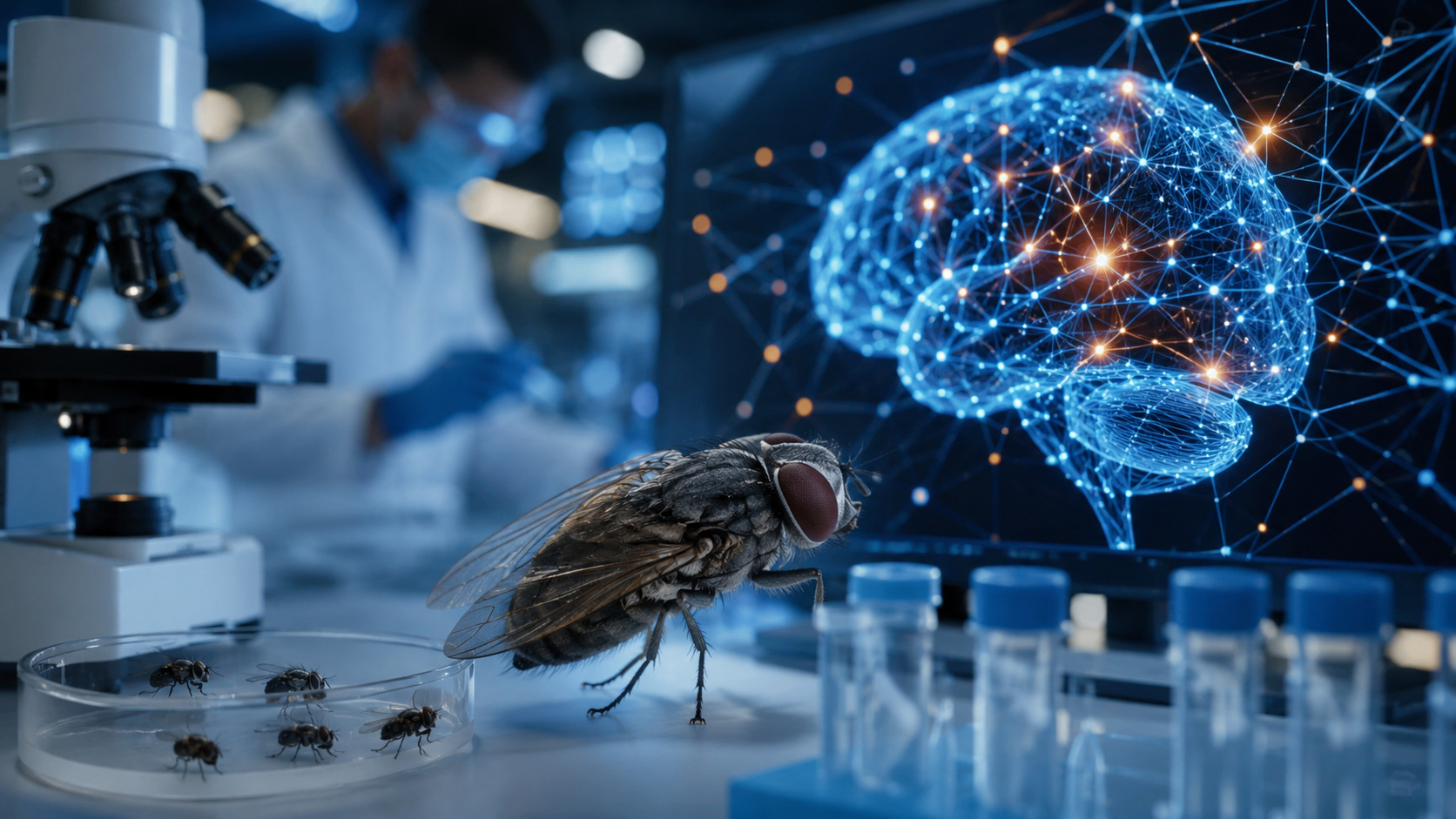

Researchers from England reveal how flies can inspire faster, more efficient, and advanced artificial intelligence technologies.
Researchers from England have discovered that the brain of flies possesses an extremely efficient visual system, capable of inspiring new generations of artificial intelligence, autonomous robots, and smart sensors. The study, published in the scientific journal Nature Communications on May 5, showed that these insects can process visual information at high speed even during rapid movements, something that has intrigued scientists for decades.
The research was conducted by specialists from the University of Sheffield, in England, and challenges old neuroscience theories about how the brain handles moving images. According to the scientists, flies have developed a mechanism called “high-frequency synaptic jump,” which allows them to maintain clear vision in full flight.
What’s most impressive is that this system operates with energy efficiency far superior to current technologies. For specialists in artificial intelligence and robotics, the discovery could pave the way for faster, more economical, and precise machines.
-
China Develops Custom 140-Ton Electric Mining Truck with 770 kWh Swappable Battery, Deploys 290 Units in Xinjiang’s Largest Zinc Mine

-
Meta to Launch Arena, a New Prediction App Targeting 3.56 Billion Users, Competing with Polymarket and Kalshi

-
Scientist Challenges Famous Human Evolution Theory, Argues Homo Sapiens Evolved Gradually Over Thousands of Years
-
15-Year-Old American Builds Ocean Generator with PVC Pipe and 3D-Printed Propeller for $12, Wins National Prize, Presents at White House, and Makes Forbes 30 Under 30 List




Researchers from England challenge old theory about fly vision
For many years, scientists believed that flies experienced a type of “visual blackout” while performing abrupt movements in the air. The theory arose because humans experience temporary blurs during rapid eye movements, known as saccades.
Since flies do not move their eyes within the sockets but quickly change their entire body during flight, it was believed that they faced the same visual problem.
However, researchers from England discovered that these insects do exactly the opposite. Instead of interrupting visual processing, the brain of flies continues to analyze the environment in real-time.
According to the study, this happens because flies have evolved an extremely adaptive neural system, capable of automatically adjusting visual sensitivity during rapid movements.
For scientists, this discovery changes the way neuroscience understands the relationship between movement, perception, and brain response.


How the brain of flies can process images at high speed
The researchers from England analyzed how signals travel through the multifaceted eyes of flies to the internal neurons responsible for vision. The goal was to understand why these insects can react so quickly during flight.
The measurements revealed impressive numbers. According to the scientists, the visual neurons known as large monopolar cells reached about 4.1 thousand bits per second in synaptic transmission.
More than speed, the system showed extraordinary efficiency. The fly’s brain can prioritize truly important information and ignore less relevant stimuli, reducing processing delays.
The scientists identified a mechanism called “high-frequency synaptic jump.” This process expands the visual capacity to approximately 1 thousand Hz, equivalent to a thousand pulses per second.
In practice, this allows flies to perceive minimal changes in fractions of a millisecond and react almost instantly.
Among the main characteristics observed by the researchers are:
- Continuous visual processing during flight;
- Very low latency between stimulus and response;
- Dynamic adjustment of visual sensitivity;
- Ability to save energy without losing performance;
- Extremely fast reaction to changes in the environment.

Artificial intelligence may gain faster and more economical systems
The study caught the attention of artificial intelligence experts because the mechanism found in flies could solve one of the main problems of modern technologies: the excess of data processing.
Today, many artificial intelligence systems continuously analyze complete images. This requires high energy consumption and large computational capacity.
According to the researchers from England, the fly’s brain works differently. Instead of processing everything all the time, the system focuses only on the most important changes in the environment.
This model can inspire much more efficient technologies in various areas. Intelligent sensors and adaptive cameras could increase response speed without needing to consume so many computational resources.
The scientists believe that this principle could mainly benefit:
- Autonomous vehicles;
- Intelligent drones;
- Industrial robotics;
- Automated military systems;
- Security monitoring;
- Advanced medical technologies.
Additionally, the biological model of flies can help companies reduce energy costs in artificial intelligence systems.
Scientists see potential to revolutionize autonomous cars
Researchers in England highlighted that autonomous vehicles could be among the biggest beneficiaries of the discovery. Currently, smart cars need to interpret enormous amounts of data captured by sensors, radars, and cameras.
This process creates delays that can compromise decisions in critical situations.
The system found in the brains of flies proposes just the opposite: to analyze only relevant events in real time.
According to the scientists, sensors inspired by these insects could drastically reduce the time between perception and response. This would increase the safety and efficiency of autonomous vehicles.
In industrial robotics, the impact could also be enormous. Automated machines could react more quickly to obstacles and unexpected changes in the work environment.
For experts in biomimetic technologies, the discovery reinforces how solutions found in nature can surpass artificially developed systems.
Nature-inspired technologies gain strength among scientists
In recent years, scientists have increasingly studied biological mechanisms to develop new technologies. This field is known as biomimetics.
The idea is to observe solutions created by evolution over millions of years and adapt them to modern problems.
Researchers in England state that flies represent an impressive example of this natural efficiency. Even with tiny brains, these insects can perform extremely complex tasks at very high speed.
Today, various technologies have already been inspired by nature. Some examples include:
- Airplanes inspired by the aerodynamics of birds;
- Sensors based on the echolocation of bats;
- Materials inspired by spider webs;
- Robots developed with movements similar to those of animals.
Now, the brain of flies enters this list as a possible inspiration for advanced artificial intelligence systems.
Researchers from England reveal a new perspective on neuroscience
Besides technological applications, the study also brought important impacts on neuroscience. For decades, scientists believed that the brain processed information in fixed stages, with inevitable delays.
The new study suggests that this may not work the same way in all organisms.
According to the researchers from England, the brain of flies integrates movement, visual perception, and neural response almost simultaneously. This drastically reduces reaction time.
Professor Aurel Lazar, from Columbia University and co-author of the research, highlighted that intelligence does not necessarily depend on processing large volumes of data, but on quickly selecting the correct information.
This idea can directly influence the future of artificial intelligence technologies.
For many scientists, the model found in flies represents an important shift in understanding how intelligent systems really work.
What this discovery can change in the coming years
The discovery made by the researchers from England shows that even small insects can offer valuable answers to some of today’s biggest technological challenges.
The brain of flies revealed a highly efficient visual system, capable of inspiring faster, more economical, and precise technologies. Scientists believe that the mechanism can accelerate advances in artificial intelligence, robotics, autonomous vehicles, and intelligent sensors.
Moreover, the study reinforces the importance of biomimetic technologies, which use solutions present in nature to create more advanced systems.
In the coming years, researchers are expected to deepen studies on this neural mechanism. Technology companies, robot manufacturers, and artificial intelligence developers are already following these discoveries with great interest.
The reason is simple: in a scenario where speed, energy efficiency, and precision are priorities, flies can teach much more than was imagined.
With information from Nature Communications






