






 Portuguese
  Spanish


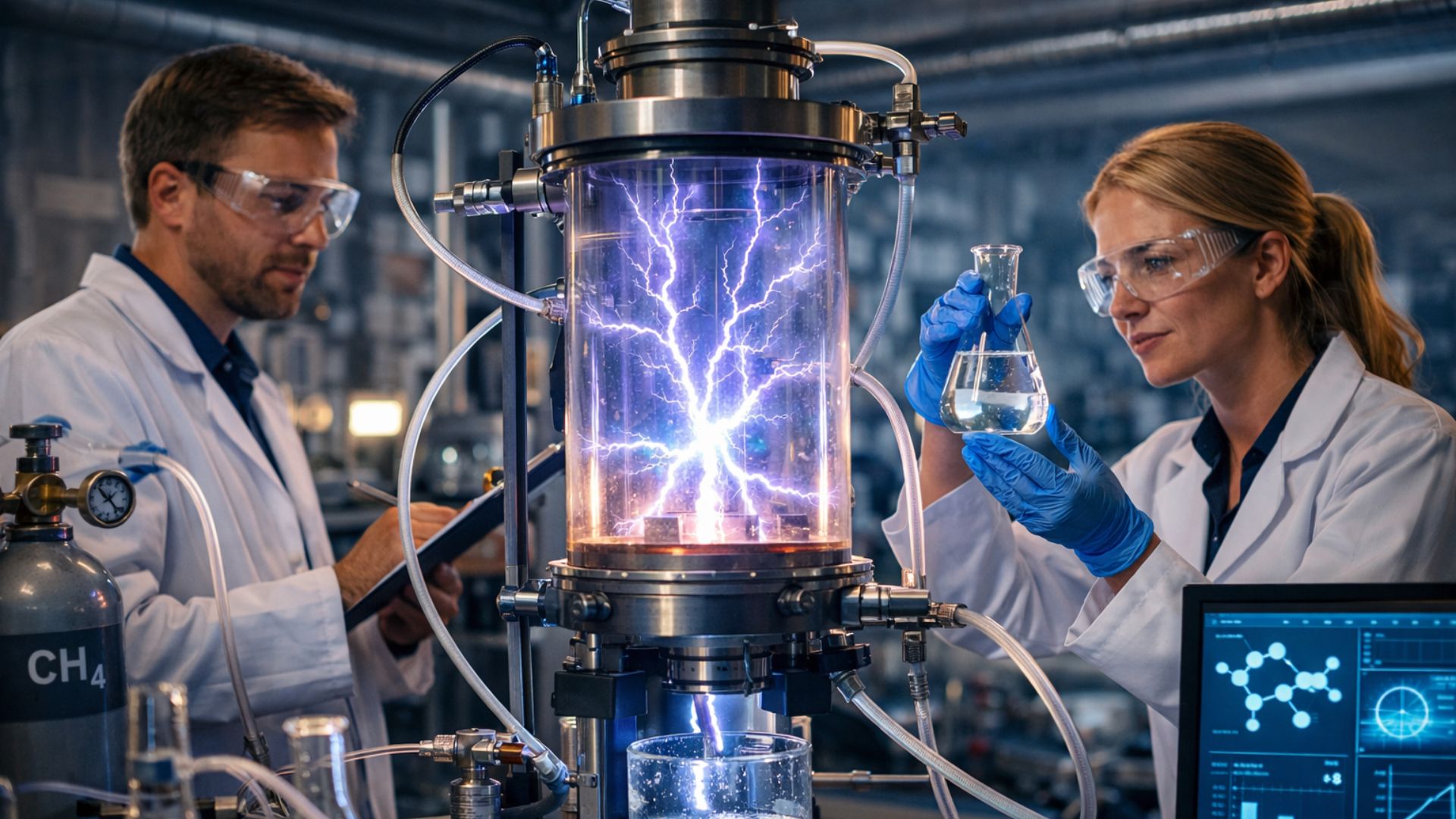

Researchers develop innovative technology that uses artificial lightning to convert natural gas into methanol, reducing emissions, avoiding methane waste, and creating cleaner alternatives for sustainable global energy.
The attempt to reduce emissions and better utilize energy resources has gained significant advancement. Researchers have developed a technology based on artificial lightning capable of transforming natural gas into methanol, a cleaner and more versatile fuel. The method promises to reduce waste, decrease environmental impacts, and create new opportunities for the global energy industry.
Today, a large portion of the extracted methane is not utilized. In many cases, it is simply burned in the field, a practice known as flaring. Although this burning reduces the immediate impact — since methane warms the atmosphere dozens of times more than carbon dioxide over short periods — it still represents significant emissions and loss of economic value.
The new approach emerges as a promising alternative to solve this problem. By converting methane directly into methanol, the researchers demonstrate a more efficient, sustainable, and potentially scalable pathway.
-
China Develops Custom 140-Ton Electric Mining Truck with 770 kWh Swappable Battery, Deploys 290 Units in Xinjiang’s Largest Zinc Mine

-
Meta to Launch Arena, a New Prediction App Targeting 3.56 Billion Users, Competing with Polymarket and Kalshi

-
Scientist Challenges Famous Human Evolution Theory, Argues Homo Sapiens Evolved Gradually Over Thousands of Years
-
15-Year-Old American Builds Ocean Generator with PVC Pipe and 3D-Printed Propeller for $12, Wins National Prize, Presents at White House, and Makes Forbes 30 Under 30 List




How researchers use artificial lightning to convert natural gas into methanol
The distinguishing feature of the technology lies in how the chemical reactions occur. Instead of relying on extreme heat, the researchers use high-voltage electric pulses that generate artificial lightning within a reactor.
These discharges create a plasma environment, similar to what occurs in storms. In this scenario, the molecules of natural gas are broken down and reorganized, forming methanol in a single step.
Another important point is the use of water in the system. As soon as methanol is formed, it dissolves immediately, preventing it from continuing to react and turning into CO₂. This detail increases the efficiency of the process and preserves the final product.
Wasted natural gas still generates environmental impact and economic losses
The waste of natural gas is a global problem. In regions without adequate infrastructure, the methane released during oil extraction is neither captured nor transported.
As an alternative, companies resort to flaring. This practice, while reducing the warming potential of methane, still generates significant CO₂ emissions and eliminates any possibility of energy recovery.
This scenario highlights two central problems:
- Continuous emissions that contribute to global warming
- Loss of a valuable energy resource that could be reused
By transforming this gas into methanol, researchers offer a solution that directly addresses both of these fronts.

Methanol production faces challenges with high temperatures and extreme pressure
The production of methanol is already well established in the industry. Currently, more than 130 billion liters are produced every year, with applications ranging from plastics to fuels.
However, the traditional process is highly intensive. It requires temperatures above 800 °C and pressures that can reach 300 times atmospheric pressure. These conditions demand enormous energy consumption.
A large part of this energy comes from burning fossil fuels, which generates millions of tons of CO₂ annually. In other words, even though it is a cleaner fuel, methanol carries a significant environmental footprint in its production.
It is precisely at this point that the method using artificial rays stands out.
Researchers enhance efficiency by using water and argon in the chemical process
To make the process more efficient, researchers incorporated simple yet effective solutions. One of them was the use of water as a medium for capturing methanol.
As soon as the compound is formed, it dissolves rapidly, preventing additional reactions that could convert it into CO₂. This improves yield and increases the selectivity of the process.
Another advancement was the addition of argon to the flow of natural gas. Although it is an inert gas, it begins to act within the plasma created by the artificial rays, helping to stabilize the reactions.
With these improvements, about 96.8% of the liquid products generated were methanol, a result considered highly efficient for this type of process.
Direct conversion in the field can transform wells into mobile productive units
One of the most promising aspects of the technology is the possibility of decentralized application. The researchers are working with the idea of compact reactors that can be transported to the extraction site.
This would allow for the transformation of natural gas directly into methanol at the well itself, eliminating the need for transportation or large industrial facilities.
Among the main benefits of this approach are:
- Reduction of logistical costs
- Immediate utilization of gas that would be wasted
- Production of liquid fuel that is easy to store and transport
This strategy can transform remote areas into small productive hubs, increasing the efficiency of the energy chain.
Positive environmental impacts drive the use of methanol as an alternative fuel
The use of methanol as fuel has gained traction in different sectors. Its combustion generates less sulfur and fewer fine particles compared to gasoline and diesel.
When produced from natural gas using artificial rays, this fuel becomes even more interesting from an environmental perspective.
Moreover, the reduction of emissions occurs in two stages:
- Avoids the direct release of methane into the atmosphere
- Reduces the use of highly polluting industrial processes
This dual benefit reinforces the potential of the technology as a solution for the energy transition.
Technical and economic challenges still limit large-scale advancement
Despite the promising results, the technology still faces significant obstacles. One of the main challenges is the scale of production.
Reactors based on artificial rays cannot be scaled up in a conventional manner. The alternative would be to use multiple smaller units operating in parallel, a strategy already used in other industrial applications.
Another critical point involves costs. As the process depends on electricity, its viability is directly linked to the price of energy.
The researchers emphasize that reducing energy costs, especially with renewable sources, will be essential to make the production of methanol competitive.
Researchers explore new frontiers with artificial rays beyond methanol
The potential of the technology goes beyond the production of methanol. The researchers believe that the use of artificial rays can be applied to other important chemical reactions.
This paves the way for cleaner and more efficient industrial processes, with less dependence on fossil fuels.
The possibility of adapting the method for different compounds makes the discovery even more relevant. It not only solves a specific problem but also creates new opportunities for innovation.
What this innovation represents for the future of sustainable energy
The advancement presented by the researchers shows that innovative solutions can arise from the combination of basic science and real industry challenges. Transforming natural gas into methanol using artificial rays is more than a scientific curiosity — it is a concrete alternative to reduce emissions and increase efficiency.
Although there are still technical and economic barriers, the initial results indicate a promising path. The possibility of producing fuel more cleanly, utilizing resources that are currently wasted, could redefine part of the global energy matrix.
With the advancement of research and support from renewable energy sources, this technology has the potential to move from the laboratory to the real world, contributing to a more sustainable future.






