






 Portuguese
  Spanish
  3 min of reading


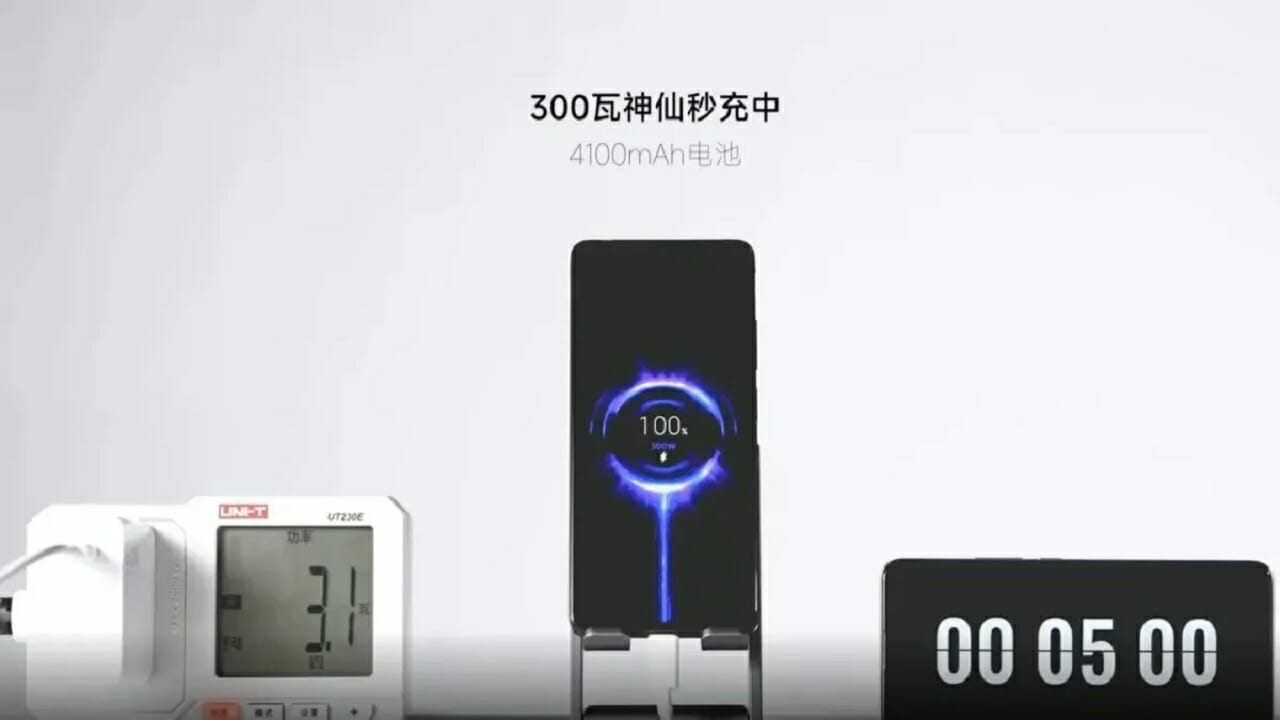
Xiaomi Just Announced Fast Charging Technology Capable of Recharging a Phone in Just 5 Minutes Using 300 W Batteries.
The new technology from Chinese giant Xiaomi promises a battery that can recharge from 0% to 100% in just 5 minutes. The project was announced during the Mobile World Congress (MWC 2023). Fast charging would be possible with 300 W batteries. However, there is still no exact date for when the multinational’s technology will be available to the general public.
New Charger from Multinational Xiaomi is Similar in Size to the Previous One
Xiaomi’s new product was announced about six months after the launch of the 210 W charging of the Redmi Note 12 Explorer. In this case, the battery fully charges in just over 10 minutes. As for the new charging technology, the presentation took place on a Redmi Note 12 Pro+, modified with a 4,100 mAh battery.
In summary, the battery used by the multinational in the presentation reached 20% in about one minute of charging and, in 2 minutes and 12 seconds, hit the 50% mark. Finally, the power input was slightly over 290W.
-
Researchers develop a revolutionary solution capable of cooling chips with up to 10 times greater efficiency, overcoming thermal limits that hindered the advancement of modern computing and enabling faster, more compact, and energy-efficient equipment.

-
Scientists pumped seawater to the surface of the Arctic during the third warmest winter ever recorded in the region and thickened the ice by up to 32 centimeters in the tested areas, a gain comparable to the thickness lost in 50 years.

-
At the age of 3, little Eduardo Amaral became the first Brazilian diagnosed with an ultra-rare genetic disease that affects fewer than 100 people worldwide, and he has just returned from the United States with news that seemed impossible.
-
James Webb Telescope finds possible black hole in object observed 1.8 billion years after the Big Bang and reveals more than 40 spectral lines in GLIMPSE-17775




Although it is fast, Xiaomi’s new technology is very similar in size to the previous 210 W. The company claims that this size maintenance is due to the use of a modular design that dissipates heat better within the smartphone.
In theory, the lithium-ion battery has 15C cells, which are more powerful than the previous 10C ones. All of this results in a reduction of the electrode thickness by 35%. Thus, the 15C cells are ultra-thin and stacked with thermal materials. This allows for heat dissipation along with the optimization of the internal mirror.
Despite the rapid charging presented by the multinational, there are market concerns regarding the lifespan of the batteries, as generally, the lifespan of batteries with higher charging power is shorter.
Xiaomi Launches Phone for US$ 1,000 and Plans to Surpass Apple and Samsung
On February 26, the multinational launched its flagship smartphone, challenging its competitors Apple and Samsung. The models were originally launched in the Chinese market in December; however, the company is bringing its devices to international markets. The Xiaomi 13 Pro features a 6.73-inch display and the latest Snapdragon 8 Gen 2. Additionally, it has a triple-lens camera and other premium features such as ultra-fast charging.
The price of the multinational’s smartphone is around 999 euros, equivalent to US$ 1,053, while the 13 Pro costs about 1,299 euros. The brand has faced several challenges, especially a tougher macroeconomic environment with the economy slowing down in China. Approximately 1.21 billion smartphones were shipped in the last year, representing the lowest annual total of shipments since 2013, according to IDC data.
Xiaomi Invests in Research and Development for Innovative Technologies
The Chinese multinational is known for offering high-quality products at very affordable prices, which has drawn attention from many people around the world. The company uses a direct-to-consumer sales strategy, without intermediaries, allowing it to offer lower prices than the competition.
In addition, the company invests in research and development to offer innovative and high-quality products. The multinational’s premium strategy will position it against Apple and Samsung, which will be a significant challenge for the Chinese rival.







Be the first to react!