






 Portuguese
  Spanish
  4 min of reading
  0 comments


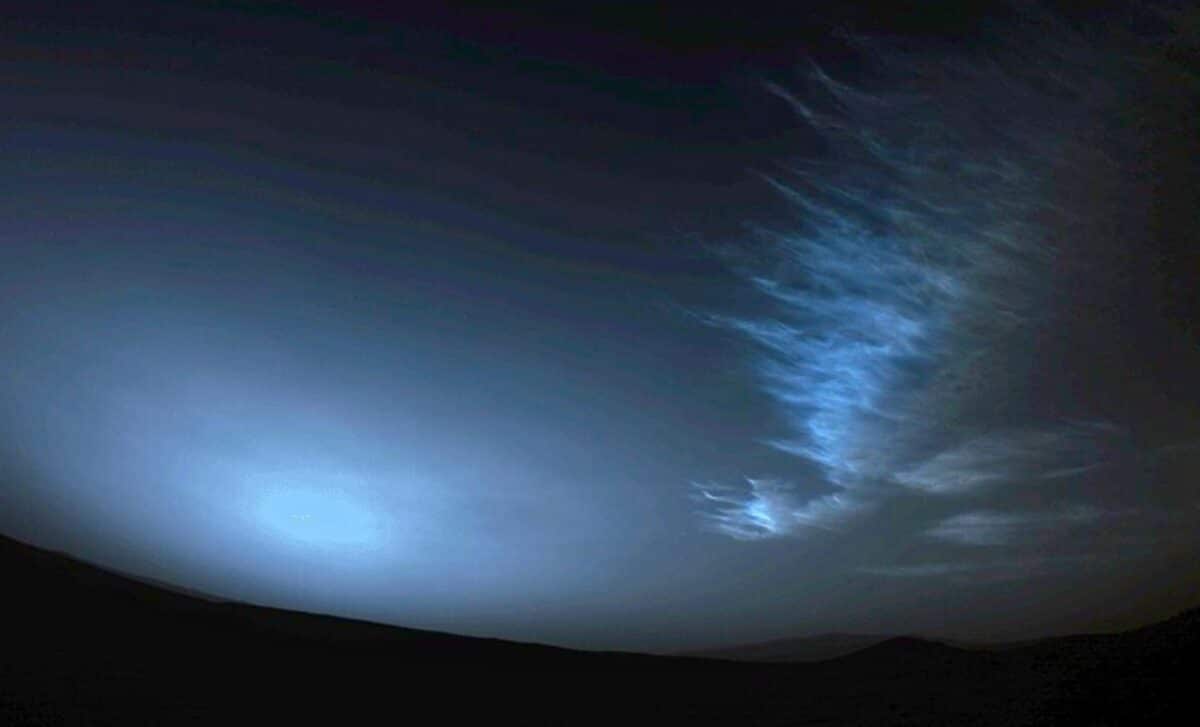
NASA’s Curiosity Rover Records Rare Iridescent Clouds on Mars, Revealing a Specific and Mysterious Color in Martian Twilight
Mars surprises again. NASA’s Curiosity rover captured an unexpected spectacle in its skies. A rare phenomenon, full of stunning colors, appeared during Martian twilight.
The recorded images are unlike anything previously seen on the Red Planet. The origin of these colorful clouds remains a mystery to scientists.
A Rare Spectacle in Mars’ Skies
The images were captured on January 17, during a 16-minute period, on the 4,426th Martian day of the Curiosity mission.
-
Space technology used to search for water on Mars is now hunting for invisible leaks under the streets of São Paulo, using satellites, AI, and chlorine signals to help Sabesp recover up to 6.7 billion liters of water.

-
Japan sends ship to extract mud rich in rare earths at nearly 6,000 meters deep in the Pacific, attempts to lift 350 tons per day from the seabed, and transforms sediments near Minamitori Island into a strategic weapon to reduce dependence on China.
-
Venus Aerospace promises a rotating detonation hypersonic engine that takes the Stargazer to Mach 9 and crosses oceans in 1 hour, but the flight that made history barely surpassed the speed of sound.

-
Brazilian student creates a cheap formula that makes plants grow up to 90% faster and wins an award in a global scientific competition.





The recording was made by the Mastcam, the rover’s high-resolution camera system. The noctilucent clouds, which glow at night, appeared when sunlight scattered through ice crystals at high altitudes.
These clouds exhibit a similar effect to Earth’s “mother of pearl” clouds. Here, light interacts with ice particles, creating a spectrum of mesmerizing cores.
On Mars, the clouds remain invisible during the day, but at dusk, they paint the sky with an intense glow.
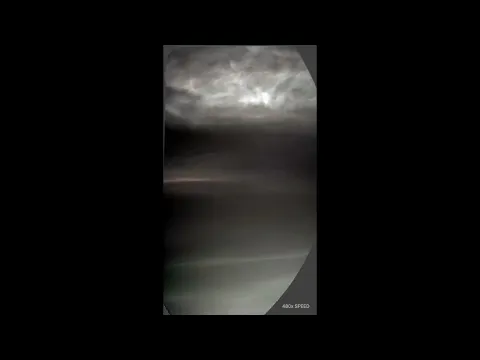

Credit: NASA/JPL-Caltech/MSSS/SSI
What Are Mars’ Clouds Made Of?
The Martian clouds captured by Curiosity are different from most seen on the planet. Generally, Martian clouds are composed of water ice. However, scientists believe these iridescent clouds are made of frozen carbon dioxide, known as dry ice.
They float between 60 and 80 kilometers above the Martian surface. Some plumes can descend down to 50 kilometers before evaporating due to rising temperatures.
Although Mars’ atmosphere is made up of 95% carbon dioxide, frozen CO₂ clouds are extremely rare.
Mark Lemmon, an atmospheric scientist at the Space Science Institute, explains that these clouds only appear in early autumn in the planet’s Southern Hemisphere. This makes them a seasonal spectacle, presenting at specific times of the Martian year.
Additionally, the images also revealed frozen water clouds. They float about 50 kilometers above Gale Crater, where Curiosity is located.
Phenomenon Detected for the First Time in 1997
This phenomenon is not entirely new. NASA had its first glimpse of these twilight clouds in 1997, with the Pathfinder mission.
However, Curiosity only managed to capture its first iridescent images in 2019. Since then, the rover has recorded the features for four consecutive years.
Mark Lemmon, who led a study on these clouds, clearly recalls the first observation: “I will always remember the first time I saw those iridescent clouds and was sure it was some color artifact,” he says.
Today, the appearance has become so predictable that scientists can plan their captures in advance.
Each new recording of these clouds provides valuable information. They have helped scientists study the size and growth of the particles, bringing new insights about the Martian atmosphere.
The Mystery of the Missing Twilight Clouds
Despite their beauty, Martian twilight clouds bring a mystery. They have never been seen in other regions of the planet, aside from Gale Crater. The Perseverance rover, which has been exploring Jezero Crater since 2021, has yet to record these clouds.
Another significant sighting was made by Pathfinder in 1997, north of the Martian equator, in Ares Vallis. However, these clouds remain elusive in other areas.
Lemmon suggests that gravitational waves—atmospheric disturbances that cool the air—may be related to the formation of these clouds. However, the functioning of these waves on Mars is still not fully understood.
Capturing the Colorful Skies with Mastcam
The most recent images were recorded using the Mastcam on the left of Curiosity. This system has a filter wheel that frames photos in a partially open circle.
Despite these limitations, both the left and right high-resolution Mastcams continue to provide valuable colored images.
In addition to studying clouds, Curiosity recently completed an investigation of the Gediz Vallis channel. The rover is now heading toward an area with box-like formations, fractures created by subterranean waters resembling giant spider webs seen from space.
The rover also explored an impact crater called “Rustic Canyon.” The study of this crater may reveal long-buried materials with the potential to contain preserved organic molecules.
With information from Daily Galaxy.


Be the first to react!