






 Portuguese
  Spanish


Saipem 7000 Impresses With Its Ability to Lift Colossal Structures in the Ocean and Its Energy Consumption Comparable to Small Cities, Being a Key Player in Engineering Operations That Challenge Physics and Redefine Standards in the Global Offshore Sector.
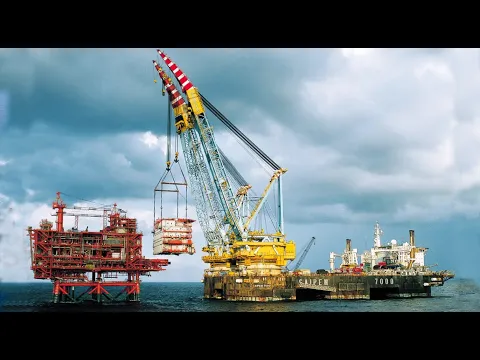
In the world of mega offshore operations, few pieces of equipment impress as much as the Saipem 7000, one of the largest floating cranes in the world.
Designed to lift structures weighing thousands of tons offshore, it has achieved feats that challenge even the most experienced engineers.
Built in the late 1980s and currently operated by Saipem, an Italian multinational in the heavy engineering sector, the Saipem 7000 is regarded as a global reference in lifting capacity and precision.
-
400 km² of Greenhouses in Almería, Spain, Astonish American Visitor by Producing Millions of Tons of Produce for Cold-Weather Markets

-
Antarctic Volcano Emits Microscopic Gold Particles That Travel Up to 1,000 Kilometers Across the Continent
-
Little-known Japanese factory is the world’s largest zipper manufacturer, producing 7 billion pieces annually and closing half the world’s pants.

-
Brazilian Factory Recycles One-Third of the Country’s Styrofoam Waste, Matching European Levels with 51,000 Tons Reused Since 2007


Its deck can accommodate up to three football fields, while its structure supports 117 thousand tons of gross displacement, making it one of the largest crane vessels ever built.
Immense Power of Cranes
The real highlight of the Saipem 7000 lies in its two main cranes, capable of lifting up to 14 thousand tons at once.
This power is sufficient to lift entire modules of oil platforms, marine bridges, and even sections of ships, transforming logistical operations that previously took weeks into tasks completed in just hours.
In comparison, each crane alone can lift the weight of approximately 3,500 standard trucks, making it essential for projects involving oversized loads.
Energy Consumption Comparable to Small Cities
The power required to perform these colossal movements demands a robust energy system.
During heavy lifting maneuvers, the Saipem 7000 can consume energy equivalent to the daily use of more than one thousand middle-class apartments.
This consumption is made possible by twelve diesel engines, with an installed capacity of up to 63 megawatts, enough to power small cities.
The system ensures that, even offshore and under adverse weather conditions, all the ship’s equipment remains operating safely and accurately.
High-Complexity Operation
Beyond energy consumption, another noteworthy factor is the rigor in operations.
Each lift requires meticulous mathematical calculations, taking into account not only the weight and center of gravity of the structures but also the wind action, maritime currents, and the tilt of the sea.
Sensors spread across the ship monitor vibrations, tensions, and any oscillations in real-time, allowing the engineering team to anticipate problems and ensure the stability of each operation.
Global Missions and Logistics
The Saipem 7000 gained international notoriety by participating in emblematic projects, such as lifting 12 thousand-ton modules in the North Sea and assembling platforms in oil fields in Africa, Europe, South America, and Asia.
Among its most complex missions is the installation and decommissioning of offshore platforms, operations that mobilize hundreds of professionals from different countries.
The vessel can accommodate up to 800 people on large-scale missions, housing engineers, technicians, operators, and support teams in accommodations with amenities similar to those of a cruise ship.
The ship also features state-of-the-art dynamic positioning systems, which allow for precise position maintenance even during severe storms, ensuring the safety of the entire operation.

Embedded Engineering and Technology
The operation of the cranes is another spectacle in itself.
Each arm is equipped with steel cables over 10 centimeters in diameter, capable of withstanding forces greater than 14 thousand tons.
Intelligent counterweight systems automatically adjust the ship’s balance according to the weight lifted, preventing any tilt that could compromise the mission.
Sustainability and Impact in the Saipem 7000 Sector
In terms of sustainability, the Saipem 7000 has participated in decommissioning operations, removing old structures from oil fields without environmental damage.
This type of operation demands absolute precision, as it often involves cutting, lifting, and transporting materials in sensitive areas of the oceans.
The relevance of the Saipem 7000 to the industry is such that universities and research centers frequently track its operations to improve lifting techniques, cargo movement, and maritime safety.
The knowledge generated in these missions directly influences the development of new technologies and methods for the global heavy construction sector.
Saipem 7000, a Symbol of Innovation
The Saipem 7000 remains a symbol of innovation and strength in the offshore sector.
Capable of transforming high-complexity operations into daily routines, the crane vessel challenges limits and inspires engineering projects around the world.
With each new challenge faced at sea, the expectation is that global engineering takes another step forward, making possible what once seemed unattainable.
With so many records, impressive numbers, and high-risk operations,
Have you ever imagined what the next feat of this giant of the seas will be and how far maritime engineering can go?





Na década de 80 embarquei nesse colossal navio também fiz um mergulho na Bahia de Guanabara para retirar um cabo de nylon preso num dos hélices foi muito bom os embarques muito vinho muita cerveja show de ****