






 Portuguese
  Spanish


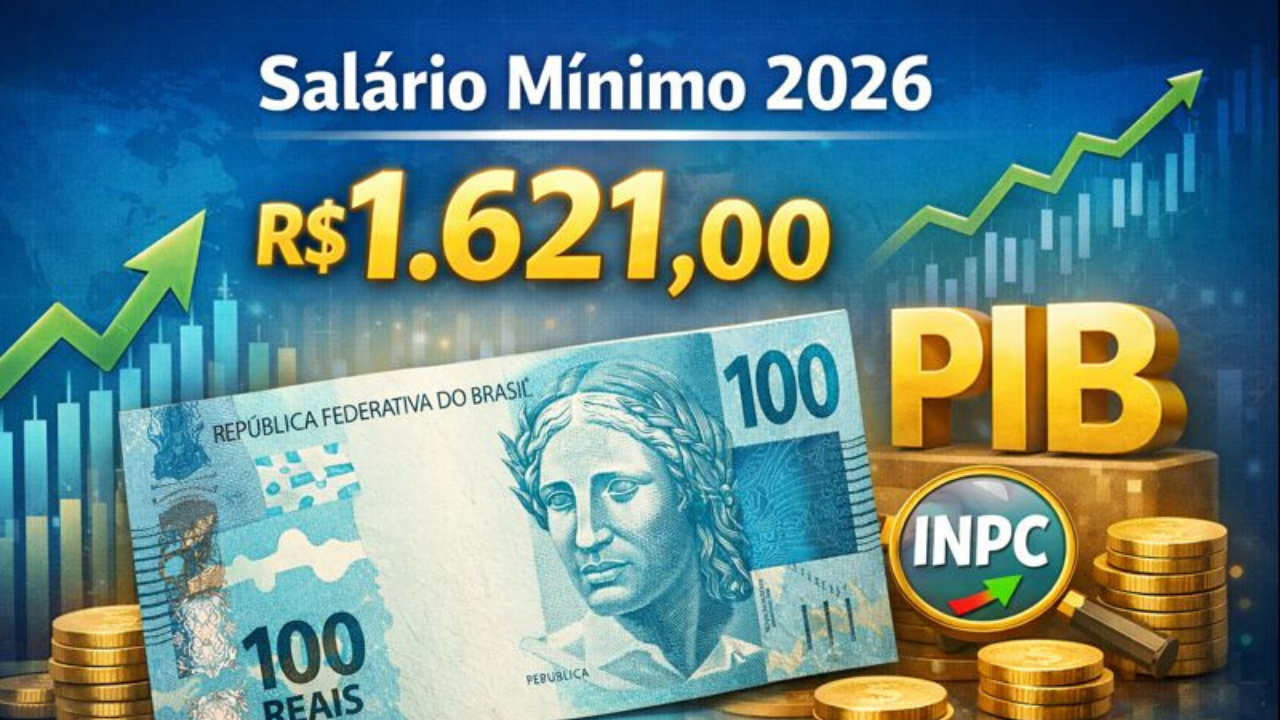
Minimum Wage 2026 Will Have a Salary Adjustment of 6.79%, Based on INPC and GDP, Expanding the Economic Impact in Brazil.
The minimum wage 2026 has been officially adjusted to R$ 1,621, after a decree signed by President Luiz Inácio Lula da Silva at the end of December, in Brasília.
The new value will take effect in January 2026, benefiting workers, retirees, and people receiving assistance linked to the national minimum.
The salary adjustment was defined based on inflation measured by INPC and the growth of GDP, following the appreciation policy resumed by the federal government.
-
Coca-Cola Shuts Down 100-Year-Old Factory in the U.S., Impacting 85 Workers and Shaking Local Community with Historic Consequences

-
Bianca Andrade Invests $30 Million of Her Own Money in Boca Rosa, Launches Over 100 Products in a Year, Aiming for $400 Million by 2026
-
Belo Horizonte Becomes First Brazilian City to Fund Housing, Utilities for 100 Homeless Families with $900,000 Initiative
-
Brazilian Joins Homeownership Consortium, Faces Decade of Dual Payments Totaling $141,000, Surpassing Traditional Mortgage


The measure seeks to preserve purchasing power while simultaneously stimulating the economic impact throughout the country.
The increase will be R$ 103 in relation to the current value in 2025, which was R$ 1,518.
In percentage terms, this represents an increase of 6.79%, considered significant given the fiscal scenario and the rules currently in force.
How the Salary Adjustment of Minimum Wage 2026 Was Calculated
The salary adjustment of the minimum wage 2026 follows the methodology established since 2024.
The formula considers two main factors: accumulated inflation and the performance of the Brazilian economy.
The inflation used in the calculation was measured by the National Consumer Price Index (INPC), which recorded 4.18% in the period accumulated between December 2024 and November 2025, according to data from the Brazilian Institute of Geography and Statistics.
This index reflects the price variation for low-income families, being considered the most appropriate for adjustments to the minimum wage.
Additionally, the calculation incorporates the growth of the Gross Domestic Product (GDP) two years prior to the new minimum’s validity.
Fiscal Limit Reduces Total Gain Above Inflation
Despite the growth of 3.4% in GDP, the full percentage was not entirely passed on to the minimum wage 2026.
This occurred because the new fiscal framework imposes a cap of 2.5% on real gains above inflation.
In practice, this limitation reduced the potential increase.
Still, the final salary adjustment of 6.79% remained above the INPC, ensuring real gains for workers.
Economic Impact Reaches Millions of Brazilians
The economic impact of the minimum wage 2026 will be extensive.
According to a study by Dieese, 61.9 million people have income directly referenced to the minimum wage, either through formal salaries or social benefits.
Of this total, 29.2 million are beneficiaries of the National Institute of Social Security (INSS).
Another 17.6 million are employed workers, 10.7 million are self-employed, and 3.8 million are domestic workers.
More Than R$ 81 Billion to Circulate in the Economy
Still according to Dieese, the new value of the minimum wage 2026 is expected to inject approximately R$ 81.7 billion into the Brazilian economy over the year.
Of this amount, nearly R$ 40 billion corresponds to the increase in expenses with social security benefits.
This additional volume tends to boost consumption, especially in sectors such as commerce, services, and food.
Therefore, the economic impact goes beyond individual income, reaching productive activity as a whole.
History Shows Appreciation Above Inflation
Since 2002, when the minimum wage was R$ 200, the value has accumulated an increase of 710.5%, according to Dieese.
During the same period, inflation measured by the INPC advanced 306.7%, demonstrating real gains over more than two decades.
This history reinforces the role of the minimum wage as an instrument for reducing inequality and strengthening basic income.
With the minimum wage 2026, the government continues this trajectory, even in the face of fiscal constraints.
Minimum Wage 2026 and Its Effects on Daily Life
In summary, the minimum wage 2026 consolidates a salary adjustment above inflation, supported by the INPC and the growth of GDP, even if limited by the fiscal framework.
Thus, the outcome is a real gain that benefits millions of Brazilians and amplifies the economic impact across the country.
Therefore, the new value of R$ 1,621 not only preserves purchasing power but also reinforces the role of the minimum wage as a driver of the economy and social inclusion.




-

-

2 people reacted to this.