Portuguese
  Spanish




Discover Why the NDT Inspector Became One of the Most Sought-After Careers in Offshore Profession, with High Salaries, No College Degree Required, Quick Technical Certifications, and High Demand in Oil and Gas
A report published this Thursday (18) by the Market Monitor portal highlighted one of the most valued technical careers in the Brazilian energy industry. The focus was on the NDT Inspector, a strategic offshore profession that offers high salaries, quick technical training, and strong demand in the oil and gas sector, even though it is a job without a college degree.
The main attraction is the faster financial return. Unlike traditional careers that require long degrees and high investment, this role allows for quick entry into the market, with earnings that can exceed R$ 15 thousand per month in boarding regimes, combining base salary and legal bonuses.
Next, understand why this career has gained national prominence, how the technical role functions, which certifications are required, and why demand remains high even in unstable economic scenarios.
-
Petrobras to Double Natural Gas Supply in Northeastern Brazil with New Investment

-
Petrobras Approves $1.2 Billion Refinery in Brazil to Produce Aviation Fuel and Diesel from Plants
-
Petrobras Secures $2.2 Billion Contract to Build and Operate Four Support Vessels for Brazil’s Offshore Oil Fields
-
Oil production grows in Rio, but reserve replacement raises a warning sign



NDT Inspector and the Importance of Inspection in Offshore Profession
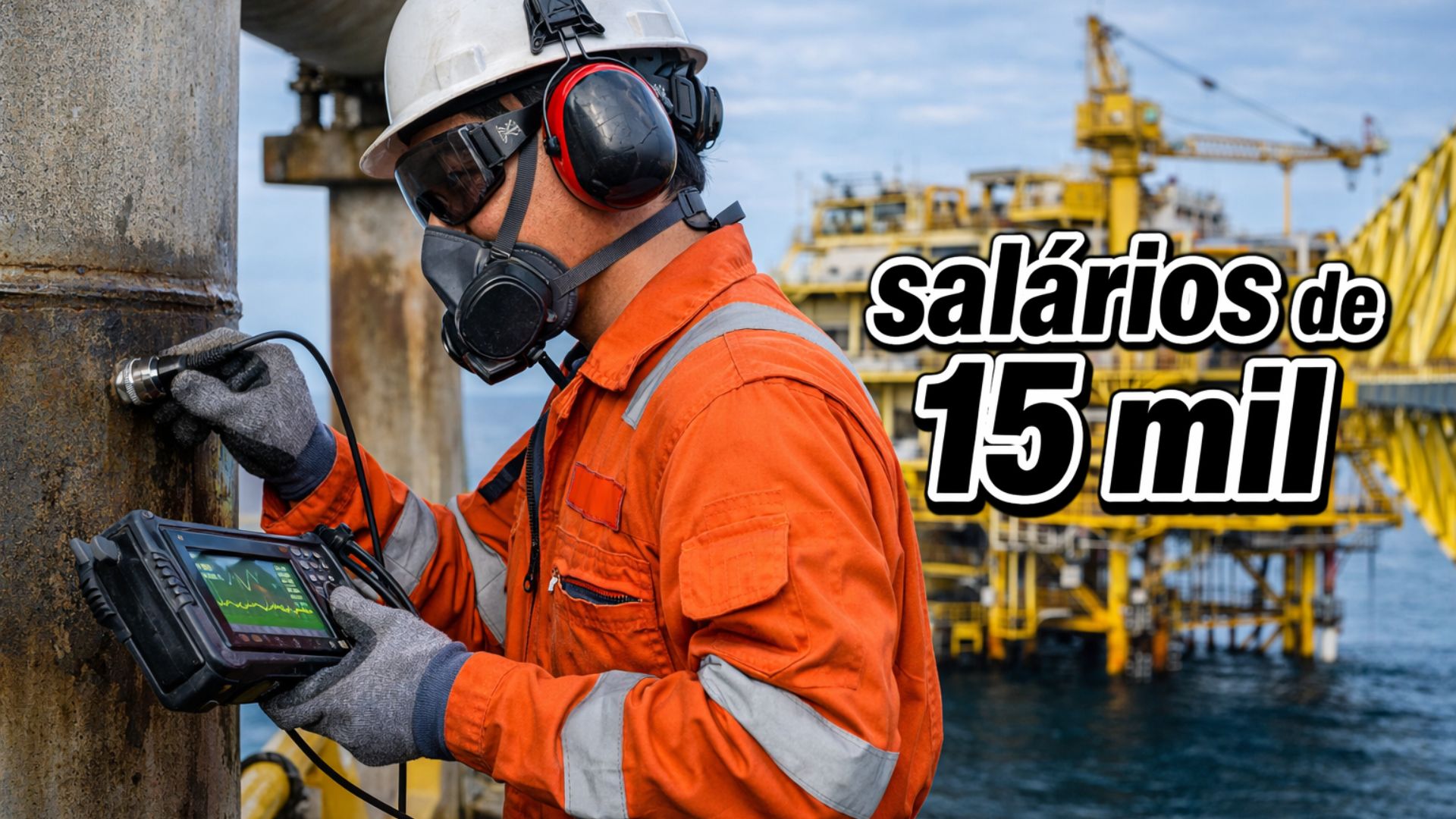
The NDT Inspector operates on the front line of industrial safety. In the offshore profession, their responsibility is to ensure the structural integrity of pipelines, pressure vessels, hulls, welds, and critical metallic components used in the exploration and production of oil and gas.
This professional utilizes non-destructive testing methods to identify invisible internal flaws without compromising the analyzed equipment. It is an essential technical job to prevent leaks, explosions, and environmental accidents.
Among the main activities are the operation of industrial ultrasound equipment, magnetic particle inspections, liquid penetrant testing, and industrial radiography. After testing, the inspector interprets the results and issues technical reports that determine whether a structure can continue operating or if it requires immediate intervention.
In practice, the inspector functions as a “doctor” for metal structures, monitoring the health of the platform and ensuring that all systems operate within the safety limits required by national and international standards.
Why Salaries Are High in the Oil and Gas Sector
The salaries paid to the NDT Inspector are directly linked to the level of technical responsibility and the operational risk of the offshore profession. Any assessment error can lead to serious consequences, from production stoppages to large-scale environmental damage in the oil and gas sector.
In addition to the base salary, the onboard professional receives additional benefits provided by law, such as hazard pay and confinement pay. These amounts significantly increase the monthly compensation, especially in work schedules like 14×14, common on offshore platforms.
It is this combination of risk, responsibility, and shortage of qualified labor that sustains high salaries, even for those in a job without a college degree.
Job Without a College Degree and Technical Training with Quick Return
One of the main differentiators of this career is the fact that it is a job without a college degree. To become a NDT Inspector, the initial requirement is the completion of high school, followed by specific technical courses and certifications recognized by the market.
In the offshore profession, the investment is focused on practical training, with a focus on inspection techniques and interpretation of standards. Unlike traditional degrees, training occurs in months, not years, which accelerates entry into the oil and gas market.
This qualification model makes the cost-benefit extremely attractive. In many cases, the amount invested in courses is recovered within the first months or years of boarding, thanks to the salaries practiced in the sector.
Mandatory Certifications for the NDT Inspector
Despite being a job without a college degree, working as a NDT Inspector requires strict certifications. In the offshore profession, these requirements ensure the safety of operations and the crew.
Among the most common technical certifications are those linked to the National Qualification and Certification System (SNQC), as well as proficiency in international standards such as ASME and API, widely used in the oil and gas sector.
Safety training for boarding is also mandatory, such as CBSP, focused on survival on platforms, and HUET, which prepares the professional for helicopter escape situations in emergencies. Professional ethics is a central point of this career, as the reports issued serve as the basis for critical operational decisions.
Constant Demand and Stability in the Offshore Profession
The demand for the NDT Inspector is considered high. In the offshore profession, periodic inspections are required by environmental legislation, technical standards, and operational safety requirements.
Platforms, refineries, and pipeline systems need to be continuously monitored to maintain operating licenses. This ensures a constant flow of work, regardless of short-term economic fluctuations.
As a result, salaries remain competitive over time, reinforcing the attractiveness of this role in the oil and gas sector for those seeking stability without the need for a university degree.
Technology, Innovation, and the Future of the NDT Inspector
The role of the NDT Inspector is undergoing significant transformations. In the offshore profession, the use of drones, digital sensors, and remotely operated underwater vehicles is already part of the inspection routine in hard-to-reach areas.
These technologies allow for more accurate analyses and reduce human exposure to risks. Professionals who adapt to these tools expand their job opportunities and tend to achieve salaries even higher in the oil and gas sector.
The future of the career is tied to data interpretation and real-time monitoring, requiring constant updates even in a job without a college degree.
Offshore Profession That Brings Together Safety, High Salaries, and Quick Access to the Market
The trajectory of the NDT Inspector demonstrates that it is possible to achieve high salaries with well-directed technical qualification. In the offshore profession, the quick financial return, constant demand, and strategic relevance make this career one of the most efficient entry points into the oil and gas sector.
Even though it is a job without a college degree, it is a position that requires responsibility, precision, and commitment to safety. For those seeking a solid profession, with good compensation and long-term prospects, this career establishes itself as one of the most promising in the Brazilian energy market.