






 Portuguese
  Spanish


Pilot project in Santos delivers homes over the mangrove, combining housing, sanitation, and local commerce, and paves the way for a new stage planned at the Dique da Vila Gilda, with public investment and planned expansion.
The City Hall of Santos delivered, on April 30, 2026, the first 60 homes of the pilot project Parque Palafitas, at the Dique da Vila Gilda, in the Northwest Zone of the city.
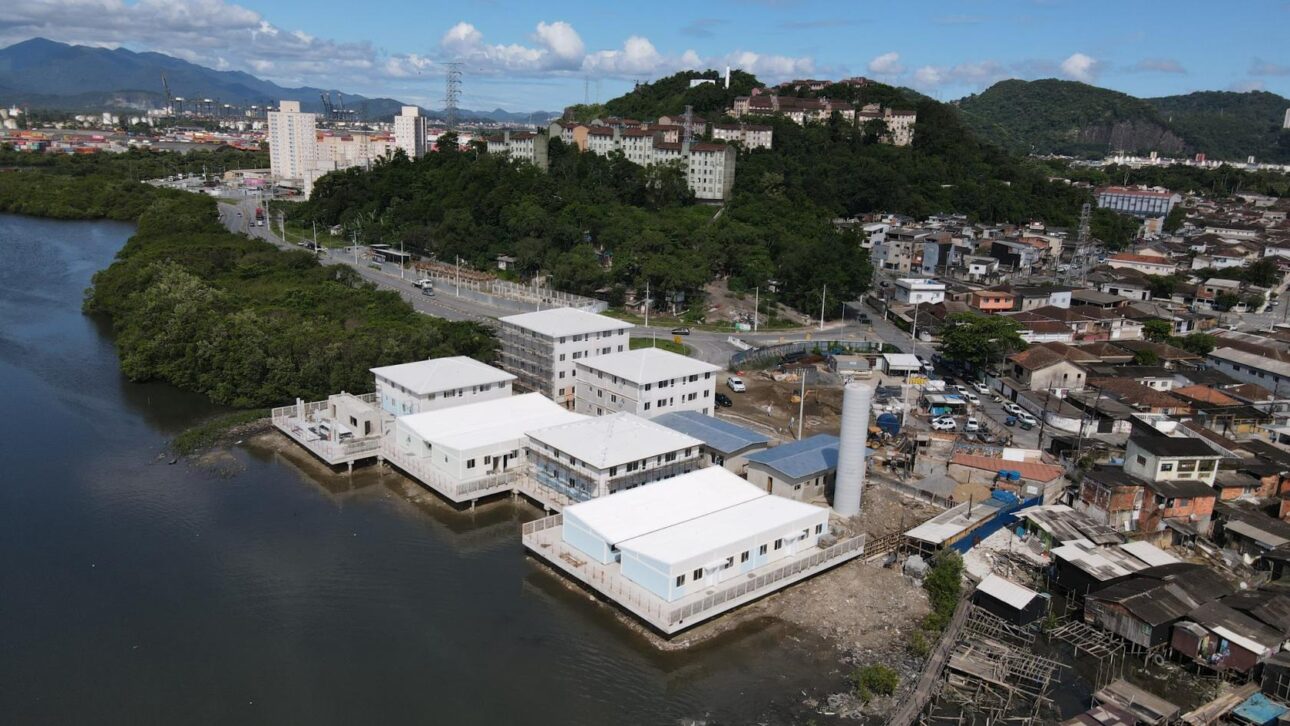
The intervention replaces part of the precarious constructions over the mangrove with apartments, ground-floor houses, and urban structures with sanitation, public lighting, support areas, and a floating pier.
The units were implemented in the same region where the families already lived, without transferring them to distant neighborhoods.
-
Motorcycle Accident Inspires World’s First Fully Automated Cassava Biscuit Factory Producing 1,000 Tons Monthly

-
Attention Brazilian Tap-to-Pay Users: Quick Transactions May Conceal Important Details Noticed Only Post-Purchase

-
Why Air Conditioning Remains Scarce in Millions of European Homes Despite Deadly Heatwaves, While Nearly 90% of U.S. Homes Have It

-
7.1 Magnitude Earthquake in Venezuela Shakes Buildings in the Brazilian Amazon: Residents Report Panic as Civil Defense Monitors Aftershocks Far from Epicenter in Morón


According to the City Hall, the proposal aimed to maintain community ties and expand infrastructure in an area marked by stilt house occupations, tide advancement, irregular waste disposal, and the discharge of untreated sewage.
The development was built in an area of about 4,000 square meters in Vila Gilda.
According to the municipal administration, the total investment of the project is R$ 29.2 million, an amount related to the stages of foundation, superstructure, and implementation of the housing units.
The delivery marked the symbolic receipt of the keys by the residents.
The moves were scheduled to begin in the first half of May 2026, after the completion of the final stages of organizing the families and properties.
Parque Palafitas brings together apartments, ground-floor houses, and support areas
Parque Palafitas brings together 44 apartments distributed in four residential buildings and 16 ground-floor houses.
Four of these houses were allocated to people with disabilities, according to information released by the City Hall of Santos.
The structure of the complex also includes commercial blocks, space for a residents’ association, technical areas for electrical and hydraulic installations, accessible sidewalks, public lighting, and a solar energy capture system aimed at common areas.
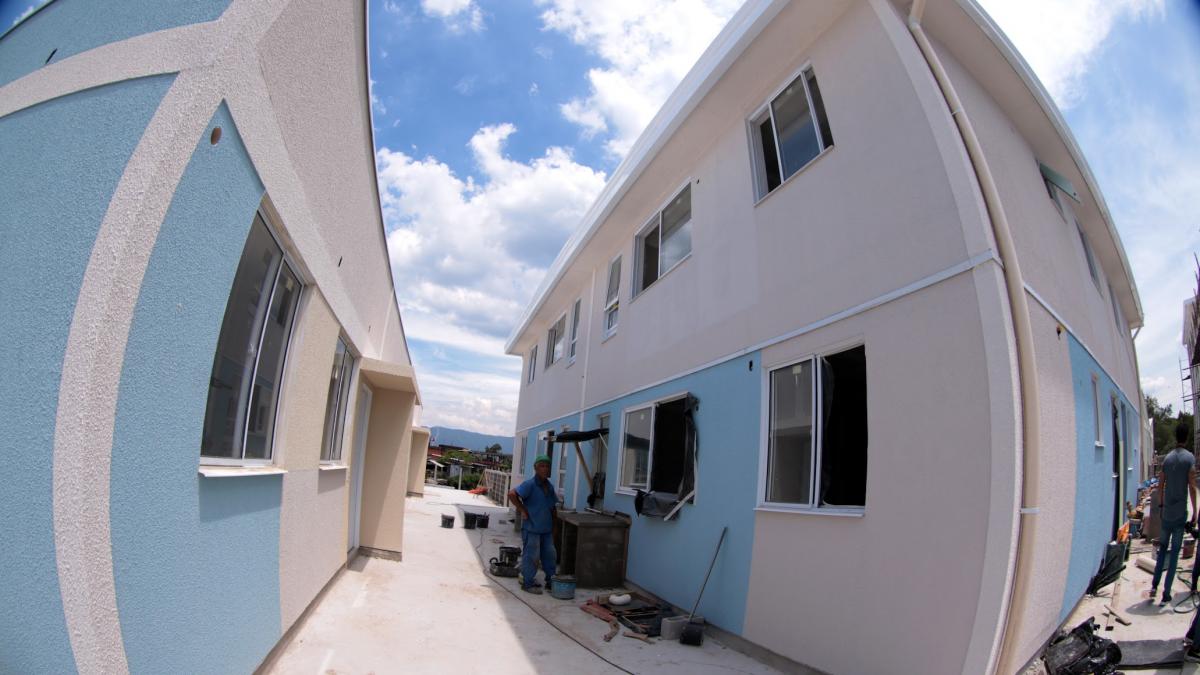
Each apartment has 41.69 m² of private area, with a living room, two bedrooms, a kitchen combined with a laundry room, a bathroom, and circulation.
In the ground-floor houses, the configuration includes integrated living and dining rooms, a kitchen, a service area, two bedrooms, a bathroom, and a backyard porch.
Some of the units have been adapted for residents with disabilities.
The division of spaces, according to the City Hall, was planned to accommodate families who already lived in the Dique da Vila Gilda and were selected for the pilot stage of the project.
In addition to the housing, the complex includes spaces for commerce and community interaction.
The commercial blocks are expected to house small businesses and local services, while the residents’ association will have its own area within the complex.
Housing in mangrove area was built on deep piles
The construction technique is one of the central points of the project.
Since the land is in a mangrove area, with unstable soil and tidal influence, the units were built on slabs supported by deep piles.
According to the Santos City Hall, 212 piles, with depths between 30 and 35 meters, were concreted to support the housing structures.
The method is similar to solutions used in port works but was applied in a social housing project.
In Parque Palafitas, the structure combines support slabs, guardrails, and prefabricated elements.
The solution was adopted to allow the implementation of the units in an area subject to tides and soil variations, without the need to relocate all residents from the territory.
The project also includes water supply and sewage collection by Sabesp.
The hydraulic infrastructure provides separate boxes for different types of effluents and for rainwater, according to information released by the municipal administration.
The buildings also include fire safety measures.
In the buildings, there are extinguishers; in the three and four-story constructions, the City Hall reported the installation of an alarm center and hydrants.
Work in Santos involves City Hall, State, and Union
The area used in the project was granted by the Superintendence of Union Heritage to the City Hall of Santos.
The term of grant was signed in January 2024, a necessary step to allow the implementation of the intervention in the Dique da Vila Gilda.
The execution involved resources from the Government of São Paulo and municipal counterpart.
The Communication Department of the São Paulo government informed that the State transferred R$ 27.4 million through the Secretariat of Government and Institutional Relations, while the City Hall of Santos was responsible for the construction works.
The architectural project was developed by the office of urban planner and former mayor of Curitiba Jaime Lerner, who passed away in 2021.
The proposal was presented by the City Hall as an urbanization alternative for areas occupied by stilt houses, with families remaining in the same region.
The choice to keep residents close to their original territory was treated by the public authorities as a way to preserve neighborhood relations and access to services.
There is no indication in the original text or the consulted sources of direct statements from residents that would allow attributing personal evaluations about the change.
Santos Housing Project was Presented at International Events
Before the delivery of the first units, the Parque Palafitas had already been presented at national and international events.
In November 2024, the City Hall of Santos took the project to the Smart City Expo World Congress, in Barcelona, Spain.
On that occasion, architect and urban planner Ariadne Daher, partner at Jaime Lerner’s office, participated in a panel on urban solutions for more inclusive cities.
The presentation treated Parque Palafitas as an urbanization experience in a mangrove area and resettlement in the same territory.
The initiative had also been shown in 2022 during the 14th Annual Conference of the Unesco Creative Cities Network, held in Santos.
The participation occurred before the delivery of the units and was part of the dissemination of the urbanization proposal for Vila Gilda.
Expansion of Parque Palafitas Foresees 350 More Homes
The pilot stage does not conclude the intervention planned for the Dique da Vila Gilda.
On January 26, 2026, the Housing and Urban Development Company, the Santos City Hall, and Cohab Santista signed an agreement of R$ 77 million to build 350 more housing units in the region.
The agreement provides for 176 homes in one area and 174 in another.
According to CDHU, the execution is expected to occur within an estimated period of 18 to 24 months from the start of the works.
The new units will be managed by Cohab-ST, with state funding.
The selection of the beneficiary families will be the responsibility of the Santos City Hall, according to the municipality’s housing service rules.
According to CDHU, the expansion aims to resettle families living in stilt houses and in flood-prone areas.
The measure is part of the housing actions aimed at the Dique da Vila Gilda, considered by the City Hall to be the largest stilt house community in Brazil.
With the delivery of the first 60 units and the planned expansion to another 350 homes, the Palafitas Park becomes a reference for public authorities for interventions in already occupied mangrove areas.
The application of this model in new stages will depend on the execution of the agreements, the selection of families, and the continuity of the planned works for the territory.


