Portuguese
  Spanish


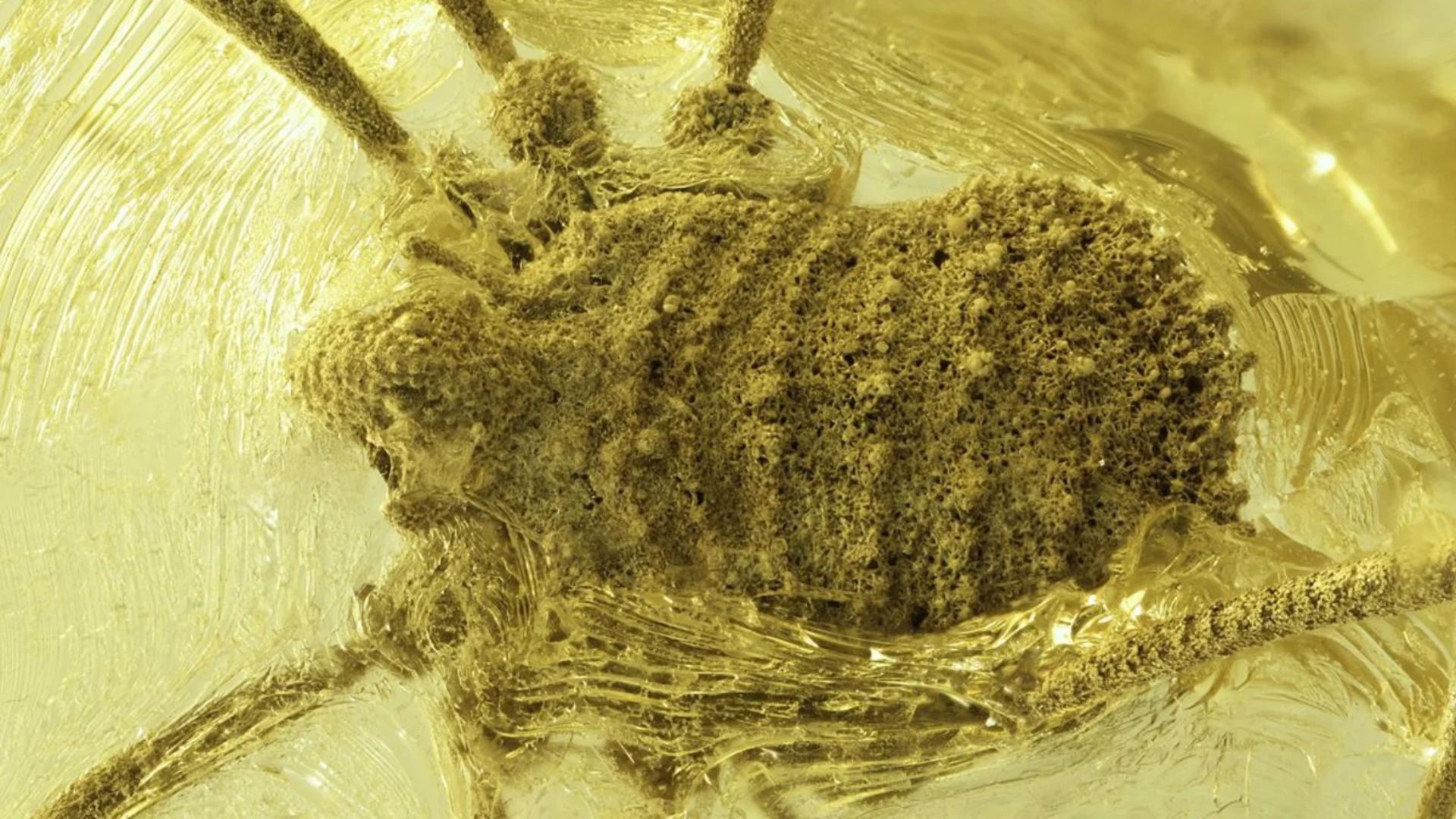

Unique discovery in fossils reveals a hot and unexpected past in northern Europe, with impressive details of an extinct species that challenges what we knew about the evolution of arachnids
Arachnids have always sparked curiosity due to their peculiar yet fascinating appearance. However, a recent discovery has elevated this interest to a new level. Scientists have identified a completely new species of harvestman — a type of arachnid known for its unusual appearance — preserved in amber for an impressive 35 million years. The finding not only surprised the scientific community but also provided new clues about the climate and biodiversity of Europe during the Eocene period.
The information was released by the website “ScienceAlert”, based on a scientific study published in the journal Acta Palaeontologica Polonica, revealing detailed data about this previously unknown species.
Rare species found in amber reveals surprising details of the anatomy and evolution of harvestmen
The new species has been named Balticolasma wunderlichi and belongs to the subfamily Ortholasmatinae, a group of harvestmen that no longer exists in Europe today. Interestingly, their closest relatives are now found only in East Asia and regions of North and Central America, highlighting a drastic change in the distribution of these animals over millions of years.
-
Detectorist found a 900-year-old silver coin

-
A newly discovered caterpillar in Hawaii wears the remains of its prey that it devoured as a macabre armor, stitching bones and insect shells to its own back for camouflage.

-
She heard for decades that space was not a place for women, became a pioneer in aviation, was part of the Mercury 13, and at 82, finally traveled with Jeff Bezos before dying at 87.
-
Scientists investigate microplastics in the airways of patients with sleep apnea and reveal a new focus for research on environmental pollution, human exposure, and possible impacts on breathing quality.



Additionally, the fossils were found in two distinct amber deposits about 35 million years old: one in the Baltic region and another in Rovno, in northwestern Ukraine. This detail is particularly relevant as it indicates that this species had a much broader geographical distribution during the Eocene.
To analyze the specimens with unprecedented precision, researchers used a combination of optical microscopy and computed tomography. As a result, it was possible to digitally reconstruct the three-dimensional anatomy of the arachnid with an impressive level of detail.
Among the observed features, the following stand out:
- Ornate structures on the back
- Net-like patterns on the head
- A prominent and curious eye mound
- Highly complex mouthparts
- Eight long and thin legs, with the second pair significantly larger
In addition, scientists have managed to identify differences between the sexes by analyzing genital structures — an essential factor in the classification of arachnids.
Subtropical climate in ancient Europe helps explain the impressive diversity revealed by fossils
Although it is difficult to imagine today, the region between the Baltic Sea and the Black Sea — which includes countries like Ukraine, Estonia, Latvia, Lithuania, and Belarus — had a much warmer climate during the Eocene. In fact, evidence indicates that the environment was temperate and possibly even subtropical.
In this sense, this climatic condition favored a biodiversity much richer than the current one. This explains why species like Balticolasma wunderlichi were able to thrive in areas where they no longer exist today.
The two types of amber analyzed — Baltic and Rovno — have distinct characteristics and generally contain different species. However, in this specific case, there was a rare overlap, indicating that the fauna of these regions was quite similar at that time.
With this discovery, the number of species of harvestmen found in both regions reached six. Furthermore, the total recorded in Baltic amber rose to 19 species, while Rovno amber now counts seven.
According to paleontologist Christian Bartel, the leader of the study, the discovery was unexpected, as this group of arachnids is not currently found in Europe. Researcher Jason Dunlop highlighted that Baltic amber continues to be an extraordinary source of fossils, often revealing species that have completely disappeared from the region.
Discovery helps fill giant gaps in the evolution of arachnids and raises new scientific questions
As the first known fossils of the subfamily Ortholasmatinae, this discovery has a significant impact on the understanding of the evolution of harvestmen. In other words, it helps fill a continental gap in the distribution of these animals over time.
Moreover, the fact that they currently exist only in East Asia and America reinforces the idea that there have been profound environmental changes over millions of years, completely altering the habitats of these organisms.
Despite the advances, researchers emphasize that there are still many unanswered questions. To fully reconstruct the evolutionary history of this subfamily, new fossil discoveries will be needed in other regions of the world.