Portuguese
  Spanish


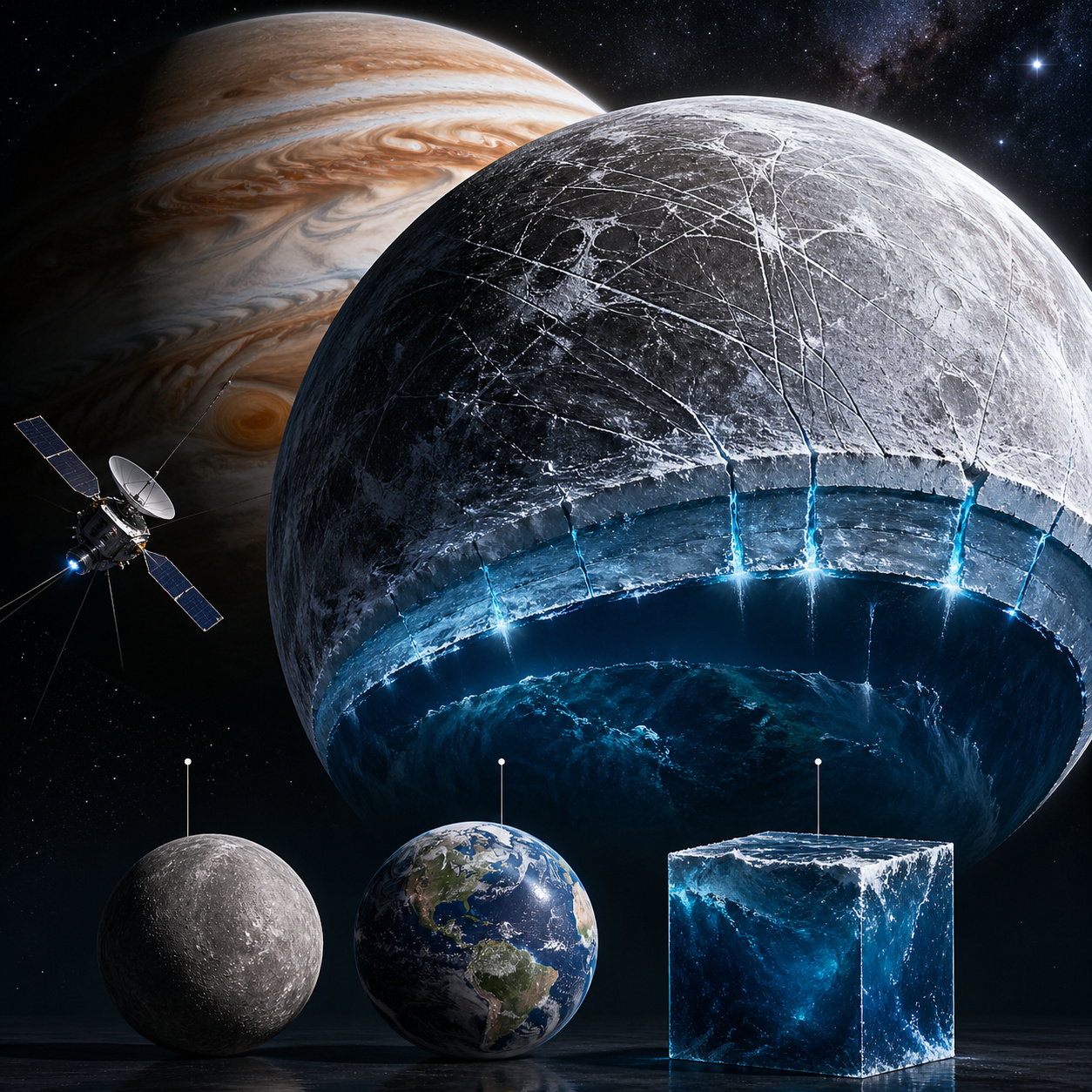

The mission’s arrival at the Jupiter system is expected in the next decade, and the data obtained could redefine our understanding of extraterrestrial oceans.
Ganymede has ceased to be just a distant moon and has become one of the main natural laboratories for studying water outside Earth.
Temperature and pressure create an extreme environment beneath the surface
Although liquid water exists, conditions on Ganymede are far from comparable to those on Earth. The surface temperature can reach about -160 °C, and the pressure in the deep layers is extremely high.
-
AI Video Generator Automatically Creates Subtitles and Animated Captions

-
São Paulo Unveils Latin America’s Largest Underground Reservoir, Holding 900 Million Liters, in the Greater São Paulo Area

-
Chinese Teen Wins Gold in Germany for Invention Turning Air Moisture into Underground Irrigation in Drought-Stricken Areas

-
Desertification Threatens Brazil’s Caatinga: 85% of Semi-Arid Region Affected, 30 Million at Risk, and Efforts Underway to Restore 10 Million Hectares by 2045




Even in the subsurface ocean, water can be under high-pressure conditions, which alters its physical and chemical properties.
This means that, despite the presence of water, the environment is extremely hostile and still poorly understood.
Comparison with Earth reveals the impressive scale of the reservoir
Earth’s oceans cover about 70% of the planet’s surface, with an average depth of approximately 3.7 km.


On Ganymede, although the water is buried, estimates indicate that the total volume may be greater than Earth’s, considering the global extent of the ocean beneath the crust.
The difference is that, while on Earth water defines the surface environment, on Ganymede it is hidden beneath an ice barrier tens of kilometers thick.
Other worlds with water reinforce Ganymede’s importance in science
Ganymede is not alone. Other moons in the Solar System also show evidence of subsurface oceans, such as Europa and Enceladus. However, Ganymede stands out for:
- its size
- its complex structure
- the possible quantity of water
This makes the moon considered one of the main candidates for studies on large-scale water outside Earth.
Scientific interest goes beyond water and involves the origin of planetary systems
The study of Ganymede is not limited to the search for water. The moon also helps scientists understand:
- formation of giant moons
- interaction between magnetic fields
- thermal evolution of planetary bodies
This information is fundamental to understanding how planetary systems form and evolve. Ganymede functions as a key piece to decipher processes that shape planets and moons throughout the universe.
Given this scenario, what does it mean for so much water to exist outside Earth?
The possibility of a global ocean hidden beneath Ganymede’s surface raises profound questions about the distribution of water in the universe.
While Earth faces challenges related to the management of this resource, other worlds may concentrate even larger quantities in inaccessible forms.
The direct question that remains is: if water can exist in such large volumes outside Earth, to what extent is our planet truly unique within this cosmic scenario?
The mission’s arrival at the Jupiter system is expected in the next decade, and the data obtained could redefine our understanding of extraterrestrial oceans.
Ganymede has ceased to be just a distant moon and has become one of the main natural laboratories for studying water outside Earth.
Temperature and pressure create an extreme environment beneath the surface
Although liquid water exists, conditions on Ganymede are far from comparable to those on Earth. The surface temperature can reach about -160 °C, and the pressure in the deep layers is extremely high.
Even in the subsurface ocean, water can be under high-pressure conditions, which alters its physical and chemical properties.
This means that, despite the presence of water, the environment is extremely hostile and still poorly understood.
Comparison with Earth reveals the impressive scale of the reservoir
Earth’s oceans cover about 70% of the planet’s surface, with an average depth of approximately 3.7 km.
On Ganymede, although the water is buried, estimates indicate that the total volume may be greater than Earth’s, considering the global extent of the ocean beneath the crust.
The difference is that, while on Earth water defines the surface environment, on Ganymede it is hidden beneath an ice barrier tens of kilometers thick.
Other worlds with water reinforce Ganymede’s importance in science
Ganymede is not alone. Other moons in the Solar System also show evidence of subsurface oceans, such as Europa and Enceladus. However, Ganymede stands out for:
- its size
- its complex structure
- the possible quantity of water
This makes the moon considered one of the main candidates for studies on large-scale water outside Earth.
Scientific interest goes beyond water and involves the origin of planetary systems
The study of Ganymede is not limited to the search for water. The moon also helps scientists understand:
- formation of giant moons
- interaction between magnetic fields
- thermal evolution of planetary bodies
This information is fundamental to understanding how planetary systems form and evolve. Ganymede functions as a key piece to decipher processes that shape planets and moons throughout the universe.
Given this scenario, what does it mean for so much water to exist outside Earth?
The possibility of a global ocean hidden beneath Ganymede’s surface raises profound questions about the distribution of water in the universe.
While Earth faces challenges related to the management of this resource, other worlds may concentrate even larger quantities in inaccessible forms.
The direct question that remains is: if water can exist in such large volumes outside Earth, to what extent is our planet truly unique within this cosmic scenario?
- measure the thickness of the ice crust
- analyze the surface composition
- map the magnetic field with greater precision
- investigate the depth and extent of the ocean
The mission’s arrival at the Jupiter system is expected in the next decade, and the data obtained could redefine our understanding of extraterrestrial oceans.
Ganymede has ceased to be just a distant moon and has become one of the main natural laboratories for studying water outside Earth.
Temperature and pressure create an extreme environment beneath the surface
Although liquid water exists, conditions on Ganymede are far from comparable to those on Earth. The surface temperature can reach about -160 °C, and the pressure in the deep layers is extremely high.
Even in the subsurface ocean, water can be under high-pressure conditions, which alters its physical and chemical properties.
This means that, despite the presence of water, the environment is extremely hostile and still poorly understood.
Comparison with Earth reveals the impressive scale of the reservoir
Earth’s oceans cover about 70% of the planet’s surface, with an average depth of approximately 3.7 km.
On Ganymede, although the water is buried, estimates indicate that the total volume may be greater than Earth’s, considering the global extent of the ocean beneath the crust.
The difference is that, while on Earth water defines the surface environment, on Ganymede it is hidden beneath an ice barrier tens of kilometers thick.
Other worlds with water reinforce Ganymede’s importance in science
Ganymede is not alone. Other moons in the Solar System also show evidence of subsurface oceans, such as Europa and Enceladus. However, Ganymede stands out for:
- its size
- its complex structure
- the possible quantity of water
This makes the moon considered one of the main candidates for studies on large-scale water outside Earth.
Scientific interest goes beyond water and involves the origin of planetary systems
The study of Ganymede is not limited to the search for water. The moon also helps scientists understand:
- formation of giant moons
- interaction between magnetic fields
- thermal evolution of planetary bodies
This information is fundamental to understanding how planetary systems form and evolve. Ganymede functions as a key piece to decipher processes that shape planets and moons throughout the universe.
Given this scenario, what does it mean for so much water to exist outside Earth?
The possibility of a global ocean hidden beneath Ganymede’s surface raises profound questions about the distribution of water in the universe.
While Earth faces challenges related to the management of this resource, other worlds may concentrate even larger quantities in inaccessible forms.
The direct question that remains is: if water can exist in such large volumes outside Earth, to what extent is our planet truly unique within this cosmic scenario?
Ganymede, the largest moon in the Solar System, may harbor a global ocean with more water than Earth beneath a thick ice crust.
In 2025, scientific models published in the journal Icarus once again placed Ganymede, Jupiter’s largest moon and the largest natural satellite in the Solar System, at the center of the investigation into ocean worlds. The study, available in July 2025, analyzed 128 numerical simulations of thermal circulation in its subsurface ocean, while the European Space Agency, in material published on January 31, 2024, highlighted Ganymede as a central target for the Jupiter Icy Moons Explorer, Juice mission, precisely because of its ice crust, its own magnetic field, and its possible global ocean hidden beneath the surface.
This scenario makes Ganymede one of the most intriguing bodies when it comes to water outside Earth. NASA itself, in a statement on March 12, 2015 based on observations from the Hubble Space Telescope, stated that the moon may harbor a subsurface saltwater ocean with more water than all the water existing on Earth’s surface, buried under an ice crust estimated to be about 150 kilometers thick.
Even frozen on the outside, Ganymede may hold one of the largest liquid reservoirs ever identified in the Solar System, and it is precisely this scale that makes Jupiter’s moon one of the most important targets for the next phase of planetary exploration.
Moon is larger than planet Mercury and has unique characteristics in the Solar System
Ganymede is not just large, it is larger than the planet Mercury itself, with a diameter of about 5,268 km. This dimension allows the body to have a complex internal structure, similar to that of rocky planets.
Furthermore, Ganymede possesses a unique characteristic among known moons: it is the only natural satellite with its own magnetic field. This field interacts with Jupiter’s magnetic field and provides important clues about the moon’s internal structure.
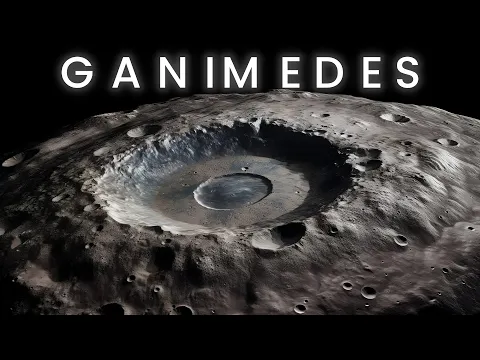
The presence of a magnetic field is one of the main indications that there is a conductive saltwater ocean beneath the surface.
Evidence of the ocean comes from magnetic data and observations from the Hubble Space Telescope
The strongest confirmation of the existence of this ocean did not come from drilling or direct images, but from indirect analyses.
Observations made by Hubble identified oscillations in Ganymede’s magnetic field that could not be explained solely by its solid structure. The observed behavior indicates the presence of a liquid saltwater layer capable of conducting electricity.

This type of evidence is considered robust in planetary science, especially when combined with thermal and structural models. In practice, Ganymede’s ocean was “detected” through its invisible influence on the magnetic field.
Internal structure may contain multiple layers of ice and water
Unlike terrestrial oceans, Ganymede’s ocean is not directly beneath the surface. Models indicate that the moon may have a layered structure, with ice and water alternating over tens or even hundreds of kilometers in depth.
This structure may include:
- outer crust of solid ice
- internal layers of high-pressure ice
- one or more liquid oceans between these layers
This type of configuration creates an environment completely different from any known terrestrial ocean.
JUICE mission seeks to understand the quantity and depth of this water
To answer the main questions about Ganymede, the European Space Agency launched the JUICE (Jupiter Icy Moons Explorer) mission, which has this very moon as one of its main targets.

The mission aims to:
- measure the thickness of the ice crust
- analyze the surface composition
- map the magnetic field with greater precision
- investigate the depth and extent of the ocean
The mission’s arrival at the Jupiter system is expected in the next decade, and the data obtained could redefine our understanding of extraterrestrial oceans.
Ganymede has ceased to be just a distant moon and has become one of the main natural laboratories for studying water outside Earth.
Temperature and pressure create an extreme environment beneath the surface
Although liquid water exists, conditions on Ganymede are far from comparable to those on Earth. The surface temperature can reach about -160 °C, and the pressure in the deep layers is extremely high.
Even in the subsurface ocean, water can be under high-pressure conditions, which alters its physical and chemical properties.
This means that, despite the presence of water, the environment is extremely hostile and still poorly understood.
Comparison with Earth reveals the impressive scale of the reservoir
Earth’s oceans cover about 70% of the planet’s surface, with an average depth of approximately 3.7 km.
On Ganymede, although the water is buried, estimates indicate that the total volume may be greater than Earth’s, considering the global extent of the ocean beneath the crust.
The difference is that, while on Earth water defines the surface environment, on Ganymede it is hidden beneath an ice barrier tens of kilometers thick.
Other worlds with water reinforce Ganymede’s importance in science
Ganymede is not alone. Other moons in the Solar System also show evidence of subsurface oceans, such as Europa and Enceladus. However, Ganymede stands out for:
- its size
- its complex structure
- the possible quantity of water
This makes the moon considered one of the main candidates for studies on large-scale water outside Earth.
Scientific interest goes beyond water and involves the origin of planetary systems
The study of Ganymede is not limited to the search for water. The moon also helps scientists understand:
- formation of giant moons
- interaction between magnetic fields
- thermal evolution of planetary bodies
This information is fundamental to understanding how planetary systems form and evolve. Ganymede functions as a key piece to decipher processes that shape planets and moons throughout the universe.
Given this scenario, what does it mean for so much water to exist outside Earth?
The possibility of a global ocean hidden beneath Ganymede’s surface raises profound questions about the distribution of water in the universe.
While Earth faces challenges related to the management of this resource, other worlds may concentrate even larger quantities in inaccessible forms.
The direct question that remains is: if water can exist in such large volumes outside Earth, to what extent is our planet truly unique within this cosmic scenario?
The mission’s arrival at the Jupiter system is expected in the next decade, and the data obtained could redefine our understanding of extraterrestrial oceans.
Ganymede has ceased to be just a distant moon and has become one of the main natural laboratories for studying water outside Earth.
Temperature and pressure create an extreme environment beneath the surface
Although liquid water exists, conditions on Ganymede are far from comparable to those on Earth. The surface temperature can reach about -160 °C, and the pressure in the deep layers is extremely high.
Even in the subsurface ocean, water can be under high-pressure conditions, which alters its physical and chemical properties.
This means that, despite the presence of water, the environment is extremely hostile and still poorly understood.
Comparison with Earth reveals the impressive scale of the reservoir
Earth’s oceans cover about 70% of the planet’s surface, with an average depth of approximately 3.7 km.
On Ganymede, although the water is buried, estimates indicate that the total volume may be greater than Earth’s, considering the global extent of the ocean beneath the crust.
The difference is that, while on Earth water defines the surface environment, on Ganymede it is hidden beneath an ice barrier tens of kilometers thick.
Other worlds with water reinforce Ganymede’s importance in science
Ganymede is not alone. Other moons in the Solar System also show evidence of subsurface oceans, such as Europa and Enceladus. However, Ganymede stands out for:
- its size
- its complex structure
- the possible quantity of water
This makes the moon considered one of the main candidates for studies on large-scale water outside Earth.
Scientific interest goes beyond water and involves the origin of planetary systems
The study of Ganymede is not limited to the search for water. The moon also helps scientists understand:
- formation of giant moons
- interaction between magnetic fields
- thermal evolution of planetary bodies
This information is fundamental to understanding how planetary systems form and evolve. Ganymede functions as a key piece to decipher processes that shape planets and moons throughout the universe.
Given this scenario, what does it mean for so much water to exist outside Earth?
The possibility of a global ocean hidden beneath Ganymede’s surface raises profound questions about the distribution of water in the universe.
While Earth faces challenges related to the management of this resource, other worlds may concentrate even larger quantities in inaccessible forms.
The direct question that remains is: if water can exist in such large volumes outside Earth, to what extent is our planet truly unique within this cosmic scenario?
Ganymede, the largest moon in the Solar System, may harbor a global ocean with more water than Earth beneath a thick ice crust.
In 2025, scientific models published in the journal Icarus once again placed Ganymede, Jupiter’s largest moon and the largest natural satellite in the Solar System, at the center of the investigation into ocean worlds. The study, available in July 2025, analyzed 128 numerical simulations of thermal circulation in its subsurface ocean, while the European Space Agency, in material published on January 31, 2024, highlighted Ganymede as a central target for the Jupiter Icy Moons Explorer, Juice mission, precisely because of its ice crust, its own magnetic field, and its possible global ocean hidden beneath the surface.
This scenario makes Ganymede one of the most intriguing bodies when it comes to water outside Earth. NASA itself, in a statement on March 12, 2015 based on observations from the Hubble Space Telescope, stated that the moon may harbor a subsurface saltwater ocean with more water than all the water existing on Earth’s surface, buried under an ice crust estimated to be about 150 kilometers thick.
Even frozen on the outside, Ganymede may hold one of the largest liquid reservoirs ever identified in the Solar System, and it is precisely this scale that makes Jupiter’s moon one of the most important targets for the next phase of planetary exploration.
Moon is larger than planet Mercury and has unique characteristics in the Solar System
Ganymede is not just large, it is larger than the planet Mercury itself, with a diameter of about 5,268 km. This dimension allows the body to have a complex internal structure, similar to that of rocky planets.
Furthermore, Ganymede possesses a unique characteristic among known moons: it is the only natural satellite with its own magnetic field. This field interacts with Jupiter’s magnetic field and provides important clues about the moon’s internal structure.
The presence of a magnetic field is one of the main indications that there is a conductive saltwater ocean beneath the surface.
Evidence of the ocean comes from magnetic data and observations from the Hubble Space Telescope
The strongest confirmation of the existence of this ocean did not come from drilling or direct images, but from indirect analyses.
Observations made by Hubble identified oscillations in Ganymede’s magnetic field that could not be explained solely by its solid structure. The observed behavior indicates the presence of a liquid saltwater layer capable of conducting electricity.
This type of evidence is considered robust in planetary science, especially when combined with thermal and structural models. In practice, Ganymede’s ocean was “detected” through its invisible influence on the magnetic field.
Internal structure may contain multiple layers of ice and water
Unlike terrestrial oceans, Ganymede’s ocean is not directly beneath the surface. Models indicate that the moon may have a layered structure, with ice and water alternating over tens or even hundreds of kilometers in depth.
This structure may include:
- outer crust of solid ice
- internal layers of high-pressure ice
- one or more liquid oceans between these layers
This type of configuration creates an environment completely different from any known terrestrial ocean.
JUICE mission seeks to understand the quantity and depth of this water
To answer the main questions about Ganymede, the European Space Agency launched the JUICE (Jupiter Icy Moons Explorer) mission, which has this very moon as one of its main targets.
The mission aims to:
- measure the thickness of the ice crust
- analyze the surface composition
- map the magnetic field with greater precision
- investigate the depth and extent of the ocean
The mission’s arrival at the Jupiter system is expected in the next decade, and the data obtained could redefine our understanding of extraterrestrial oceans.
Ganymede has ceased to be just a distant moon and has become one of the main natural laboratories for studying water outside Earth.
Temperature and pressure create an extreme environment beneath the surface
Although liquid water exists, conditions on Ganymede are far from comparable to those on Earth. The surface temperature can reach about -160 °C, and the pressure in the deep layers is extremely high.
Even in the subsurface ocean, water can be under high-pressure conditions, which alters its physical and chemical properties.
This means that, despite the presence of water, the environment is extremely hostile and still poorly understood.
Comparison with Earth reveals the impressive scale of the reservoir
Earth’s oceans cover about 70% of the planet’s surface, with an average depth of approximately 3.7 km.
On Ganymede, although the water is buried, estimates indicate that the total volume may be greater than Earth’s, considering the global extent of the ocean beneath the crust.
The difference is that, while on Earth water defines the surface environment, on Ganymede it is hidden beneath an ice barrier tens of kilometers thick.
Other worlds with water reinforce Ganymede’s importance in science
Ganymede is not alone. Other moons in the Solar System also show evidence of subsurface oceans, such as Europa and Enceladus. However, Ganymede stands out for:
- its size
- its complex structure
- the possible quantity of water
This makes the moon considered one of the main candidates for studies on large-scale water outside Earth.
Scientific interest goes beyond water and involves the origin of planetary systems
The study of Ganymede is not limited to the search for water. The moon also helps scientists understand:
- formation of giant moons
- interaction between magnetic fields
- thermal evolution of planetary bodies
This information is fundamental to understanding how planetary systems form and evolve. Ganymede functions as a key piece to decipher processes that shape planets and moons throughout the universe.
Given this scenario, what does it mean for so much water to exist outside Earth?
The possibility of a global ocean hidden beneath Ganymede’s surface raises profound questions about the distribution of water in the universe.
While Earth faces challenges related to the management of this resource, other worlds may concentrate even larger quantities in inaccessible forms.
The direct question that remains is: if water can exist in such large volumes outside Earth, to what extent is our planet truly unique within this cosmic scenario?
- measure the thickness of the ice crust
- analyze the surface composition
- map the magnetic field with greater precision
- investigate the depth and extent of the ocean
The mission’s arrival at the Jupiter system is expected in the next decade, and the data obtained could redefine our understanding of extraterrestrial oceans.
Ganymede has ceased to be just a distant moon and has become one of the main natural laboratories for studying water outside Earth.
Temperature and pressure create an extreme environment beneath the surface
Although liquid water exists, conditions on Ganymede are far from comparable to those on Earth. The surface temperature can reach about -160 °C, and the pressure in the deep layers is extremely high.
Even in the subsurface ocean, water can be under high-pressure conditions, which alters its physical and chemical properties.
This means that, despite the presence of water, the environment is extremely hostile and still poorly understood.
Comparison with Earth reveals the impressive scale of the reservoir
Earth’s oceans cover about 70% of the planet’s surface, with an average depth of approximately 3.7 km.
On Ganymede, although the water is buried, estimates indicate that the total volume may be greater than Earth’s, considering the global extent of the ocean beneath the crust.
The difference is that, while on Earth water defines the surface environment, on Ganymede it is hidden beneath an ice barrier tens of kilometers thick.
Other worlds with water reinforce Ganymede’s importance in science
Ganymede is not alone. Other moons in the Solar System also show evidence of subsurface oceans, such as Europa and Enceladus. However, Ganymede stands out for:
- its size
- its complex structure
- the possible quantity of water
This makes the moon considered one of the main candidates for studies on large-scale water outside Earth.
Scientific interest goes beyond water and involves the origin of planetary systems
The study of Ganymede is not limited to the search for water. The moon also helps scientists understand:
- formation of giant moons
- interaction between magnetic fields
- thermal evolution of planetary bodies
This information is fundamental to understanding how planetary systems form and evolve. Ganymede functions as a key piece to decipher processes that shape planets and moons throughout the universe.
Given this scenario, what does it mean for so much water to exist outside Earth?
The possibility of a global ocean hidden beneath Ganymede’s surface raises profound questions about the distribution of water in the universe.
While Earth faces challenges related to the management of this resource, other worlds may concentrate even larger quantities in inaccessible forms.
The direct question that remains is: if water can exist in such large volumes outside Earth, to what extent is our planet truly unique within this cosmic scenario?
Ganymede, the largest moon in the Solar System, may harbor a global ocean with more water than Earth beneath a thick ice crust.
In 2025, scientific models published in the journal Icarus once again placed Ganymede, Jupiter’s largest moon and the largest natural satellite in the Solar System, at the center of the investigation into ocean worlds. The study, available in July 2025, analyzed 128 numerical simulations of thermal circulation in its subsurface ocean, while the European Space Agency, in material published on January 31, 2024, highlighted Ganymede as a central target for the Jupiter Icy Moons Explorer, Juice mission, precisely because of its ice crust, its own magnetic field, and its possible global ocean hidden beneath the surface.
This scenario makes Ganymede one of the most intriguing bodies when it comes to water outside Earth. NASA itself, in a statement on March 12, 2015 based on observations from the Hubble Space Telescope, stated that the moon may harbor a subsurface saltwater ocean with more water than all the water existing on Earth’s surface, buried under an ice crust estimated to be about 150 kilometers thick.
Even frozen on the outside, Ganymede may hold one of the largest liquid reservoirs ever identified in the Solar System, and it is precisely this scale that makes Jupiter’s moon one of the most important targets for the next phase of planetary exploration.
Moon is larger than planet Mercury and has unique characteristics in the Solar System
Ganymede is not just large, it is larger than the planet Mercury itself, with a diameter of about 5,268 km. This dimension allows the body to have a complex internal structure, similar to that of rocky planets.
Furthermore, Ganymede possesses a unique characteristic among known moons: it is the only natural satellite with its own magnetic field. This field interacts with Jupiter’s magnetic field and provides important clues about the moon’s internal structure.
The presence of a magnetic field is one of the main indications that there is a conductive saltwater ocean beneath the surface.
Evidence of the ocean comes from magnetic data and observations from the Hubble Space Telescope
The strongest confirmation of the existence of this ocean did not come from drilling or direct images, but from indirect analyses.
Observations made by Hubble identified oscillations in Ganymede’s magnetic field that could not be explained solely by its solid structure. The observed behavior indicates the presence of a liquid saltwater layer capable of conducting electricity.
This type of evidence is considered robust in planetary science, especially when combined with thermal and structural models. In practice, Ganymede’s ocean was “detected” through its invisible influence on the magnetic field.
Internal structure may contain multiple layers of ice and water
Unlike terrestrial oceans, Ganymede’s ocean is not directly beneath the surface. Models indicate that the moon may have a layered structure, with ice and water alternating over tens or even hundreds of kilometers in depth.
This structure may include:
- outer crust of solid ice
- internal layers of high-pressure ice
- one or more liquid oceans between these layers
This type of configuration creates an environment completely different from any known terrestrial ocean.
JUICE mission seeks to understand the quantity and depth of this water
To answer the main questions about Ganymede, the European Space Agency launched the JUICE (Jupiter Icy Moons Explorer) mission, which has this very moon as one of its main targets.
The mission aims to:
- measure the thickness of the ice crust
- analyze the surface composition
- map the magnetic field with greater precision
- investigate the depth and extent of the ocean
The mission’s arrival at the Jupiter system is expected in the next decade, and the data obtained could redefine our understanding of extraterrestrial oceans.
Ganymede has ceased to be just a distant moon and has become one of the main natural laboratories for studying water outside Earth.
Temperature and pressure create an extreme environment beneath the surface
Although liquid water exists, conditions on Ganymede are far from comparable to those on Earth. The surface temperature can reach about -160 °C, and the pressure in the deep layers is extremely high.
Even in the subsurface ocean, water can be under high-pressure conditions, which alters its physical and chemical properties.
This means that, despite the presence of water, the environment is extremely hostile and still poorly understood.
Comparison with Earth reveals the impressive scale of the reservoir
Earth’s oceans cover about 70% of the planet’s surface, with an average depth of approximately 3.7 km.
On Ganymede, although the water is buried, estimates indicate that the total volume may be greater than Earth’s, considering the global extent of the ocean beneath the crust.
The difference is that, while on Earth water defines the surface environment, on Ganymede it is hidden beneath an ice barrier tens of kilometers thick.
Other worlds with water reinforce Ganymede’s importance in science
Ganymede is not alone. Other moons in the Solar System also show evidence of subsurface oceans, such as Europa and Enceladus. However, Ganymede stands out for:
- its size
- its complex structure
- the possible quantity of water
This makes the moon considered one of the main candidates for studies on large-scale water outside Earth.
Scientific interest goes beyond water and involves the origin of planetary systems
The study of Ganymede is not limited to the search for water. The moon also helps scientists understand:
- formation of giant moons
- interaction between magnetic fields
- thermal evolution of planetary bodies
This information is fundamental to understanding how planetary systems form and evolve. Ganymede functions as a key piece to decipher processes that shape planets and moons throughout the universe.
Given this scenario, what does it mean for so much water to exist outside Earth?
The possibility of a global ocean hidden beneath Ganymede’s surface raises profound questions about the distribution of water in the universe.
While Earth faces challenges related to the management of this resource, other worlds may concentrate even larger quantities in inaccessible forms.
The direct question that remains is: if water can exist in such large volumes outside Earth, to what extent is our planet truly unique within this cosmic scenario?
The mission’s arrival at the Jupiter system is expected in the next decade, and the data obtained could redefine our understanding of extraterrestrial oceans.
Ganymede has ceased to be just a distant moon and has become one of the main natural laboratories for studying water outside Earth.
Temperature and pressure create an extreme environment beneath the surface
Although liquid water exists, conditions on Ganymede are far from comparable to those on Earth. The surface temperature can reach about -160 °C, and the pressure in the deep layers is extremely high.
Even in the subsurface ocean, water can be under high-pressure conditions, which alters its physical and chemical properties.
This means that, despite the presence of water, the environment is extremely hostile and still poorly understood.
Comparison with Earth reveals the impressive scale of the reservoir
Earth’s oceans cover about 70% of the planet’s surface, with an average depth of approximately 3.7 km.
On Ganymede, although the water is buried, estimates indicate that the total volume may be greater than Earth’s, considering the global extent of the ocean beneath the crust.
The difference is that, while on Earth water defines the surface environment, on Ganymede it is hidden beneath an ice barrier tens of kilometers thick.
Other worlds with water reinforce Ganymede’s importance in science
Ganymede is not alone. Other moons in the Solar System also show evidence of subsurface oceans, such as Europa and Enceladus. However, Ganymede stands out for:
- its size
- its complex structure
- the possible quantity of water
This makes the moon considered one of the main candidates for studies on large-scale water outside Earth.
Scientific interest goes beyond water and involves the origin of planetary systems
The study of Ganymede is not limited to the search for water. The moon also helps scientists understand:
- formation of giant moons
- interaction between magnetic fields
- thermal evolution of planetary bodies
This information is fundamental to understanding how planetary systems form and evolve. Ganymede functions as a key piece to decipher processes that shape planets and moons throughout the universe.
Given this scenario, what does it mean for so much water to exist outside Earth?
The possibility of a global ocean hidden beneath Ganymede’s surface raises profound questions about the distribution of water in the universe.
While Earth faces challenges related to the management of this resource, other worlds may concentrate even larger quantities in inaccessible forms.
The direct question that remains is: if water can exist in such large volumes outside Earth, to what extent is our planet truly unique within this cosmic scenario?
- measure the thickness of the ice crust
- analyze the surface composition
- map the magnetic field with greater precision
- investigate the depth and extent of the ocean
The mission’s arrival at the Jupiter system is expected in the next decade, and the data obtained could redefine our understanding of extraterrestrial oceans.
Ganymede has ceased to be just a distant moon and has become one of the main natural laboratories for studying water outside Earth.
Temperature and pressure create an extreme environment beneath the surface
Although liquid water exists, conditions on Ganymede are far from comparable to those on Earth. The surface temperature can reach about -160 °C, and the pressure in the deep layers is extremely high.
Even in the subsurface ocean, water can be under high-pressure conditions, which alters its physical and chemical properties.
This means that, despite the presence of water, the environment is extremely hostile and still poorly understood.
Comparison with Earth reveals the impressive scale of the reservoir
Earth’s oceans cover about 70% of the planet’s surface, with an average depth of approximately 3.7 km.
On Ganymede, although the water is buried, estimates indicate that the total volume may be greater than Earth’s, considering the global extent of the ocean beneath the crust.
The difference is that, while on Earth water defines the surface environment, on Ganymede it is hidden beneath an ice barrier tens of kilometers thick.
Other worlds with water reinforce Ganymede’s importance in science
Ganymede is not alone. Other moons in the Solar System also show evidence of subsurface oceans, such as Europa and Enceladus. However, Ganymede stands out for:
- its size
- its complex structure
- the possible quantity of water
This makes the moon considered one of the main candidates for studies on large-scale water outside Earth.
Scientific interest goes beyond water and involves the origin of planetary systems
The study of Ganymede is not limited to the search for water. The moon also helps scientists understand:
- formation of giant moons
- interaction between magnetic fields
- thermal evolution of planetary bodies
This information is fundamental to understanding how planetary systems form and evolve. Ganymede functions as a key piece to decipher processes that shape planets and moons throughout the universe.
Given this scenario, what does it mean for so much water to exist outside Earth?
The possibility of a global ocean hidden beneath Ganymede’s surface raises profound questions about the distribution of water in the universe.
While Earth faces challenges related to the management of this resource, other worlds may concentrate even larger quantities in inaccessible forms.
The direct question that remains is: if water can exist in such large volumes outside Earth, to what extent is our planet truly unique within this cosmic scenario?
Ganymede, the largest moon in the Solar System, may harbor a global ocean with more water than Earth beneath a thick ice crust.
In 2025, scientific models published in the journal Icarus once again placed Ganymede, Jupiter’s largest moon and the largest natural satellite in the Solar System, at the center of the investigation into ocean worlds. The study, available in July 2025, analyzed 128 numerical simulations of thermal circulation in its subsurface ocean, while the European Space Agency, in material published on January 31, 2024, highlighted Ganymede as a central target for the Jupiter Icy Moons Explorer, Juice mission, precisely because of its ice crust, its own magnetic field, and its possible global ocean hidden beneath the surface.
This scenario makes Ganymede one of the most intriguing bodies when it comes to water outside Earth. NASA itself, in a statement on March 12, 2015 based on observations from the Hubble Space Telescope, stated that the moon may harbor a subsurface saltwater ocean with more water than all the water existing on Earth’s surface, buried under an ice crust estimated to be about 150 kilometers thick.
Even frozen on the outside, Ganymede may hold one of the largest liquid reservoirs ever identified in the Solar System, and it is precisely this scale that makes Jupiter’s moon one of the most important targets for the next phase of planetary exploration.
Moon is larger than planet Mercury and has unique characteristics in the Solar System
Ganymede is not just large, it is larger than the planet Mercury itself, with a diameter of about 5,268 km. This dimension allows the body to have a complex internal structure, similar to that of rocky planets.
Furthermore, Ganymede possesses a unique characteristic among known moons: it is the only natural satellite with its own magnetic field. This field interacts with Jupiter’s magnetic field and provides important clues about the moon’s internal structure.
The presence of a magnetic field is one of the main indications that there is a conductive saltwater ocean beneath the surface.
Evidence of the ocean comes from magnetic data and observations from the Hubble Space Telescope
The strongest confirmation of the existence of this ocean did not come from drilling or direct images, but from indirect analyses.
Observations made by Hubble identified oscillations in Ganymede’s magnetic field that could not be explained solely by its solid structure. The observed behavior indicates the presence of a liquid saltwater layer capable of conducting electricity.
This type of evidence is considered robust in planetary science, especially when combined with thermal and structural models. In practice, Ganymede’s ocean was “detected” through its invisible influence on the magnetic field.
Internal structure may contain multiple layers of ice and water
Unlike terrestrial oceans, Ganymede’s ocean is not directly beneath the surface. Models indicate that the moon may have a layered structure, with ice and water alternating over tens or even hundreds of kilometers in depth.
This structure may include:
- outer crust of solid ice
- internal layers of high-pressure ice
- one or more liquid oceans between these layers
This type of configuration creates an environment completely different from any known terrestrial ocean.
JUICE mission seeks to understand the quantity and depth of this water
To answer the main questions about Ganymede, the European Space Agency launched the JUICE (Jupiter Icy Moons Explorer) mission, which has this very moon as one of its main targets.
The mission aims to:
- measure the thickness of the ice crust
- analyze the surface composition
- map the magnetic field with greater precision
- investigate the depth and extent of the ocean
The mission’s arrival at the Jupiter system is expected in the next decade, and the data obtained could redefine our understanding of extraterrestrial oceans.
Ganymede has ceased to be just a distant moon and has become one of the main natural laboratories for studying water outside Earth.
Temperature and pressure create an extreme environment beneath the surface
Although liquid water exists, conditions on Ganymede are far from comparable to those on Earth. The surface temperature can reach about -160 °C, and the pressure in the deep layers is extremely high.
Even in the subsurface ocean, water can be under high-pressure conditions, which alters its physical and chemical properties.
This means that, despite the presence of water, the environment is extremely hostile and still poorly understood.
Comparison with Earth reveals the impressive scale of the reservoir
Earth’s oceans cover about 70% of the planet’s surface, with an average depth of approximately 3.7 km.
On Ganymede, although the water is buried, estimates indicate that the total volume may be greater than Earth’s, considering the global extent of the ocean beneath the crust.
The difference is that, while on Earth water defines the surface environment, on Ganymede it is hidden beneath an ice barrier tens of kilometers thick.
Other worlds with water reinforce Ganymede’s importance in science
Ganymede is not alone. Other moons in the Solar System also show evidence of subsurface oceans, such as Europa and Enceladus. However, Ganymede stands out for:
- its size
- its complex structure
- the possible quantity of water
This makes the moon considered one of the main candidates for studies on large-scale water outside Earth.
Scientific interest goes beyond water and involves the origin of planetary systems
The study of Ganymede is not limited to the search for water. The moon also helps scientists understand:
- formation of giant moons
- interaction between magnetic fields
- thermal evolution of planetary bodies
This information is fundamental to understanding how planetary systems form and evolve. Ganymede functions as a key piece to decipher processes that shape planets and moons throughout the universe.
Given this scenario, what does it mean for so much water to exist outside Earth?
The possibility of a global ocean hidden beneath Ganymede’s surface raises profound questions about the distribution of water in the universe.
While Earth faces challenges related to the management of this resource, other worlds may concentrate even larger quantities in inaccessible forms.
The direct question that remains is: if water can exist in such large volumes outside Earth, to what extent is our planet truly unique within this cosmic scenario?
- measure the thickness of the ice crust
- analyze the surface composition
- map the magnetic field with greater precision
- investigate the depth and extent of the ocean
The mission’s arrival at the Jupiter system is expected in the next decade, and the data obtained could redefine our understanding of extraterrestrial oceans.
Ganymede has ceased to be just a distant moon and has become one of the main natural laboratories for studying water outside Earth.
Temperature and pressure create an extreme environment beneath the surface
Although liquid water exists, conditions on Ganymede are far from comparable to those on Earth. The surface temperature can reach about -160 °C, and the pressure in the deep layers is extremely high.
Even in the subsurface ocean, water can be under high-pressure conditions, which alters its physical and chemical properties.
This means that, despite the presence of water, the environment is extremely hostile and still poorly understood.
Comparison with Earth reveals the impressive scale of the reservoir
Earth’s oceans cover about 70% of the planet’s surface, with an average depth of approximately 3.7 km.
On Ganymede, although the water is buried, estimates indicate that the total volume may be greater than Earth’s, considering the global extent of the ocean beneath the crust.
The difference is that, while on Earth water defines the surface environment, on Ganymede it is hidden beneath an ice barrier tens of kilometers thick.
Other worlds with water reinforce Ganymede’s importance in science
Ganymede is not alone. Other moons in the Solar System also show evidence of subsurface oceans, such as Europa and Enceladus. However, Ganymede stands out for:
- its size
- its complex structure
- the possible quantity of water
This makes the moon considered one of the main candidates for studies on large-scale water outside Earth.
Scientific interest goes beyond water and involves the origin of planetary systems
The study of Ganymede is not limited to the search for water. The moon also helps scientists understand:
- formation of giant moons
- interaction between magnetic fields
- thermal evolution of planetary bodies
This information is fundamental to understanding how planetary systems form and evolve. Ganymede functions as a key piece to decipher processes that shape planets and moons throughout the universe.
Given this scenario, what does it mean for so much water to exist outside Earth?
The possibility of a global ocean hidden beneath Ganymede’s surface raises profound questions about the distribution of water in the universe.
While Earth faces challenges related to the management of this resource, other worlds may concentrate even larger quantities in inaccessible forms.
The direct question that remains is: if water can exist in such large volumes outside Earth, to what extent is our planet truly unique within this cosmic scenario?
The mission’s arrival at the Jupiter system is expected in the next decade, and the data obtained could redefine our understanding of extraterrestrial oceans.
Ganymede has ceased to be just a distant moon and has become one of the main natural laboratories for studying water outside Earth.
Temperature and pressure create an extreme environment beneath the surface
Although liquid water exists, conditions on Ganymede are far from comparable to those on Earth. The surface temperature can reach about -160 °C, and the pressure in the deep layers is extremely high.
Even in the subsurface ocean, water can be under high-pressure conditions, which alters its physical and chemical properties.
This means that, despite the presence of water, the environment is extremely hostile and still poorly understood.
Comparison with Earth reveals the impressive scale of the reservoir
Earth’s oceans cover about 70% of the planet’s surface, with an average depth of approximately 3.7 km.
On Ganymede, although the water is buried, estimates indicate that the total volume may be greater than Earth’s, considering the global extent of the ocean beneath the crust.
The difference is that, while on Earth water defines the surface environment, on Ganymede it is hidden beneath an ice barrier tens of kilometers thick.
Other worlds with water reinforce Ganymede’s importance in science
Ganymede is not alone. Other moons in the Solar System also show evidence of subsurface oceans, such as Europa and Enceladus. However, Ganymede stands out for:
- its size
- its complex structure
- the possible quantity of water
This makes the moon considered one of the main candidates for studies on large-scale water outside Earth.
Scientific interest goes beyond water and involves the origin of planetary systems
The study of Ganymede is not limited to the search for water. The moon also helps scientists understand:
- formation of giant moons
- interaction between magnetic fields
- thermal evolution of planetary bodies
This information is fundamental to understanding how planetary systems form and evolve. Ganymede functions as a key piece to decipher processes that shape planets and moons throughout the universe.
Given this scenario, what does it mean for so much water to exist outside Earth?
The possibility of a global ocean hidden beneath Ganymede’s surface raises profound questions about the distribution of water in the universe.
While Earth faces challenges related to the management of this resource, other worlds may concentrate even larger quantities in inaccessible forms.
The direct question that remains is: if water can exist in such large volumes outside Earth, to what extent is our planet truly unique within this cosmic scenario?
- measure the thickness of the ice crust
- analyze the surface composition
- map the magnetic field with greater precision
- investigate the depth and extent of the ocean
The mission’s arrival at the Jupiter system is expected in the next decade, and the data obtained could redefine our understanding of extraterrestrial oceans.
Ganymede has ceased to be just a distant moon and has become one of the main natural laboratories for studying water outside Earth.
Temperature and pressure create an extreme environment beneath the surface
Although liquid water exists, conditions on Ganymede are far from comparable to those on Earth. The surface temperature can reach about -160 °C, and the pressure in the deep layers is extremely high.
Even in the subsurface ocean, water can be under high-pressure conditions, which alters its physical and chemical properties.
This means that, despite the presence of water, the environment is extremely hostile and still poorly understood.
Comparison with Earth reveals the impressive scale of the reservoir
Earth’s oceans cover about 70% of the planet’s surface, with an average depth of approximately 3.7 km.
On Ganymede, although the water is buried, estimates indicate that the total volume may be greater than Earth’s, considering the global extent of the ocean beneath the crust.
The difference is that, while on Earth water defines the surface environment, on Ganymede it is hidden beneath an ice barrier tens of kilometers thick.
Other worlds with water reinforce Ganymede’s importance in science
Ganymede is not alone. Other moons in the Solar System also show evidence of subsurface oceans, such as Europa and Enceladus. However, Ganymede stands out for:
- its size
- its complex structure
- the possible quantity of water
This makes the moon considered one of the main candidates for studies on large-scale water outside Earth.
Scientific interest goes beyond water and involves the origin of planetary systems
The study of Ganymede is not limited to the search for water. The moon also helps scientists understand:
- formation of giant moons
- interaction between magnetic fields
- thermal evolution of planetary bodies
This information is fundamental to understanding how planetary systems form and evolve. Ganymede functions as a key piece to decipher processes that shape planets and moons throughout the universe.
Given this scenario, what does it mean for so much water to exist outside Earth?
The possibility of a global ocean hidden beneath Ganymede’s surface raises profound questions about the distribution of water in the universe.
While Earth faces challenges related to the management of this resource, other worlds may concentrate even larger quantities in inaccessible forms.
The direct question that remains is: if water can exist in such large volumes outside Earth, to what extent is our planet truly unique within this cosmic scenario?
Ganymede, the largest moon in the Solar System, may harbor a global ocean with more water than Earth beneath a thick ice crust.
In 2025, scientific models published in the journal Icarus once again placed Ganymede, Jupiter’s largest moon and the largest natural satellite in the Solar System, at the center of the investigation into ocean worlds. The study, available in July 2025, analyzed 128 numerical simulations of thermal circulation in its subsurface ocean, while the European Space Agency, in material published on January 31, 2024, highlighted Ganymede as a central target for the Jupiter Icy Moons Explorer, Juice mission, precisely because of its ice crust, its own magnetic field, and its possible global ocean hidden beneath the surface.
This scenario makes Ganymede one of the most intriguing bodies when it comes to water outside Earth. NASA itself, in a statement on March 12, 2015 based on observations from the Hubble Space Telescope, stated that the moon may harbor a subsurface saltwater ocean with more water than all the water existing on Earth’s surface, buried under an ice crust estimated to be about 150 kilometers thick.
Even frozen on the outside, Ganymede may hold one of the largest liquid reservoirs ever identified in the Solar System, and it is precisely this scale that makes Jupiter’s moon one of the most important targets for the next phase of planetary exploration.
Moon is larger than planet Mercury and has unique characteristics in the Solar System
Ganymede is not just large, it is larger than the planet Mercury itself, with a diameter of about 5,268 km. This dimension allows the body to have a complex internal structure, similar to that of rocky planets.
Furthermore, Ganymede possesses a unique characteristic among known moons: it is the only natural satellite with its own magnetic field. This field interacts with Jupiter’s magnetic field and provides important clues about the moon’s internal structure.
The presence of a magnetic field is one of the main indications that there is a conductive saltwater ocean beneath the surface.
Evidence of the ocean comes from magnetic data and observations from the Hubble Space Telescope
The strongest confirmation of the existence of this ocean did not come from drilling or direct images, but from indirect analyses.
Observations made by Hubble identified oscillations in Ganymede’s magnetic field that could not be explained solely by its solid structure. The observed behavior indicates the presence of a liquid saltwater layer capable of conducting electricity.
This type of evidence is considered robust in planetary science, especially when combined with thermal and structural models. In practice, Ganymede’s ocean was “detected” through its invisible influence on the magnetic field.
Internal structure may contain multiple layers of ice and water
Unlike terrestrial oceans, Ganymede’s ocean is not directly beneath the surface. Models indicate that the moon may have a layered structure, with ice and water alternating over tens or even hundreds of kilometers in depth.
This structure may include:
- outer crust of solid ice
- internal layers of high-pressure ice
- one or more liquid oceans between these layers
This type of configuration creates an environment completely different from any known terrestrial ocean.
JUICE mission seeks to understand the quantity and depth of this water
To answer the main questions about Ganymede, the European Space Agency launched the JUICE (Jupiter Icy Moons Explorer) mission, which has this very moon as one of its main targets.
The mission aims to:
- measure the thickness of the ice crust
- analyze the surface composition
- map the magnetic field with greater precision
- investigate the depth and extent of the ocean
The mission’s arrival at the Jupiter system is expected in the next decade, and the data obtained could redefine our understanding of extraterrestrial oceans.
Ganymede has ceased to be just a distant moon and has become one of the main natural laboratories for studying water outside Earth.
Temperature and pressure create an extreme environment beneath the surface
Although liquid water exists, conditions on Ganymede are far from comparable to those on Earth. The surface temperature can reach about -160 °C, and the pressure in the deep layers is extremely high.
Even in the subsurface ocean, water can be under high-pressure conditions, which alters its physical and chemical properties.
This means that, despite the presence of water, the environment is extremely hostile and still poorly understood.
Comparison with Earth reveals the impressive scale of the reservoir
Earth’s oceans cover about 70% of the planet’s surface, with an average depth of approximately 3.7 km.
On Ganymede, although the water is buried, estimates indicate that the total volume may be greater than Earth’s, considering the global extent of the ocean beneath the crust.
The difference is that, while on Earth water defines the surface environment, on Ganymede it is hidden beneath an ice barrier tens of kilometers thick.
Other worlds with water reinforce Ganymede’s importance in science
Ganymede is not alone. Other moons in the Solar System also show evidence of subsurface oceans, such as Europa and Enceladus. However, Ganymede stands out for:
- its size
- its complex structure
- the possible quantity of water
This makes the moon considered one of the main candidates for studies on large-scale water outside Earth.
Scientific interest goes beyond water and involves the origin of planetary systems
The study of Ganymede is not limited to the search for water. The moon also helps scientists understand:
- formation of giant moons
- interaction between magnetic fields
- thermal evolution of planetary bodies
This information is fundamental to understanding how planetary systems form and evolve. Ganymede functions as a key piece to decipher processes that shape planets and moons throughout the universe.
Given this scenario, what does it mean for so much water to exist outside Earth?
The possibility of a global ocean hidden beneath Ganymede’s surface raises profound questions about the distribution of water in the universe.
While Earth faces challenges related to the management of this resource, other worlds may concentrate even larger quantities in inaccessible forms.
The direct question that remains is: if water can exist in such large volumes outside Earth, to what extent is our planet truly unique within this cosmic scenario?
Ganymede, the largest moon in the Solar System, may harbor a global ocean with more water than Earth beneath a thick ice crust.
In 2025, scientific models published in the journal Icarus once again placed Ganymede, Jupiter’s largest moon and the largest natural satellite in the Solar System, at the center of the investigation into ocean worlds. The study, available in July 2025, analyzed 128 numerical simulations of thermal circulation in its subsurface ocean, while the European Space Agency, in material published on January 31, 2024, highlighted Ganymede as a central target for the Jupiter Icy Moons Explorer, Juice mission, precisely because of its ice crust, its own magnetic field, and its possible global ocean hidden beneath the surface.
This scenario makes Ganymede one of the most intriguing bodies when it comes to water outside Earth. NASA itself, in a statement on March 12, 2015 based on observations from the Hubble Space Telescope, stated that the moon may harbor a subsurface saltwater ocean with more water than all the water existing on Earth’s surface, buried under an ice crust estimated to be about 150 kilometers thick.
Even frozen on the outside, Ganymede may hold one of the largest liquid reservoirs ever identified in the Solar System, and it is precisely this scale that makes Jupiter’s moon one of the most important targets for the next phase of planetary exploration.
Moon is larger than planet Mercury and has unique characteristics in the Solar System
Ganymede is not just large, it is larger than the planet Mercury itself, with a diameter of about 5,268 km. This dimension allows the body to have a complex internal structure, similar to that of rocky planets.
Furthermore, Ganymede possesses a unique characteristic among known moons: it is the only natural satellite with its own magnetic field. This field interacts with Jupiter’s magnetic field and provides important clues about the moon’s internal structure.
The presence of a magnetic field is one of the main indications that there is a conductive saltwater ocean beneath the surface.
Evidence of the ocean comes from magnetic data and observations from the Hubble Space Telescope
The strongest confirmation of the existence of this ocean did not come from drilling or direct images, but from indirect analyses.
Observations made by Hubble identified oscillations in Ganymede’s magnetic field that could not be explained solely by its solid structure. The observed behavior indicates the presence of a liquid saltwater layer capable of conducting electricity.
This type of evidence is considered robust in planetary science, especially when combined with thermal and structural models. In practice, Ganymede’s ocean was “detected” through its invisible influence on the magnetic field.
Internal structure may contain multiple layers of ice and water
Unlike terrestrial oceans, Ganymede’s ocean is not directly beneath the surface. Models indicate that the moon may have a layered structure, with ice and water alternating over tens or even hundreds of kilometers in depth.
This structure may include:
- outer crust of solid ice
- internal layers of high-pressure ice
- one or more liquid oceans between these layers
This type of configuration creates an environment completely different from any known terrestrial ocean.
JUICE mission seeks to understand the quantity and depth of this water
To answer the main questions about Ganymede, the European Space Agency launched the JUICE (Jupiter Icy Moons Explorer) mission, which has this very moon as one of its main targets.
The mission aims to:
- measure the thickness of the ice crust
- analyze the surface composition
- map the magnetic field with greater precision
- investigate the depth and extent of the ocean
The mission’s arrival at the Jupiter system is expected in the next decade, and the data obtained could redefine our understanding of extraterrestrial oceans.
Ganymede has ceased to be just a distant moon and has become one of the main natural laboratories for studying water outside Earth.
Temperature and pressure create an extreme environment beneath the surface
Although liquid water exists, conditions on Ganymede are far from comparable to those on Earth. The surface temperature can reach about -160 °C, and the pressure in the deep layers is extremely high.
Even in the subsurface ocean, water can be under high-pressure conditions, which alters its physical and chemical properties.
This means that, despite the presence of water, the environment is extremely hostile and still poorly understood.
Comparison with Earth reveals the impressive scale of the reservoir
Earth’s oceans cover about 70% of the planet’s surface, with an average depth of approximately 3.7 km.
On Ganymede, although the water is buried, estimates indicate that the total volume may be greater than Earth’s, considering the global extent of the ocean beneath the crust.
The difference is that, while on Earth water defines the surface environment, on Ganymede it is hidden beneath an ice barrier tens of kilometers thick.
Other worlds with water reinforce Ganymede’s importance in science
Ganymede is not alone. Other moons in the Solar System also show evidence of subsurface oceans, such as Europa and Enceladus. However, Ganymede stands out for:
- its size
- its complex structure
- the possible quantity of water
This makes the moon considered one of the main candidates for studies on large-scale water outside Earth.
Scientific interest goes beyond water and involves the origin of planetary systems
The study of Ganymede is not limited to the search for water. The moon also helps scientists understand:
- formation of giant moons
- interaction between magnetic fields
- thermal evolution of planetary bodies
This information is fundamental to understanding how planetary systems form and evolve. Ganymede functions as a key piece to decipher processes that shape planets and moons throughout the universe.
Given this scenario, what does it mean for so much water to exist outside Earth?
The possibility of a global ocean hidden beneath Ganymede’s surface raises profound questions about the distribution of water in the universe.
While Earth faces challenges related to the management of this resource, other worlds may concentrate even larger quantities in inaccessible forms.
The direct question that remains is: if water can exist in such large volumes outside Earth, to what extent is our planet truly unique within this cosmic scenario?
The mission’s arrival at the Jupiter system is expected in the next decade, and the data obtained could redefine our understanding of extraterrestrial oceans.
Ganymede has ceased to be just a distant moon and has become one of the main natural laboratories for studying water outside Earth.
Temperature and pressure create an extreme environment beneath the surface
Although liquid water exists, conditions on Ganymede are far from comparable to those on Earth. The surface temperature can reach about -160 °C, and the pressure in the deep layers is extremely high.
Even in the subsurface ocean, water can be under high-pressure conditions, which alters its physical and chemical properties.
This means that, despite the presence of water, the environment is extremely hostile and still poorly understood.
Comparison with Earth reveals the impressive scale of the reservoir
Earth’s oceans cover about 70% of the planet’s surface, with an average depth of approximately 3.7 km.
On Ganymede, although the water is buried, estimates indicate that the total volume may be greater than Earth’s, considering the global extent of the ocean beneath the crust.
The difference is that, while on Earth water defines the surface environment, on Ganymede it is hidden beneath an ice barrier tens of kilometers thick.
Other worlds with water reinforce Ganymede’s importance in science
Ganymede is not alone. Other moons in the Solar System also show evidence of subsurface oceans, such as Europa and Enceladus. However, Ganymede stands out for:
- its size
- its complex structure
- the possible quantity of water
This makes the moon considered one of the main candidates for studies on large-scale water outside Earth.
Scientific interest goes beyond water and involves the origin of planetary systems
The study of Ganymede is not limited to the search for water. The moon also helps scientists understand:
- formation of giant moons
- interaction between magnetic fields
- thermal evolution of planetary bodies
This information is fundamental to understanding how planetary systems form and evolve. Ganymede functions as a key piece to decipher processes that shape planets and moons throughout the universe.
Given this scenario, what does it mean for so much water to exist outside Earth?
The possibility of a global ocean hidden beneath Ganymede’s surface raises profound questions about the distribution of water in the universe.
While Earth faces challenges related to the management of this resource, other worlds may concentrate even larger quantities in inaccessible forms.
The direct question that remains is: if water can exist in such large volumes outside Earth, to what extent is our planet truly unique within this cosmic scenario?
- measure the thickness of the ice crust
- analyze the surface composition
- map the magnetic field with greater precision
- investigate the depth and extent of the ocean
The mission’s arrival at the Jupiter system is expected in the next decade, and the data obtained could redefine our understanding of extraterrestrial oceans.
Ganymede has ceased to be just a distant moon and has become one of the main natural laboratories for studying water outside Earth.
Temperature and pressure create an extreme environment beneath the surface
Although liquid water exists, conditions on Ganymede are far from comparable to those on Earth. The surface temperature can reach about -160 °C, and the pressure in the deep layers is extremely high.
Even in the subsurface ocean, water can be under high-pressure conditions, which alters its physical and chemical properties.
This means that, despite the presence of water, the environment is extremely hostile and still poorly understood.
Comparison with Earth reveals the impressive scale of the reservoir
Earth’s oceans cover about 70% of the planet’s surface, with an average depth of approximately 3.7 km.
On Ganymede, although the water is buried, estimates indicate that the total volume may be greater than Earth’s, considering the global extent of the ocean beneath the crust.
The difference is that, while on Earth water defines the surface environment, on Ganymede it is hidden beneath an ice barrier tens of kilometers thick.
Other worlds with water reinforce Ganymede’s importance in science
Ganymede is not alone. Other moons in the Solar System also show evidence of subsurface oceans, such as Europa and Enceladus. However, Ganymede stands out for:
- its size
- its complex structure
- the possible quantity of water
This makes the moon considered one of the main candidates for studies on large-scale water outside Earth.
Scientific interest goes beyond water and involves the origin of planetary systems
The study of Ganymede is not limited to the search for water. The moon also helps scientists understand:
- formation of giant moons
- interaction between magnetic fields
- thermal evolution of planetary bodies
This information is fundamental to understanding how planetary systems form and evolve. Ganymede functions as a key piece to decipher processes that shape planets and moons throughout the universe.
Given this scenario, what does it mean for so much water to exist outside Earth?
The possibility of a global ocean hidden beneath Ganymede’s surface raises profound questions about the distribution of water in the universe.
While Earth faces challenges related to the management of this resource, other worlds may concentrate even larger quantities in inaccessible forms.
The direct question that remains is: if water can exist in such large volumes outside Earth, to what extent is our planet truly unique within this cosmic scenario?
Ganymede, the largest moon in the Solar System, may harbor a global ocean with more water than Earth beneath a thick ice crust.
In 2025, scientific models published in the journal Icarus once again placed Ganymede, Jupiter’s largest moon and the largest natural satellite in the Solar System, at the center of the investigation into ocean worlds. The study, available in July 2025, analyzed 128 numerical simulations of thermal circulation in its subsurface ocean, while the European Space Agency, in material published on January 31, 2024, highlighted Ganymede as a central target for the Jupiter Icy Moons Explorer, Juice mission, precisely because of its ice crust, its own magnetic field, and its possible global ocean hidden beneath the surface.
This scenario makes Ganymede one of the most intriguing bodies when it comes to water outside Earth. NASA itself, in a statement on March 12, 2015 based on observations from the Hubble Space Telescope, stated that the moon may harbor a subsurface saltwater ocean with more water than all the water existing on Earth’s surface, buried under an ice crust estimated to be about 150 kilometers thick.
Even frozen on the outside, Ganymede may hold one of the largest liquid reservoirs ever identified in the Solar System, and it is precisely this scale that makes Jupiter’s moon one of the most important targets for the next phase of planetary exploration.
Moon is larger than planet Mercury and has unique characteristics in the Solar System
Ganymede is not just large, it is larger than the planet Mercury itself, with a diameter of about 5,268 km. This dimension allows the body to have a complex internal structure, similar to that of rocky planets.
Furthermore, Ganymede possesses a unique characteristic among known moons: it is the only natural satellite with its own magnetic field. This field interacts with Jupiter’s magnetic field and provides important clues about the moon’s internal structure.
The presence of a magnetic field is one of the main indications that there is a conductive saltwater ocean beneath the surface.
Evidence of the ocean comes from magnetic data and observations from the Hubble Space Telescope
The strongest confirmation of the existence of this ocean did not come from drilling or direct images, but from indirect analyses.
Observations made by Hubble identified oscillations in Ganymede’s magnetic field that could not be explained solely by its solid structure. The observed behavior indicates the presence of a liquid saltwater layer capable of conducting electricity.
This type of evidence is considered robust in planetary science, especially when combined with thermal and structural models. In practice, Ganymede’s ocean was “detected” through its invisible influence on the magnetic field.
Internal structure may contain multiple layers of ice and water
Unlike terrestrial oceans, Ganymede’s ocean is not directly beneath the surface. Models indicate that the moon may have a layered structure, with ice and water alternating over tens or even hundreds of kilometers in depth.
This structure may include:
- outer crust of solid ice
- internal layers of high-pressure ice
- one or more liquid oceans between these layers
This type of configuration creates an environment completely different from any known terrestrial ocean.
JUICE mission seeks to understand the quantity and depth of this water
To answer the main questions about Ganymede, the European Space Agency launched the JUICE (Jupiter Icy Moons Explorer) mission, which has this very moon as one of its main targets.
The mission aims to:
- measure the thickness of the ice crust
- analyze the surface composition
- map the magnetic field with greater precision
- investigate the depth and extent of the ocean
The mission’s arrival at the Jupiter system is expected in the next decade, and the data obtained could redefine our understanding of extraterrestrial oceans.
Ganymede has ceased to be just a distant moon and has become one of the main natural laboratories for studying water outside Earth.
Temperature and pressure create an extreme environment beneath the surface
Although liquid water exists, conditions on Ganymede are far from comparable to those on Earth. The surface temperature can reach about -160 °C, and the pressure in the deep layers is extremely high.
Even in the subsurface ocean, water can be under high-pressure conditions, which alters its physical and chemical properties.
This means that, despite the presence of water, the environment is extremely hostile and still poorly understood.
Comparison with Earth reveals the impressive scale of the reservoir
Earth’s oceans cover about 70% of the planet’s surface, with an average depth of approximately 3.7 km.
On Ganymede, although the water is buried, estimates indicate that the total volume may be greater than Earth’s, considering the global extent of the ocean beneath the crust.
The difference is that, while on Earth water defines the surface environment, on Ganymede it is hidden beneath an ice barrier tens of kilometers thick.
Other worlds with water reinforce Ganymede’s importance in science
Ganymede is not alone. Other moons in the Solar System also show evidence of subsurface oceans, such as Europa and Enceladus. However, Ganymede stands out for:
- its size
- its complex structure
- the possible quantity of water
This makes the moon considered one of the main candidates for studies on large-scale water outside Earth.
Scientific interest goes beyond water and involves the origin of planetary systems
The study of Ganymede is not limited to the search for water. The moon also helps scientists understand:
- formation of giant moons
- interaction between magnetic fields
- thermal evolution of planetary bodies
This information is fundamental to understanding how planetary systems form and evolve. Ganymede functions as a key piece to decipher processes that shape planets and moons throughout the universe.
Given this scenario, what does it mean for so much water to exist outside Earth?
The possibility of a global ocean hidden beneath Ganymede’s surface raises profound questions about the distribution of water in the universe.
While Earth faces challenges related to the management of this resource, other worlds may concentrate even larger quantities in inaccessible forms.
The direct question that remains is: if water can exist in such large volumes outside Earth, to what extent is our planet truly unique within this cosmic scenario?
The mission’s arrival at the Jupiter system is expected in the next decade, and the data obtained could redefine our understanding of extraterrestrial oceans.
Ganymede has ceased to be just a distant moon and has become one of the main natural laboratories for studying water outside Earth.
Temperature and pressure create an extreme environment beneath the surface
Although liquid water exists, conditions on Ganymede are far from comparable to those on Earth. The surface temperature can reach about -160 °C, and the pressure in the deep layers is extremely high.
Even in the subsurface ocean, water can be under high-pressure conditions, which alters its physical and chemical properties.
This means that, despite the presence of water, the environment is extremely hostile and still poorly understood.
Comparison with Earth reveals the impressive scale of the reservoir
Earth’s oceans cover about 70% of the planet’s surface, with an average depth of approximately 3.7 km.
On Ganymede, although the water is buried, estimates indicate that the total volume may be greater than Earth’s, considering the global extent of the ocean beneath the crust.
The difference is that, while on Earth water defines the surface environment, on Ganymede it is hidden beneath an ice barrier tens of kilometers thick.
Other worlds with water reinforce Ganymede’s importance in science
Ganymede is not alone. Other moons in the Solar System also show evidence of subsurface oceans, such as Europa and Enceladus. However, Ganymede stands out for:
- its size
- its complex structure
- the possible quantity of water
This makes the moon considered one of the main candidates for studies on large-scale water outside Earth.
Scientific interest goes beyond water and involves the origin of planetary systems
The study of Ganymede is not limited to the search for water. The moon also helps scientists understand:
- formation of giant moons
- interaction between magnetic fields
- thermal evolution of planetary bodies
This information is fundamental to understanding how planetary systems form and evolve. Ganymede functions as a key piece to decipher processes that shape planets and moons throughout the universe.
Given this scenario, what does it mean for so much water to exist outside Earth?
The possibility of a global ocean hidden beneath Ganymede’s surface raises profound questions about the distribution of water in the universe.
While Earth faces challenges related to the management of this resource, other worlds may concentrate even larger quantities in inaccessible forms.
The direct question that remains is: if water can exist in such large volumes outside Earth, to what extent is our planet truly unique within this cosmic scenario?
Ganymede, the largest moon in the Solar System, may harbor a global ocean with more water than Earth beneath a thick ice crust.
In 2025, scientific models published in the journal Icarus once again placed Ganymede, Jupiter’s largest moon and the largest natural satellite in the Solar System, at the center of the investigation into ocean worlds. The study, available in July 2025, analyzed 128 numerical simulations of thermal circulation in its subsurface ocean, while the European Space Agency, in material published on January 31, 2024, highlighted Ganymede as a central target for the Jupiter Icy Moons Explorer, Juice mission, precisely because of its ice crust, its own magnetic field, and its possible global ocean hidden beneath the surface.
This scenario makes Ganymede one of the most intriguing bodies when it comes to water outside Earth. NASA itself, in a statement on March 12, 2015 based on observations from the Hubble Space Telescope, stated that the moon may harbor a subsurface saltwater ocean with more water than all the water existing on Earth’s surface, buried under an ice crust estimated to be about 150 kilometers thick.
Even frozen on the outside, Ganymede may hold one of the largest liquid reservoirs ever identified in the Solar System, and it is precisely this scale that makes Jupiter’s moon one of the most important targets for the next phase of planetary exploration.
Moon is larger than planet Mercury and has unique characteristics in the Solar System
Ganymede is not just large, it is larger than the planet Mercury itself, with a diameter of about 5,268 km. This dimension allows the body to have a complex internal structure, similar to that of rocky planets.
Furthermore, Ganymede possesses a unique characteristic among known moons: it is the only natural satellite with its own magnetic field. This field interacts with Jupiter’s magnetic field and provides important clues about the moon’s internal structure.
The presence of a magnetic field is one of the main indications that there is a conductive saltwater ocean beneath the surface.
Evidence of the ocean comes from magnetic data and observations from the Hubble Space Telescope
The strongest confirmation of the existence of this ocean did not come from drilling or direct images, but from indirect analyses.
Observations made by Hubble identified oscillations in Ganymede’s magnetic field that could not be explained solely by its solid structure. The observed behavior indicates the presence of a liquid saltwater layer capable of conducting electricity.
This type of evidence is considered robust in planetary science, especially when combined with thermal and structural models. In practice, Ganymede’s ocean was “detected” through its invisible influence on the magnetic field.
Internal structure may contain multiple layers of ice and water
Unlike terrestrial oceans, Ganymede’s ocean is not directly beneath the surface. Models indicate that the moon may have a layered structure, with ice and water alternating over tens or even hundreds of kilometers in depth.
This structure may include:
- outer crust of solid ice
- internal layers of high-pressure ice
- one or more liquid oceans between these layers
This type of configuration creates an environment completely different from any known terrestrial ocean.
JUICE mission seeks to understand the quantity and depth of this water
To answer the main questions about Ganymede, the European Space Agency launched the JUICE (Jupiter Icy Moons Explorer) mission, which has this very moon as one of its main targets.
The mission aims to:
- measure the thickness of the ice crust
- analyze the surface composition
- map the magnetic field with greater precision
- investigate the depth and extent of the ocean
The mission’s arrival at the Jupiter system is expected in the next decade, and the data obtained could redefine our understanding of extraterrestrial oceans.
Ganymede has ceased to be just a distant moon and has become one of the main natural laboratories for studying water outside Earth.
Temperature and pressure create an extreme environment beneath the surface
Although liquid water exists, conditions on Ganymede are far from comparable to those on Earth. The surface temperature can reach about -160 °C, and the pressure in the deep layers is extremely high.
Even in the subsurface ocean, water can be under high-pressure conditions, which alters its physical and chemical properties.
This means that, despite the presence of water, the environment is extremely hostile and still poorly understood.
Comparison with Earth reveals the impressive scale of the reservoir
Earth’s oceans cover about 70% of the planet’s surface, with an average depth of approximately 3.7 km.
On Ganymede, although the water is buried, estimates indicate that the total volume may be greater than Earth’s, considering the global extent of the ocean beneath the crust.
The difference is that, while on Earth water defines the surface environment, on Ganymede it is hidden beneath an ice barrier tens of kilometers thick.
Other worlds with water reinforce Ganymede’s importance in science
Ganymede is not alone. Other moons in the Solar System also show evidence of subsurface oceans, such as Europa and Enceladus. However, Ganymede stands out for:
- its size
- its complex structure
- the possible quantity of water
This makes the moon considered one of the main candidates for studies on large-scale water outside Earth.
Scientific interest goes beyond water and involves the origin of planetary systems
The study of Ganymede is not limited to the search for water. The moon also helps scientists understand:
- formation of giant moons
- interaction between magnetic fields
- thermal evolution of planetary bodies
This information is fundamental to understanding how planetary systems form and evolve. Ganymede functions as a key piece to decipher processes that shape planets and moons throughout the universe.
Given this scenario, what does it mean for so much water to exist outside Earth?
The possibility of a global ocean hidden beneath Ganymede’s surface raises profound questions about the distribution of water in the universe.
While Earth faces challenges related to the management of this resource, other worlds may concentrate even larger quantities in inaccessible forms.
The direct question that remains is: if water can exist in such large volumes outside Earth, to what extent is our planet truly unique within this cosmic scenario?
The mission’s arrival at the Jupiter system is expected in the next decade, and the data obtained could redefine our understanding of extraterrestrial oceans.
Ganymede has ceased to be just a distant moon and has become one of the main natural laboratories for studying water outside Earth.
Temperature and pressure create an extreme environment beneath the surface
Although liquid water exists, conditions on Ganymede are far from comparable to those on Earth. The surface temperature can reach about -160 °C, and the pressure in the deep layers is extremely high.
Even in the subsurface ocean, water can be under high-pressure conditions, which alters its physical and chemical properties.
This means that, despite the presence of water, the environment is extremely hostile and still poorly understood.
Comparison with Earth reveals the impressive scale of the reservoir
Earth’s oceans cover about 70% of the planet’s surface, with an average depth of approximately 3.7 km.
On Ganymede, although the water is buried, estimates indicate that the total volume may be greater than Earth’s, considering the global extent of the ocean beneath the crust.
The difference is that, while on Earth water defines the surface environment, on Ganymede it is hidden beneath an ice barrier tens of kilometers thick.
Other worlds with water reinforce Ganymede’s importance in science
Ganymede is not alone. Other moons in the Solar System also show evidence of subsurface oceans, such as Europa and Enceladus. However, Ganymede stands out for:
- its size
- its complex structure
- the possible quantity of water
This makes the moon considered one of the main candidates for studies on large-scale water outside Earth.
Scientific interest goes beyond water and involves the origin of planetary systems
The study of Ganymede is not limited to the search for water. The moon also helps scientists understand:
- formation of giant moons
- interaction between magnetic fields
- thermal evolution of planetary bodies
This information is fundamental to understanding how planetary systems form and evolve. Ganymede functions as a key piece to decipher processes that shape planets and moons throughout the universe.
Given this scenario, what does it mean for so much water to exist outside Earth?
The possibility of a global ocean hidden beneath Ganymede’s surface raises profound questions about the distribution of water in the universe.
While Earth faces challenges related to the management of this resource, other worlds may concentrate even larger quantities in inaccessible forms.
The direct question that remains is: if water can exist in such large volumes outside Earth, to what extent is our planet truly unique within this cosmic scenario?
- measure the thickness of the ice crust
- analyze the surface composition
- map the magnetic field with greater precision
- investigate the depth and extent of the ocean
The mission’s arrival at the Jupiter system is expected in the next decade, and the data obtained could redefine our understanding of extraterrestrial oceans.
Ganymede has ceased to be just a distant moon and has become one of the main natural laboratories for studying water outside Earth.
Temperature and pressure create an extreme environment beneath the surface
Although liquid water exists, conditions on Ganymede are far from comparable to those on Earth. The surface temperature can reach about -160 °C, and the pressure in the deep layers is extremely high.
Even in the subsurface ocean, water can be under high-pressure conditions, which alters its physical and chemical properties.
This means that, despite the presence of water, the environment is extremely hostile and still poorly understood.
Comparison with Earth reveals the impressive scale of the reservoir
Earth’s oceans cover about 70% of the planet’s surface, with an average depth of approximately 3.7 km.
On Ganymede, although the water is buried, estimates indicate that the total volume may be greater than Earth’s, considering the global extent of the ocean beneath the crust.
The difference is that, while on Earth water defines the surface environment, on Ganymede it is hidden beneath an ice barrier tens of kilometers thick.
Other worlds with water reinforce Ganymede’s importance in science
Ganymede is not alone. Other moons in the Solar System also show evidence of subsurface oceans, such as Europa and Enceladus. However, Ganymede stands out for:
- its size
- its complex structure
- the possible quantity of water
This makes the moon considered one of the main candidates for studies on large-scale water outside Earth.
Scientific interest goes beyond water and involves the origin of planetary systems
The study of Ganymede is not limited to the search for water. The moon also helps scientists understand:
- formation of giant moons
- interaction between magnetic fields
- thermal evolution of planetary bodies
This information is fundamental to understanding how planetary systems form and evolve. Ganymede functions as a key piece to decipher processes that shape planets and moons throughout the universe.
Given this scenario, what does it mean for so much water to exist outside Earth?
The possibility of a global ocean hidden beneath Ganymede’s surface raises profound questions about the distribution of water in the universe.
While Earth faces challenges related to the management of this resource, other worlds may concentrate even larger quantities in inaccessible forms.
The direct question that remains is: if water can exist in such large volumes outside Earth, to what extent is our planet truly unique within this cosmic scenario?
Ganymede, the largest moon in the Solar System, may harbor a global ocean with more water than Earth beneath a thick ice crust.
In 2025, scientific models published in the journal Icarus once again placed Ganymede, Jupiter’s largest moon and the largest natural satellite in the Solar System, at the center of the investigation into ocean worlds. The study, available in July 2025, analyzed 128 numerical simulations of thermal circulation in its subsurface ocean, while the European Space Agency, in material published on January 31, 2024, highlighted Ganymede as a central target for the Jupiter Icy Moons Explorer, Juice mission, precisely because of its ice crust, its own magnetic field, and its possible global ocean hidden beneath the surface.
This scenario makes Ganymede one of the most intriguing bodies when it comes to water outside Earth. NASA itself, in a statement on March 12, 2015 based on observations from the Hubble Space Telescope, stated that the moon may harbor a subsurface saltwater ocean with more water than all the water existing on Earth’s surface, buried under an ice crust estimated to be about 150 kilometers thick.
Even frozen on the outside, Ganymede may hold one of the largest liquid reservoirs ever identified in the Solar System, and it is precisely this scale that makes Jupiter’s moon one of the most important targets for the next phase of planetary exploration.
Moon is larger than planet Mercury and has unique characteristics in the Solar System
Ganymede is not just large, it is larger than the planet Mercury itself, with a diameter of about 5,268 km. This dimension allows the body to have a complex internal structure, similar to that of rocky planets.
Furthermore, Ganymede possesses a unique characteristic among known moons: it is the only natural satellite with its own magnetic field. This field interacts with Jupiter’s magnetic field and provides important clues about the moon’s internal structure.
The presence of a magnetic field is one of the main indications that there is a conductive saltwater ocean beneath the surface.
Evidence of the ocean comes from magnetic data and observations from the Hubble Space Telescope
The strongest confirmation of the existence of this ocean did not come from drilling or direct images, but from indirect analyses.
Observations made by Hubble identified oscillations in Ganymede’s magnetic field that could not be explained solely by its solid structure. The observed behavior indicates the presence of a liquid saltwater layer capable of conducting electricity.
This type of evidence is considered robust in planetary science, especially when combined with thermal and structural models. In practice, Ganymede’s ocean was “detected” through its invisible influence on the magnetic field.
Internal structure may contain multiple layers of ice and water
Unlike terrestrial oceans, Ganymede’s ocean is not directly beneath the surface. Models indicate that the moon may have a layered structure, with ice and water alternating over tens or even hundreds of kilometers in depth.
This structure may include:
- outer crust of solid ice
- internal layers of high-pressure ice
- one or more liquid oceans between these layers
This type of configuration creates an environment completely different from any known terrestrial ocean.
JUICE mission seeks to understand the quantity and depth of this water
To answer the main questions about Ganymede, the European Space Agency launched the JUICE (Jupiter Icy Moons Explorer) mission, which has this very moon as one of its main targets.
The mission aims to:
- measure the thickness of the ice crust
- analyze the surface composition
- map the magnetic field with greater precision
- investigate the depth and extent of the ocean
The mission’s arrival at the Jupiter system is expected in the next decade, and the data obtained could redefine our understanding of extraterrestrial oceans.
Ganymede has ceased to be just a distant moon and has become one of the main natural laboratories for studying water outside Earth.
Temperature and pressure create an extreme environment beneath the surface
Although liquid water exists, conditions on Ganymede are far from comparable to those on Earth. The surface temperature can reach about -160 °C, and the pressure in the deep layers is extremely high.
Even in the subsurface ocean, water can be under high-pressure conditions, which alters its physical and chemical properties.
This means that, despite the presence of water, the environment is extremely hostile and still poorly understood.
Comparison with Earth reveals the impressive scale of the reservoir
Earth’s oceans cover about 70% of the planet’s surface, with an average depth of approximately 3.7 km.
On Ganymede, although the water is buried, estimates indicate that the total volume may be greater than Earth’s, considering the global extent of the ocean beneath the crust.
The difference is that, while on Earth water defines the surface environment, on Ganymede it is hidden beneath an ice barrier tens of kilometers thick.
Other worlds with water reinforce Ganymede’s importance in science
Ganymede is not alone. Other moons in the Solar System also show evidence of subsurface oceans, such as Europa and Enceladus. However, Ganymede stands out for:
- its size
- its complex structure
- the possible quantity of water
This makes the moon considered one of the main candidates for studies on large-scale water outside Earth.
Scientific interest goes beyond water and involves the origin of planetary systems
The study of Ganymede is not limited to the search for water. The moon also helps scientists understand:
- formation of giant moons
- interaction between magnetic fields
- thermal evolution of planetary bodies
This information is fundamental to understanding how planetary systems form and evolve. Ganymede functions as a key piece to decipher processes that shape planets and moons throughout the universe.
Given this scenario, what does it mean for so much water to exist outside Earth?
The possibility of a global ocean hidden beneath Ganymede’s surface raises profound questions about the distribution of water in the universe.
While Earth faces challenges related to the management of this resource, other worlds may concentrate even larger quantities in inaccessible forms.
The direct question that remains is: if water can exist in such large volumes outside Earth, to what extent is our planet truly unique within this cosmic scenario?
- measure the thickness of the ice crust
- analyze the surface composition
- map the magnetic field with greater precision
- investigate the depth and extent of the ocean
The mission’s arrival at the Jupiter system is expected in the next decade, and the data obtained could redefine our understanding of extraterrestrial oceans.
Ganymede has ceased to be just a distant moon and has become one of the main natural laboratories for studying water outside Earth.
Temperature and pressure create an extreme environment beneath the surface
Although liquid water exists, conditions on Ganymede are far from comparable to those on Earth. The surface temperature can reach about -160 °C, and the pressure in the deep layers is extremely high.
Even in the subsurface ocean, water can be under high-pressure conditions, which alters its physical and chemical properties.
This means that, despite the presence of water, the environment is extremely hostile and still poorly understood.
Comparison with Earth reveals the impressive scale of the reservoir
Earth’s oceans cover about 70% of the planet’s surface, with an average depth of approximately 3.7 km.
On Ganymede, although the water is buried, estimates indicate that the total volume may be greater than Earth’s, considering the global extent of the ocean beneath the crust.
The difference is that, while on Earth water defines the surface environment, on Ganymede it is hidden beneath an ice barrier tens of kilometers thick.
Other worlds with water reinforce Ganymede’s importance in science
Ganymede is not alone. Other moons in the Solar System also show evidence of subsurface oceans, such as Europa and Enceladus. However, Ganymede stands out for:
- its size
- its complex structure
- the possible quantity of water
This makes the moon considered one of the main candidates for studies on large-scale water outside Earth.
Scientific interest goes beyond water and involves the origin of planetary systems
The study of Ganymede is not limited to the search for water. The moon also helps scientists understand:
- formation of giant moons
- interaction between magnetic fields
- thermal evolution of planetary bodies
This information is fundamental to understanding how planetary systems form and evolve. Ganymede functions as a key piece to decipher processes that shape planets and moons throughout the universe.
Given this scenario, what does it mean for so much water to exist outside Earth?
The possibility of a global ocean hidden beneath Ganymede’s surface raises profound questions about the distribution of water in the universe.
While Earth faces challenges related to the management of this resource, other worlds may concentrate even larger quantities in inaccessible forms.
The direct question that remains is: if water can exist in such large volumes outside Earth, to what extent is our planet truly unique within this cosmic scenario?
Ganymede, the largest moon in the Solar System, may harbor a global ocean with more water than Earth beneath a thick ice crust.
In 2025, scientific models published in the journal Icarus once again placed Ganymede, Jupiter’s largest moon and the largest natural satellite in the Solar System, at the center of the investigation into ocean worlds. The study, available in July 2025, analyzed 128 numerical simulations of thermal circulation in its subsurface ocean, while the European Space Agency, in material published on January 31, 2024, highlighted Ganymede as a central target for the Jupiter Icy Moons Explorer, Juice mission, precisely because of its ice crust, its own magnetic field, and its possible global ocean hidden beneath the surface.
This scenario makes Ganymede one of the most intriguing bodies when it comes to water outside Earth. NASA itself, in a statement on March 12, 2015 based on observations from the Hubble Space Telescope, stated that the moon may harbor a subsurface saltwater ocean with more water than all the water existing on Earth’s surface, buried under an ice crust estimated to be about 150 kilometers thick.
Even frozen on the outside, Ganymede may hold one of the largest liquid reservoirs ever identified in the Solar System, and it is precisely this scale that makes Jupiter’s moon one of the most important targets for the next phase of planetary exploration.
Moon is larger than planet Mercury and has unique characteristics in the Solar System
Ganymede is not just large, it is larger than the planet Mercury itself, with a diameter of about 5,268 km. This dimension allows the body to have a complex internal structure, similar to that of rocky planets.
Furthermore, Ganymede possesses a unique characteristic among known moons: it is the only natural satellite with its own magnetic field. This field interacts with Jupiter’s magnetic field and provides important clues about the moon’s internal structure.
The presence of a magnetic field is one of the main indications that there is a conductive saltwater ocean beneath the surface.
Evidence of the ocean comes from magnetic data and observations from the Hubble Space Telescope
The strongest confirmation of the existence of this ocean did not come from drilling or direct images, but from indirect analyses.
Observations made by Hubble identified oscillations in Ganymede’s magnetic field that could not be explained solely by its solid structure. The observed behavior indicates the presence of a liquid saltwater layer capable of conducting electricity.
This type of evidence is considered robust in planetary science, especially when combined with thermal and structural models. In practice, Ganymede’s ocean was “detected” through its invisible influence on the magnetic field.
Internal structure may contain multiple layers of ice and water
Unlike terrestrial oceans, Ganymede’s ocean is not directly beneath the surface. Models indicate that the moon may have a layered structure, with ice and water alternating over tens or even hundreds of kilometers in depth.
This structure may include:
- outer crust of solid ice
- internal layers of high-pressure ice
- one or more liquid oceans between these layers
This type of configuration creates an environment completely different from any known terrestrial ocean.
JUICE mission seeks to understand the quantity and depth of this water
To answer the main questions about Ganymede, the European Space Agency launched the JUICE (Jupiter Icy Moons Explorer) mission, which has this very moon as one of its main targets.
The mission aims to:
- measure the thickness of the ice crust
- analyze the surface composition
- map the magnetic field with greater precision
- investigate the depth and extent of the ocean
The mission’s arrival at the Jupiter system is expected in the next decade, and the data obtained could redefine our understanding of extraterrestrial oceans.
Ganymede has ceased to be just a distant moon and has become one of the main natural laboratories for studying water outside Earth.
Temperature and pressure create an extreme environment beneath the surface
Although liquid water exists, conditions on Ganymede are far from comparable to those on Earth. The surface temperature can reach about -160 °C, and the pressure in the deep layers is extremely high.
Even in the subsurface ocean, water can be under high-pressure conditions, which alters its physical and chemical properties.
This means that, despite the presence of water, the environment is extremely hostile and still poorly understood.
Comparison with Earth reveals the impressive scale of the reservoir
Earth’s oceans cover about 70% of the planet’s surface, with an average depth of approximately 3.7 km.
On Ganymede, although the water is buried, estimates indicate that the total volume may be greater than Earth’s, considering the global extent of the ocean beneath the crust.
The difference is that, while on Earth water defines the surface environment, on Ganymede it is hidden beneath an ice barrier tens of kilometers thick.
Other worlds with water reinforce Ganymede’s importance in science
Ganymede is not alone. Other moons in the Solar System also show evidence of subsurface oceans, such as Europa and Enceladus. However, Ganymede stands out for:
- its size
- its complex structure
- the possible quantity of water
This makes the moon considered one of the main candidates for studies on large-scale water outside Earth.
Scientific interest goes beyond water and involves the origin of planetary systems
The study of Ganymede is not limited to the search for water. The moon also helps scientists understand:
- formation of giant moons
- interaction between magnetic fields
- thermal evolution of planetary bodies
This information is fundamental to understanding how planetary systems form and evolve. Ganymede functions as a key piece to decipher processes that shape planets and moons throughout the universe.
Given this scenario, what does it mean for so much water to exist outside Earth?
The possibility of a global ocean hidden beneath Ganymede’s surface raises profound questions about the distribution of water in the universe.
While Earth faces challenges related to the management of this resource, other worlds may concentrate even larger quantities in inaccessible forms.
The direct question that remains is: if water can exist in such large volumes outside Earth, to what extent is our planet truly unique within this cosmic scenario?
The mission’s arrival at the Jupiter system is expected in the next decade, and the data obtained could redefine our understanding of extraterrestrial oceans.
Ganymede has ceased to be just a distant moon and has become one of the main natural laboratories for studying water outside Earth.
Temperature and pressure create an extreme environment beneath the surface
Although liquid water exists, conditions on Ganymede are far from comparable to those on Earth. The surface temperature can reach about -160 °C, and the pressure in the deep layers is extremely high.
Even in the subsurface ocean, water can be under high-pressure conditions, which alters its physical and chemical properties.
This means that, despite the presence of water, the environment is extremely hostile and still poorly understood.
Comparison with Earth reveals the impressive scale of the reservoir
Earth’s oceans cover about 70% of the planet’s surface, with an average depth of approximately 3.7 km.
On Ganymede, although the water is buried, estimates indicate that the total volume may be greater than Earth’s, considering the global extent of the ocean beneath the crust.
The difference is that, while on Earth water defines the surface environment, on Ganymede it is hidden beneath an ice barrier tens of kilometers thick.
Other worlds with water reinforce Ganymede’s importance in science
Ganymede is not alone. Other moons in the Solar System also show evidence of subsurface oceans, such as Europa and Enceladus. However, Ganymede stands out for:
- its size
- its complex structure
- the possible quantity of water
This makes the moon considered one of the main candidates for studies on large-scale water outside Earth.
Scientific interest goes beyond water and involves the origin of planetary systems
The study of Ganymede is not limited to the search for water. The moon also helps scientists understand:
- formation of giant moons
- interaction between magnetic fields
- thermal evolution of planetary bodies
This information is fundamental to understanding how planetary systems form and evolve. Ganymede functions as a key piece to decipher processes that shape planets and moons throughout the universe.
Given this scenario, what does it mean for so much water to exist outside Earth?
The possibility of a global ocean hidden beneath Ganymede’s surface raises profound questions about the distribution of water in the universe.
While Earth faces challenges related to the management of this resource, other worlds may concentrate even larger quantities in inaccessible forms.
The direct question that remains is: if water can exist in such large volumes outside Earth, to what extent is our planet truly unique within this cosmic scenario?
- measure the thickness of the ice crust
- analyze the surface composition
- map the magnetic field with greater precision
- investigate the depth and extent of the ocean
The mission’s arrival at the Jupiter system is expected in the next decade, and the data obtained could redefine our understanding of extraterrestrial oceans.
Ganymede has ceased to be just a distant moon and has become one of the main natural laboratories for studying water outside Earth.
Temperature and pressure create an extreme environment beneath the surface
Although liquid water exists, conditions on Ganymede are far from comparable to those on Earth. The surface temperature can reach about -160 °C, and the pressure in the deep layers is extremely high.
Even in the subsurface ocean, water can be under high-pressure conditions, which alters its physical and chemical properties.
This means that, despite the presence of water, the environment is extremely hostile and still poorly understood.
Comparison with Earth reveals the impressive scale of the reservoir
Earth’s oceans cover about 70% of the planet’s surface, with an average depth of approximately 3.7 km.
On Ganymede, although the water is buried, estimates indicate that the total volume may be greater than Earth’s, considering the global extent of the ocean beneath the crust.
The difference is that, while on Earth water defines the surface environment, on Ganymede it is hidden beneath an ice barrier tens of kilometers thick.
Other worlds with water reinforce Ganymede’s importance in science
Ganymede is not alone. Other moons in the Solar System also show evidence of subsurface oceans, such as Europa and Enceladus. However, Ganymede stands out for:
- its size
- its complex structure
- the possible quantity of water
This makes the moon considered one of the main candidates for studies on large-scale water outside Earth.
Scientific interest goes beyond water and involves the origin of planetary systems
The study of Ganymede is not limited to the search for water. The moon also helps scientists understand:
- formation of giant moons
- interaction between magnetic fields
- thermal evolution of planetary bodies
This information is fundamental to understanding how planetary systems form and evolve. Ganymede functions as a key piece to decipher processes that shape planets and moons throughout the universe.
Given this scenario, what does it mean for so much water to exist outside Earth?
The possibility of a global ocean hidden beneath Ganymede’s surface raises profound questions about the distribution of water in the universe.
While Earth faces challenges related to the management of this resource, other worlds may concentrate even larger quantities in inaccessible forms.
The direct question that remains is: if water can exist in such large volumes outside Earth, to what extent is our planet truly unique within this cosmic scenario?
Ganymede, the largest moon in the Solar System, may harbor a global ocean with more water than Earth beneath a thick ice crust.
In 2025, scientific models published in the journal Icarus once again placed Ganymede, Jupiter’s largest moon and the largest natural satellite in the Solar System, at the center of the investigation into ocean worlds. The study, available in July 2025, analyzed 128 numerical simulations of thermal circulation in its subsurface ocean, while the European Space Agency, in material published on January 31, 2024, highlighted Ganymede as a central target for the Jupiter Icy Moons Explorer, Juice mission, precisely because of its ice crust, its own magnetic field, and its possible global ocean hidden beneath the surface.
This scenario makes Ganymede one of the most intriguing bodies when it comes to water outside Earth. NASA itself, in a statement on March 12, 2015 based on observations from the Hubble Space Telescope, stated that the moon may harbor a subsurface saltwater ocean with more water than all the water existing on Earth’s surface, buried under an ice crust estimated to be about 150 kilometers thick.
Even frozen on the outside, Ganymede may hold one of the largest liquid reservoirs ever identified in the Solar System, and it is precisely this scale that makes Jupiter’s moon one of the most important targets for the next phase of planetary exploration.
Moon is larger than planet Mercury and has unique characteristics in the Solar System
Ganymede is not just large, it is larger than the planet Mercury itself, with a diameter of about 5,268 km. This dimension allows the body to have a complex internal structure, similar to that of rocky planets.
Furthermore, Ganymede possesses a unique characteristic among known moons: it is the only natural satellite with its own magnetic field. This field interacts with Jupiter’s magnetic field and provides important clues about the moon’s internal structure.
The presence of a magnetic field is one of the main indications that there is a conductive saltwater ocean beneath the surface.
Evidence of the ocean comes from magnetic data and observations from the Hubble Space Telescope
The strongest confirmation of the existence of this ocean did not come from drilling or direct images, but from indirect analyses.
Observations made by Hubble identified oscillations in Ganymede’s magnetic field that could not be explained solely by its solid structure. The observed behavior indicates the presence of a liquid saltwater layer capable of conducting electricity.
This type of evidence is considered robust in planetary science, especially when combined with thermal and structural models. In practice, Ganymede’s ocean was “detected” through its invisible influence on the magnetic field.
Internal structure may contain multiple layers of ice and water
Unlike terrestrial oceans, Ganymede’s ocean is not directly beneath the surface. Models indicate that the moon may have a layered structure, with ice and water alternating over tens or even hundreds of kilometers in depth.
This structure may include:
- outer crust of solid ice
- internal layers of high-pressure ice
- one or more liquid oceans between these layers
This type of configuration creates an environment completely different from any known terrestrial ocean.
JUICE mission seeks to understand the quantity and depth of this water
To answer the main questions about Ganymede, the European Space Agency launched the JUICE (Jupiter Icy Moons Explorer) mission, which has this very moon as one of its main targets.
The mission aims to:
- measure the thickness of the ice crust
- analyze the surface composition
- map the magnetic field with greater precision
- investigate the depth and extent of the ocean
The mission’s arrival at the Jupiter system is expected in the next decade, and the data obtained could redefine our understanding of extraterrestrial oceans.
Ganymede has ceased to be just a distant moon and has become one of the main natural laboratories for studying water outside Earth.
Temperature and pressure create an extreme environment beneath the surface
Although liquid water exists, conditions on Ganymede are far from comparable to those on Earth. The surface temperature can reach about -160 °C, and the pressure in the deep layers is extremely high.
Even in the subsurface ocean, water can be under high-pressure conditions, which alters its physical and chemical properties.
This means that, despite the presence of water, the environment is extremely hostile and still poorly understood.
Comparison with Earth reveals the impressive scale of the reservoir
Earth’s oceans cover about 70% of the planet’s surface, with an average depth of approximately 3.7 km.
On Ganymede, although the water is buried, estimates indicate that the total volume may be greater than Earth’s, considering the global extent of the ocean beneath the crust.
The difference is that, while on Earth water defines the surface environment, on Ganymede it is hidden beneath an ice barrier tens of kilometers thick.
Other worlds with water reinforce Ganymede’s importance in science
Ganymede is not alone. Other moons in the Solar System also show evidence of subsurface oceans, such as Europa and Enceladus. However, Ganymede stands out for:
- its size
- its complex structure
- the possible quantity of water
This makes the moon considered one of the main candidates for studies on large-scale water outside Earth.
Scientific interest goes beyond water and involves the origin of planetary systems
The study of Ganymede is not limited to the search for water. The moon also helps scientists understand:
- formation of giant moons
- interaction between magnetic fields
- thermal evolution of planetary bodies
This information is fundamental to understanding how planetary systems form and evolve. Ganymede functions as a key piece to decipher processes that shape planets and moons throughout the universe.
Given this scenario, what does it mean for so much water to exist outside Earth?
The possibility of a global ocean hidden beneath Ganymede’s surface raises profound questions about the distribution of water in the universe.
While Earth faces challenges related to the management of this resource, other worlds may concentrate even larger quantities in inaccessible forms.
The direct question that remains is: if water can exist in such large volumes outside Earth, to what extent is our planet truly unique within this cosmic scenario?
- measure the thickness of the ice crust
- analyze the surface composition
- map the magnetic field with greater precision
- investigate the depth and extent of the ocean
The mission’s arrival at the Jupiter system is expected in the next decade, and the data obtained could redefine our understanding of extraterrestrial oceans.
Ganymede has ceased to be just a distant moon and has become one of the main natural laboratories for studying water outside Earth.
Temperature and pressure create an extreme environment beneath the surface
Although liquid water exists, conditions on Ganymede are far from comparable to those on Earth. The surface temperature can reach about -160 °C, and the pressure in the deep layers is extremely high.
Even in the subsurface ocean, water can be under high-pressure conditions, which alters its physical and chemical properties.
This means that, despite the presence of water, the environment is extremely hostile and still poorly understood.
Comparison with Earth reveals the impressive scale of the reservoir
Earth’s oceans cover about 70% of the planet’s surface, with an average depth of approximately 3.7 km.
On Ganymede, although the water is buried, estimates indicate that the total volume may be greater than Earth’s, considering the global extent of the ocean beneath the crust.
The difference is that, while on Earth water defines the surface environment, on Ganymede it is hidden beneath an ice barrier tens of kilometers thick.
Other worlds with water reinforce Ganymede’s importance in science
Ganymede is not alone. Other moons in the Solar System also show evidence of subsurface oceans, such as Europa and Enceladus. However, Ganymede stands out for:
- its size
- its complex structure
- the possible quantity of water
This makes the moon considered one of the main candidates for studies on large-scale water outside Earth.
Scientific interest goes beyond water and involves the origin of planetary systems
The study of Ganymede is not limited to the search for water. The moon also helps scientists understand:
- formation of giant moons
- interaction between magnetic fields
- thermal evolution of planetary bodies
This information is fundamental to understanding how planetary systems form and evolve. Ganymede functions as a key piece to decipher processes that shape planets and moons throughout the universe.
Given this scenario, what does it mean for so much water to exist outside Earth?
The possibility of a global ocean hidden beneath Ganymede’s surface raises profound questions about the distribution of water in the universe.
While Earth faces challenges related to the management of this resource, other worlds may concentrate even larger quantities in inaccessible forms.
The direct question that remains is: if water can exist in such large volumes outside Earth, to what extent is our planet truly unique within this cosmic scenario?
- measure the thickness of the ice crust
- analyze the surface composition
- map the magnetic field with greater precision
- investigate the depth and extent of the ocean
The mission’s arrival at the Jupiter system is expected in the next decade, and the data obtained could redefine our understanding of extraterrestrial oceans.
Ganymede has ceased to be just a distant moon and has become one of the main natural laboratories for studying water outside Earth.
Temperature and pressure create an extreme environment beneath the surface
Although liquid water exists, conditions on Ganymede are far from comparable to those on Earth. The surface temperature can reach about -160 °C, and the pressure in the deep layers is extremely high.
Even in the subsurface ocean, water can be under high-pressure conditions, which alters its physical and chemical properties.
This means that, despite the presence of water, the environment is extremely hostile and still poorly understood.
Comparison with Earth reveals the impressive scale of the reservoir
Earth’s oceans cover about 70% of the planet’s surface, with an average depth of approximately 3.7 km.
On Ganymede, although the water is buried, estimates indicate that the total volume may be greater than Earth’s, considering the global extent of the ocean beneath the crust.
The difference is that, while on Earth water defines the surface environment, on Ganymede it is hidden beneath an ice barrier tens of kilometers thick.
Other worlds with water reinforce Ganymede’s importance in science
Ganymede is not alone. Other moons in the Solar System also show evidence of subsurface oceans, such as Europa and Enceladus. However, Ganymede stands out for:
- its size
- its complex structure
- the possible quantity of water
This makes the moon considered one of the main candidates for studies on large-scale water outside Earth.
Scientific interest goes beyond water and involves the origin of planetary systems
The study of Ganymede is not limited to the search for water. The moon also helps scientists understand:
- formation of giant moons
- interaction between magnetic fields
- thermal evolution of planetary bodies
This information is fundamental to understanding how planetary systems form and evolve. Ganymede functions as a key piece to decipher processes that shape planets and moons throughout the universe.
Given this scenario, what does it mean for so much water to exist outside Earth?
The possibility of a global ocean hidden beneath Ganymede’s surface raises profound questions about the distribution of water in the universe.
While Earth faces challenges related to the management of this resource, other worlds may concentrate even larger quantities in inaccessible forms.
The direct question that remains is: if water can exist in such large volumes outside Earth, to what extent is our planet truly unique within this cosmic scenario?
Ganymede, the largest moon in the Solar System, may harbor a global ocean with more water than Earth beneath a thick ice crust.
In 2025, scientific models published in the journal Icarus once again placed Ganymede, Jupiter’s largest moon and the largest natural satellite in the Solar System, at the center of the investigation into ocean worlds. The study, available in July 2025, analyzed 128 numerical simulations of thermal circulation in its subsurface ocean, while the European Space Agency, in material published on January 31, 2024, highlighted Ganymede as a central target for the Jupiter Icy Moons Explorer, Juice mission, precisely because of its ice crust, its own magnetic field, and its possible global ocean hidden beneath the surface.
This scenario makes Ganymede one of the most intriguing bodies when it comes to water outside Earth. NASA itself, in a statement on March 12, 2015 based on observations from the Hubble Space Telescope, stated that the moon may harbor a subsurface saltwater ocean with more water than all the water existing on Earth’s surface, buried under an ice crust estimated to be about 150 kilometers thick.
Even frozen on the outside, Ganymede may hold one of the largest liquid reservoirs ever identified in the Solar System, and it is precisely this scale that makes Jupiter’s moon one of the most important targets for the next phase of planetary exploration.
Moon is larger than planet Mercury and has unique characteristics in the Solar System
Ganymede is not just large, it is larger than the planet Mercury itself, with a diameter of about 5,268 km. This dimension allows the body to have a complex internal structure, similar to that of rocky planets.
Furthermore, Ganymede possesses a unique characteristic among known moons: it is the only natural satellite with its own magnetic field. This field interacts with Jupiter’s magnetic field and provides important clues about the moon’s internal structure.
The presence of a magnetic field is one of the main indications that there is a conductive saltwater ocean beneath the surface.
Evidence of the ocean comes from magnetic data and observations from the Hubble Space Telescope
The strongest confirmation of the existence of this ocean did not come from drilling or direct images, but from indirect analyses.
Observations made by Hubble identified oscillations in Ganymede’s magnetic field that could not be explained solely by its solid structure. The observed behavior indicates the presence of a liquid saltwater layer capable of conducting electricity.
This type of evidence is considered robust in planetary science, especially when combined with thermal and structural models. In practice, Ganymede’s ocean was “detected” through its invisible influence on the magnetic field.
Internal structure may contain multiple layers of ice and water
Unlike terrestrial oceans, Ganymede’s ocean is not directly beneath the surface. Models indicate that the moon may have a layered structure, with ice and water alternating over tens or even hundreds of kilometers in depth.
This structure may include:
- outer crust of solid ice
- internal layers of high-pressure ice
- one or more liquid oceans between these layers
This type of configuration creates an environment completely different from any known terrestrial ocean.
JUICE mission seeks to understand the quantity and depth of this water
To answer the main questions about Ganymede, the European Space Agency launched the JUICE (Jupiter Icy Moons Explorer) mission, which has this very moon as one of its main targets.
The mission aims to:
- measure the thickness of the ice crust
- analyze the surface composition
- map the magnetic field with greater precision
- investigate the depth and extent of the ocean
The mission’s arrival at the Jupiter system is expected in the next decade, and the data obtained could redefine our understanding of extraterrestrial oceans.
Ganymede has ceased to be just a distant moon and has become one of the main natural laboratories for studying water outside Earth.
Temperature and pressure create an extreme environment beneath the surface
Although liquid water exists, conditions on Ganymede are far from comparable to those on Earth. The surface temperature can reach about -160 °C, and the pressure in the deep layers is extremely high.
Even in the subsurface ocean, water can be under high-pressure conditions, which alters its physical and chemical properties.
This means that, despite the presence of water, the environment is extremely hostile and still poorly understood.
Comparison with Earth reveals the impressive scale of the reservoir
Earth’s oceans cover about 70% of the planet’s surface, with an average depth of approximately 3.7 km.
On Ganymede, although the water is buried, estimates indicate that the total volume may be greater than Earth’s, considering the global extent of the ocean beneath the crust.
The difference is that, while on Earth water defines the surface environment, on Ganymede it is hidden beneath an ice barrier tens of kilometers thick.
Other worlds with water reinforce Ganymede’s importance in science
Ganymede is not alone. Other moons in the Solar System also show evidence of subsurface oceans, such as Europa and Enceladus. However, Ganymede stands out for:
- its size
- its complex structure
- the possible quantity of water
This makes the moon considered one of the main candidates for studies on large-scale water outside Earth.
Scientific interest goes beyond water and involves the origin of planetary systems
The study of Ganymede is not limited to the search for water. The moon also helps scientists understand:
- formation of giant moons
- interaction between magnetic fields
- thermal evolution of planetary bodies
This information is fundamental to understanding how planetary systems form and evolve. Ganymede functions as a key piece to decipher processes that shape planets and moons throughout the universe.
Given this scenario, what does it mean for so much water to exist outside Earth?
The possibility of a global ocean hidden beneath Ganymede’s surface raises profound questions about the distribution of water in the universe.
While Earth faces challenges related to the management of this resource, other worlds may concentrate even larger quantities in inaccessible forms.
The direct question that remains is: if water can exist in such large volumes outside Earth, to what extent is our planet truly unique within this cosmic scenario?
The mission’s arrival at the Jupiter system is expected in the next decade, and the data obtained could redefine our understanding of extraterrestrial oceans.
Ganymede has ceased to be just a distant moon and has become one of the main natural laboratories for studying water outside Earth.
Temperature and pressure create an extreme environment beneath the surface
Although liquid water exists, conditions on Ganymede are far from comparable to those on Earth. The surface temperature can reach about -160 °C, and the pressure in the deep layers is extremely high.
Even in the subsurface ocean, water can be under high-pressure conditions, which alters its physical and chemical properties.
This means that, despite the presence of water, the environment is extremely hostile and still poorly understood.
Comparison with Earth reveals the impressive scale of the reservoir
Earth’s oceans cover about 70% of the planet’s surface, with an average depth of approximately 3.7 km.
On Ganymede, although the water is buried, estimates indicate that the total volume may be greater than Earth’s, considering the global extent of the ocean beneath the crust.
The difference is that, while on Earth water defines the surface environment, on Ganymede it is hidden beneath an ice barrier tens of kilometers thick.
Other worlds with water reinforce Ganymede’s importance in science
Ganymede is not alone. Other moons in the Solar System also show evidence of subsurface oceans, such as Europa and Enceladus. However, Ganymede stands out for:
- its size
- its complex structure
- the possible quantity of water
This makes the moon considered one of the main candidates for studies on large-scale water outside Earth.
Scientific interest goes beyond water and involves the origin of planetary systems
The study of Ganymede is not limited to the search for water. The moon also helps scientists understand:
- formation of giant moons
- interaction between magnetic fields
- thermal evolution of planetary bodies
This information is fundamental to understanding how planetary systems form and evolve. Ganymede functions as a key piece to decipher processes that shape planets and moons throughout the universe.
Given this scenario, what does it mean for so much water to exist outside Earth?
The possibility of a global ocean hidden beneath Ganymede’s surface raises profound questions about the distribution of water in the universe.
While Earth faces challenges related to the management of this resource, other worlds may concentrate even larger quantities in inaccessible forms.
The direct question that remains is: if water can exist in such large volumes outside Earth, to what extent is our planet truly unique within this cosmic scenario?
- measure the thickness of the ice crust
- analyze the surface composition
- map the magnetic field with greater precision
- investigate the depth and extent of the ocean
The mission’s arrival at the Jupiter system is expected in the next decade, and the data obtained could redefine our understanding of extraterrestrial oceans.
Ganymede has ceased to be just a distant moon and has become one of the main natural laboratories for studying water outside Earth.
Temperature and pressure create an extreme environment beneath the surface
Although liquid water exists, conditions on Ganymede are far from comparable to those on Earth. The surface temperature can reach about -160 °C, and the pressure in the deep layers is extremely high.
Even in the subsurface ocean, water can be under high-pressure conditions, which alters its physical and chemical properties.
This means that, despite the presence of water, the environment is extremely hostile and still poorly understood.
Comparison with Earth reveals the impressive scale of the reservoir
Earth’s oceans cover about 70% of the planet’s surface, with an average depth of approximately 3.7 km.
On Ganymede, although the water is buried, estimates indicate that the total volume may be greater than Earth’s, considering the global extent of the ocean beneath the crust.
The difference is that, while on Earth water defines the surface environment, on Ganymede it is hidden beneath an ice barrier tens of kilometers thick.
Other worlds with water reinforce Ganymede’s importance in science
Ganymede is not alone. Other moons in the Solar System also show evidence of subsurface oceans, such as Europa and Enceladus. However, Ganymede stands out for:
- its size
- its complex structure
- the possible quantity of water
This makes the moon considered one of the main candidates for studies on large-scale water outside Earth.
Scientific interest goes beyond water and involves the origin of planetary systems
The study of Ganymede is not limited to the search for water. The moon also helps scientists understand:
- formation of giant moons
- interaction between magnetic fields
- thermal evolution of planetary bodies
This information is fundamental to understanding how planetary systems form and evolve. Ganymede functions as a key piece to decipher processes that shape planets and moons throughout the universe.
Given this scenario, what does it mean for so much water to exist outside Earth?
The possibility of a global ocean hidden beneath Ganymede’s surface raises profound questions about the distribution of water in the universe.
While Earth faces challenges related to the management of this resource, other worlds may concentrate even larger quantities in inaccessible forms.
The direct question that remains is: if water can exist in such large volumes outside Earth, to what extent is our planet truly unique within this cosmic scenario?
Ganymede, the largest moon in the Solar System, may harbor a global ocean with more water than Earth beneath a thick ice crust.
In 2025, scientific models published in the journal Icarus once again placed Ganymede, Jupiter’s largest moon and the largest natural satellite in the Solar System, at the center of the investigation into ocean worlds. The study, available in July 2025, analyzed 128 numerical simulations of thermal circulation in its subsurface ocean, while the European Space Agency, in material published on January 31, 2024, highlighted Ganymede as a central target for the Jupiter Icy Moons Explorer, Juice mission, precisely because of its ice crust, its own magnetic field, and its possible global ocean hidden beneath the surface.
This scenario makes Ganymede one of the most intriguing bodies when it comes to water outside Earth. NASA itself, in a statement on March 12, 2015 based on observations from the Hubble Space Telescope, stated that the moon may harbor a subsurface saltwater ocean with more water than all the water existing on Earth’s surface, buried under an ice crust estimated to be about 150 kilometers thick.
Even frozen on the outside, Ganymede may hold one of the largest liquid reservoirs ever identified in the Solar System, and it is precisely this scale that makes Jupiter’s moon one of the most important targets for the next phase of planetary exploration.
Moon is larger than planet Mercury and has unique characteristics in the Solar System
Ganymede is not just large, it is larger than the planet Mercury itself, with a diameter of about 5,268 km. This dimension allows the body to have a complex internal structure, similar to that of rocky planets.
Furthermore, Ganymede possesses a unique characteristic among known moons: it is the only natural satellite with its own magnetic field. This field interacts with Jupiter’s magnetic field and provides important clues about the moon’s internal structure.
The presence of a magnetic field is one of the main indications that there is a conductive saltwater ocean beneath the surface.
Evidence of the ocean comes from magnetic data and observations from the Hubble Space Telescope
The strongest confirmation of the existence of this ocean did not come from drilling or direct images, but from indirect analyses.
Observations made by Hubble identified oscillations in Ganymede’s magnetic field that could not be explained solely by its solid structure. The observed behavior indicates the presence of a liquid saltwater layer capable of conducting electricity.
This type of evidence is considered robust in planetary science, especially when combined with thermal and structural models. In practice, Ganymede’s ocean was “detected” through its invisible influence on the magnetic field.
Internal structure may contain multiple layers of ice and water
Unlike terrestrial oceans, Ganymede’s ocean is not directly beneath the surface. Models indicate that the moon may have a layered structure, with ice and water alternating over tens or even hundreds of kilometers in depth.
This structure may include:
- outer crust of solid ice
- internal layers of high-pressure ice
- one or more liquid oceans between these layers
This type of configuration creates an environment completely different from any known terrestrial ocean.
JUICE mission seeks to understand the quantity and depth of this water
To answer the main questions about Ganymede, the European Space Agency launched the JUICE (Jupiter Icy Moons Explorer) mission, which has this very moon as one of its main targets.
The mission aims to:
- measure the thickness of the ice crust
- analyze the surface composition
- map the magnetic field with greater precision
- investigate the depth and extent of the ocean
The mission’s arrival at the Jupiter system is expected in the next decade, and the data obtained could redefine our understanding of extraterrestrial oceans.
Ganymede has ceased to be just a distant moon and has become one of the main natural laboratories for studying water outside Earth.
Temperature and pressure create an extreme environment beneath the surface
Although liquid water exists, conditions on Ganymede are far from comparable to those on Earth. The surface temperature can reach about -160 °C, and the pressure in the deep layers is extremely high.
Even in the subsurface ocean, water can be under high-pressure conditions, which alters its physical and chemical properties.
This means that, despite the presence of water, the environment is extremely hostile and still poorly understood.
Comparison with Earth reveals the impressive scale of the reservoir
Earth’s oceans cover about 70% of the planet’s surface, with an average depth of approximately 3.7 km.
On Ganymede, although the water is buried, estimates indicate that the total volume may be greater than Earth’s, considering the global extent of the ocean beneath the crust.
The difference is that, while on Earth water defines the surface environment, on Ganymede it is hidden beneath an ice barrier tens of kilometers thick.
Other worlds with water reinforce Ganymede’s importance in science
Ganymede is not alone. Other moons in the Solar System also show evidence of subsurface oceans, such as Europa and Enceladus. However, Ganymede stands out for:
- its size
- its complex structure
- the possible quantity of water
This makes the moon considered one of the main candidates for studies on large-scale water outside Earth.
Scientific interest goes beyond water and involves the origin of planetary systems
The study of Ganymede is not limited to the search for water. The moon also helps scientists understand:
- formation of giant moons
- interaction between magnetic fields
- thermal evolution of planetary bodies
This information is fundamental to understanding how planetary systems form and evolve. Ganymede functions as a key piece to decipher processes that shape planets and moons throughout the universe.
Given this scenario, what does it mean for so much water to exist outside Earth?
The possibility of a global ocean hidden beneath Ganymede’s surface raises profound questions about the distribution of water in the universe.
While Earth faces challenges related to the management of this resource, other worlds may concentrate even larger quantities in inaccessible forms.
The direct question that remains is: if water can exist in such large volumes outside Earth, to what extent is our planet truly unique within this cosmic scenario?
Ganymede, the largest moon in the Solar System, may harbor a global ocean with more water than Earth beneath a thick ice crust.
In 2025, scientific models published in the journal Icarus once again placed Ganymede, Jupiter’s largest moon and the largest natural satellite in the Solar System, at the center of the investigation into ocean worlds. The study, available in July 2025, analyzed 128 numerical simulations of thermal circulation in its subsurface ocean, while the European Space Agency, in material published on January 31, 2024, highlighted Ganymede as a central target for the Jupiter Icy Moons Explorer, Juice mission, precisely because of its ice crust, its own magnetic field, and its possible global ocean hidden beneath the surface.
This scenario makes Ganymede one of the most intriguing bodies when it comes to water outside Earth. NASA itself, in a statement on March 12, 2015 based on observations from the Hubble Space Telescope, stated that the moon may harbor a subsurface saltwater ocean with more water than all the water existing on Earth’s surface, buried under an ice crust estimated to be about 150 kilometers thick.
Even frozen on the outside, Ganymede may hold one of the largest liquid reservoirs ever identified in the Solar System, and it is precisely this scale that makes Jupiter’s moon one of the most important targets for the next phase of planetary exploration.
Moon is larger than planet Mercury and has unique characteristics in the Solar System
Ganymede is not just large, it is larger than the planet Mercury itself, with a diameter of about 5,268 km. This dimension allows the body to have a complex internal structure, similar to that of rocky planets.
Furthermore, Ganymede possesses a unique characteristic among known moons: it is the only natural satellite with its own magnetic field. This field interacts with Jupiter’s magnetic field and provides important clues about the moon’s internal structure.
The presence of a magnetic field is one of the main indications that there is a conductive saltwater ocean beneath the surface.
Evidence of the ocean comes from magnetic data and observations from the Hubble Space Telescope
The strongest confirmation of the existence of this ocean did not come from drilling or direct images, but from indirect analyses.
Observations made by Hubble identified oscillations in Ganymede’s magnetic field that could not be explained solely by its solid structure. The observed behavior indicates the presence of a liquid saltwater layer capable of conducting electricity.
This type of evidence is considered robust in planetary science, especially when combined with thermal and structural models. In practice, Ganymede’s ocean was “detected” through its invisible influence on the magnetic field.
Internal structure may contain multiple layers of ice and water
Unlike terrestrial oceans, Ganymede’s ocean is not directly beneath the surface. Models indicate that the moon may have a layered structure, with ice and water alternating over tens or even hundreds of kilometers in depth.
This structure may include:
- outer crust of solid ice
- internal layers of high-pressure ice
- one or more liquid oceans between these layers
This type of configuration creates an environment completely different from any known terrestrial ocean.
JUICE mission seeks to understand the quantity and depth of this water
To answer the main questions about Ganymede, the European Space Agency launched the JUICE (Jupiter Icy Moons Explorer) mission, which has this very moon as one of its main targets.
The mission aims to:
- measure the thickness of the ice crust
- analyze the surface composition
- map the magnetic field with greater precision
- investigate the depth and extent of the ocean
The mission’s arrival at the Jupiter system is expected in the next decade, and the data obtained could redefine our understanding of extraterrestrial oceans.
Ganymede has ceased to be just a distant moon and has become one of the main natural laboratories for studying water outside Earth.
Temperature and pressure create an extreme environment beneath the surface
Although liquid water exists, conditions on Ganymede are far from comparable to those on Earth. The surface temperature can reach about -160 °C, and the pressure in the deep layers is extremely high.
Even in the subsurface ocean, water can be under high-pressure conditions, which alters its physical and chemical properties.
This means that, despite the presence of water, the environment is extremely hostile and still poorly understood.
Comparison with Earth reveals the impressive scale of the reservoir
Earth’s oceans cover about 70% of the planet’s surface, with an average depth of approximately 3.7 km.
On Ganymede, although the water is buried, estimates indicate that the total volume may be greater than Earth’s, considering the global extent of the ocean beneath the crust.
The difference is that, while on Earth water defines the surface environment, on Ganymede it is hidden beneath an ice barrier tens of kilometers thick.
Other worlds with water reinforce Ganymede’s importance in science
Ganymede is not alone. Other moons in the Solar System also show evidence of subsurface oceans, such as Europa and Enceladus. However, Ganymede stands out for:
- its size
- its complex structure
- the possible quantity of water
This makes the moon considered one of the main candidates for studies on large-scale water outside Earth.
Scientific interest goes beyond water and involves the origin of planetary systems
The study of Ganymede is not limited to the search for water. The moon also helps scientists understand:
- formation of giant moons
- interaction between magnetic fields
- thermal evolution of planetary bodies
This information is fundamental to understanding how planetary systems form and evolve. Ganymede functions as a key piece to decipher processes that shape planets and moons throughout the universe.
Given this scenario, what does it mean for so much water to exist outside Earth?
The possibility of a global ocean hidden beneath Ganymede’s surface raises profound questions about the distribution of water in the universe.
While Earth faces challenges related to the management of this resource, other worlds may concentrate even larger quantities in inaccessible forms.
The direct question that remains is: if water can exist in such large volumes outside Earth, to what extent is our planet truly unique within this cosmic scenario?
- measure the thickness of the ice crust
- analyze the surface composition
- map the magnetic field with greater precision
- investigate the depth and extent of the ocean
The mission’s arrival at the Jupiter system is expected in the next decade, and the data obtained could redefine our understanding of extraterrestrial oceans.
Ganymede has ceased to be just a distant moon and has become one of the main natural laboratories for studying water outside Earth.
Temperature and pressure create an extreme environment beneath the surface
Although liquid water exists, conditions on Ganymede are far from comparable to those on Earth. The surface temperature can reach about -160 °C, and the pressure in the deep layers is extremely high.
Even in the subsurface ocean, water can be under high-pressure conditions, which alters its physical and chemical properties.
This means that, despite the presence of water, the environment is extremely hostile and still poorly understood.
Comparison with Earth reveals the impressive scale of the reservoir
Earth’s oceans cover about 70% of the planet’s surface, with an average depth of approximately 3.7 km.
On Ganymede, although the water is buried, estimates indicate that the total volume may be greater than Earth’s, considering the global extent of the ocean beneath the crust.
The difference is that, while on Earth water defines the surface environment, on Ganymede it is hidden beneath an ice barrier tens of kilometers thick.
Other worlds with water reinforce Ganymede’s importance in science
Ganymede is not alone. Other moons in the Solar System also show evidence of subsurface oceans, such as Europa and Enceladus. However, Ganymede stands out for:
- its size
- its complex structure
- the possible quantity of water
This makes the moon considered one of the main candidates for studies on large-scale water outside Earth.
Scientific interest goes beyond water and involves the origin of planetary systems
The study of Ganymede is not limited to the search for water. The moon also helps scientists understand:
- formation of giant moons
- interaction between magnetic fields
- thermal evolution of planetary bodies
This information is fundamental to understanding how planetary systems form and evolve. Ganymede functions as a key piece to decipher processes that shape planets and moons throughout the universe.
Given this scenario, what does it mean for so much water to exist outside Earth?
The possibility of a global ocean hidden beneath Ganymede’s surface raises profound questions about the distribution of water in the universe.
While Earth faces challenges related to the management of this resource, other worlds may concentrate even larger quantities in inaccessible forms.
The direct question that remains is: if water can exist in such large volumes outside Earth, to what extent is our planet truly unique within this cosmic scenario?
Ganymede, the largest moon in the Solar System, may harbor a global ocean with more water than Earth beneath a thick ice crust.
In 2025, scientific models published in the journal Icarus once again placed Ganymede, Jupiter’s largest moon and the largest natural satellite in the Solar System, at the center of the investigation into ocean worlds. The study, available in July 2025, analyzed 128 numerical simulations of thermal circulation in its subsurface ocean, while the European Space Agency, in material published on January 31, 2024, highlighted Ganymede as a central target for the Jupiter Icy Moons Explorer, Juice mission, precisely because of its ice crust, its own magnetic field, and its possible global ocean hidden beneath the surface.
This scenario makes Ganymede one of the most intriguing bodies when it comes to water outside Earth. NASA itself, in a statement on March 12, 2015 based on observations from the Hubble Space Telescope, stated that the moon may harbor a subsurface saltwater ocean with more water than all the water existing on Earth’s surface, buried under an ice crust estimated to be about 150 kilometers thick.
Even frozen on the outside, Ganymede may hold one of the largest liquid reservoirs ever identified in the Solar System, and it is precisely this scale that makes Jupiter’s moon one of the most important targets for the next phase of planetary exploration.
Moon is larger than planet Mercury and has unique characteristics in the Solar System
Ganymede is not just large, it is larger than the planet Mercury itself, with a diameter of about 5,268 km. This dimension allows the body to have a complex internal structure, similar to that of rocky planets.
Furthermore, Ganymede possesses a unique characteristic among known moons: it is the only natural satellite with its own magnetic field. This field interacts with Jupiter’s magnetic field and provides important clues about the moon’s internal structure.
The presence of a magnetic field is one of the main indications that there is a conductive saltwater ocean beneath the surface.
Evidence of the ocean comes from magnetic data and observations from the Hubble Space Telescope
The strongest confirmation of the existence of this ocean did not come from drilling or direct images, but from indirect analyses.
Observations made by Hubble identified oscillations in Ganymede’s magnetic field that could not be explained solely by its solid structure. The observed behavior indicates the presence of a liquid saltwater layer capable of conducting electricity.
This type of evidence is considered robust in planetary science, especially when combined with thermal and structural models. In practice, Ganymede’s ocean was “detected” through its invisible influence on the magnetic field.
Internal structure may contain multiple layers of ice and water
Unlike terrestrial oceans, Ganymede’s ocean is not directly beneath the surface. Models indicate that the moon may have a layered structure, with ice and water alternating over tens or even hundreds of kilometers in depth.
This structure may include:
- outer crust of solid ice
- internal layers of high-pressure ice
- one or more liquid oceans between these layers
This type of configuration creates an environment completely different from any known terrestrial ocean.
JUICE mission seeks to understand the quantity and depth of this water
To answer the main questions about Ganymede, the European Space Agency launched the JUICE (Jupiter Icy Moons Explorer) mission, which has this very moon as one of its main targets.
The mission aims to:
- measure the thickness of the ice crust
- analyze the surface composition
- map the magnetic field with greater precision
- investigate the depth and extent of the ocean
The mission’s arrival at the Jupiter system is expected in the next decade, and the data obtained could redefine our understanding of extraterrestrial oceans.
Ganymede has ceased to be just a distant moon and has become one of the main natural laboratories for studying water outside Earth.
Temperature and pressure create an extreme environment beneath the surface
Although liquid water exists, conditions on Ganymede are far from comparable to those on Earth. The surface temperature can reach about -160 °C, and the pressure in the deep layers is extremely high.
Even in the subsurface ocean, water can be under high-pressure conditions, which alters its physical and chemical properties.
This means that, despite the presence of water, the environment is extremely hostile and still poorly understood.
Comparison with Earth reveals the impressive scale of the reservoir
Earth’s oceans cover about 70% of the planet’s surface, with an average depth of approximately 3.7 km.
On Ganymede, although the water is buried, estimates indicate that the total volume may be greater than Earth’s, considering the global extent of the ocean beneath the crust.
The difference is that, while on Earth water defines the surface environment, on Ganymede it is hidden beneath an ice barrier tens of kilometers thick.
Other worlds with water reinforce Ganymede’s importance in science
Ganymede is not alone. Other moons in the Solar System also show evidence of subsurface oceans, such as Europa and Enceladus. However, Ganymede stands out for:
- its size
- its complex structure
- the possible quantity of water
This makes the moon considered one of the main candidates for studies on large-scale water outside Earth.
Scientific interest goes beyond water and involves the origin of planetary systems
The study of Ganymede is not limited to the search for water. The moon also helps scientists understand:
- formation of giant moons
- interaction between magnetic fields
- thermal evolution of planetary bodies
This information is fundamental to understanding how planetary systems form and evolve. Ganymede functions as a key piece to decipher processes that shape planets and moons throughout the universe.
Given this scenario, what does it mean for so much water to exist outside Earth?
The possibility of a global ocean hidden beneath Ganymede’s surface raises profound questions about the distribution of water in the universe.
While Earth faces challenges related to the management of this resource, other worlds may concentrate even larger quantities in inaccessible forms.
The direct question that remains is: if water can exist in such large volumes outside Earth, to what extent is our planet truly unique within this cosmic scenario?
The mission’s arrival at the Jupiter system is expected in the next decade, and the data obtained could redefine our understanding of extraterrestrial oceans.
Ganymede has ceased to be just a distant moon and has become one of the main natural laboratories for studying water outside Earth.
Temperature and pressure create an extreme environment beneath the surface
Although liquid water exists, conditions on Ganymede are far from comparable to those on Earth. The surface temperature can reach about -160 °C, and the pressure in the deep layers is extremely high.
Even in the subsurface ocean, water can be under high-pressure conditions, which alters its physical and chemical properties.
This means that, despite the presence of water, the environment is extremely hostile and still poorly understood.
Comparison with Earth reveals the impressive scale of the reservoir
Earth’s oceans cover about 70% of the planet’s surface, with an average depth of approximately 3.7 km.
On Ganymede, although the water is buried, estimates indicate that the total volume may be greater than Earth’s, considering the global extent of the ocean beneath the crust.
The difference is that, while on Earth water defines the surface environment, on Ganymede it is hidden beneath an ice barrier tens of kilometers thick.
Other worlds with water reinforce Ganymede’s importance in science
Ganymede is not alone. Other moons in the Solar System also show evidence of subsurface oceans, such as Europa and Enceladus. However, Ganymede stands out for:
- its size
- its complex structure
- the possible quantity of water
This makes the moon considered one of the main candidates for studies on large-scale water outside Earth.
Scientific interest goes beyond water and involves the origin of planetary systems
The study of Ganymede is not limited to the search for water. The moon also helps scientists understand:
- formation of giant moons
- interaction between magnetic fields
- thermal evolution of planetary bodies
This information is fundamental to understanding how planetary systems form and evolve. Ganymede functions as a key piece to decipher processes that shape planets and moons throughout the universe.
Given this scenario, what does it mean for so much water to exist outside Earth?
The possibility of a global ocean hidden beneath Ganymede’s surface raises profound questions about the distribution of water in the universe.
While Earth faces challenges related to the management of this resource, other worlds may concentrate even larger quantities in inaccessible forms.
The direct question that remains is: if water can exist in such large volumes outside Earth, to what extent is our planet truly unique within this cosmic scenario?
- measure the thickness of the ice crust
- analyze the surface composition
- map the magnetic field with greater precision
- investigate the depth and extent of the ocean
The mission’s arrival at the Jupiter system is expected in the next decade, and the data obtained could redefine our understanding of extraterrestrial oceans.
Ganymede has ceased to be just a distant moon and has become one of the main natural laboratories for studying water outside Earth.
Temperature and pressure create an extreme environment beneath the surface
Although liquid water exists, conditions on Ganymede are far from comparable to those on Earth. The surface temperature can reach about -160 °C, and the pressure in the deep layers is extremely high.
Even in the subsurface ocean, water can be under high-pressure conditions, which alters its physical and chemical properties.
This means that, despite the presence of water, the environment is extremely hostile and still poorly understood.
Comparison with Earth reveals the impressive scale of the reservoir
Earth’s oceans cover about 70% of the planet’s surface, with an average depth of approximately 3.7 km.
On Ganymede, although the water is buried, estimates indicate that the total volume may be greater than Earth’s, considering the global extent of the ocean beneath the crust.
The difference is that, while on Earth water defines the surface environment, on Ganymede it is hidden beneath an ice barrier tens of kilometers thick.
Other worlds with water reinforce Ganymede’s importance in science
Ganymede is not alone. Other moons in the Solar System also show evidence of subsurface oceans, such as Europa and Enceladus. However, Ganymede stands out for:
- its size
- its complex structure
- the possible quantity of water
This makes the moon considered one of the main candidates for studies on large-scale water outside Earth.
Scientific interest goes beyond water and involves the origin of planetary systems
The study of Ganymede is not limited to the search for water. The moon also helps scientists understand:
- formation of giant moons
- interaction between magnetic fields
- thermal evolution of planetary bodies
This information is fundamental to understanding how planetary systems form and evolve. Ganymede functions as a key piece to decipher processes that shape planets and moons throughout the universe.
Given this scenario, what does it mean for so much water to exist outside Earth?
The possibility of a global ocean hidden beneath Ganymede’s surface raises profound questions about the distribution of water in the universe.
While Earth faces challenges related to the management of this resource, other worlds may concentrate even larger quantities in inaccessible forms.
The direct question that remains is: if water can exist in such large volumes outside Earth, to what extent is our planet truly unique within this cosmic scenario?
Ganymede, the largest moon in the Solar System, may harbor a global ocean with more water than Earth beneath a thick ice crust.
In 2025, scientific models published in the journal Icarus once again placed Ganymede, Jupiter’s largest moon and the largest natural satellite in the Solar System, at the center of the investigation into ocean worlds. The study, available in July 2025, analyzed 128 numerical simulations of thermal circulation in its subsurface ocean, while the European Space Agency, in material published on January 31, 2024, highlighted Ganymede as a central target for the Jupiter Icy Moons Explorer, Juice mission, precisely because of its ice crust, its own magnetic field, and its possible global ocean hidden beneath the surface.
This scenario makes Ganymede one of the most intriguing bodies when it comes to water outside Earth. NASA itself, in a statement on March 12, 2015 based on observations from the Hubble Space Telescope, stated that the moon may harbor a subsurface saltwater ocean with more water than all the water existing on Earth’s surface, buried under an ice crust estimated to be about 150 kilometers thick.
Even frozen on the outside, Ganymede may hold one of the largest liquid reservoirs ever identified in the Solar System, and it is precisely this scale that makes Jupiter’s moon one of the most important targets for the next phase of planetary exploration.
Moon is larger than planet Mercury and has unique characteristics in the Solar System
Ganymede is not just large, it is larger than the planet Mercury itself, with a diameter of about 5,268 km. This dimension allows the body to have a complex internal structure, similar to that of rocky planets.
Furthermore, Ganymede possesses a unique characteristic among known moons: it is the only natural satellite with its own magnetic field. This field interacts with Jupiter’s magnetic field and provides important clues about the moon’s internal structure.
The presence of a magnetic field is one of the main indications that there is a conductive saltwater ocean beneath the surface.
Evidence of the ocean comes from magnetic data and observations from the Hubble Space Telescope
The strongest confirmation of the existence of this ocean did not come from drilling or direct images, but from indirect analyses.
Observations made by Hubble identified oscillations in Ganymede’s magnetic field that could not be explained solely by its solid structure. The observed behavior indicates the presence of a liquid saltwater layer capable of conducting electricity.
This type of evidence is considered robust in planetary science, especially when combined with thermal and structural models. In practice, Ganymede’s ocean was “detected” through its invisible influence on the magnetic field.
Internal structure may contain multiple layers of ice and water
Unlike terrestrial oceans, Ganymede’s ocean is not directly beneath the surface. Models indicate that the moon may have a layered structure, with ice and water alternating over tens or even hundreds of kilometers in depth.
This structure may include:
- outer crust of solid ice
- internal layers of high-pressure ice
- one or more liquid oceans between these layers
This type of configuration creates an environment completely different from any known terrestrial ocean.
JUICE mission seeks to understand the quantity and depth of this water
To answer the main questions about Ganymede, the European Space Agency launched the JUICE (Jupiter Icy Moons Explorer) mission, which has this very moon as one of its main targets.
The mission aims to:
- measure the thickness of the ice crust
- analyze the surface composition
- map the magnetic field with greater precision
- investigate the depth and extent of the ocean
The mission’s arrival at the Jupiter system is expected in the next decade, and the data obtained could redefine our understanding of extraterrestrial oceans.
Ganymede has ceased to be just a distant moon and has become one of the main natural laboratories for studying water outside Earth.
Temperature and pressure create an extreme environment beneath the surface
Although liquid water exists, conditions on Ganymede are far from comparable to those on Earth. The surface temperature can reach about -160 °C, and the pressure in the deep layers is extremely high.
Even in the subsurface ocean, water can be under high-pressure conditions, which alters its physical and chemical properties.
This means that, despite the presence of water, the environment is extremely hostile and still poorly understood.
Comparison with Earth reveals the impressive scale of the reservoir
Earth’s oceans cover about 70% of the planet’s surface, with an average depth of approximately 3.7 km.
On Ganymede, although the water is buried, estimates indicate that the total volume may be greater than Earth’s, considering the global extent of the ocean beneath the crust.
The difference is that, while on Earth water defines the surface environment, on Ganymede it is hidden beneath an ice barrier tens of kilometers thick.
Other worlds with water reinforce Ganymede’s importance in science
Ganymede is not alone. Other moons in the Solar System also show evidence of subsurface oceans, such as Europa and Enceladus. However, Ganymede stands out for:
- its size
- its complex structure
- the possible quantity of water
This makes the moon considered one of the main candidates for studies on large-scale water outside Earth.
Scientific interest goes beyond water and involves the origin of planetary systems
The study of Ganymede is not limited to the search for water. The moon also helps scientists understand:
- formation of giant moons
- interaction between magnetic fields
- thermal evolution of planetary bodies
This information is fundamental to understanding how planetary systems form and evolve. Ganymede functions as a key piece to decipher processes that shape planets and moons throughout the universe.
Given this scenario, what does it mean for so much water to exist outside Earth?
The possibility of a global ocean hidden beneath Ganymede’s surface raises profound questions about the distribution of water in the universe.
While Earth faces challenges related to the management of this resource, other worlds may concentrate even larger quantities in inaccessible forms.
The direct question that remains is: if water can exist in such large volumes outside Earth, to what extent is our planet truly unique within this cosmic scenario?
The mission’s arrival at the Jupiter system is expected in the next decade, and the data obtained could redefine our understanding of extraterrestrial oceans.
Ganymede has ceased to be just a distant moon and has become one of the main natural laboratories for studying water outside Earth.
Temperature and pressure create an extreme environment beneath the surface
Although liquid water exists, conditions on Ganymede are far from comparable to those on Earth. The surface temperature can reach about -160 °C, and the pressure in the deep layers is extremely high.
Even in the subsurface ocean, water can be under high-pressure conditions, which alters its physical and chemical properties.
This means that, despite the presence of water, the environment is extremely hostile and still poorly understood.
Comparison with Earth reveals the impressive scale of the reservoir
Earth’s oceans cover about 70% of the planet’s surface, with an average depth of approximately 3.7 km.
On Ganymede, although the water is buried, estimates indicate that the total volume may be greater than Earth’s, considering the global extent of the ocean beneath the crust.
The difference is that, while on Earth water defines the surface environment, on Ganymede it is hidden beneath an ice barrier tens of kilometers thick.
Other worlds with water reinforce Ganymede’s importance in science
Ganymede is not alone. Other moons in the Solar System also show evidence of subsurface oceans, such as Europa and Enceladus. However, Ganymede stands out for:
- its size
- its complex structure
- the possible quantity of water
This makes the moon considered one of the main candidates for studies on large-scale water outside Earth.
Scientific interest goes beyond water and involves the origin of planetary systems
The study of Ganymede is not limited to the search for water. The moon also helps scientists understand:
- formation of giant moons
- interaction between magnetic fields
- thermal evolution of planetary bodies
This information is fundamental to understanding how planetary systems form and evolve. Ganymede functions as a key piece to decipher processes that shape planets and moons throughout the universe.
Given this scenario, what does it mean for so much water to exist outside Earth?
The possibility of a global ocean hidden beneath Ganymede’s surface raises profound questions about the distribution of water in the universe.
While Earth faces challenges related to the management of this resource, other worlds may concentrate even larger quantities in inaccessible forms.
The direct question that remains is: if water can exist in such large volumes outside Earth, to what extent is our planet truly unique within this cosmic scenario?
Ganymede, the largest moon in the Solar System, may harbor a global ocean with more water than Earth beneath a thick ice crust.
In 2025, scientific models published in the journal Icarus once again placed Ganymede, Jupiter’s largest moon and the largest natural satellite in the Solar System, at the center of the investigation into ocean worlds. The study, available in July 2025, analyzed 128 numerical simulations of thermal circulation in its subsurface ocean, while the European Space Agency, in material published on January 31, 2024, highlighted Ganymede as a central target for the Jupiter Icy Moons Explorer, Juice mission, precisely because of its ice crust, its own magnetic field, and its possible global ocean hidden beneath the surface.
This scenario makes Ganymede one of the most intriguing bodies when it comes to water outside Earth. NASA itself, in a statement on March 12, 2015 based on observations from the Hubble Space Telescope, stated that the moon may harbor a subsurface saltwater ocean with more water than all the water existing on Earth’s surface, buried under an ice crust estimated to be about 150 kilometers thick.
Even frozen on the outside, Ganymede may hold one of the largest liquid reservoirs ever identified in the Solar System, and it is precisely this scale that makes Jupiter’s moon one of the most important targets for the next phase of planetary exploration.
Moon is larger than planet Mercury and has unique characteristics in the Solar System
Ganymede is not just large, it is larger than the planet Mercury itself, with a diameter of about 5,268 km. This dimension allows the body to have a complex internal structure, similar to that of rocky planets.
Furthermore, Ganymede possesses a unique characteristic among known moons: it is the only natural satellite with its own magnetic field. This field interacts with Jupiter’s magnetic field and provides important clues about the moon’s internal structure.
The presence of a magnetic field is one of the main indications that there is a conductive saltwater ocean beneath the surface.
Evidence of the ocean comes from magnetic data and observations from the Hubble Space Telescope
The strongest confirmation of the existence of this ocean did not come from drilling or direct images, but from indirect analyses.
Observations made by Hubble identified oscillations in Ganymede’s magnetic field that could not be explained solely by its solid structure. The observed behavior indicates the presence of a liquid saltwater layer capable of conducting electricity.
This type of evidence is considered robust in planetary science, especially when combined with thermal and structural models. In practice, Ganymede’s ocean was “detected” through its invisible influence on the magnetic field.
Internal structure may contain multiple layers of ice and water
Unlike terrestrial oceans, Ganymede’s ocean is not directly beneath the surface. Models indicate that the moon may have a layered structure, with ice and water alternating over tens or even hundreds of kilometers in depth.
This structure may include:
- outer crust of solid ice
- internal layers of high-pressure ice
- one or more liquid oceans between these layers
This type of configuration creates an environment completely different from any known terrestrial ocean.
JUICE mission seeks to understand the quantity and depth of this water
To answer the main questions about Ganymede, the European Space Agency launched the JUICE (Jupiter Icy Moons Explorer) mission, which has this very moon as one of its main targets.
The mission aims to:
- measure the thickness of the ice crust
- analyze the surface composition
- map the magnetic field with greater precision
- investigate the depth and extent of the ocean
The mission’s arrival at the Jupiter system is expected in the next decade, and the data obtained could redefine our understanding of extraterrestrial oceans.
Ganymede has ceased to be just a distant moon and has become one of the main natural laboratories for studying water outside Earth.
Temperature and pressure create an extreme environment beneath the surface
Although liquid water exists, conditions on Ganymede are far from comparable to those on Earth. The surface temperature can reach about -160 °C, and the pressure in the deep layers is extremely high.
Even in the subsurface ocean, water can be under high-pressure conditions, which alters its physical and chemical properties.
This means that, despite the presence of water, the environment is extremely hostile and still poorly understood.
Comparison with Earth reveals the impressive scale of the reservoir
Earth’s oceans cover about 70% of the planet’s surface, with an average depth of approximately 3.7 km.
On Ganymede, although the water is buried, estimates indicate that the total volume may be greater than Earth’s, considering the global extent of the ocean beneath the crust.
The difference is that, while on Earth water defines the surface environment, on Ganymede it is hidden beneath an ice barrier tens of kilometers thick.
Other worlds with water reinforce Ganymede’s importance in science
Ganymede is not alone. Other moons in the Solar System also show evidence of subsurface oceans, such as Europa and Enceladus. However, Ganymede stands out for:
- its size
- its complex structure
- the possible quantity of water
This makes the moon considered one of the main candidates for studies on large-scale water outside Earth.
Scientific interest goes beyond water and involves the origin of planetary systems
The study of Ganymede is not limited to the search for water. The moon also helps scientists understand:
- formation of giant moons
- interaction between magnetic fields
- thermal evolution of planetary bodies
This information is fundamental to understanding how planetary systems form and evolve. Ganymede functions as a key piece to decipher processes that shape planets and moons throughout the universe.
Given this scenario, what does it mean for so much water to exist outside Earth?
The possibility of a global ocean hidden beneath Ganymede’s surface raises profound questions about the distribution of water in the universe.
While Earth faces challenges related to the management of this resource, other worlds may concentrate even larger quantities in inaccessible forms.
The direct question that remains is: if water can exist in such large volumes outside Earth, to what extent is our planet truly unique within this cosmic scenario?
- measure the thickness of the ice crust
- analyze the surface composition
- map the magnetic field with greater precision
- investigate the depth and extent of the ocean
The mission’s arrival at the Jupiter system is expected in the next decade, and the data obtained could redefine our understanding of extraterrestrial oceans.
Ganymede has ceased to be just a distant moon and has become one of the main natural laboratories for studying water outside Earth.
Temperature and pressure create an extreme environment beneath the surface
Although liquid water exists, conditions on Ganymede are far from comparable to those on Earth. The surface temperature can reach about -160 °C, and the pressure in the deep layers is extremely high.
Even in the subsurface ocean, water can be under high-pressure conditions, which alters its physical and chemical properties.
This means that, despite the presence of water, the environment is extremely hostile and still poorly understood.
Comparison with Earth reveals the impressive scale of the reservoir
Earth’s oceans cover about 70% of the planet’s surface, with an average depth of approximately 3.7 km.
On Ganymede, although the water is buried, estimates indicate that the total volume may be greater than Earth’s, considering the global extent of the ocean beneath the crust.
The difference is that, while on Earth water defines the surface environment, on Ganymede it is hidden beneath an ice barrier tens of kilometers thick.
Other worlds with water reinforce Ganymede’s importance in science
Ganymede is not alone. Other moons in the Solar System also show evidence of subsurface oceans, such as Europa and Enceladus. However, Ganymede stands out for:
- its size
- its complex structure
- the possible quantity of water
This makes the moon considered one of the main candidates for studies on large-scale water outside Earth.
Scientific interest goes beyond water and involves the origin of planetary systems
The study of Ganymede is not limited to the search for water. The moon also helps scientists understand:
- formation of giant moons
- interaction between magnetic fields
- thermal evolution of planetary bodies
This information is fundamental to understanding how planetary systems form and evolve. Ganymede functions as a key piece to decipher processes that shape planets and moons throughout the universe.
Given this scenario, what does it mean for so much water to exist outside Earth?
The possibility of a global ocean hidden beneath Ganymede’s surface raises profound questions about the distribution of water in the universe.
While Earth faces challenges related to the management of this resource, other worlds may concentrate even larger quantities in inaccessible forms.
The direct question that remains is: if water can exist in such large volumes outside Earth, to what extent is our planet truly unique within this cosmic scenario?
Ganymede, the largest moon in the Solar System, may harbor a global ocean with more water than Earth beneath a thick ice crust.
In 2025, scientific models published in the journal Icarus once again placed Ganymede, Jupiter’s largest moon and the largest natural satellite in the Solar System, at the center of the investigation into ocean worlds. The study, available in July 2025, analyzed 128 numerical simulations of thermal circulation in its subsurface ocean, while the European Space Agency, in material published on January 31, 2024, highlighted Ganymede as a central target for the Jupiter Icy Moons Explorer, Juice mission, precisely because of its ice crust, its own magnetic field, and its possible global ocean hidden beneath the surface.
This scenario makes Ganymede one of the most intriguing bodies when it comes to water outside Earth. NASA itself, in a statement on March 12, 2015 based on observations from the Hubble Space Telescope, stated that the moon may harbor a subsurface saltwater ocean with more water than all the water existing on Earth’s surface, buried under an ice crust estimated to be about 150 kilometers thick.
Even frozen on the outside, Ganymede may hold one of the largest liquid reservoirs ever identified in the Solar System, and it is precisely this scale that makes Jupiter’s moon one of the most important targets for the next phase of planetary exploration.
Moon is larger than planet Mercury and has unique characteristics in the Solar System
Ganymede is not just large, it is larger than the planet Mercury itself, with a diameter of about 5,268 km. This dimension allows the body to have a complex internal structure, similar to that of rocky planets.
Furthermore, Ganymede possesses a unique characteristic among known moons: it is the only natural satellite with its own magnetic field. This field interacts with Jupiter’s magnetic field and provides important clues about the moon’s internal structure.
The presence of a magnetic field is one of the main indications that there is a conductive saltwater ocean beneath the surface.
Evidence of the ocean comes from magnetic data and observations from the Hubble Space Telescope
The strongest confirmation of the existence of this ocean did not come from drilling or direct images, but from indirect analyses.
Observations made by Hubble identified oscillations in Ganymede’s magnetic field that could not be explained solely by its solid structure. The observed behavior indicates the presence of a liquid saltwater layer capable of conducting electricity.
This type of evidence is considered robust in planetary science, especially when combined with thermal and structural models. In practice, Ganymede’s ocean was “detected” through its invisible influence on the magnetic field.
Internal structure may contain multiple layers of ice and water
Unlike terrestrial oceans, Ganymede’s ocean is not directly beneath the surface. Models indicate that the moon may have a layered structure, with ice and water alternating over tens or even hundreds of kilometers in depth.
This structure may include:
- outer crust of solid ice
- internal layers of high-pressure ice
- one or more liquid oceans between these layers
This type of configuration creates an environment completely different from any known terrestrial ocean.
JUICE mission seeks to understand the quantity and depth of this water
To answer the main questions about Ganymede, the European Space Agency launched the JUICE (Jupiter Icy Moons Explorer) mission, which has this very moon as one of its main targets.
The mission aims to:
- measure the thickness of the ice crust
- analyze the surface composition
- map the magnetic field with greater precision
- investigate the depth and extent of the ocean
The mission’s arrival at the Jupiter system is expected in the next decade, and the data obtained could redefine our understanding of extraterrestrial oceans.
Ganymede has ceased to be just a distant moon and has become one of the main natural laboratories for studying water outside Earth.
Temperature and pressure create an extreme environment beneath the surface
Although liquid water exists, conditions on Ganymede are far from comparable to those on Earth. The surface temperature can reach about -160 °C, and the pressure in the deep layers is extremely high.
Even in the subsurface ocean, water can be under high-pressure conditions, which alters its physical and chemical properties.
This means that, despite the presence of water, the environment is extremely hostile and still poorly understood.
Comparison with Earth reveals the impressive scale of the reservoir
Earth’s oceans cover about 70% of the planet’s surface, with an average depth of approximately 3.7 km.
On Ganymede, although the water is buried, estimates indicate that the total volume may be greater than Earth’s, considering the global extent of the ocean beneath the crust.
The difference is that, while on Earth water defines the surface environment, on Ganymede it is hidden beneath an ice barrier tens of kilometers thick.
Other worlds with water reinforce Ganymede’s importance in science
Ganymede is not alone. Other moons in the Solar System also show evidence of subsurface oceans, such as Europa and Enceladus. However, Ganymede stands out for:
- its size
- its complex structure
- the possible quantity of water
This makes the moon considered one of the main candidates for studies on large-scale water outside Earth.
Scientific interest goes beyond water and involves the origin of planetary systems
The study of Ganymede is not limited to the search for water. The moon also helps scientists understand:
- formation of giant moons
- interaction between magnetic fields
- thermal evolution of planetary bodies
This information is fundamental to understanding how planetary systems form and evolve. Ganymede functions as a key piece to decipher processes that shape planets and moons throughout the universe.
Given this scenario, what does it mean for so much water to exist outside Earth?
The possibility of a global ocean hidden beneath Ganymede’s surface raises profound questions about the distribution of water in the universe.
While Earth faces challenges related to the management of this resource, other worlds may concentrate even larger quantities in inaccessible forms.
The direct question that remains is: if water can exist in such large volumes outside Earth, to what extent is our planet truly unique within this cosmic scenario?
The mission’s arrival at the Jupiter system is expected in the next decade, and the data obtained could redefine our understanding of extraterrestrial oceans.
Ganymede has ceased to be just a distant moon and has become one of the main natural laboratories for studying water outside Earth.
Temperature and pressure create an extreme environment beneath the surface
Although liquid water exists, conditions on Ganymede are far from comparable to those on Earth. The surface temperature can reach about -160 °C, and the pressure in the deep layers is extremely high.
Even in the subsurface ocean, water can be under high-pressure conditions, which alters its physical and chemical properties.
This means that, despite the presence of water, the environment is extremely hostile and still poorly understood.
Comparison with Earth reveals the impressive scale of the reservoir
Earth’s oceans cover about 70% of the planet’s surface, with an average depth of approximately 3.7 km.
On Ganymede, although the water is buried, estimates indicate that the total volume may be greater than Earth’s, considering the global extent of the ocean beneath the crust.
The difference is that, while on Earth water defines the surface environment, on Ganymede it is hidden beneath an ice barrier tens of kilometers thick.
Other worlds with water reinforce Ganymede’s importance in science
Ganymede is not alone. Other moons in the Solar System also show evidence of subsurface oceans, such as Europa and Enceladus. However, Ganymede stands out for:
- its size
- its complex structure
- the possible quantity of water
This makes the moon considered one of the main candidates for studies on large-scale water outside Earth.
Scientific interest goes beyond water and involves the origin of planetary systems
The study of Ganymede is not limited to the search for water. The moon also helps scientists understand:
- formation of giant moons
- interaction between magnetic fields
- thermal evolution of planetary bodies
This information is fundamental to understanding how planetary systems form and evolve. Ganymede functions as a key piece to decipher processes that shape planets and moons throughout the universe.
Given this scenario, what does it mean for so much water to exist outside Earth?
The possibility of a global ocean hidden beneath Ganymede’s surface raises profound questions about the distribution of water in the universe.
While Earth faces challenges related to the management of this resource, other worlds may concentrate even larger quantities in inaccessible forms.
The direct question that remains is: if water can exist in such large volumes outside Earth, to what extent is our planet truly unique within this cosmic scenario?
- measure the thickness of the ice crust
- analyze the surface composition
- map the magnetic field with greater precision
- investigate the depth and extent of the ocean
The mission’s arrival at the Jupiter system is expected in the next decade, and the data obtained could redefine our understanding of extraterrestrial oceans.
Ganymede has ceased to be just a distant moon and has become one of the main natural laboratories for studying water outside Earth.
Temperature and pressure create an extreme environment beneath the surface
Although liquid water exists, conditions on Ganymede are far from comparable to those on Earth. The surface temperature can reach about -160 °C, and the pressure in the deep layers is extremely high.
Even in the subsurface ocean, water can be under high-pressure conditions, which alters its physical and chemical properties.
This means that, despite the presence of water, the environment is extremely hostile and still poorly understood.
Comparison with Earth reveals the impressive scale of the reservoir
Earth’s oceans cover about 70% of the planet’s surface, with an average depth of approximately 3.7 km.
On Ganymede, although the water is buried, estimates indicate that the total volume may be greater than Earth’s, considering the global extent of the ocean beneath the crust.
The difference is that, while on Earth water defines the surface environment, on Ganymede it is hidden beneath an ice barrier tens of kilometers thick.
Other worlds with water reinforce Ganymede’s importance in science
Ganymede is not alone. Other moons in the Solar System also show evidence of subsurface oceans, such as Europa and Enceladus. However, Ganymede stands out for:
- its size
- its complex structure
- the possible quantity of water
This makes the moon considered one of the main candidates for studies on large-scale water outside Earth.
Scientific interest goes beyond water and involves the origin of planetary systems
The study of Ganymede is not limited to the search for water. The moon also helps scientists understand:
- formation of giant moons
- interaction between magnetic fields
- thermal evolution of planetary bodies
This information is fundamental to understanding how planetary systems form and evolve. Ganymede functions as a key piece to decipher processes that shape planets and moons throughout the universe.
Given this scenario, what does it mean for so much water to exist outside Earth?
The possibility of a global ocean hidden beneath Ganymede’s surface raises profound questions about the distribution of water in the universe.
While Earth faces challenges related to the management of this resource, other worlds may concentrate even larger quantities in inaccessible forms.
The direct question that remains is: if water can exist in such large volumes outside Earth, to what extent is our planet truly unique within this cosmic scenario?
Ganymede, the largest moon in the Solar System, may harbor a global ocean with more water than Earth beneath a thick ice crust.
In 2025, scientific models published in the journal Icarus once again placed Ganymede, Jupiter’s largest moon and the largest natural satellite in the Solar System, at the center of the investigation into ocean worlds. The study, available in July 2025, analyzed 128 numerical simulations of thermal circulation in its subsurface ocean, while the European Space Agency, in material published on January 31, 2024, highlighted Ganymede as a central target for the Jupiter Icy Moons Explorer, Juice mission, precisely because of its ice crust, its own magnetic field, and its possible global ocean hidden beneath the surface.
This scenario makes Ganymede one of the most intriguing bodies when it comes to water outside Earth. NASA itself, in a statement on March 12, 2015 based on observations from the Hubble Space Telescope, stated that the moon may harbor a subsurface saltwater ocean with more water than all the water existing on Earth’s surface, buried under an ice crust estimated to be about 150 kilometers thick.
Even frozen on the outside, Ganymede may hold one of the largest liquid reservoirs ever identified in the Solar System, and it is precisely this scale that makes Jupiter’s moon one of the most important targets for the next phase of planetary exploration.
Moon is larger than planet Mercury and has unique characteristics in the Solar System
Ganymede is not just large, it is larger than the planet Mercury itself, with a diameter of about 5,268 km. This dimension allows the body to have a complex internal structure, similar to that of rocky planets.
Furthermore, Ganymede possesses a unique characteristic among known moons: it is the only natural satellite with its own magnetic field. This field interacts with Jupiter’s magnetic field and provides important clues about the moon’s internal structure.
The presence of a magnetic field is one of the main indications that there is a conductive saltwater ocean beneath the surface.
Evidence of the ocean comes from magnetic data and observations from the Hubble Space Telescope
The strongest confirmation of the existence of this ocean did not come from drilling or direct images, but from indirect analyses.
Observations made by Hubble identified oscillations in Ganymede’s magnetic field that could not be explained solely by its solid structure. The observed behavior indicates the presence of a liquid saltwater layer capable of conducting electricity.
This type of evidence is considered robust in planetary science, especially when combined with thermal and structural models. In practice, Ganymede’s ocean was “detected” through its invisible influence on the magnetic field.
Internal structure may contain multiple layers of ice and water
Unlike terrestrial oceans, Ganymede’s ocean is not directly beneath the surface. Models indicate that the moon may have a layered structure, with ice and water alternating over tens or even hundreds of kilometers in depth.
This structure may include:
- outer crust of solid ice
- internal layers of high-pressure ice
- one or more liquid oceans between these layers
This type of configuration creates an environment completely different from any known terrestrial ocean.
JUICE mission seeks to understand the quantity and depth of this water
To answer the main questions about Ganymede, the European Space Agency launched the JUICE (Jupiter Icy Moons Explorer) mission, which has this very moon as one of its main targets.
The mission aims to:
- measure the thickness of the ice crust
- analyze the surface composition
- map the magnetic field with greater precision
- investigate the depth and extent of the ocean
The mission’s arrival at the Jupiter system is expected in the next decade, and the data obtained could redefine our understanding of extraterrestrial oceans.
Ganymede has ceased to be just a distant moon and has become one of the main natural laboratories for studying water outside Earth.
Temperature and pressure create an extreme environment beneath the surface
Although liquid water exists, conditions on Ganymede are far from comparable to those on Earth. The surface temperature can reach about -160 °C, and the pressure in the deep layers is extremely high.
Even in the subsurface ocean, water can be under high-pressure conditions, which alters its physical and chemical properties.
This means that, despite the presence of water, the environment is extremely hostile and still poorly understood.
Comparison with Earth reveals the impressive scale of the reservoir
Earth’s oceans cover about 70% of the planet’s surface, with an average depth of approximately 3.7 km.
On Ganymede, although the water is buried, estimates indicate that the total volume may be greater than Earth’s, considering the global extent of the ocean beneath the crust.
The difference is that, while on Earth water defines the surface environment, on Ganymede it is hidden beneath an ice barrier tens of kilometers thick.
Other worlds with water reinforce Ganymede’s importance in science
Ganymede is not alone. Other moons in the Solar System also show evidence of subsurface oceans, such as Europa and Enceladus. However, Ganymede stands out for:
- its size
- its complex structure
- the possible quantity of water
This makes the moon considered one of the main candidates for studies on large-scale water outside Earth.
Scientific interest goes beyond water and involves the origin of planetary systems
The study of Ganymede is not limited to the search for water. The moon also helps scientists understand:
- formation of giant moons
- interaction between magnetic fields
- thermal evolution of planetary bodies
This information is fundamental to understanding how planetary systems form and evolve. Ganymede functions as a key piece to decipher processes that shape planets and moons throughout the universe.
Given this scenario, what does it mean for so much water to exist outside Earth?
The possibility of a global ocean hidden beneath Ganymede’s surface raises profound questions about the distribution of water in the universe.
While Earth faces challenges related to the management of this resource, other worlds may concentrate even larger quantities in inaccessible forms.
The direct question that remains is: if water can exist in such large volumes outside Earth, to what extent is our planet truly unique within this cosmic scenario?
- measure the thickness of the ice crust
- analyze the surface composition
- map the magnetic field with greater precision
- investigate the depth and extent of the ocean
The mission’s arrival at the Jupiter system is expected in the next decade, and the data obtained could redefine our understanding of extraterrestrial oceans.
Ganymede has ceased to be just a distant moon and has become one of the main natural laboratories for studying water outside Earth.
Temperature and pressure create an extreme environment beneath the surface
Although liquid water exists, conditions on Ganymede are far from comparable to those on Earth. The surface temperature can reach about -160 °C, and the pressure in the deep layers is extremely high.
Even in the subsurface ocean, water can be under high-pressure conditions, which alters its physical and chemical properties.
This means that, despite the presence of water, the environment is extremely hostile and still poorly understood.
Comparison with Earth reveals the impressive scale of the reservoir
Earth’s oceans cover about 70% of the planet’s surface, with an average depth of approximately 3.7 km.
On Ganymede, although the water is buried, estimates indicate that the total volume may be greater than Earth’s, considering the global extent of the ocean beneath the crust.
The difference is that, while on Earth water defines the surface environment, on Ganymede it is hidden beneath an ice barrier tens of kilometers thick.
Other worlds with water reinforce Ganymede’s importance in science
Ganymede is not alone. Other moons in the Solar System also show evidence of subsurface oceans, such as Europa and Enceladus. However, Ganymede stands out for:
- its size
- its complex structure
- the possible quantity of water
This makes the moon considered one of the main candidates for studies on large-scale water outside Earth.
Scientific interest goes beyond water and involves the origin of planetary systems
The study of Ganymede is not limited to the search for water. The moon also helps scientists understand:
- formation of giant moons
- interaction between magnetic fields
- thermal evolution of planetary bodies
This information is fundamental to understanding how planetary systems form and evolve. Ganymede functions as a key piece to decipher processes that shape planets and moons throughout the universe.
Given this scenario, what does it mean for so much water to exist outside Earth?
The possibility of a global ocean hidden beneath Ganymede’s surface raises profound questions about the distribution of water in the universe.
While Earth faces challenges related to the management of this resource, other worlds may concentrate even larger quantities in inaccessible forms.
The direct question that remains is: if water can exist in such large volumes outside Earth, to what extent is our planet truly unique within this cosmic scenario?
The mission’s arrival at the Jupiter system is expected in the next decade, and the data obtained could redefine our understanding of extraterrestrial oceans.
Ganymede has ceased to be just a distant moon and has become one of the main natural laboratories for studying water outside Earth.
Temperature and pressure create an extreme environment beneath the surface
Although liquid water exists, conditions on Ganymede are far from comparable to those on Earth. The surface temperature can reach about -160 °C, and the pressure in the deep layers is extremely high.
Even in the subsurface ocean, water can be under high-pressure conditions, which alters its physical and chemical properties.
This means that, despite the presence of water, the environment is extremely hostile and still poorly understood.
Comparison with Earth reveals the impressive scale of the reservoir
Earth’s oceans cover about 70% of the planet’s surface, with an average depth of approximately 3.7 km.
On Ganymede, although the water is buried, estimates indicate that the total volume may be greater than Earth’s, considering the global extent of the ocean beneath the crust.
The difference is that, while on Earth water defines the surface environment, on Ganymede it is hidden beneath an ice barrier tens of kilometers thick.
Other worlds with water reinforce Ganymede’s importance in science
Ganymede is not alone. Other moons in the Solar System also show evidence of subsurface oceans, such as Europa and Enceladus. However, Ganymede stands out for:
- its size
- its complex structure
- the possible quantity of water
This makes the moon considered one of the main candidates for studies on large-scale water outside Earth.
Scientific interest goes beyond water and involves the origin of planetary systems
The study of Ganymede is not limited to the search for water. The moon also helps scientists understand:
- formation of giant moons
- interaction between magnetic fields
- thermal evolution of planetary bodies
This information is fundamental to understanding how planetary systems form and evolve. Ganymede functions as a key piece to decipher processes that shape planets and moons throughout the universe.
Given this scenario, what does it mean for so much water to exist outside Earth?
The possibility of a global ocean hidden beneath Ganymede’s surface raises profound questions about the distribution of water in the universe.
While Earth faces challenges related to the management of this resource, other worlds may concentrate even larger quantities in inaccessible forms.
The direct question that remains is: if water can exist in such large volumes outside Earth, to what extent is our planet truly unique within this cosmic scenario?
Ganymede, the largest moon in the Solar System, may harbor a global ocean with more water than Earth beneath a thick ice crust.
In 2025, scientific models published in the journal Icarus once again placed Ganymede, Jupiter’s largest moon and the largest natural satellite in the Solar System, at the center of the investigation into ocean worlds. The study, available in July 2025, analyzed 128 numerical simulations of thermal circulation in its subsurface ocean, while the European Space Agency, in material published on January 31, 2024, highlighted Ganymede as a central target for the Jupiter Icy Moons Explorer, Juice mission, precisely because of its ice crust, its own magnetic field, and its possible global ocean hidden beneath the surface.
This scenario makes Ganymede one of the most intriguing bodies when it comes to water outside Earth. NASA itself, in a statement on March 12, 2015 based on observations from the Hubble Space Telescope, stated that the moon may harbor a subsurface saltwater ocean with more water than all the water existing on Earth’s surface, buried under an ice crust estimated to be about 150 kilometers thick.
Even frozen on the outside, Ganymede may hold one of the largest liquid reservoirs ever identified in the Solar System, and it is precisely this scale that makes Jupiter’s moon one of the most important targets for the next phase of planetary exploration.
Moon is larger than planet Mercury and has unique characteristics in the Solar System
Ganymede is not just large, it is larger than the planet Mercury itself, with a diameter of about 5,268 km. This dimension allows the body to have a complex internal structure, similar to that of rocky planets.
Furthermore, Ganymede possesses a unique characteristic among known moons: it is the only natural satellite with its own magnetic field. This field interacts with Jupiter’s magnetic field and provides important clues about the moon’s internal structure.
The presence of a magnetic field is one of the main indications that there is a conductive saltwater ocean beneath the surface.
Evidence of the ocean comes from magnetic data and observations from the Hubble Space Telescope
The strongest confirmation of the existence of this ocean did not come from drilling or direct images, but from indirect analyses.
Observations made by Hubble identified oscillations in Ganymede’s magnetic field that could not be explained solely by its solid structure. The observed behavior indicates the presence of a liquid saltwater layer capable of conducting electricity.
This type of evidence is considered robust in planetary science, especially when combined with thermal and structural models. In practice, Ganymede’s ocean was “detected” through its invisible influence on the magnetic field.
Internal structure may contain multiple layers of ice and water
Unlike terrestrial oceans, Ganymede’s ocean is not directly beneath the surface. Models indicate that the moon may have a layered structure, with ice and water alternating over tens or even hundreds of kilometers in depth.
This structure may include:
- outer crust of solid ice
- internal layers of high-pressure ice
- one or more liquid oceans between these layers
This type of configuration creates an environment completely different from any known terrestrial ocean.
JUICE mission seeks to understand the quantity and depth of this water
To answer the main questions about Ganymede, the European Space Agency launched the JUICE (Jupiter Icy Moons Explorer) mission, which has this very moon as one of its main targets.
The mission aims to:
- measure the thickness of the ice crust
- analyze the surface composition
- map the magnetic field with greater precision
- investigate the depth and extent of the ocean
The mission’s arrival at the Jupiter system is expected in the next decade, and the data obtained could redefine our understanding of extraterrestrial oceans.
Ganymede has ceased to be just a distant moon and has become one of the main natural laboratories for studying water outside Earth.
Temperature and pressure create an extreme environment beneath the surface
Although liquid water exists, conditions on Ganymede are far from comparable to those on Earth. The surface temperature can reach about -160 °C, and the pressure in the deep layers is extremely high.
Even in the subsurface ocean, water can be under high-pressure conditions, which alters its physical and chemical properties.
This means that, despite the presence of water, the environment is extremely hostile and still poorly understood.
Comparison with Earth reveals the impressive scale of the reservoir
Earth’s oceans cover about 70% of the planet’s surface, with an average depth of approximately 3.7 km.
On Ganymede, although the water is buried, estimates indicate that the total volume may be greater than Earth’s, considering the global extent of the ocean beneath the crust.
The difference is that, while on Earth water defines the surface environment, on Ganymede it is hidden beneath an ice barrier tens of kilometers thick.
Other worlds with water reinforce Ganymede’s importance in science
Ganymede is not alone. Other moons in the Solar System also show evidence of subsurface oceans, such as Europa and Enceladus. However, Ganymede stands out for:
- its size
- its complex structure
- the possible quantity of water
This makes the moon considered one of the main candidates for studies on large-scale water outside Earth.
Scientific interest goes beyond water and involves the origin of planetary systems
The study of Ganymede is not limited to the search for water. The moon also helps scientists understand:
- formation of giant moons
- interaction between magnetic fields
- thermal evolution of planetary bodies
This information is fundamental to understanding how planetary systems form and evolve. Ganymede functions as a key piece to decipher processes that shape planets and moons throughout the universe.
Given this scenario, what does it mean for so much water to exist outside Earth?
The possibility of a global ocean hidden beneath Ganymede’s surface raises profound questions about the distribution of water in the universe.
While Earth faces challenges related to the management of this resource, other worlds may concentrate even larger quantities in inaccessible forms.
The direct question that remains is: if water can exist in such large volumes outside Earth, to what extent is our planet truly unique within this cosmic scenario?
- measure the thickness of the ice crust
- analyze the surface composition
- map the magnetic field with greater precision
- investigate the depth and extent of the ocean
The mission’s arrival at the Jupiter system is expected in the next decade, and the data obtained could redefine our understanding of extraterrestrial oceans.
Ganymede has ceased to be just a distant moon and has become one of the main natural laboratories for studying water outside Earth.
Temperature and pressure create an extreme environment beneath the surface
Although liquid water exists, conditions on Ganymede are far from comparable to those on Earth. The surface temperature can reach about -160 °C, and the pressure in the deep layers is extremely high.
Even in the subsurface ocean, water can be under high-pressure conditions, which alters its physical and chemical properties.
This means that, despite the presence of water, the environment is extremely hostile and still poorly understood.
Comparison with Earth reveals the impressive scale of the reservoir
Earth’s oceans cover about 70% of the planet’s surface, with an average depth of approximately 3.7 km.
On Ganymede, although the water is buried, estimates indicate that the total volume may be greater than Earth’s, considering the global extent of the ocean beneath the crust.
The difference is that, while on Earth water defines the surface environment, on Ganymede it is hidden beneath an ice barrier tens of kilometers thick.
Other worlds with water reinforce Ganymede’s importance in science
Ganymede is not alone. Other moons in the Solar System also show evidence of subsurface oceans, such as Europa and Enceladus. However, Ganymede stands out for:
- its size
- its complex structure
- the possible quantity of water
This makes the moon considered one of the main candidates for studies on large-scale water outside Earth.
Scientific interest goes beyond water and involves the origin of planetary systems
The study of Ganymede is not limited to the search for water. The moon also helps scientists understand:
- formation of giant moons
- interaction between magnetic fields
- thermal evolution of planetary bodies
This information is fundamental to understanding how planetary systems form and evolve. Ganymede functions as a key piece to decipher processes that shape planets and moons throughout the universe.
Given this scenario, what does it mean for so much water to exist outside Earth?
The possibility of a global ocean hidden beneath Ganymede’s surface raises profound questions about the distribution of water in the universe.
While Earth faces challenges related to the management of this resource, other worlds may concentrate even larger quantities in inaccessible forms.
The direct question that remains is: if water can exist in such large volumes outside Earth, to what extent is our planet truly unique within this cosmic scenario?
Ganymede, the largest moon in the Solar System, may harbor a global ocean with more water than Earth beneath a thick ice crust.
In 2025, scientific models published in the journal Icarus once again placed Ganymede, Jupiter’s largest moon and the largest natural satellite in the Solar System, at the center of the investigation into ocean worlds. The study, available in July 2025, analyzed 128 numerical simulations of thermal circulation in its subsurface ocean, while the European Space Agency, in material published on January 31, 2024, highlighted Ganymede as a central target for the Jupiter Icy Moons Explorer, Juice mission, precisely because of its ice crust, its own magnetic field, and its possible global ocean hidden beneath the surface.
This scenario makes Ganymede one of the most intriguing bodies when it comes to water outside Earth. NASA itself, in a statement on March 12, 2015 based on observations from the Hubble Space Telescope, stated that the moon may harbor a subsurface saltwater ocean with more water than all the water existing on Earth’s surface, buried under an ice crust estimated to be about 150 kilometers thick.
Even frozen on the outside, Ganymede may hold one of the largest liquid reservoirs ever identified in the Solar System, and it is precisely this scale that makes Jupiter’s moon one of the most important targets for the next phase of planetary exploration.
Moon is larger than planet Mercury and has unique characteristics in the Solar System
Ganymede is not just large, it is larger than the planet Mercury itself, with a diameter of about 5,268 km. This dimension allows the body to have a complex internal structure, similar to that of rocky planets.
Furthermore, Ganymede possesses a unique characteristic among known moons: it is the only natural satellite with its own magnetic field. This field interacts with Jupiter’s magnetic field and provides important clues about the moon’s internal structure.
The presence of a magnetic field is one of the main indications that there is a conductive saltwater ocean beneath the surface.
Evidence of the ocean comes from magnetic data and observations from the Hubble Space Telescope
The strongest confirmation of the existence of this ocean did not come from drilling or direct images, but from indirect analyses.
Observations made by Hubble identified oscillations in Ganymede’s magnetic field that could not be explained solely by its solid structure. The observed behavior indicates the presence of a liquid saltwater layer capable of conducting electricity.
This type of evidence is considered robust in planetary science, especially when combined with thermal and structural models. In practice, Ganymede’s ocean was “detected” through its invisible influence on the magnetic field.
Internal structure may contain multiple layers of ice and water
Unlike terrestrial oceans, Ganymede’s ocean is not directly beneath the surface. Models indicate that the moon may have a layered structure, with ice and water alternating over tens or even hundreds of kilometers in depth.
This structure may include:
- outer crust of solid ice
- internal layers of high-pressure ice
- one or more liquid oceans between these layers
This type of configuration creates an environment completely different from any known terrestrial ocean.
JUICE mission seeks to understand the quantity and depth of this water
To answer the main questions about Ganymede, the European Space Agency launched the JUICE (Jupiter Icy Moons Explorer) mission, which has this very moon as one of its main targets.
The mission aims to:
- measure the thickness of the ice crust
- analyze the surface composition
- map the magnetic field with greater precision
- investigate the depth and extent of the ocean
The mission’s arrival at the Jupiter system is expected in the next decade, and the data obtained could redefine our understanding of extraterrestrial oceans.
Ganymede has ceased to be just a distant moon and has become one of the main natural laboratories for studying water outside Earth.
Temperature and pressure create an extreme environment beneath the surface
Although liquid water exists, conditions on Ganymede are far from comparable to those on Earth. The surface temperature can reach about -160 °C, and the pressure in the deep layers is extremely high.
Even in the subsurface ocean, water can be under high-pressure conditions, which alters its physical and chemical properties.
This means that, despite the presence of water, the environment is extremely hostile and still poorly understood.
Comparison with Earth reveals the impressive scale of the reservoir
Earth’s oceans cover about 70% of the planet’s surface, with an average depth of approximately 3.7 km.
On Ganymede, although the water is buried, estimates indicate that the total volume may be greater than Earth’s, considering the global extent of the ocean beneath the crust.
The difference is that, while on Earth water defines the surface environment, on Ganymede it is hidden beneath an ice barrier tens of kilometers thick.
Other worlds with water reinforce Ganymede’s importance in science
Ganymede is not alone. Other moons in the Solar System also show evidence of subsurface oceans, such as Europa and Enceladus. However, Ganymede stands out for:
- its size
- its complex structure
- the possible quantity of water
This makes the moon considered one of the main candidates for studies on large-scale water outside Earth.
Scientific interest goes beyond water and involves the origin of planetary systems
The study of Ganymede is not limited to the search for water. The moon also helps scientists understand:
- formation of giant moons
- interaction between magnetic fields
- thermal evolution of planetary bodies
This information is fundamental to understanding how planetary systems form and evolve. Ganymede functions as a key piece to decipher processes that shape planets and moons throughout the universe.
Given this scenario, what does it mean for so much water to exist outside Earth?
The possibility of a global ocean hidden beneath Ganymede’s surface raises profound questions about the distribution of water in the universe.
While Earth faces challenges related to the management of this resource, other worlds may concentrate even larger quantities in inaccessible forms.
The direct question that remains is: if water can exist in such large volumes outside Earth, to what extent is our planet truly unique within this cosmic scenario?
The mission’s arrival at the Jupiter system is expected in the next decade, and the data obtained could redefine our understanding of extraterrestrial oceans.
Ganymede has ceased to be just a distant moon and has become one of the main natural laboratories for studying water outside Earth.
Temperature and pressure create an extreme environment beneath the surface
Although liquid water exists, conditions on Ganymede are far from comparable to those on Earth. The surface temperature can reach about -160 °C, and the pressure in the deep layers is extremely high.
Even in the subsurface ocean, water can be under high-pressure conditions, which alters its physical and chemical properties.
This means that, despite the presence of water, the environment is extremely hostile and still poorly understood.
Comparison with Earth reveals the impressive scale of the reservoir
Earth’s oceans cover about 70% of the planet’s surface, with an average depth of approximately 3.7 km.
On Ganymede, although the water is buried, estimates indicate that the total volume may be greater than Earth’s, considering the global extent of the ocean beneath the crust.
The difference is that, while on Earth water defines the surface environment, on Ganymede it is hidden beneath an ice barrier tens of kilometers thick.
Other worlds with water reinforce Ganymede’s importance in science
Ganymede is not alone. Other moons in the Solar System also show evidence of subsurface oceans, such as Europa and Enceladus. However, Ganymede stands out for:
- its size
- its complex structure
- the possible quantity of water
This makes the moon considered one of the main candidates for studies on large-scale water outside Earth.
Scientific interest goes beyond water and involves the origin of planetary systems
The study of Ganymede is not limited to the search for water. The moon also helps scientists understand:
- formation of giant moons
- interaction between magnetic fields
- thermal evolution of planetary bodies
This information is fundamental to understanding how planetary systems form and evolve. Ganymede functions as a key piece to decipher processes that shape planets and moons throughout the universe.
Given this scenario, what does it mean for so much water to exist outside Earth?
The possibility of a global ocean hidden beneath Ganymede’s surface raises profound questions about the distribution of water in the universe.
While Earth faces challenges related to the management of this resource, other worlds may concentrate even larger quantities in inaccessible forms.
The direct question that remains is: if water can exist in such large volumes outside Earth, to what extent is our planet truly unique within this cosmic scenario?
- measure the thickness of the ice crust
- analyze the surface composition
- map the magnetic field with greater precision
- investigate the depth and extent of the ocean
The mission’s arrival at the Jupiter system is expected in the next decade, and the data obtained could redefine our understanding of extraterrestrial oceans.
Ganymede has ceased to be just a distant moon and has become one of the main natural laboratories for studying water outside Earth.
Temperature and pressure create an extreme environment beneath the surface
Although liquid water exists, conditions on Ganymede are far from comparable to those on Earth. The surface temperature can reach about -160 °C, and the pressure in the deep layers is extremely high.
Even in the subsurface ocean, water can be under high-pressure conditions, which alters its physical and chemical properties.
This means that, despite the presence of water, the environment is extremely hostile and still poorly understood.
Comparison with Earth reveals the impressive scale of the reservoir
Earth’s oceans cover about 70% of the planet’s surface, with an average depth of approximately 3.7 km.
On Ganymede, although the water is buried, estimates indicate that the total volume may be greater than Earth’s, considering the global extent of the ocean beneath the crust.
The difference is that, while on Earth water defines the surface environment, on Ganymede it is hidden beneath an ice barrier tens of kilometers thick.
Other worlds with water reinforce Ganymede’s importance in science
Ganymede is not alone. Other moons in the Solar System also show evidence of subsurface oceans, such as Europa and Enceladus. However, Ganymede stands out for:
- its size
- its complex structure
- the possible quantity of water
This makes the moon considered one of the main candidates for studies on large-scale water outside Earth.
Scientific interest goes beyond water and involves the origin of planetary systems
The study of Ganymede is not limited to the search for water. The moon also helps scientists understand:
- formation of giant moons
- interaction between magnetic fields
- thermal evolution of planetary bodies
This information is fundamental to understanding how planetary systems form and evolve. Ganymede functions as a key piece to decipher processes that shape planets and moons throughout the universe.
Given this scenario, what does it mean for so much water to exist outside Earth?
The possibility of a global ocean hidden beneath Ganymede’s surface raises profound questions about the distribution of water in the universe.
While Earth faces challenges related to the management of this resource, other worlds may concentrate even larger quantities in inaccessible forms.
The direct question that remains is: if water can exist in such large volumes outside Earth, to what extent is our planet truly unique within this cosmic scenario?
Ganymede, the largest moon in the Solar System, may harbor a global ocean with more water than Earth beneath a thick ice crust.
In 2025, scientific models published in the journal Icarus once again placed Ganymede, Jupiter’s largest moon and the largest natural satellite in the Solar System, at the center of the investigation into ocean worlds. The study, available in July 2025, analyzed 128 numerical simulations of thermal circulation in its subsurface ocean, while the European Space Agency, in material published on January 31, 2024, highlighted Ganymede as a central target for the Jupiter Icy Moons Explorer, Juice mission, precisely because of its ice crust, its own magnetic field, and its possible global ocean hidden beneath the surface.
This scenario makes Ganymede one of the most intriguing bodies when it comes to water outside Earth. NASA itself, in a statement on March 12, 2015 based on observations from the Hubble Space Telescope, stated that the moon may harbor a subsurface saltwater ocean with more water than all the water existing on Earth’s surface, buried under an ice crust estimated to be about 150 kilometers thick.
Even frozen on the outside, Ganymede may hold one of the largest liquid reservoirs ever identified in the Solar System, and it is precisely this scale that makes Jupiter’s moon one of the most important targets for the next phase of planetary exploration.
Moon is larger than planet Mercury and has unique characteristics in the Solar System
Ganymede is not just large, it is larger than the planet Mercury itself, with a diameter of about 5,268 km. This dimension allows the body to have a complex internal structure, similar to that of rocky planets.
Furthermore, Ganymede possesses a unique characteristic among known moons: it is the only natural satellite with its own magnetic field. This field interacts with Jupiter’s magnetic field and provides important clues about the moon’s internal structure.
The presence of a magnetic field is one of the main indications that there is a conductive saltwater ocean beneath the surface.
Evidence of the ocean comes from magnetic data and observations from the Hubble Space Telescope
The strongest confirmation of the existence of this ocean did not come from drilling or direct images, but from indirect analyses.
Observations made by Hubble identified oscillations in Ganymede’s magnetic field that could not be explained solely by its solid structure. The observed behavior indicates the presence of a liquid saltwater layer capable of conducting electricity.
This type of evidence is considered robust in planetary science, especially when combined with thermal and structural models. In practice, Ganymede’s ocean was “detected” through its invisible influence on the magnetic field.
Internal structure may contain multiple layers of ice and water
Unlike terrestrial oceans, Ganymede’s ocean is not directly beneath the surface. Models indicate that the moon may have a layered structure, with ice and water alternating over tens or even hundreds of kilometers in depth.
This structure may include:
- outer crust of solid ice
- internal layers of high-pressure ice
- one or more liquid oceans between these layers
This type of configuration creates an environment completely different from any known terrestrial ocean.
JUICE mission seeks to understand the quantity and depth of this water
To answer the main questions about Ganymede, the European Space Agency launched the JUICE (Jupiter Icy Moons Explorer) mission, which has this very moon as one of its main targets.
The mission aims to:
- measure the thickness of the ice crust
- analyze the surface composition
- map the magnetic field with greater precision
- investigate the depth and extent of the ocean
The mission’s arrival at the Jupiter system is expected in the next decade, and the data obtained could redefine our understanding of extraterrestrial oceans.
Ganymede has ceased to be just a distant moon and has become one of the main natural laboratories for studying water outside Earth.
Temperature and pressure create an extreme environment beneath the surface
Although liquid water exists, conditions on Ganymede are far from comparable to those on Earth. The surface temperature can reach about -160 °C, and the pressure in the deep layers is extremely high.
Even in the subsurface ocean, water can be under high-pressure conditions, which alters its physical and chemical properties.
This means that, despite the presence of water, the environment is extremely hostile and still poorly understood.
Comparison with Earth reveals the impressive scale of the reservoir
Earth’s oceans cover about 70% of the planet’s surface, with an average depth of approximately 3.7 km.
On Ganymede, although the water is buried, estimates indicate that the total volume may be greater than Earth’s, considering the global extent of the ocean beneath the crust.
The difference is that, while on Earth water defines the surface environment, on Ganymede it is hidden beneath an ice barrier tens of kilometers thick.
Other worlds with water reinforce Ganymede’s importance in science
Ganymede is not alone. Other moons in the Solar System also show evidence of subsurface oceans, such as Europa and Enceladus. However, Ganymede stands out for:
- its size
- its complex structure
- the possible quantity of water
This makes the moon considered one of the main candidates for studies on large-scale water outside Earth.
Scientific interest goes beyond water and involves the origin of planetary systems
The study of Ganymede is not limited to the search for water. The moon also helps scientists understand:
- formation of giant moons
- interaction between magnetic fields
- thermal evolution of planetary bodies
This information is fundamental to understanding how planetary systems form and evolve. Ganymede functions as a key piece to decipher processes that shape planets and moons throughout the universe.
Given this scenario, what does it mean for so much water to exist outside Earth?
The possibility of a global ocean hidden beneath Ganymede’s surface raises profound questions about the distribution of water in the universe.
While Earth faces challenges related to the management of this resource, other worlds may concentrate even larger quantities in inaccessible forms.
The direct question that remains is: if water can exist in such large volumes outside Earth, to what extent is our planet truly unique within this cosmic scenario?
Ganymede, the largest moon in the Solar System, may harbor a global ocean with more water than Earth beneath a thick ice crust.
In 2025, scientific models published in the journal Icarus once again placed Ganymede, Jupiter’s largest moon and the largest natural satellite in the Solar System, at the center of the investigation into ocean worlds. The study, available in July 2025, analyzed 128 numerical simulations of thermal circulation in its subsurface ocean, while the European Space Agency, in material published on January 31, 2024, highlighted Ganymede as a central target for the Jupiter Icy Moons Explorer, Juice mission, precisely because of its ice crust, its own magnetic field, and its possible global ocean hidden beneath the surface.
This scenario makes Ganymede one of the most intriguing bodies when it comes to water outside Earth. NASA itself, in a statement on March 12, 2015 based on observations from the Hubble Space Telescope, stated that the moon may harbor a subsurface saltwater ocean with more water than all the water existing on Earth’s surface, buried under an ice crust estimated to be about 150 kilometers thick.
Even frozen on the outside, Ganymede may hold one of the largest liquid reservoirs ever identified in the Solar System, and it is precisely this scale that makes Jupiter’s moon one of the most important targets for the next phase of planetary exploration.
Moon is larger than planet Mercury and has unique characteristics in the Solar System
Ganymede is not just large, it is larger than the planet Mercury itself, with a diameter of about 5,268 km. This dimension allows the body to have a complex internal structure, similar to that of rocky planets.
Furthermore, Ganymede possesses a unique characteristic among known moons: it is the only natural satellite with its own magnetic field. This field interacts with Jupiter’s magnetic field and provides important clues about the moon’s internal structure.
The presence of a magnetic field is one of the main indications that there is a conductive saltwater ocean beneath the surface.
Evidence of the ocean comes from magnetic data and observations from the Hubble Space Telescope
The strongest confirmation of the existence of this ocean did not come from drilling or direct images, but from indirect analyses.
Observations made by Hubble identified oscillations in Ganymede’s magnetic field that could not be explained solely by its solid structure. The observed behavior indicates the presence of a liquid saltwater layer capable of conducting electricity.
This type of evidence is considered robust in planetary science, especially when combined with thermal and structural models. In practice, Ganymede’s ocean was “detected” through its invisible influence on the magnetic field.
Internal structure may contain multiple layers of ice and water
Unlike terrestrial oceans, Ganymede’s ocean is not directly beneath the surface. Models indicate that the moon may have a layered structure, with ice and water alternating over tens or even hundreds of kilometers in depth.
This structure may include:
- outer crust of solid ice
- internal layers of high-pressure ice
- one or more liquid oceans between these layers
This type of configuration creates an environment completely different from any known terrestrial ocean.
JUICE mission seeks to understand the quantity and depth of this water
To answer the main questions about Ganymede, the European Space Agency launched the JUICE (Jupiter Icy Moons Explorer) mission, which has this very moon as one of its main targets.
The mission aims to:
- measure the thickness of the ice crust
- analyze the surface composition
- map the magnetic field with greater precision
- investigate the depth and extent of the ocean
The mission’s arrival at the Jupiter system is expected in the next decade, and the data obtained could redefine our understanding of extraterrestrial oceans.
Ganymede has ceased to be just a distant moon and has become one of the main natural laboratories for studying water outside Earth.
Temperature and pressure create an extreme environment beneath the surface
Although liquid water exists, conditions on Ganymede are far from comparable to those on Earth. The surface temperature can reach about -160 °C, and the pressure in the deep layers is extremely high.
Even in the subsurface ocean, water can be under high-pressure conditions, which alters its physical and chemical properties.
This means that, despite the presence of water, the environment is extremely hostile and still poorly understood.
Comparison with Earth reveals the impressive scale of the reservoir
Earth’s oceans cover about 70% of the planet’s surface, with an average depth of approximately 3.7 km.
On Ganymede, although the water is buried, estimates indicate that the total volume may be greater than Earth’s, considering the global extent of the ocean beneath the crust.
The difference is that, while on Earth water defines the surface environment, on Ganymede it is hidden beneath an ice barrier tens of kilometers thick.
Other worlds with water reinforce Ganymede’s importance in science
Ganymede is not alone. Other moons in the Solar System also show evidence of subsurface oceans, such as Europa and Enceladus. However, Ganymede stands out for:
- its size
- its complex structure
- the possible quantity of water
This makes the moon considered one of the main candidates for studies on large-scale water outside Earth.
Scientific interest goes beyond water and involves the origin of planetary systems
The study of Ganymede is not limited to the search for water. The moon also helps scientists understand:
- formation of giant moons
- interaction between magnetic fields
- thermal evolution of planetary bodies
This information is fundamental to understanding how planetary systems form and evolve. Ganymede functions as a key piece to decipher processes that shape planets and moons throughout the universe.
Given this scenario, what does it mean for so much water to exist outside Earth?
The possibility of a global ocean hidden beneath Ganymede’s surface raises profound questions about the distribution of water in the universe.
While Earth faces challenges related to the management of this resource, other worlds may concentrate even larger quantities in inaccessible forms.
The direct question that remains is: if water can exist in such large volumes outside Earth, to what extent is our planet truly unique within this cosmic scenario?
The mission’s arrival at the Jupiter system is expected in the next decade, and the data obtained could redefine our understanding of extraterrestrial oceans.
Ganymede has ceased to be just a distant moon and has become one of the main natural laboratories for studying water outside Earth.
Temperature and pressure create an extreme environment beneath the surface
Although liquid water exists, conditions on Ganymede are far from comparable to those on Earth. The surface temperature can reach about -160 °C, and the pressure in the deep layers is extremely high.
Even in the subsurface ocean, water can be under high-pressure conditions, which alters its physical and chemical properties.
This means that, despite the presence of water, the environment is extremely hostile and still poorly understood.
Comparison with Earth reveals the impressive scale of the reservoir
Earth’s oceans cover about 70% of the planet’s surface, with an average depth of approximately 3.7 km.
On Ganymede, although the water is buried, estimates indicate that the total volume may be greater than Earth’s, considering the global extent of the ocean beneath the crust.
The difference is that, while on Earth water defines the surface environment, on Ganymede it is hidden beneath an ice barrier tens of kilometers thick.
Other worlds with water reinforce Ganymede’s importance in science
Ganymede is not alone. Other moons in the Solar System also show evidence of subsurface oceans, such as Europa and Enceladus. However, Ganymede stands out for:
- its size
- its complex structure
- the possible quantity of water
This makes the moon considered one of the main candidates for studies on large-scale water outside Earth.
Scientific interest goes beyond water and involves the origin of planetary systems
The study of Ganymede is not limited to the search for water. The moon also helps scientists understand:
- formation of giant moons
- interaction between magnetic fields
- thermal evolution of planetary bodies
This information is fundamental to understanding how planetary systems form and evolve. Ganymede functions as a key piece to decipher processes that shape planets and moons throughout the universe.
Given this scenario, what does it mean for so much water to exist outside Earth?
The possibility of a global ocean hidden beneath Ganymede’s surface raises profound questions about the distribution of water in the universe.
While Earth faces challenges related to the management of this resource, other worlds may concentrate even larger quantities in inaccessible forms.
The direct question that remains is: if water can exist in such large volumes outside Earth, to what extent is our planet truly unique within this cosmic scenario?
Ganymede, the largest moon in the Solar System, may harbor a global ocean with more water than Earth beneath a thick ice crust.
In 2025, scientific models published in the journal Icarus once again placed Ganymede, Jupiter’s largest moon and the largest natural satellite in the Solar System, at the center of the investigation into ocean worlds. The study, available in July 2025, analyzed 128 numerical simulations of thermal circulation in its subsurface ocean, while the European Space Agency, in material published on January 31, 2024, highlighted Ganymede as a central target for the Jupiter Icy Moons Explorer, Juice mission, precisely because of its ice crust, its own magnetic field, and its possible global ocean hidden beneath the surface.
This scenario makes Ganymede one of the most intriguing bodies when it comes to water outside Earth. NASA itself, in a statement on March 12, 2015 based on observations from the Hubble Space Telescope, stated that the moon may harbor a subsurface saltwater ocean with more water than all the water existing on Earth’s surface, buried under an ice crust estimated to be about 150 kilometers thick.
Even frozen on the outside, Ganymede may hold one of the largest liquid reservoirs ever identified in the Solar System, and it is precisely this scale that makes Jupiter’s moon one of the most important targets for the next phase of planetary exploration.
Moon is larger than planet Mercury and has unique characteristics in the Solar System
Ganymede is not just large, it is larger than the planet Mercury itself, with a diameter of about 5,268 km. This dimension allows the body to have a complex internal structure, similar to that of rocky planets.
Furthermore, Ganymede possesses a unique characteristic among known moons: it is the only natural satellite with its own magnetic field. This field interacts with Jupiter’s magnetic field and provides important clues about the moon’s internal structure.
The presence of a magnetic field is one of the main indications that there is a conductive saltwater ocean beneath the surface.
Evidence of the ocean comes from magnetic data and observations from the Hubble Space Telescope
The strongest confirmation of the existence of this ocean did not come from drilling or direct images, but from indirect analyses.
Observations made by Hubble identified oscillations in Ganymede’s magnetic field that could not be explained solely by its solid structure. The observed behavior indicates the presence of a liquid saltwater layer capable of conducting electricity.
This type of evidence is considered robust in planetary science, especially when combined with thermal and structural models. In practice, Ganymede’s ocean was “detected” through its invisible influence on the magnetic field.
Internal structure may contain multiple layers of ice and water
Unlike terrestrial oceans, Ganymede’s ocean is not directly beneath the surface. Models indicate that the moon may have a layered structure, with ice and water alternating over tens or even hundreds of kilometers in depth.
This structure may include:
- outer crust of solid ice
- internal layers of high-pressure ice
- one or more liquid oceans between these layers
This type of configuration creates an environment completely different from any known terrestrial ocean.
JUICE mission seeks to understand the quantity and depth of this water
To answer the main questions about Ganymede, the European Space Agency launched the JUICE (Jupiter Icy Moons Explorer) mission, which has this very moon as one of its main targets.
The mission aims to:
- measure the thickness of the ice crust
- analyze the surface composition
- map the magnetic field with greater precision
- investigate the depth and extent of the ocean
The mission’s arrival at the Jupiter system is expected in the next decade, and the data obtained could redefine our understanding of extraterrestrial oceans.
Ganymede has ceased to be just a distant moon and has become one of the main natural laboratories for studying water outside Earth.
Temperature and pressure create an extreme environment beneath the surface
Although liquid water exists, conditions on Ganymede are far from comparable to those on Earth. The surface temperature can reach about -160 °C, and the pressure in the deep layers is extremely high.
Even in the subsurface ocean, water can be under high-pressure conditions, which alters its physical and chemical properties.
This means that, despite the presence of water, the environment is extremely hostile and still poorly understood.
Comparison with Earth reveals the impressive scale of the reservoir
Earth’s oceans cover about 70% of the planet’s surface, with an average depth of approximately 3.7 km.
On Ganymede, although the water is buried, estimates indicate that the total volume may be greater than Earth’s, considering the global extent of the ocean beneath the crust.
The difference is that, while on Earth water defines the surface environment, on Ganymede it is hidden beneath an ice barrier tens of kilometers thick.
Other worlds with water reinforce Ganymede’s importance in science
Ganymede is not alone. Other moons in the Solar System also show evidence of subsurface oceans, such as Europa and Enceladus. However, Ganymede stands out for:
- its size
- its complex structure
- the possible quantity of water
This makes the moon considered one of the main candidates for studies on large-scale water outside Earth.
Scientific interest goes beyond water and involves the origin of planetary systems
The study of Ganymede is not limited to the search for water. The moon also helps scientists understand:
- formation of giant moons
- interaction between magnetic fields
- thermal evolution of planetary bodies
This information is fundamental to understanding how planetary systems form and evolve. Ganymede functions as a key piece to decipher processes that shape planets and moons throughout the universe.
Given this scenario, what does it mean for so much water to exist outside Earth?
The possibility of a global ocean hidden beneath Ganymede’s surface raises profound questions about the distribution of water in the universe.
While Earth faces challenges related to the management of this resource, other worlds may concentrate even larger quantities in inaccessible forms.
The direct question that remains is: if water can exist in such large volumes outside Earth, to what extent is our planet truly unique within this cosmic scenario?
- measure the thickness of the ice crust
- analyze the surface composition
- map the magnetic field with greater precision
- investigate the depth and extent of the ocean
The mission’s arrival at the Jupiter system is expected in the next decade, and the data obtained could redefine our understanding of extraterrestrial oceans.
Ganymede has ceased to be just a distant moon and has become one of the main natural laboratories for studying water outside Earth.
Temperature and pressure create an extreme environment beneath the surface
Although liquid water exists, conditions on Ganymede are far from comparable to those on Earth. The surface temperature can reach about -160 °C, and the pressure in the deep layers is extremely high.
Even in the subsurface ocean, water can be under high-pressure conditions, which alters its physical and chemical properties.
This means that, despite the presence of water, the environment is extremely hostile and still poorly understood.
Comparison with Earth reveals the impressive scale of the reservoir
Earth’s oceans cover about 70% of the planet’s surface, with an average depth of approximately 3.7 km.
On Ganymede, although the water is buried, estimates indicate that the total volume may be greater than Earth’s, considering the global extent of the ocean beneath the crust.
The difference is that, while on Earth water defines the surface environment, on Ganymede it is hidden beneath an ice barrier tens of kilometers thick.
Other worlds with water reinforce Ganymede’s importance in science
Ganymede is not alone. Other moons in the Solar System also show evidence of subsurface oceans, such as Europa and Enceladus. However, Ganymede stands out for:
- its size
- its complex structure
- the possible quantity of water
This makes the moon considered one of the main candidates for studies on large-scale water outside Earth.
Scientific interest goes beyond water and involves the origin of planetary systems
The study of Ganymede is not limited to the search for water. The moon also helps scientists understand:
- formation of giant moons
- interaction between magnetic fields
- thermal evolution of planetary bodies
This information is fundamental to understanding how planetary systems form and evolve. Ganymede functions as a key piece to decipher processes that shape planets and moons throughout the universe.
Given this scenario, what does it mean for so much water to exist outside Earth?
The possibility of a global ocean hidden beneath Ganymede’s surface raises profound questions about the distribution of water in the universe.
While Earth faces challenges related to the management of this resource, other worlds may concentrate even larger quantities in inaccessible forms.
The direct question that remains is: if water can exist in such large volumes outside Earth, to what extent is our planet truly unique within this cosmic scenario?
Ganymede, the largest moon in the Solar System, may harbor a global ocean with more water than Earth beneath a thick ice crust.
In 2025, scientific models published in the journal Icarus once again placed Ganymede, Jupiter’s largest moon and the largest natural satellite in the Solar System, at the center of the investigation into ocean worlds. The study, available in July 2025, analyzed 128 numerical simulations of thermal circulation in its subsurface ocean, while the European Space Agency, in material published on January 31, 2024, highlighted Ganymede as a central target for the Jupiter Icy Moons Explorer, Juice mission, precisely because of its ice crust, its own magnetic field, and its possible global ocean hidden beneath the surface.
This scenario makes Ganymede one of the most intriguing bodies when it comes to water outside Earth. NASA itself, in a statement on March 12, 2015 based on observations from the Hubble Space Telescope, stated that the moon may harbor a subsurface saltwater ocean with more water than all the water existing on Earth’s surface, buried under an ice crust estimated to be about 150 kilometers thick.
Even frozen on the outside, Ganymede may hold one of the largest liquid reservoirs ever identified in the Solar System, and it is precisely this scale that makes Jupiter’s moon one of the most important targets for the next phase of planetary exploration.
Moon is larger than planet Mercury and has unique characteristics in the Solar System
Ganymede is not just large, it is larger than the planet Mercury itself, with a diameter of about 5,268 km. This dimension allows the body to have a complex internal structure, similar to that of rocky planets.
Furthermore, Ganymede possesses a unique characteristic among known moons: it is the only natural satellite with its own magnetic field. This field interacts with Jupiter’s magnetic field and provides important clues about the moon’s internal structure.
The presence of a magnetic field is one of the main indications that there is a conductive saltwater ocean beneath the surface.
Evidence of the ocean comes from magnetic data and observations from the Hubble Space Telescope
The strongest confirmation of the existence of this ocean did not come from drilling or direct images, but from indirect analyses.
Observations made by Hubble identified oscillations in Ganymede’s magnetic field that could not be explained solely by its solid structure. The observed behavior indicates the presence of a liquid saltwater layer capable of conducting electricity.
This type of evidence is considered robust in planetary science, especially when combined with thermal and structural models. In practice, Ganymede’s ocean was “detected” through its invisible influence on the magnetic field.
Internal structure may contain multiple layers of ice and water
Unlike terrestrial oceans, Ganymede’s ocean is not directly beneath the surface. Models indicate that the moon may have a layered structure, with ice and water alternating over tens or even hundreds of kilometers in depth.
This structure may include:
- outer crust of solid ice
- internal layers of high-pressure ice
- one or more liquid oceans between these layers
This type of configuration creates an environment completely different from any known terrestrial ocean.
JUICE mission seeks to understand the quantity and depth of this water
To answer the main questions about Ganymede, the European Space Agency launched the JUICE (Jupiter Icy Moons Explorer) mission, which has this very moon as one of its main targets.
The mission aims to:
- measure the thickness of the ice crust
- analyze the surface composition
- map the magnetic field with greater precision
- investigate the depth and extent of the ocean
The mission’s arrival at the Jupiter system is expected in the next decade, and the data obtained could redefine our understanding of extraterrestrial oceans.
Ganymede has ceased to be just a distant moon and has become one of the main natural laboratories for studying water outside Earth.
Temperature and pressure create an extreme environment beneath the surface
Although liquid water exists, conditions on Ganymede are far from comparable to those on Earth. The surface temperature can reach about -160 °C, and the pressure in the deep layers is extremely high.
Even in the subsurface ocean, water can be under high-pressure conditions, which alters its physical and chemical properties.
This means that, despite the presence of water, the environment is extremely hostile and still poorly understood.
Comparison with Earth reveals the impressive scale of the reservoir
Earth’s oceans cover about 70% of the planet’s surface, with an average depth of approximately 3.7 km.
On Ganymede, although the water is buried, estimates indicate that the total volume may be greater than Earth’s, considering the global extent of the ocean beneath the crust.
The difference is that, while on Earth water defines the surface environment, on Ganymede it is hidden beneath an ice barrier tens of kilometers thick.
Other worlds with water reinforce Ganymede’s importance in science
Ganymede is not alone. Other moons in the Solar System also show evidence of subsurface oceans, such as Europa and Enceladus. However, Ganymede stands out for:
- its size
- its complex structure
- the possible quantity of water
This makes the moon considered one of the main candidates for studies on large-scale water outside Earth.
Scientific interest goes beyond water and involves the origin of planetary systems
The study of Ganymede is not limited to the search for water. The moon also helps scientists understand:
- formation of giant moons
- interaction between magnetic fields
- thermal evolution of planetary bodies
This information is fundamental to understanding how planetary systems form and evolve. Ganymede functions as a key piece to decipher processes that shape planets and moons throughout the universe.
Given this scenario, what does it mean for so much water to exist outside Earth?
The possibility of a global ocean hidden beneath Ganymede’s surface raises profound questions about the distribution of water in the universe.
While Earth faces challenges related to the management of this resource, other worlds may concentrate even larger quantities in inaccessible forms.
The direct question that remains is: if water can exist in such large volumes outside Earth, to what extent is our planet truly unique within this cosmic scenario?
The mission’s arrival at the Jupiter system is expected in the next decade, and the data obtained could redefine our understanding of extraterrestrial oceans.
Ganymede has ceased to be just a distant moon and has become one of the main natural laboratories for studying water outside Earth.
Temperature and pressure create an extreme environment beneath the surface
Although liquid water exists, conditions on Ganymede are far from comparable to those on Earth. The surface temperature can reach about -160 °C, and the pressure in the deep layers is extremely high.
Even in the subsurface ocean, water can be under high-pressure conditions, which alters its physical and chemical properties.
This means that, despite the presence of water, the environment is extremely hostile and still poorly understood.
Comparison with Earth reveals the impressive scale of the reservoir
Earth’s oceans cover about 70% of the planet’s surface, with an average depth of approximately 3.7 km.
On Ganymede, although the water is buried, estimates indicate that the total volume may be greater than Earth’s, considering the global extent of the ocean beneath the crust.
The difference is that, while on Earth water defines the surface environment, on Ganymede it is hidden beneath an ice barrier tens of kilometers thick.
Other worlds with water reinforce Ganymede’s importance in science
Ganymede is not alone. Other moons in the Solar System also show evidence of subsurface oceans, such as Europa and Enceladus. However, Ganymede stands out for:
- its size
- its complex structure
- the possible quantity of water
This makes the moon considered one of the main candidates for studies on large-scale water outside Earth.
Scientific interest goes beyond water and involves the origin of planetary systems
The study of Ganymede is not limited to the search for water. The moon also helps scientists understand:
- formation of giant moons
- interaction between magnetic fields
- thermal evolution of planetary bodies
This information is fundamental to understanding how planetary systems form and evolve. Ganymede functions as a key piece to decipher processes that shape planets and moons throughout the universe.
Given this scenario, what does it mean for so much water to exist outside Earth?
The possibility of a global ocean hidden beneath Ganymede’s surface raises profound questions about the distribution of water in the universe.
While Earth faces challenges related to the management of this resource, other worlds may concentrate even larger quantities in inaccessible forms.
The direct question that remains is: if water can exist in such large volumes outside Earth, to what extent is our planet truly unique within this cosmic scenario?
- measure the thickness of the ice crust
- analyze the surface composition
- map the magnetic field with greater precision
- investigate the depth and extent of the ocean
The mission’s arrival at the Jupiter system is expected in the next decade, and the data obtained could redefine our understanding of extraterrestrial oceans.
Ganymede has ceased to be just a distant moon and has become one of the main natural laboratories for studying water outside Earth.
Temperature and pressure create an extreme environment beneath the surface
Although liquid water exists, conditions on Ganymede are far from comparable to those on Earth. The surface temperature can reach about -160 °C, and the pressure in the deep layers is extremely high.
Even in the subsurface ocean, water can be under high-pressure conditions, which alters its physical and chemical properties.
This means that, despite the presence of water, the environment is extremely hostile and still poorly understood.
Comparison with Earth reveals the impressive scale of the reservoir
Earth’s oceans cover about 70% of the planet’s surface, with an average depth of approximately 3.7 km.
On Ganymede, although the water is buried, estimates indicate that the total volume may be greater than Earth’s, considering the global extent of the ocean beneath the crust.
The difference is that, while on Earth water defines the surface environment, on Ganymede it is hidden beneath an ice barrier tens of kilometers thick.
Other worlds with water reinforce Ganymede’s importance in science
Ganymede is not alone. Other moons in the Solar System also show evidence of subsurface oceans, such as Europa and Enceladus. However, Ganymede stands out for:
- its size
- its complex structure
- the possible quantity of water
This makes the moon considered one of the main candidates for studies on large-scale water outside Earth.
Scientific interest goes beyond water and involves the origin of planetary systems
The study of Ganymede is not limited to the search for water. The moon also helps scientists understand:
- formation of giant moons
- interaction between magnetic fields
- thermal evolution of planetary bodies
This information is fundamental to understanding how planetary systems form and evolve. Ganymede functions as a key piece to decipher processes that shape planets and moons throughout the universe.
Given this scenario, what does it mean for so much water to exist outside Earth?
The possibility of a global ocean hidden beneath Ganymede’s surface raises profound questions about the distribution of water in the universe.
While Earth faces challenges related to the management of this resource, other worlds may concentrate even larger quantities in inaccessible forms.
The direct question that remains is: if water can exist in such large volumes outside Earth, to what extent is our planet truly unique within this cosmic scenario?
Ganymede, the largest moon in the Solar System, may harbor a global ocean with more water than Earth beneath a thick ice crust.
In 2025, scientific models published in the journal Icarus once again placed Ganymede, Jupiter’s largest moon and the largest natural satellite in the Solar System, at the center of the investigation into ocean worlds. The study, available in July 2025, analyzed 128 numerical simulations of thermal circulation in its subsurface ocean, while the European Space Agency, in material published on January 31, 2024, highlighted Ganymede as a central target for the Jupiter Icy Moons Explorer, Juice mission, precisely because of its ice crust, its own magnetic field, and its possible global ocean hidden beneath the surface.
This scenario makes Ganymede one of the most intriguing bodies when it comes to water outside Earth. NASA itself, in a statement on March 12, 2015 based on observations from the Hubble Space Telescope, stated that the moon may harbor a subsurface saltwater ocean with more water than all the water existing on Earth’s surface, buried under an ice crust estimated to be about 150 kilometers thick.
Even frozen on the outside, Ganymede may hold one of the largest liquid reservoirs ever identified in the Solar System, and it is precisely this scale that makes Jupiter’s moon one of the most important targets for the next phase of planetary exploration.
Moon is larger than planet Mercury and has unique characteristics in the Solar System
Ganymede is not just large, it is larger than the planet Mercury itself, with a diameter of about 5,268 km. This dimension allows the body to have a complex internal structure, similar to that of rocky planets.
Furthermore, Ganymede possesses a unique characteristic among known moons: it is the only natural satellite with its own magnetic field. This field interacts with Jupiter’s magnetic field and provides important clues about the moon’s internal structure.
The presence of a magnetic field is one of the main indications that there is a conductive saltwater ocean beneath the surface.
Evidence of the ocean comes from magnetic data and observations from the Hubble Space Telescope
The strongest confirmation of the existence of this ocean did not come from drilling or direct images, but from indirect analyses.
Observations made by Hubble identified oscillations in Ganymede’s magnetic field that could not be explained solely by its solid structure. The observed behavior indicates the presence of a liquid saltwater layer capable of conducting electricity.
This type of evidence is considered robust in planetary science, especially when combined with thermal and structural models. In practice, Ganymede’s ocean was “detected” through its invisible influence on the magnetic field.
Internal structure may contain multiple layers of ice and water
Unlike terrestrial oceans, Ganymede’s ocean is not directly beneath the surface. Models indicate that the moon may have a layered structure, with ice and water alternating over tens or even hundreds of kilometers in depth.
This structure may include:
- outer crust of solid ice
- internal layers of high-pressure ice
- one or more liquid oceans between these layers
This type of configuration creates an environment completely different from any known terrestrial ocean.
JUICE mission seeks to understand the quantity and depth of this water
To answer the main questions about Ganymede, the European Space Agency launched the JUICE (Jupiter Icy Moons Explorer) mission, which has this very moon as one of its main targets.
The mission aims to:
- measure the thickness of the ice crust
- analyze the surface composition
- map the magnetic field with greater precision
- investigate the depth and extent of the ocean
The mission’s arrival at the Jupiter system is expected in the next decade, and the data obtained could redefine our understanding of extraterrestrial oceans.
Ganymede has ceased to be just a distant moon and has become one of the main natural laboratories for studying water outside Earth.
Temperature and pressure create an extreme environment beneath the surface
Although liquid water exists, conditions on Ganymede are far from comparable to those on Earth. The surface temperature can reach about -160 °C, and the pressure in the deep layers is extremely high.
Even in the subsurface ocean, water can be under high-pressure conditions, which alters its physical and chemical properties.
This means that, despite the presence of water, the environment is extremely hostile and still poorly understood.
Comparison with Earth reveals the impressive scale of the reservoir
Earth’s oceans cover about 70% of the planet’s surface, with an average depth of approximately 3.7 km.
On Ganymede, although the water is buried, estimates indicate that the total volume may be greater than Earth’s, considering the global extent of the ocean beneath the crust.
The difference is that, while on Earth water defines the surface environment, on Ganymede it is hidden beneath an ice barrier tens of kilometers thick.
Other worlds with water reinforce Ganymede’s importance in science
Ganymede is not alone. Other moons in the Solar System also show evidence of subsurface oceans, such as Europa and Enceladus. However, Ganymede stands out for:
- its size
- its complex structure
- the possible quantity of water
This makes the moon considered one of the main candidates for studies on large-scale water outside Earth.
Scientific interest goes beyond water and involves the origin of planetary systems
The study of Ganymede is not limited to the search for water. The moon also helps scientists understand:
- formation of giant moons
- interaction between magnetic fields
- thermal evolution of planetary bodies
This information is fundamental to understanding how planetary systems form and evolve. Ganymede functions as a key piece to decipher processes that shape planets and moons throughout the universe.
Given this scenario, what does it mean for so much water to exist outside Earth?
The possibility of a global ocean hidden beneath Ganymede’s surface raises profound questions about the distribution of water in the universe.
While Earth faces challenges related to the management of this resource, other worlds may concentrate even larger quantities in inaccessible forms.
The direct question that remains is: if water can exist in such large volumes outside Earth, to what extent is our planet truly unique within this cosmic scenario?
- measure the thickness of the ice crust
- analyze the surface composition
- map the magnetic field with greater precision
- investigate the depth and extent of the ocean
The mission’s arrival at the Jupiter system is expected in the next decade, and the data obtained could redefine our understanding of extraterrestrial oceans.
Ganymede has ceased to be just a distant moon and has become one of the main natural laboratories for studying water outside Earth.
Temperature and pressure create an extreme environment beneath the surface
Although liquid water exists, conditions on Ganymede are far from comparable to those on Earth. The surface temperature can reach about -160 °C, and the pressure in the deep layers is extremely high.
Even in the subsurface ocean, water can be under high-pressure conditions, which alters its physical and chemical properties.
This means that, despite the presence of water, the environment is extremely hostile and still poorly understood.
Comparison with Earth reveals the impressive scale of the reservoir
Earth’s oceans cover about 70% of the planet’s surface, with an average depth of approximately 3.7 km.
On Ganymede, although the water is buried, estimates indicate that the total volume may be greater than Earth’s, considering the global extent of the ocean beneath the crust.
The difference is that, while on Earth water defines the surface environment, on Ganymede it is hidden beneath an ice barrier tens of kilometers thick.
Other worlds with water reinforce Ganymede’s importance in science
Ganymede is not alone. Other moons in the Solar System also show evidence of subsurface oceans, such as Europa and Enceladus. However, Ganymede stands out for:
- its size
- its complex structure
- the possible quantity of water
This makes the moon considered one of the main candidates for studies on large-scale water outside Earth.
Scientific interest goes beyond water and involves the origin of planetary systems
The study of Ganymede is not limited to the search for water. The moon also helps scientists understand:
- formation of giant moons
- interaction between magnetic fields
- thermal evolution of planetary bodies
This information is fundamental to understanding how planetary systems form and evolve. Ganymede functions as a key piece to decipher processes that shape planets and moons throughout the universe.
Given this scenario, what does it mean for so much water to exist outside Earth?
The possibility of a global ocean hidden beneath Ganymede’s surface raises profound questions about the distribution of water in the universe.
While Earth faces challenges related to the management of this resource, other worlds may concentrate even larger quantities in inaccessible forms.
The direct question that remains is: if water can exist in such large volumes outside Earth, to what extent is our planet truly unique within this cosmic scenario?
Ganymede, the largest moon in the Solar System, may harbor a global ocean with more water than Earth beneath a thick ice crust.
In 2025, scientific models published in the journal Icarus once again placed Ganymede, Jupiter’s largest moon and the largest natural satellite in the Solar System, at the center of the investigation into ocean worlds. The study, available in July 2025, analyzed 128 numerical simulations of thermal circulation in its subsurface ocean, while the European Space Agency, in material published on January 31, 2024, highlighted Ganymede as a central target for the Jupiter Icy Moons Explorer, Juice mission, precisely because of its ice crust, its own magnetic field, and its possible global ocean hidden beneath the surface.
This scenario makes Ganymede one of the most intriguing bodies when it comes to water outside Earth. NASA itself, in a statement on March 12, 2015 based on observations from the Hubble Space Telescope, stated that the moon may harbor a subsurface saltwater ocean with more water than all the water existing on Earth’s surface, buried under an ice crust estimated to be about 150 kilometers thick.
Even frozen on the outside, Ganymede may hold one of the largest liquid reservoirs ever identified in the Solar System, and it is precisely this scale that makes Jupiter’s moon one of the most important targets for the next phase of planetary exploration.
Moon is larger than planet Mercury and has unique characteristics in the Solar System
Ganymede is not just large, it is larger than the planet Mercury itself, with a diameter of about 5,268 km. This dimension allows the body to have a complex internal structure, similar to that of rocky planets.
Furthermore, Ganymede possesses a unique characteristic among known moons: it is the only natural satellite with its own magnetic field. This field interacts with Jupiter’s magnetic field and provides important clues about the moon’s internal structure.
The presence of a magnetic field is one of the main indications that there is a conductive saltwater ocean beneath the surface.
Evidence of the ocean comes from magnetic data and observations from the Hubble Space Telescope
The strongest confirmation of the existence of this ocean did not come from drilling or direct images, but from indirect analyses.
Observations made by Hubble identified oscillations in Ganymede’s magnetic field that could not be explained solely by its solid structure. The observed behavior indicates the presence of a liquid saltwater layer capable of conducting electricity.
This type of evidence is considered robust in planetary science, especially when combined with thermal and structural models. In practice, Ganymede’s ocean was “detected” through its invisible influence on the magnetic field.
Internal structure may contain multiple layers of ice and water
Unlike terrestrial oceans, Ganymede’s ocean is not directly beneath the surface. Models indicate that the moon may have a layered structure, with ice and water alternating over tens or even hundreds of kilometers in depth.
This structure may include:
- outer crust of solid ice
- internal layers of high-pressure ice
- one or more liquid oceans between these layers
This type of configuration creates an environment completely different from any known terrestrial ocean.
JUICE mission seeks to understand the quantity and depth of this water
To answer the main questions about Ganymede, the European Space Agency launched the JUICE (Jupiter Icy Moons Explorer) mission, which has this very moon as one of its main targets.
The mission aims to:
- measure the thickness of the ice crust
- analyze the surface composition
- map the magnetic field with greater precision
- investigate the depth and extent of the ocean
The mission’s arrival at the Jupiter system is expected in the next decade, and the data obtained could redefine our understanding of extraterrestrial oceans.
Ganymede has ceased to be just a distant moon and has become one of the main natural laboratories for studying water outside Earth.
Temperature and pressure create an extreme environment beneath the surface
Although liquid water exists, conditions on Ganymede are far from comparable to those on Earth. The surface temperature can reach about -160 °C, and the pressure in the deep layers is extremely high.
Even in the subsurface ocean, water can be under high-pressure conditions, which alters its physical and chemical properties.
This means that, despite the presence of water, the environment is extremely hostile and still poorly understood.
Comparison with Earth reveals the impressive scale of the reservoir
Earth’s oceans cover about 70% of the planet’s surface, with an average depth of approximately 3.7 km.
On Ganymede, although the water is buried, estimates indicate that the total volume may be greater than Earth’s, considering the global extent of the ocean beneath the crust.
The difference is that, while on Earth water defines the surface environment, on Ganymede it is hidden beneath an ice barrier tens of kilometers thick.
Other worlds with water reinforce Ganymede’s importance in science
Ganymede is not alone. Other moons in the Solar System also show evidence of subsurface oceans, such as Europa and Enceladus. However, Ganymede stands out for:
- its size
- its complex structure
- the possible quantity of water
This makes the moon considered one of the main candidates for studies on large-scale water outside Earth.
Scientific interest goes beyond water and involves the origin of planetary systems
The study of Ganymede is not limited to the search for water. The moon also helps scientists understand:
- formation of giant moons
- interaction between magnetic fields
- thermal evolution of planetary bodies
This information is fundamental to understanding how planetary systems form and evolve. Ganymede functions as a key piece to decipher processes that shape planets and moons throughout the universe.
Given this scenario, what does it mean for so much water to exist outside Earth?
The possibility of a global ocean hidden beneath Ganymede’s surface raises profound questions about the distribution of water in the universe.
While Earth faces challenges related to the management of this resource, other worlds may concentrate even larger quantities in inaccessible forms.
The direct question that remains is: if water can exist in such large volumes outside Earth, to what extent is our planet truly unique within this cosmic scenario?
The mission’s arrival at the Jupiter system is expected in the next decade, and the data obtained could redefine our understanding of extraterrestrial oceans.
Ganymede has ceased to be just a distant moon and has become one of the main natural laboratories for studying water outside Earth.
Temperature and pressure create an extreme environment beneath the surface
Although liquid water exists, conditions on Ganymede are far from comparable to those on Earth. The surface temperature can reach about -160 °C, and the pressure in the deep layers is extremely high.
Even in the subsurface ocean, water can be under high-pressure conditions, which alters its physical and chemical properties.
This means that, despite the presence of water, the environment is extremely hostile and still poorly understood.
Comparison with Earth reveals the impressive scale of the reservoir
Earth’s oceans cover about 70% of the planet’s surface, with an average depth of approximately 3.7 km.
On Ganymede, although the water is buried, estimates indicate that the total volume may be greater than Earth’s, considering the global extent of the ocean beneath the crust.
The difference is that, while on Earth water defines the surface environment, on Ganymede it is hidden beneath an ice barrier tens of kilometers thick.
Other worlds with water reinforce Ganymede’s importance in science
Ganymede is not alone. Other moons in the Solar System also show evidence of subsurface oceans, such as Europa and Enceladus. However, Ganymede stands out for:
- its size
- its complex structure
- the possible quantity of water
This makes the moon considered one of the main candidates for studies on large-scale water outside Earth.
Scientific interest goes beyond water and involves the origin of planetary systems
The study of Ganymede is not limited to the search for water. The moon also helps scientists understand:
- formation of giant moons
- interaction between magnetic fields
- thermal evolution of planetary bodies
This information is fundamental to understanding how planetary systems form and evolve. Ganymede functions as a key piece to decipher processes that shape planets and moons throughout the universe.
Given this scenario, what does it mean for so much water to exist outside Earth?
The possibility of a global ocean hidden beneath Ganymede’s surface raises profound questions about the distribution of water in the universe.
While Earth faces challenges related to the management of this resource, other worlds may concentrate even larger quantities in inaccessible forms.
The direct question that remains is: if water can exist in such large volumes outside Earth, to what extent is our planet truly unique within this cosmic scenario?
Ganymede, the largest moon in the Solar System, may harbor a global ocean with more water than Earth beneath a thick ice crust.
In 2025, scientific models published in the journal Icarus once again placed Ganymede, Jupiter’s largest moon and the largest natural satellite in the Solar System, at the center of the investigation into ocean worlds. The study, available in July 2025, analyzed 128 numerical simulations of thermal circulation in its subsurface ocean, while the European Space Agency, in material published on January 31, 2024, highlighted Ganymede as a central target for the Jupiter Icy Moons Explorer, Juice mission, precisely because of its ice crust, its own magnetic field, and its possible global ocean hidden beneath the surface.
This scenario makes Ganymede one of the most intriguing bodies when it comes to water outside Earth. NASA itself, in a statement on March 12, 2015 based on observations from the Hubble Space Telescope, stated that the moon may harbor a subsurface saltwater ocean with more water than all the water existing on Earth’s surface, buried under an ice crust estimated to be about 150 kilometers thick.
Even frozen on the outside, Ganymede may hold one of the largest liquid reservoirs ever identified in the Solar System, and it is precisely this scale that makes Jupiter’s moon one of the most important targets for the next phase of planetary exploration.
Moon is larger than planet Mercury and has unique characteristics in the Solar System
Ganymede is not just large, it is larger than the planet Mercury itself, with a diameter of about 5,268 km. This dimension allows the body to have a complex internal structure, similar to that of rocky planets.
Furthermore, Ganymede possesses a unique characteristic among known moons: it is the only natural satellite with its own magnetic field. This field interacts with Jupiter’s magnetic field and provides important clues about the moon’s internal structure.
The presence of a magnetic field is one of the main indications that there is a conductive saltwater ocean beneath the surface.
Evidence of the ocean comes from magnetic data and observations from the Hubble Space Telescope
The strongest confirmation of the existence of this ocean did not come from drilling or direct images, but from indirect analyses.
Observations made by Hubble identified oscillations in Ganymede’s magnetic field that could not be explained solely by its solid structure. The observed behavior indicates the presence of a liquid saltwater layer capable of conducting electricity.
This type of evidence is considered robust in planetary science, especially when combined with thermal and structural models. In practice, Ganymede’s ocean was “detected” through its invisible influence on the magnetic field.
Internal structure may contain multiple layers of ice and water
Unlike terrestrial oceans, Ganymede’s ocean is not directly beneath the surface. Models indicate that the moon may have a layered structure, with ice and water alternating over tens or even hundreds of kilometers in depth.
This structure may include:
- outer crust of solid ice
- internal layers of high-pressure ice
- one or more liquid oceans between these layers
This type of configuration creates an environment completely different from any known terrestrial ocean.
JUICE mission seeks to understand the quantity and depth of this water
To answer the main questions about Ganymede, the European Space Agency launched the JUICE (Jupiter Icy Moons Explorer) mission, which has this very moon as one of its main targets.
The mission aims to:
- measure the thickness of the ice crust
- analyze the surface composition
- map the magnetic field with greater precision
- investigate the depth and extent of the ocean
The mission’s arrival at the Jupiter system is expected in the next decade, and the data obtained could redefine our understanding of extraterrestrial oceans.
Ganymede has ceased to be just a distant moon and has become one of the main natural laboratories for studying water outside Earth.
Temperature and pressure create an extreme environment beneath the surface
Although liquid water exists, conditions on Ganymede are far from comparable to those on Earth. The surface temperature can reach about -160 °C, and the pressure in the deep layers is extremely high.
Even in the subsurface ocean, water can be under high-pressure conditions, which alters its physical and chemical properties.
This means that, despite the presence of water, the environment is extremely hostile and still poorly understood.
Comparison with Earth reveals the impressive scale of the reservoir
Earth’s oceans cover about 70% of the planet’s surface, with an average depth of approximately 3.7 km.
On Ganymede, although the water is buried, estimates indicate that the total volume may be greater than Earth’s, considering the global extent of the ocean beneath the crust.
The difference is that, while on Earth water defines the surface environment, on Ganymede it is hidden beneath an ice barrier tens of kilometers thick.
Other worlds with water reinforce Ganymede’s importance in science
Ganymede is not alone. Other moons in the Solar System also show evidence of subsurface oceans, such as Europa and Enceladus. However, Ganymede stands out for:
- its size
- its complex structure
- the possible quantity of water
This makes the moon considered one of the main candidates for studies on large-scale water outside Earth.
Scientific interest goes beyond water and involves the origin of planetary systems
The study of Ganymede is not limited to the search for water. The moon also helps scientists understand:
- formation of giant moons
- interaction between magnetic fields
- thermal evolution of planetary bodies
This information is fundamental to understanding how planetary systems form and evolve. Ganymede functions as a key piece to decipher processes that shape planets and moons throughout the universe.
Given this scenario, what does it mean for so much water to exist outside Earth?
The possibility of a global ocean hidden beneath Ganymede’s surface raises profound questions about the distribution of water in the universe.
While Earth faces challenges related to the management of this resource, other worlds may concentrate even larger quantities in inaccessible forms.
The direct question that remains is: if water can exist in such large volumes outside Earth, to what extent is our planet truly unique within this cosmic scenario?
- measure the thickness of the ice crust
- analyze the surface composition
- map the magnetic field with greater precision
- investigate the depth and extent of the ocean
The mission’s arrival at the Jupiter system is expected in the next decade, and the data obtained could redefine our understanding of extraterrestrial oceans.
Ganymede has ceased to be just a distant moon and has become one of the main natural laboratories for studying water outside Earth.
Temperature and pressure create an extreme environment beneath the surface
Although liquid water exists, conditions on Ganymede are far from comparable to those on Earth. The surface temperature can reach about -160 °C, and the pressure in the deep layers is extremely high.
Even in the subsurface ocean, water can be under high-pressure conditions, which alters its physical and chemical properties.
This means that, despite the presence of water, the environment is extremely hostile and still poorly understood.
Comparison with Earth reveals the impressive scale of the reservoir
Earth’s oceans cover about 70% of the planet’s surface, with an average depth of approximately 3.7 km.
On Ganymede, although the water is buried, estimates indicate that the total volume may be greater than Earth’s, considering the global extent of the ocean beneath the crust.
The difference is that, while on Earth water defines the surface environment, on Ganymede it is hidden beneath an ice barrier tens of kilometers thick.
Other worlds with water reinforce Ganymede’s importance in science
Ganymede is not alone. Other moons in the Solar System also show evidence of subsurface oceans, such as Europa and Enceladus. However, Ganymede stands out for:
- its size
- its complex structure
- the possible quantity of water
This makes the moon considered one of the main candidates for studies on large-scale water outside Earth.
Scientific interest goes beyond water and involves the origin of planetary systems
The study of Ganymede is not limited to the search for water. The moon also helps scientists understand:
- formation of giant moons
- interaction between magnetic fields
- thermal evolution of planetary bodies
This information is fundamental to understanding how planetary systems form and evolve. Ganymede functions as a key piece to decipher processes that shape planets and moons throughout the universe.
Given this scenario, what does it mean for so much water to exist outside Earth?
The possibility of a global ocean hidden beneath Ganymede’s surface raises profound questions about the distribution of water in the universe.
While Earth faces challenges related to the management of this resource, other worlds may concentrate even larger quantities in inaccessible forms.
The direct question that remains is: if water can exist in such large volumes outside Earth, to what extent is our planet truly unique within this cosmic scenario?
Ganymede, the largest moon in the Solar System, may harbor a global ocean with more water than Earth beneath a thick ice crust.
In 2025, scientific models published in the journal Icarus once again placed Ganymede, Jupiter’s largest moon and the largest natural satellite in the Solar System, at the center of the investigation into ocean worlds. The study, available in July 2025, analyzed 128 numerical simulations of thermal circulation in its subsurface ocean, while the European Space Agency, in material published on January 31, 2024, highlighted Ganymede as a central target for the Jupiter Icy Moons Explorer, Juice mission, precisely because of its ice crust, its own magnetic field, and its possible global ocean hidden beneath the surface.
This scenario makes Ganymede one of the most intriguing bodies when it comes to water outside Earth. NASA itself, in a statement on March 12, 2015 based on observations from the Hubble Space Telescope, stated that the moon may harbor a subsurface saltwater ocean with more water than all the water existing on Earth’s surface, buried under an ice crust estimated to be about 150 kilometers thick.
Even frozen on the outside, Ganymede may hold one of the largest liquid reservoirs ever identified in the Solar System, and it is precisely this scale that makes Jupiter’s moon one of the most important targets for the next phase of planetary exploration.
Moon is larger than planet Mercury and has unique characteristics in the Solar System
Ganymede is not just large, it is larger than the planet Mercury itself, with a diameter of about 5,268 km. This dimension allows the body to have a complex internal structure, similar to that of rocky planets.
Furthermore, Ganymede possesses a unique characteristic among known moons: it is the only natural satellite with its own magnetic field. This field interacts with Jupiter’s magnetic field and provides important clues about the moon’s internal structure.
The presence of a magnetic field is one of the main indications that there is a conductive saltwater ocean beneath the surface.
Evidence of the ocean comes from magnetic data and observations from the Hubble Space Telescope
The strongest confirmation of the existence of this ocean did not come from drilling or direct images, but from indirect analyses.
Observations made by Hubble identified oscillations in Ganymede’s magnetic field that could not be explained solely by its solid structure. The observed behavior indicates the presence of a liquid saltwater layer capable of conducting electricity.
This type of evidence is considered robust in planetary science, especially when combined with thermal and structural models. In practice, Ganymede’s ocean was “detected” through its invisible influence on the magnetic field.
Internal structure may contain multiple layers of ice and water
Unlike terrestrial oceans, Ganymede’s ocean is not directly beneath the surface. Models indicate that the moon may have a layered structure, with ice and water alternating over tens or even hundreds of kilometers in depth.
This structure may include:
- outer crust of solid ice
- internal layers of high-pressure ice
- one or more liquid oceans between these layers
This type of configuration creates an environment completely different from any known terrestrial ocean.
JUICE mission seeks to understand the quantity and depth of this water
To answer the main questions about Ganymede, the European Space Agency launched the JUICE (Jupiter Icy Moons Explorer) mission, which has this very moon as one of its main targets.
The mission aims to:
- measure the thickness of the ice crust
- analyze the surface composition
- map the magnetic field with greater precision
- investigate the depth and extent of the ocean
The mission’s arrival at the Jupiter system is expected in the next decade, and the data obtained could redefine our understanding of extraterrestrial oceans.
Ganymede has ceased to be just a distant moon and has become one of the main natural laboratories for studying water outside Earth.
Temperature and pressure create an extreme environment beneath the surface
Although liquid water exists, conditions on Ganymede are far from comparable to those on Earth. The surface temperature can reach about -160 °C, and the pressure in the deep layers is extremely high.
Even in the subsurface ocean, water can be under high-pressure conditions, which alters its physical and chemical properties.
This means that, despite the presence of water, the environment is extremely hostile and still poorly understood.
Comparison with Earth reveals the impressive scale of the reservoir
Earth’s oceans cover about 70% of the planet’s surface, with an average depth of approximately 3.7 km.
On Ganymede, although the water is buried, estimates indicate that the total volume may be greater than Earth’s, considering the global extent of the ocean beneath the crust.
The difference is that, while on Earth water defines the surface environment, on Ganymede it is hidden beneath an ice barrier tens of kilometers thick.
Other worlds with water reinforce Ganymede’s importance in science
Ganymede is not alone. Other moons in the Solar System also show evidence of subsurface oceans, such as Europa and Enceladus. However, Ganymede stands out for:
- its size
- its complex structure
- the possible quantity of water
This makes the moon considered one of the main candidates for studies on large-scale water outside Earth.
Scientific interest goes beyond water and involves the origin of planetary systems
The study of Ganymede is not limited to the search for water. The moon also helps scientists understand:
- formation of giant moons
- interaction between magnetic fields
- thermal evolution of planetary bodies
This information is fundamental to understanding how planetary systems form and evolve. Ganymede functions as a key piece to decipher processes that shape planets and moons throughout the universe.
Given this scenario, what does it mean for so much water to exist outside Earth?
The possibility of a global ocean hidden beneath Ganymede’s surface raises profound questions about the distribution of water in the universe.
While Earth faces challenges related to the management of this resource, other worlds may concentrate even larger quantities in inaccessible forms.
The direct question that remains is: if water can exist in such large volumes outside Earth, to what extent is our planet truly unique within this cosmic scenario?
The mission’s arrival at the Jupiter system is expected in the next decade, and the data obtained could redefine our understanding of extraterrestrial oceans.
Ganymede has ceased to be just a distant moon and has become one of the main natural laboratories for studying water outside Earth.
Temperature and pressure create an extreme environment beneath the surface
Although liquid water exists, conditions on Ganymede are far from comparable to those on Earth. The surface temperature can reach about -160 °C, and the pressure in the deep layers is extremely high.
Even in the subsurface ocean, water can be under high-pressure conditions, which alters its physical and chemical properties.
This means that, despite the presence of water, the environment is extremely hostile and still poorly understood.
Comparison with Earth reveals the impressive scale of the reservoir
Earth’s oceans cover about 70% of the planet’s surface, with an average depth of approximately 3.7 km.
On Ganymede, although the water is buried, estimates indicate that the total volume may be greater than Earth’s, considering the global extent of the ocean beneath the crust.
The difference is that, while on Earth water defines the surface environment, on Ganymede it is hidden beneath an ice barrier tens of kilometers thick.
Other worlds with water reinforce Ganymede’s importance in science
Ganymede is not alone. Other moons in the Solar System also show evidence of subsurface oceans, such as Europa and Enceladus. However, Ganymede stands out for:
- its size
- its complex structure
- the possible quantity of water
This makes the moon considered one of the main candidates for studies on large-scale water outside Earth.
Scientific interest goes beyond water and involves the origin of planetary systems
The study of Ganymede is not limited to the search for water. The moon also helps scientists understand:
- formation of giant moons
- interaction between magnetic fields
- thermal evolution of planetary bodies
This information is fundamental to understanding how planetary systems form and evolve. Ganymede functions as a key piece to decipher processes that shape planets and moons throughout the universe.
Given this scenario, what does it mean for so much water to exist outside Earth?
The possibility of a global ocean hidden beneath Ganymede’s surface raises profound questions about the distribution of water in the universe.
While Earth faces challenges related to the management of this resource, other worlds may concentrate even larger quantities in inaccessible forms.
The direct question that remains is: if water can exist in such large volumes outside Earth, to what extent is our planet truly unique within this cosmic scenario?
- measure the thickness of the ice crust
- analyze the surface composition
- map the magnetic field with greater precision
- investigate the depth and extent of the ocean
The mission’s arrival at the Jupiter system is expected in the next decade, and the data obtained could redefine our understanding of extraterrestrial oceans.
Ganymede has ceased to be just a distant moon and has become one of the main natural laboratories for studying water outside Earth.
Temperature and pressure create an extreme environment beneath the surface
Although liquid water exists, conditions on Ganymede are far from comparable to those on Earth. The surface temperature can reach about -160 °C, and the pressure in the deep layers is extremely high.
Even in the subsurface ocean, water can be under high-pressure conditions, which alters its physical and chemical properties.
This means that, despite the presence of water, the environment is extremely hostile and still poorly understood.
Comparison with Earth reveals the impressive scale of the reservoir
Earth’s oceans cover about 70% of the planet’s surface, with an average depth of approximately 3.7 km.
On Ganymede, although the water is buried, estimates indicate that the total volume may be greater than Earth’s, considering the global extent of the ocean beneath the crust.
The difference is that, while on Earth water defines the surface environment, on Ganymede it is hidden beneath an ice barrier tens of kilometers thick.
Other worlds with water reinforce Ganymede’s importance in science
Ganymede is not alone. Other moons in the Solar System also show evidence of subsurface oceans, such as Europa and Enceladus. However, Ganymede stands out for:
- its size
- its complex structure
- the possible quantity of water
This makes the moon considered one of the main candidates for studies on large-scale water outside Earth.
Scientific interest goes beyond water and involves the origin of planetary systems
The study of Ganymede is not limited to the search for water. The moon also helps scientists understand:
- formation of giant moons
- interaction between magnetic fields
- thermal evolution of planetary bodies
This information is fundamental to understanding how planetary systems form and evolve. Ganymede functions as a key piece to decipher processes that shape planets and moons throughout the universe.
Given this scenario, what does it mean for so much water to exist outside Earth?
The possibility of a global ocean hidden beneath Ganymede’s surface raises profound questions about the distribution of water in the universe.
While Earth faces challenges related to the management of this resource, other worlds may concentrate even larger quantities in inaccessible forms.
The direct question that remains is: if water can exist in such large volumes outside Earth, to what extent is our planet truly unique within this cosmic scenario?
Ganymede, the largest moon in the Solar System, may harbor a global ocean with more water than Earth beneath a thick ice crust.
In 2025, scientific models published in the journal Icarus once again placed Ganymede, Jupiter’s largest moon and the largest natural satellite in the Solar System, at the center of the investigation into ocean worlds. The study, available in July 2025, analyzed 128 numerical simulations of thermal circulation in its subsurface ocean, while the European Space Agency, in material published on January 31, 2024, highlighted Ganymede as a central target for the Jupiter Icy Moons Explorer, Juice mission, precisely because of its ice crust, its own magnetic field, and its possible global ocean hidden beneath the surface.
This scenario makes Ganymede one of the most intriguing bodies when it comes to water outside Earth. NASA itself, in a statement on March 12, 2015 based on observations from the Hubble Space Telescope, stated that the moon may harbor a subsurface saltwater ocean with more water than all the water existing on Earth’s surface, buried under an ice crust estimated to be about 150 kilometers thick.
Even frozen on the outside, Ganymede may hold one of the largest liquid reservoirs ever identified in the Solar System, and it is precisely this scale that makes Jupiter’s moon one of the most important targets for the next phase of planetary exploration.
Moon is larger than planet Mercury and has unique characteristics in the Solar System
Ganymede is not just large, it is larger than the planet Mercury itself, with a diameter of about 5,268 km. This dimension allows the body to have a complex internal structure, similar to that of rocky planets.
Furthermore, Ganymede possesses a unique characteristic among known moons: it is the only natural satellite with its own magnetic field. This field interacts with Jupiter’s magnetic field and provides important clues about the moon’s internal structure.
The presence of a magnetic field is one of the main indications that there is a conductive saltwater ocean beneath the surface.
Evidence of the ocean comes from magnetic data and observations from the Hubble Space Telescope
The strongest confirmation of the existence of this ocean did not come from drilling or direct images, but from indirect analyses.
Observations made by Hubble identified oscillations in Ganymede’s magnetic field that could not be explained solely by its solid structure. The observed behavior indicates the presence of a liquid saltwater layer capable of conducting electricity.
This type of evidence is considered robust in planetary science, especially when combined with thermal and structural models. In practice, Ganymede’s ocean was “detected” through its invisible influence on the magnetic field.
Internal structure may contain multiple layers of ice and water
Unlike terrestrial oceans, Ganymede’s ocean is not directly beneath the surface. Models indicate that the moon may have a layered structure, with ice and water alternating over tens or even hundreds of kilometers in depth.
This structure may include:
- outer crust of solid ice
- internal layers of high-pressure ice
- one or more liquid oceans between these layers
This type of configuration creates an environment completely different from any known terrestrial ocean.
JUICE mission seeks to understand the quantity and depth of this water
To answer the main questions about Ganymede, the European Space Agency launched the JUICE (Jupiter Icy Moons Explorer) mission, which has this very moon as one of its main targets.
The mission aims to:
- measure the thickness of the ice crust
- analyze the surface composition
- map the magnetic field with greater precision
- investigate the depth and extent of the ocean
The mission’s arrival at the Jupiter system is expected in the next decade, and the data obtained could redefine our understanding of extraterrestrial oceans.
Ganymede has ceased to be just a distant moon and has become one of the main natural laboratories for studying water outside Earth.
Temperature and pressure create an extreme environment beneath the surface
Although liquid water exists, conditions on Ganymede are far from comparable to those on Earth. The surface temperature can reach about -160 °C, and the pressure in the deep layers is extremely high.
Even in the subsurface ocean, water can be under high-pressure conditions, which alters its physical and chemical properties.
This means that, despite the presence of water, the environment is extremely hostile and still poorly understood.
Comparison with Earth reveals the impressive scale of the reservoir
Earth’s oceans cover about 70% of the planet’s surface, with an average depth of approximately 3.7 km.
On Ganymede, although the water is buried, estimates indicate that the total volume may be greater than Earth’s, considering the global extent of the ocean beneath the crust.
The difference is that, while on Earth water defines the surface environment, on Ganymede it is hidden beneath an ice barrier tens of kilometers thick.
Other worlds with water reinforce Ganymede’s importance in science
Ganymede is not alone. Other moons in the Solar System also show evidence of subsurface oceans, such as Europa and Enceladus. However, Ganymede stands out for:
- its size
- its complex structure
- the possible quantity of water
This makes the moon considered one of the main candidates for studies on large-scale water outside Earth.
Scientific interest goes beyond water and involves the origin of planetary systems
The study of Ganymede is not limited to the search for water. The moon also helps scientists understand:
- formation of giant moons
- interaction between magnetic fields
- thermal evolution of planetary bodies
This information is fundamental to understanding how planetary systems form and evolve. Ganymede functions as a key piece to decipher processes that shape planets and moons throughout the universe.
Given this scenario, what does it mean for so much water to exist outside Earth?
The possibility of a global ocean hidden beneath Ganymede’s surface raises profound questions about the distribution of water in the universe.
While Earth faces challenges related to the management of this resource, other worlds may concentrate even larger quantities in inaccessible forms.
The direct question that remains is: if water can exist in such large volumes outside Earth, to what extent is our planet truly unique within this cosmic scenario?