Portuguese
  Spanish


Chinese researchers have created a three-dimensional solar desalination method that works without electricity and reduces the costs of producing drinking water.
To reduce the costs of water purification and universalize access to the resource, researchers from the Institute of Process Engineering of the Chinese Academy of Sciences and Shenzhen University have developed a novel desalination system capable of removing salt from seawater without consuming electrical energy.
The technology, published on June 21, 2026, in the scientific journal Advanced Materials, uses a new three-dimensional photothermal material made of nanoparticles that directly captures sunlight to evaporate and purify saltwater.
The experimental prototype was successfully tested outdoors for a continuous year in a small area, proving viable for supplying isolated regions and irrigating crops without relying on the power grid.
-
Brazilians Spend Over 52 Years Online, Leading Global Internet Usage Rankings Ahead of Mexico and South Korea

-
German Printing Machine Manufacturer Dominates Over 40% of Global Offset Press Market

-
Rare Phenomenon in Brazil: Hundreds of Spiders Appear Suspended in the Sky, Astonishing Residents with Giant Webs
-
After 53 Years, the U.S. May Reopen Skies to Supersonic Passenger Jets, but Success Hinges on Quiet Technology and Overcoming Challenges That Grounded the Concorde




High solar utilization and cost savings in the process
The main advantage of the Chinese research lies in the internal structure of the evaporator material, designed to cause solar rays to undergo multiple reflections and rebounds inside it. This innovative physical dynamic enabled the device to achieve an impressive 90.2% solar radiation absorption rate.
Moreover, the method reduced the amount of thermal energy needed to transform saltwater into vapor by 45.7%, speeding up the purification cycle.
According to the financial projections made by the team of scientists, if the equipment operates for at least two years, the cost of producing desalinated water could fall below the market price of bottled water.
Therefore, the discovery breaks a historical barrier in the sector, which has always been associated with billion-dollar investments and high energy demand. Thus, it opens up a realistic perspective for the expansion of long-term projects in territories affected by extreme drought.
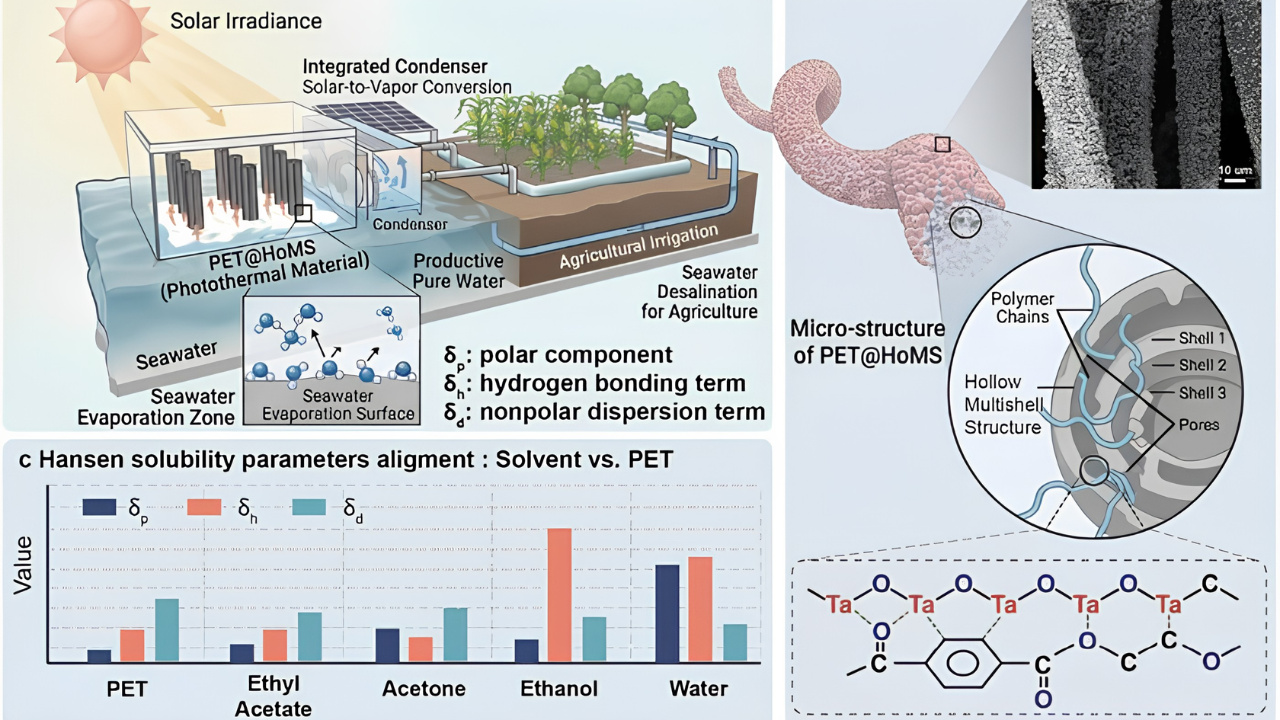
Inspiration from clothing buttons ensured durability
To achieve this level of stability and continuous operation, the researchers sought a creative solution inspired by the structure of everyday clothing buttons.
Historically, experiments with photothermal materials encountered chronic mechanical failures: microscopic particles tended to clump together over time, blocking the escape routes for water vapor.
Additionally, the plastic bases used to bind the components suffered from cracks and early degradation under strong sunlight.
In contrast, Chinese scientists shaped the nanoparticles like small individual buttons and used durable polymers as if they were threads to sew them together stably. This architecture prevented the harmful clumping of particles and created a much more robust three-dimensional structure.
With the aim of proving the longevity of this new compound in hostile maritime scenarios, the material was subjected to rigorous stress tests in the laboratory:
- Complete immersion of the structure in seawater tanks;
- Continuous mechanical agitation at 450 rotations per minute;
- Maintenance of the wear experiment for a cycle of 30 consecutive days;
- Subsequent microscopic analysis that found practically no detachment of nanoparticles.
Practical results in water production and agriculture
The practical validation of the discovery was conducted in a compact facility with dimensions of just 0.75 square meters. The mechanism included a condensation module and a small fan powered by common solar panels, responsible for directing the generated vapor to the freshwater collection area.
Under natural sunlight conditions, the equipment was able to generate more than 20 liters of clean water per day of operation.
This daily amount, according to the research data, easily meets the basic consumption needs of a group of approximately 10 people, fully complying with the World Health Organization’s potability guidelines.
Simultaneously, the project extended its reach into the field of food production. The purified volume was directed to maintain the irrigation of a test plantation of 5 square meters, successfully supporting the full development of agricultural crops of spinach, corn, and Chinese cabbage, without any connection to the conventional power grid.
The Contrast with the Traditional Model of the Persian Gulf
The innovation proposed by the Chinese team emerges as a decentralized and ecological counterpoint to the historical landscape of water purification on the planet, initiated on a commercial scale in the 1950s. To this day, the global standard is based on reverse osmosis, a technique that requires complex engineering structures and high electrical expenditure to push water through filtering membranes.
Due to requiring large investments and abundant fossil resources, this activity has historically been concentrated in the Arab countries located in the Persian Gulf. Data from a report released by the media corporation Al Jazeera indicate the magnitude of this concentrated scenario:
- The Persian Gulf region currently concentrates about 40% of all desalinated water produced in the world;
- More than 400 large plants actively operate along the coastal lines of that geographical area;
- The traditional model depends on centralized and expensive infrastructures.
Meanwhile, scientists in Beijing and Shenzhen are directing the next steps of the study towards improving condensation efficiency and reducing the cost of manufacturing inputs.
The ultimate goal is to bring the system to distant islands, isolated coastal communities, and remote areas that suffer from a chronic lack of potable water and energy infrastructure.
With information from Exame