






 Portuguese
  Spanish


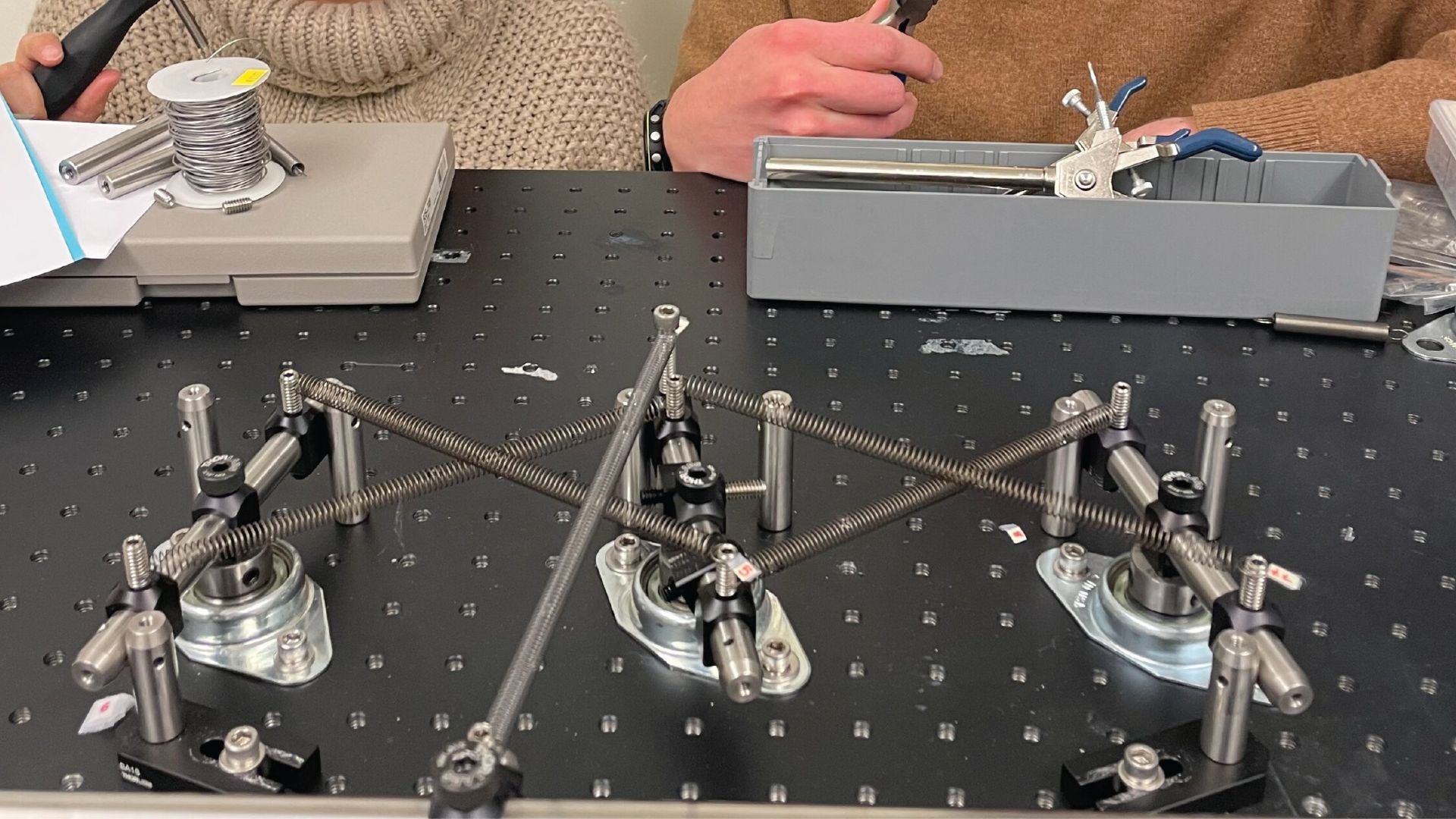


Researchers from the United States created a mechanical computer made with springs and steel, capable of executing logic and memory without battery or external power
A group of scientists from St. Olaf College and Syracuse University in the United States has created a mechanical computer made with springs and steel bars that performs logic and memory without external power, paving the way for applications in extreme environments.
How the mechanical computer works
The proposal replaces chips and electrical signals with mechanical tension and physical movement. Instead of relying on a battery or external source, the system uses the very structure of the materials to process information and store responses related to what it received before.
The basis of the mechanical computer lies in what is called physical memory. Certain common materials retain marks of what they have experienced, as happens with rubber after being compressed or stretched.
-
China Develops Custom 140-Ton Electric Mining Truck with 770 kWh Swappable Battery, Deploys 290 Units in Xinjiang’s Largest Zinc Mine

-
Meta to Launch Arena, a New Prediction App Targeting 3.56 Billion Users, Competing with Polymarket and Kalshi

-
Scientist Challenges Famous Human Evolution Theory, Argues Homo Sapiens Evolved Gradually Over Thousands of Years
-
15-Year-Old American Builds Ocean Generator with PVC Pipe and 3D-Printed Propeller for $12, Wins National Prize, Presents at White House, and Makes Forbes 30 Under 30 List




The team wanted to take advantage of this behavior not only to remember movements but also to compute.
It was from this idea that the researchers assembled three mechanical systems with steel bars and springs.
Each one was designed to perform a specific task within this model of computation without traditional electronic components.
Three systems with different functions
One of the devices acts as a counter for physical pulls. Another functions as a logic gate, capable of differentiating even and odd inputs. The third operates as a meter that retains the memory of the force applied to the system.
Together, these three arrangements demonstrate that processing tasks can occur through structural movements, without the need for electricity.
The result indicates that simple calculations can be performed by a machine built solely with physical components.
Joey Paulsen, associate professor of physics at St. Olaf College, stated that memory is often seen as something stored on a hard drive or in the brain.
He emphasized, however, that many everyday materials also retain memories of their past.
Paulsen explained that the team sought to understand whether common materials could not only remember previous movements but also process information.
He also mentioned that there is now a rational way to build machines capable of performing simple calculations without a chip and without external power.
Why the idea is attention-grabbing
Although it seems like a return to the past, the mechanical computer was conceived with future uses in mind. Silicon chips are delicate under certain conditions, potentially melting at extreme temperatures, failing under high radiation, and corroding in aggressive chemical environments.
The mechanical systems created by the researchers were designed to withstand precisely these scenarios.
The resilience of this type of structure may allow operation in locations where other hardware would be destroyed or easily lose performance.
Applications and Next Steps
Among the examples cited by the scientists is a prosthetic capable of sensing and reacting to pressure without a battery.
Another case would be a sensor installed in a jet engine to monitor wear using only the vibration of the engine itself.
Paulsen said that the results represent a step towards materials capable of perceiving the environment, making decisions, and reacting.
These smart materials, he stated, can help improve people’s lives with more responsive prosthetics and tactile environments.
Now, the focus of the work is on the scalability and limits of these systems. Students from St. Olaf are investigating how multiple rotors interact and influence each other, in search of more complex networks.
The goal is to transform isolated components into sophisticated machines with multiple parts.
With information from Interesting Engineering.





