






 Portuguese
  Spanish
  6 min of reading
  0 comments


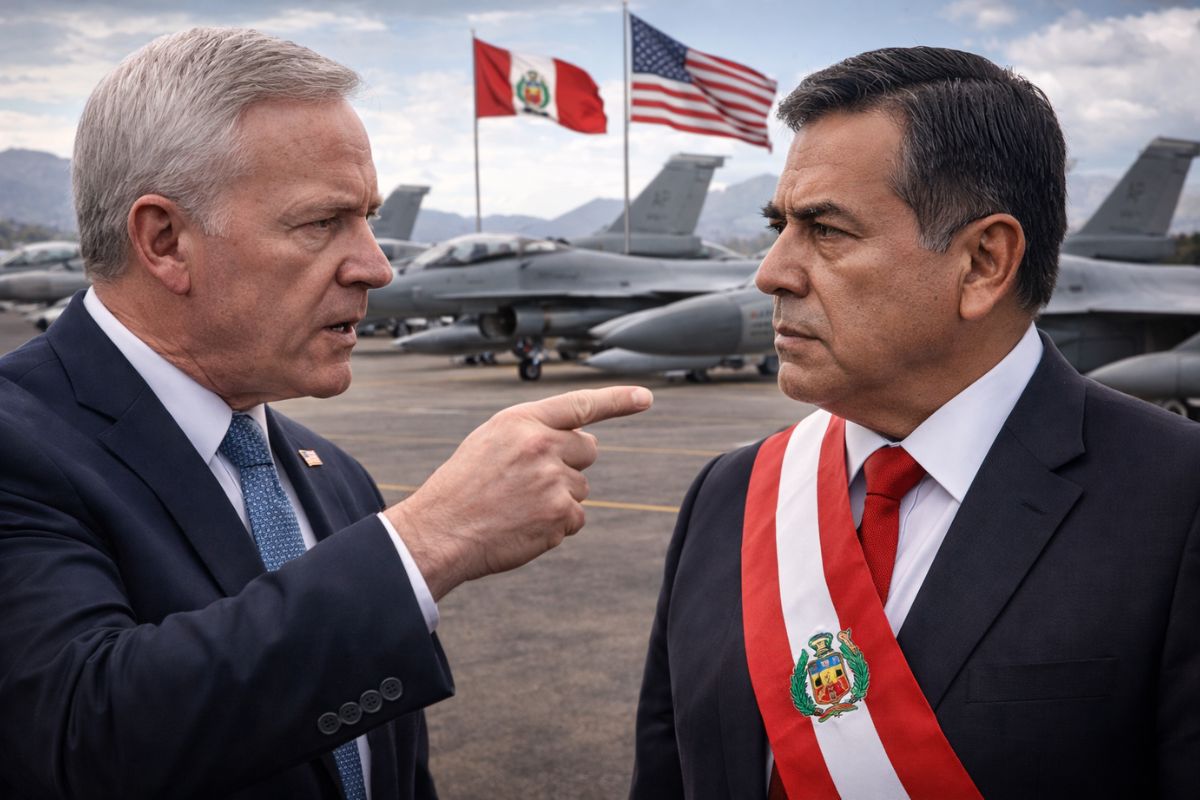
The US ambassador to Peru, Bernie Navarro, published a threat to interim president Balcázar on social media X after he declared that he plans to pause the purchase of 24 F-16 fighters due to excessive debt for a transition government that ends in July.
The interim president of Peru, José María Balcázar, provoked an immediate reaction from the US on Friday (17) by declaring in an interview with the Peruvian radio station Exitosa that he intends to pause the acquisition process of 24 combat aircraft intended to modernize the country’s military aviation. Balcázar, who assumed the presidency in February as a replacement for José Jerí, also ousted from office, argued that the purchase would imply a debt he classified as enormous and that a decision of this magnitude should be made by the next government, whose inauguration is scheduled for the end of July. Within hours, American ambassador Bernie Navarro publicly responded on social media X with a statement that diplomats and analysts interpreted as a direct threat to the interim president.
Navarro wrote that if Peru acts against American interests in the negotiations, he will use all the tools at his disposal as a representative of the Trump administration to defend the prosperity and security of the United States and the region. The message transformed what was a matter of Peruvian defense policy into a diplomatic episode with continental repercussions, exposing the degree of pressure that Washington is willing to exert on an interim president governing a country in political transition. The Peruvian government has not yet confirmed which aircraft model would be acquired, but the expectation is that the choice will fall on the American F-16s.
What the interim president of Peru said to provoke the US reaction

Balcázar’s statement to radio Exitosa was direct and straightforward. The interim president stated that his government is transitional, ending in July, and that a military acquisition of this magnitude should wait for the inauguration of the next leader elected by popular vote. In his view, compromising the Peruvian budget with the purchase of 24 fighters would be irresponsible for an administration without popular mandate and with a defined expiration date.
-
FIRJAN’s mega plan of R$ 526.3 billion for Rio de Janeiro aims to revive Brazil’s largest industry, with two-thirds of the investments going to oil and gas.

-
China signals an increase in beef imports, Brazil has already consumed 70% of the 1.106 million ton quota and seeks to renegotiate the tariff that jumps from 12% to 55%, while demand from the US also skyrockets.
-
Food inflation rose 302% in 20 years in Brazil, but the supermarket changed: purchasing power yielded 87% more mortadella and 31% less fruit, and ultra-processed foods took over the cart.
-
Petrobras sells the first batch of 3,800 m³ of aviation fuel made with certified soy, capable of reducing emissions by up to 70%, in an unprecedented project that anticipates the aviation sector’s requirements expected for 2027.


The process of renewing the Peruvian air fleet did not start with Balcázar. The negotiation was opened during the administration of Dina Boluarte, who left power in October of last year after being ousted. In March, the Peruvian presidency itself released a statement acknowledging that the acquisition had not yet been completed. Balcázar said he is assessing the situation and plans to gather his ministers next week before making any decisions, signaling caution on a matter that involves billion-dollar values and relations with the world’s greatest military power.
The ambassador’s threat and the weight of Washington’s words

Bernie Navarro’s response left no room for subtle interpretations. The ambassador stated that any negotiation conducted against the interests of the US would have consequences, and that he would invoke all available resources on behalf of the Trump administration. The explicit mention of “available tools” in a diplomatic context typically encompasses everything from economic sanctions to trade pressures and restrictions on access to international financing.
The tone of the message was surprising because it was directed at an interim president of an allied country, not a geopolitical adversary. Navarro made no reservations about the transitional nature of Balcázar’s government nor acknowledged that the decision could legitimately belong to the next elected leader. This stance reinforces a trend observed in American diplomacy under Trump: treating military deals as a direct extension of foreign policy and reacting firmly to any signs of retreat from potential buyers.
The political context that weakens the interim president of Peru
Balcázar governs Peru during one of the most unstable periods in the country’s recent history. He is the second interim president in a few months, having replaced José Jerí, who in turn had taken over after the fall of Dina Boluarte. This succession of changes at the top of Peruvian power reduces the authority of any occupant of the position and limits their ability to make long-term commitments, such as the purchase of two dozen military fighters.
The interim president’s argument has an objective basis: compromising the national budget with a billion-dollar military acquisition just months before an election is, at the very least, debatable. Balcázar said that the decision should reflect the will of the citizens expressed at the polls, not the convenience of a government that was not even chosen by popular vote. The problem is that this position, while reasonable from a democratic standpoint, directly clashes with the commercial and strategic interests of Washington at a time when the Trump administration prioritizes military exports as a tool of influence.
The F-16s and What is at Stake for the U.S. in Peru
The defense market’s expectation is that Peru will opt for the F-16s, a platform that the U.S. promotes as a solution for the air forces of allied countries worldwide. The sale of 24 units would represent a deal worth hundreds of millions of dollars, with a direct impact on the trade balance and American strategic presence in South America. For Washington, losing this sale or seeing it delayed indefinitely by an interim president without popular mandate would be an uncomfortable precedent in the region.
The U.S. is already facing increasing competition in the Latin American defense market, with European and even Chinese manufacturers vying for contracts. If the next Peruvian government decides to reopen the selection process, the advantage that the F-16s have accumulated during previous negotiations could dissipate. This risk partly explains the urgency of Navarro’s reaction: each month of delay is an open window for competitors to present alternative proposals to the new president who will take office in July.
What the Threat to the President of Peru Reveals About Current American Diplomacy
The episode transcends the specific issue of the fighter jets and sheds light on the posture of American diplomacy under Trump towards smaller countries. Publicly threatening an allied interim president for suggesting caution in a military purchase that he considers too burdensome for his transitional government is a level of pressure that would be unlikely in an administration with a different diplomatic stance. Navarro’s message was neither discreet nor confined to official channels: it was published on an open social network, turning bilateral pressure into a public spectacle.
For Peru, the message is clear: hesitating in the face of an American offer has immediate political costs. For the rest of Latin America, the case serves as a thermometer of Washington’s willingness to treat smaller allies as commercial partners obliged to close deals, rather than as sovereign nations evaluating the best use of their resources. Interim President Balcázar has until July to decide whether to face the pressure or push the problem to whoever comes after him. In any case, the ambassador’s threat has already been recorded, and the next Peruvian leader will take office knowing exactly what the U.S. expects.
And you, do you think the interim president is right to want to leave the decision to the next government, or should he conclude the purchase of the fighter jets? Was the American ambassador’s threat exaggerated? Leave your opinion in the comments.





Be the first to react!