





 Portuguese
  English
  Spanish
  8 min of reading
  1 comment


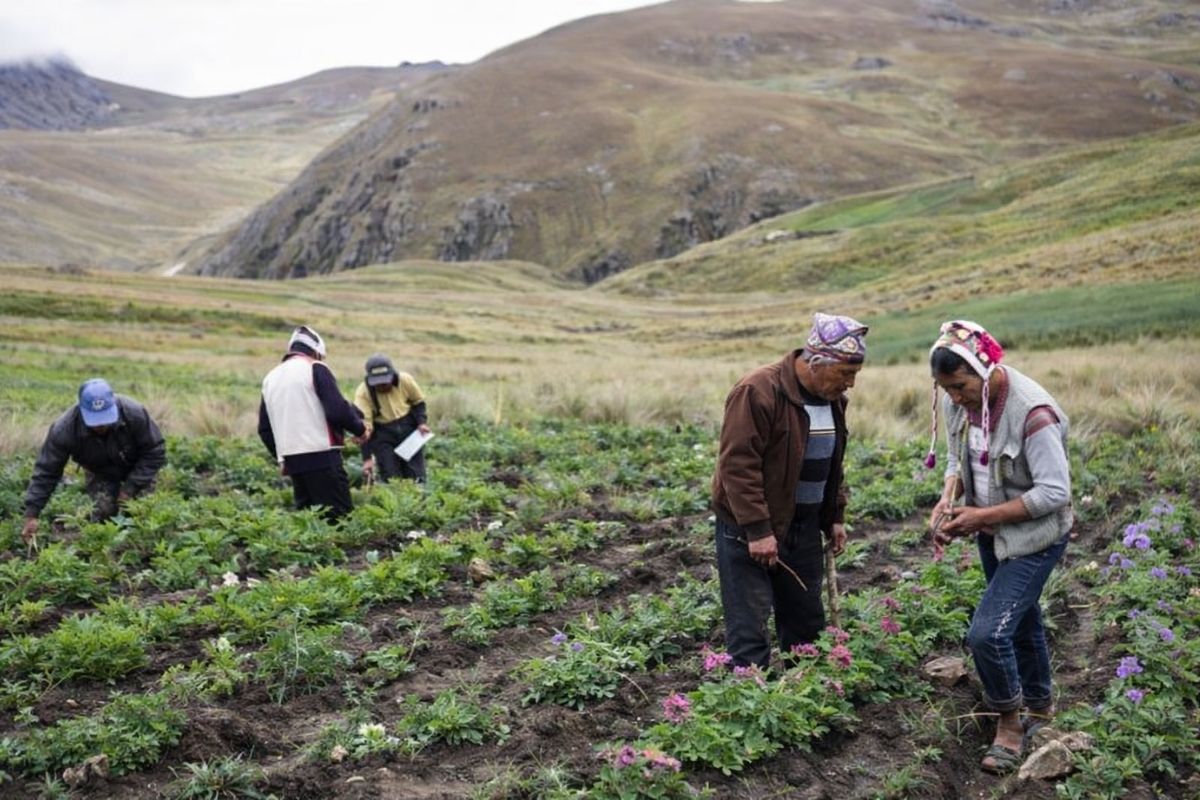


Andean Communities in Peru Protect Thousands of Ancestral Potatoes, Face Biopiracy, Unite Science and Tradition, and Offer Concrete Solutions for Food and Health Crises.
In the Andes of Peru, a group of indigenous communities protects thousands of potatoes that do not exist in any supermarket in the world. In high valleys, off the map, they safeguard a living library of native varieties, face biopiracy from large corporations, and unite science and tradition to confront real threats to the planet’s food and health.
Far from sterile laboratories and financial centers, these communities organized around the Park of the Potato show that the answer to agricultural pests, climate change, and chronic diseases may lie beneath the ground, in colorful tubers cultivated for millennia. While expensive biotechnologies promise solutions for the future, farmers protecting thousands of ancestral potatoes are already offering concrete answers today.
A Hidden Secret in the High Valleys of the Andes
The journey begins in Cusco, the ancient Inca capital. From there, the team travels along narrow mountain roads, with cliffs, landslides, and deep valleys that can become treacherous at any moment.
-
A 400-meter colossus powered by natural gas has just set sail from Shanghai to Europe, carrying over 24,000 containers. It is the world’s largest dual-fuel container ship and can cross the planet without refueling even once.

-
A new study overturns the central idea we learned about planets and suggests that Earth is the exception rather than the rule; most rocky worlds in the galaxy may not have a core or mantle, just a single turbulent fluid extending to the center.
-
Scientists reanimated a 48,500-year-old virus in the laboratory that had been frozen in the Siberian permafrost since before the extinction of the Neanderthals, and it was still capable of infecting living organisms after tens of millennia dormant in the ice.
-
The oldest nuclear aircraft carrier still in operation in the world is currently on Brazilian soil making its final journey before retirement, and two American military planes landed in Salvador and Fortaleza to support the mission.



The destination’s location barely appears on the map, there is no cell phone signal, and for long stretches, the feeling is that one is driving toward the unknown.
After hours of travel and curves, the scenery suddenly changes. The car enters a high valley where the landscape looks otherworldly: adobe houses, potato fields in different shades of green, and mountains surrounding everything.
It is here that the Park of the Potato is found, an area of indigenous biocultural heritage that simultaneously functions as traditional territory, a living laboratory, and a legal barrier against biopiracy.
Biopiracy: When Potatoes Become Targets for Global Giants

Peru is one of the richest countries in biodiversity on the planet, making it an ideal target for large multinationals interested in genes, seeds, and natural compounds.
Biopiracy is the term used for the appropriation of biological resources and traditional knowledge without consent or fair benefit for the peoples that keep them alive.
In the case of potatoes, interest is enormous. Most of the world relies on a few commercial varieties that are white, large, and uniform.
This homogeneity is fragile. History has shown the risk of famine in Ireland in the 19th century when a fungal disease called late blight destroyed entire crops. Even today, millions of dollars in harvests are lost every year due to the same problem.
Meanwhile, biopirates target precisely the communities that protect thousands of native potatoes, trying to isolate resistance genes, register them as patents, and use them in crosses with high-yielding varieties for private profit.
The danger is clear: communities may be prohibited from using their own plants if a traditional gene is patented by third parties.
Park of the Potato: Law, Territory, and Ancestral Potatoes
To preserve this heritage, six communities organized since the 1990s and created the Park of the Potato, a collective territory recognized by an innovative legal framework.
It is not just a “theme park”: it is a legal structure that recognizes collective ownership of the land, native seeds, and traditional knowledge.
In this arrangement, the communities decide how the resources are used, with whom they share genetic material, and under what conditions.
This allows for scientific agreements that are not exploitative but rather collaborative: researchers work alongside farmers, and the communities are co-authors of articles, collaborate in data collection, and have a voice in the use of their varieties.
At the heart of this system are the high-altitude fields and the daily work of families that protect thousands of potatoes in their original environment, ensuring they continue to evolve and adapt to local climate and pests.
Daily Life That Protects Thousands of Potatoes
In the home of Dílea, one of the guardians of the Park of the Potato, daily life is an inseparable part of conservation. The dwelling is primarily made of natural materials, with an internal courtyard connecting the main house, small storage areas, and animal husbandry spaces.
One of the most important spaces is the guinea pig house. Inside, over a hundred animals are fed, reproduce, and produce something essential for the system: fertilizer.
The guinea pig manure is a powerful organic fertilizer used directly in the potato fields, enriching the soil without external chemical inputs.
The family is almost self-sufficient. They produce much of their food, weave their own clothes using llama and alpaca wool, and make natural dyes from local plants and minerals.
Even the designs on the fabrics feature animals and symbols of the landscape, showing that culture, food, and territory form a unified system.
An Earthen Oven, Living Soil, and an Open-Air Science Lesson
At harvest time, the potatoes are stored under layers of dry grass, a traditional technique that helps preserve nutrients and flavor. To cook, Dílea’s mother uses an ancestral earthen oven.
She dismantles a small mound of hardened soil, mixes embers, hot soil, and potatoes, covers everything again, and lets the heat do its work. No clock, no timer: the cooking time is measured by experience and intuition.
The potatoes, served with cheese and salad, are firm, soft, and have an intense taste of earth and smoke. For visitors, it’s a privilege; for the community, it’s the daily life of an agricultural system that has endured for millennia.
After the meal, the group moves to a small field surrounded by an earthen wall. There, the ancient Andean tool, the lampa or “azada,” comes into action.
The soil reveals abundant earthworms and strands of mycelium – the fungal networks that connect roots and organisms. For Dílea’s mother, this is a sign that the harvest will be good.
This type of knowledge about mycelium and soil fertility has existed in the region for a long time, long before it was described by modern science.
Today, scientists recognize the value of this continuous observation and work with the communities to monitor the climate, move crops to more favorable altitudes, and ensure that the potatoes continue adapting to global warming.
A Genetic Library of 1,367 Varieties
Back at the headquarters of the Park of the Potato, the impact of diversity becomes even clearer. The communities protect thousands of native potatoes and systematically maintain at least 1,367 varieties cataloged across four central communities.
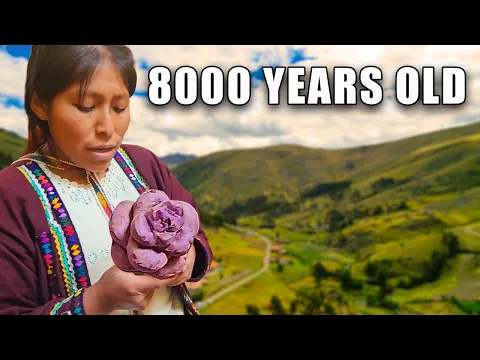
The benches resemble a colorful library: tubers in various sizes, shapes, and shades, from light yellow to deep purple, with spots, stripes, and unusual designs.
Each variety has a name, a story, and specific adaptation characteristics to pests, frost, drought, or specific soils.
Among them are wild potatoes, considered ancestors of many others. They are hardier, less “domesticated” species that serve as a genetic source of resistance.
In contrast, the commercial potatoes dominating the global market are genetically very similar to each other, almost clones.
While the world plants a half-dozen fragile varieties, these communities safeguard a true evolutionary “backup” on a landscape scale.
Medicinal Potatoes and a Pharmacy Born from the Land
A particularly sensitive part of this collection is the so-called medicinal potatoes. Dílea proudly presents some of them: tubers that, according to local knowledge, have antioxidant properties, help prevent anemia, and are traditionally used in cancer-related contexts.
One variety is known as “ano” and is used by older men in the form of extract or cooked, in practices associated with prostate health.
It is important to emphasize that these medicinal potatoes are part of Andean traditional medicine, and science is still studying their compounds without replacing conventional medical treatments.
The intense colors of many of these potatoes, purple, pink, almost wine-colored, reflect the presence of natural pigments that are also used as dyes for fabrics.
Families weave clothing with colorful wools using, often, the same palette found in the potato baskets. Eating, dressing, and healing are part of an integrated system of life.
Living Seed Bank, Greenhouse, and Protection Against Biopiracy
In the Park of the Potato, protection is not just symbolic. There is a community seed bank that follows scientific storage protocols with humidity and temperature control.
At one point, the seed bank building was even partially flooded, just to ensure ideal conservation conditions.
This local bank coordinates with the global seed vault in Norway, where hundreds of samples of native potatoes from the park have already been deposited.
The difference is that, while the European vault is static, the Andean bank is alive: the seeds are planted, harvested, and replanted, allowing them to continue evolving in response to real climate conditions.
There is also a special greenhouse dedicated to the rarest or endangered varieties, so sensitive that visitors cannot enter.
Inside, the plants are kept under constant surveillance to prevent any genetic loss. All of this reinforces the power of the communities protecting thousands of potatoes against biopiracy: here, science and tradition work together in favor of local autonomy.
Runa Ayllu: When People, Land, and Potato Are One

Behind the social organization and technical solutions lies a philosophy: the runa ayllu. This worldview understands that land, water, plants, animals, and people form a single organism.
The role of communities is not to “exploit resources” but to care for a living system of which they themselves are part.
Conserving potatoes is not an isolated project; it is an act of reciprocity with the territory and with the ancestors.
At the same time, this care produces global effects: genetic diversity to face pests and climate change, foods with unique nutritional profiles, knowledge that inspires fairer models of partnership between science and traditional peoples.
The Park of the Potato thus becomes a concrete example of how indigenous communities can organize to protect themselves from exploitation, keep their culture alive, and at the same time offer the world a functional model of biocultural conservation.
Real Answers to Global Food and Health Crises
While international reports warn of the risk of food crises and the rise of chronic diseases, the communities protecting thousands of potatoes in the Peruvian Andes demonstrate that part of the solution already exists in practice.
Instead of relying on fragile monocultures and heavy chemicals, they invest in diversity, living soil, organic fertilization, legal routes of protection, and horizontal scientific alliances.
These systems are neither romantic nor perfect, but they demonstrate that it is possible to integrate food security, health, culture, and environmental conservation into a single strategy.
For a world facing the collapse of agricultural models based on uniformity, this “Andean secret” is less of a theory and more of a real-world proof of concept.
And what do you think, should experiences like the Park of the Potato, where indigenous communities protect thousands of ancestral potatoes, influence agricultural and health policies in other countries, or is the world still underestimating this kind of knowledge?






Maior parte dos países e dos que geram a produção agrícola no mundo só pensam em dinheiro, produção em larga escala. Não estão preocupados com o alimento em si.