






 Portuguese
  Spanish


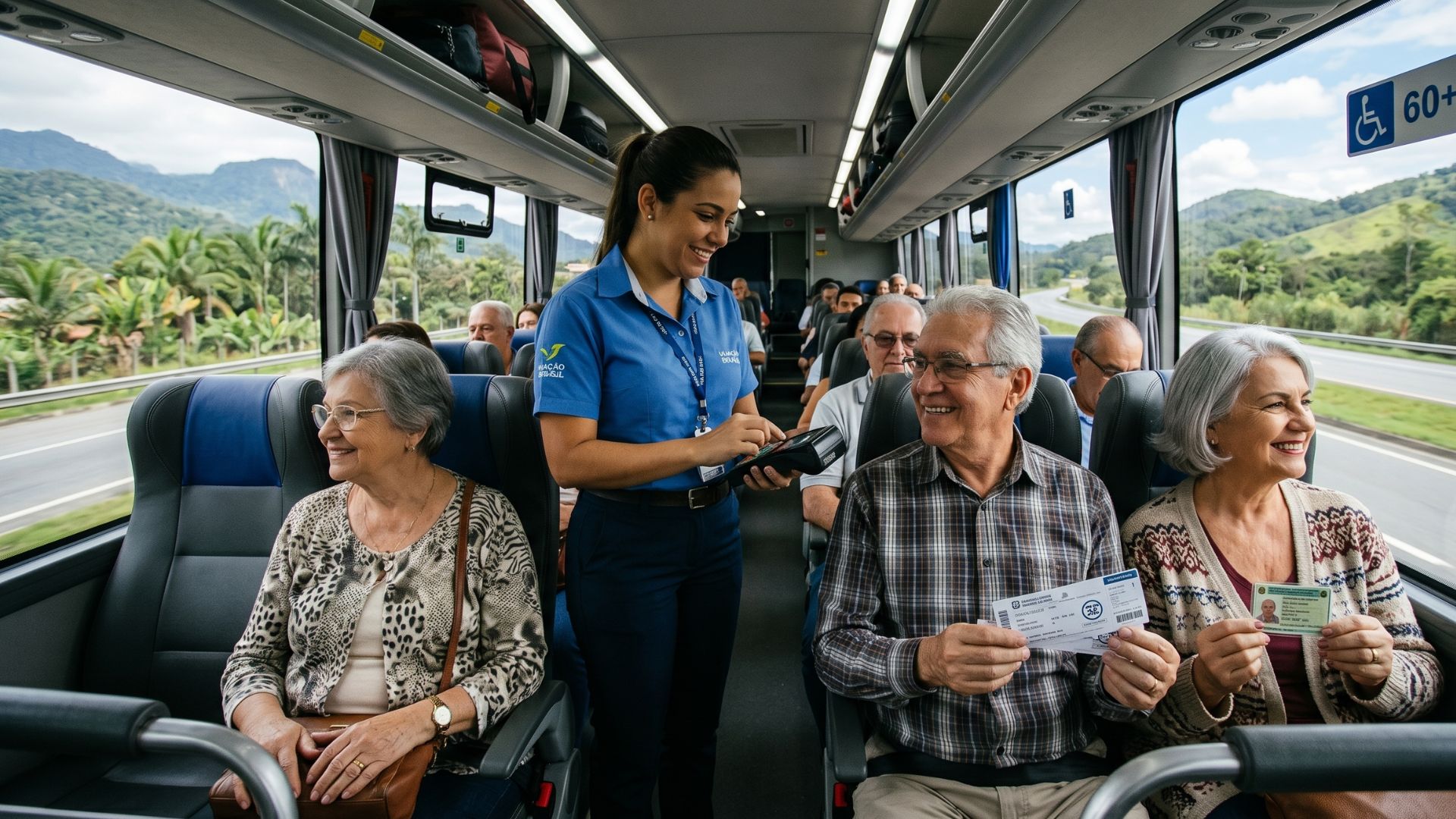
Elderly with income of up to two minimum wages can travel for free or with 50% discount on interstate transportation. See the rules.
Brazil had 32.1 million people aged 60 or older in the 2022 Census, but one of the most relevant rights of this segment of the population remains little known: the possibility of obtaining free travel or a minimum 50% discount on interstate public transportation, provided the legal age and income requirements are met.
The right exists in the article 40 of the Elderly Statute and applies to interstate transportation in conventional service. In practice, the rule ensures two free seats per vehicle for elderly people with an income equal to or less than two minimum wages and, when these seats have already been filled, guarantees a minimum 50% discount on the ticket price.
Elderly rights in interstate transportation have clear rules in the law
The legal basis of the benefit is in the Elderly Statute, regulated by federal decree. The legislation establishes that the free reservation is valid for people aged 60 or older with a monthly income of up to two minimum wages in interstate travel.
-
Detran RJ starts requiring a toxicological test for those obtaining their first driver’s license in the car and motorcycle category starting June 29; see who will be affected.

-
Florida takes TikTok to court and accuses the Chinese giant ByteDance of ignoring the law that bars minors under 14, while parents and authorities demand more protection for children on social networks.
-
Chamber approves constitutional amendment reducing the age of criminal responsibility from 18 to 16 years; what now?

-
Justice confirms that old debts in tax executions that have been stalled for more than 15 years can no longer be collected through judicial or administrative means.



When the free seats have already been occupied, the company must guarantee the elderly a minimum 50% discount on the ticket price. This is the core of the right, and not a concession by the carrier.
An important point is that ANTT itself informs that toll fees and terminal usage fees may not be included in the benefit. Therefore, the original text needed adjustment: it is not safe to generally state that any and all accessory charges are automatically covered in all cases.
Who is entitled to free elderly tickets on interstate buses
Not every elderly person has automatic access to interstate free travel. The benefit is intended for those who are 60 years or older and can prove income equal to or less than two minimum wages.
Many people confuse urban gratuity, which follows other rules, with gratuity in interstate transportation. In the case of interstate travel, the income requirement is part of the regulation.

It is also important to understand that the reservation is linked to the availability provided for the service and for that vehicle. Therefore, the passenger needs to request the ticket within the operational rules of the company and ANTT.
Which documents can prove the elderly’s income
The official ANTT guide states that income verification can be done with an updated Work and Social Security Card, paycheck or document issued by the employer, INSS contribution booklet, benefit payment statement or declaration provided by INSS or another social security regime, in addition to a document or card issued by state or municipal social assistance departments.
How to request a free ticket for the elderly in practice
According to the ANTT guide, the Elderly Travel Ticket can be requested at any section point of the line, at least three hours before the departure time from the initial point. At the time of the request and boarding, it is mandatory to present an official photo ID.

For the ticket with a 50% discount, the guide itself states that the previously established deadlines were suspended by court decision, and the discount can be requested as long as the regular ticket is still available for sale.
In practice, this means that the elderly need to contact the company in advance, formally request the benefit, and keep any protocol, ticket, or receipt issued during the service. This step is essential when undue denial arises.
What to do when the company denies the gratuity or discount for the elderly
The official booklet states that if the company denies the benefit, it is obliged to issue a document indicating the date, time, place, and reason for the refusal. This detail is crucial because it creates formal evidence for any potential complaint.
If there is a refusal, the passenger can contact the ANTT Ombudsman by phone at 166, send a message through Contact Us, use the email ouvidoria@antt.gov.br, or seek support at the agency’s inspection offices in bus terminals where there is service.
The most important thing is not to accept a verbal denial without a record. When the company does not provide a formal justification, it makes it difficult for the passenger to defend themselves and weakens transparency regarding compliance with the legislation.
Why the free ticket benefit for the elderly is still little known
The lack of dissemination helps explain why so many people continue to pay for trips that could be free or discounted. The country has aged rapidly and already totals 32.1 million people aged 60 or over, but practical information about transportation rights still circulates little outside official channels.
When this right does not clearly reach the public, the impact is direct on the lives of those who need to travel for health treatment, family reunions, religious commitments, occasional work, or simple interstate travel.
The lack of information reduces mobility and autonomy. This is a logical inference based on the purpose of the legal benefit.
In a country that is aging, access to interstate transportation with gratuity or discount is not a bureaucratic detail. It is a policy of circulation, dignity, and access.
The problem is that the law has existed for years, but its real reach still depends on correct information and the willingness of the passenger to demand what is already guaranteed.





Be the first to react!