Portuguese
  Spanish


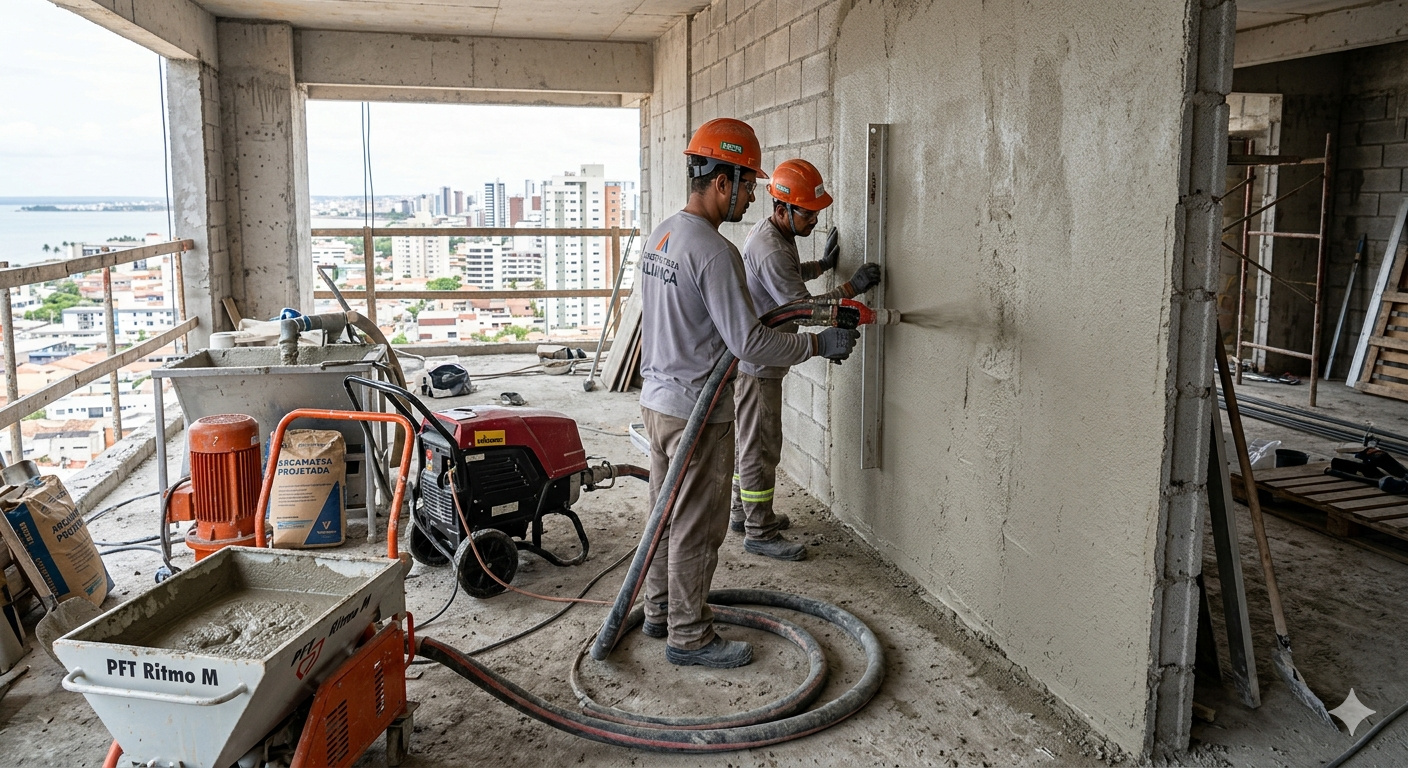

The adoption of projected mortar modernizes construction sites, increases productivity, reduces dependence on specialized labor, improves finishing, and standardizes processes.
In technical studies and materials released throughout the 2010s by entities such as the Brazilian Association of Portland Cement (ABCP), the Brazilian construction industry began to consolidate a silent yet extremely relevant change within construction sites: the replacement of traditional manual plastering with mechanized mortar projection systems.
This transition did not happen by chance. The sector has been facing a structural problem related to the shortage of qualified labor for years, combined with the need to increase productivity, reduce costs, and improve the finishing standard of buildings.
In this context, projected mortar has been adopted as a technical solution capable of directly addressing these three critical points simultaneously. The system consists of the mechanized application of mortar through equipment that projects the material directly onto the surface, eliminating intermediate steps and standardizing the execution process.
-
28-meter, 156-ton titans traveled 20,000 km from China to the port of Santa Catarina: Portonave received 7 fully electric megacranes, part of a R$ 210 million package, to double container handling.

-
They exchanged the idea of a large house for a 35 m² warehouse, spent US$ 12,000 on the structure, and created a tiny house in Colorado with space to live and work.

-
A newly opened terminal in the middle of the Amazon has begun transporting soy and corn through Amapá, eyeing the queue of ships that is congesting the ports in the South.

-
Goodbye to old tiles: renovation technique without construction transforms bathrooms in a few hours, eliminates debris, and reduces costs with coverings using special paints, high-resistance adhesives, and modern finishes that completely renew the space.


Productivity can reach three times that of manual plastering
One of the main factors that drove the adoption of projected mortar is the significant productivity gain. According to technical data from ABCP itself, mechanized application can achieve productivity between two and three times higher than the traditional method.

This gain occurs because the system eliminates several manual steps, such as constant transport of mass, application with a trowel, and repetitive finishing. The machine performs the projection continuously, maintaining a constant flow of material.
Additionally, the team required to operate the system is reduced. While manual plastering depends on multiple workers acting simultaneously in different roles, projected mortar concentrates the operation in a smaller number of professionals. This factor becomes even more relevant in a scenario where finding specialized labor has become increasingly difficult.
Continuous application eliminates joints and improves the final finish
Another important differentiator of projected mortar is the quality of the finish. The mechanized method allows for a more homogeneous application, reducing thickness variations and eliminating imperfections common in manual plastering.
As the material is designed continuously, the formation of visible joints is practically eliminated, resulting in more uniform surfaces and less need for rework.
This aspect has a direct impact on the finishing stage, such as painting and coatings, since more regular walls require fewer subsequent corrections. In practice, this means not only saving time but also reducing indirect costs throughout the construction.
Machined process reduces waste and improves material control
Sprayed mortar also stands out for its more efficient control of material usage. In the traditional system, losses are common due to manual handling, material drops, and irregular applications.

With mechanization, the flow of mortar is controlled more precisely, reducing waste and ensuring better use of inputs. This control contributes to a more efficient management of the site, especially in large-scale projects, where small losses can represent significant volumes over time.
Technology responds to the growing industrialization of civil construction
The adoption of sprayed mortar is part of a broader movement of industrialization of civil construction, in which processes that were previously entirely manual are being replaced by mechanized and standardized solutions. This movement aims to bring the sector closer to industrial logic, where productivity, repeatability, and quality control are central elements.
In this scenario, manual plastering, highly dependent on the individual skill of the worker, is beginning to lose ground to systems that ensure greater predictability of results. Sprayed mortar fits exactly into this context, serving as a bridge between the traditional model and more industrialized construction.
Specialized equipment ensures consistency in application
The operation of the system depends on specific equipment that performs the mixing, pumping, and spraying of the mortar. These machines maintain a constant pressure and control the flow of the material, ensuring that the application occurs uniformly across the entire surface.

This level of control reduces human errors and increases the repeatability of the process, allowing different areas of the construction site to present the same finishing standard. Furthermore, the speed of application reduces the exposure time of the mortar to the environment before adhesion, which can improve the performance of the coating under certain conditions.
Adoption grows in larger projects and begins to reach smaller projects
Initially more present in large projects, such as residential and commercial buildings, sprayed mortar has been expanding its use to smaller projects. This movement occurs as equipment becomes more accessible and technical knowledge about the system spreads among professionals in the field.
Construction companies seeking to reduce deadlines and increase efficiency have adopted the technique as part of their strategy to improve competitiveness.
Time reduction directly impacts the total cost of the project
One of the most relevant effects of adopting sprayed mortar is the reduction of the total execution time. Since plastering is a stage that directly influences the schedule, any gain in this phase reflects on the overall progress of the project.
The possibility of completing the coating in less time allows for the anticipation of subsequent stages, such as the installation of finishes and final delivery of the project.


This shortening of the construction cycle can generate significant savings, especially in projects where the deadline is directly linked to financial returns.
Technique reinforces structural change in the construction model
The replacement of manual plastering with sprayed mortar represents not just a method change, but a structural change in how the construction industry organizes its processes. By reducing dependence on labor-intensive work and increasing the use of technology, the sector is moving towards a more efficient and predictable model.
This transformation is expected to intensify in the coming years, driven by factors such as cost, scarcity of professionals, and the need to increase productivity. Sprayed mortar shows how an apparently simple change can profoundly alter the dynamics of a construction site, impacting time, cost, and quality simultaneously.
Now I want to know your opinion: do you believe that techniques like this will completely replace traditional methods, or is there still room for manual plastering in certain situations?