





 Portuguese
  English
  Spanish
  5 min of reading
  0 comments


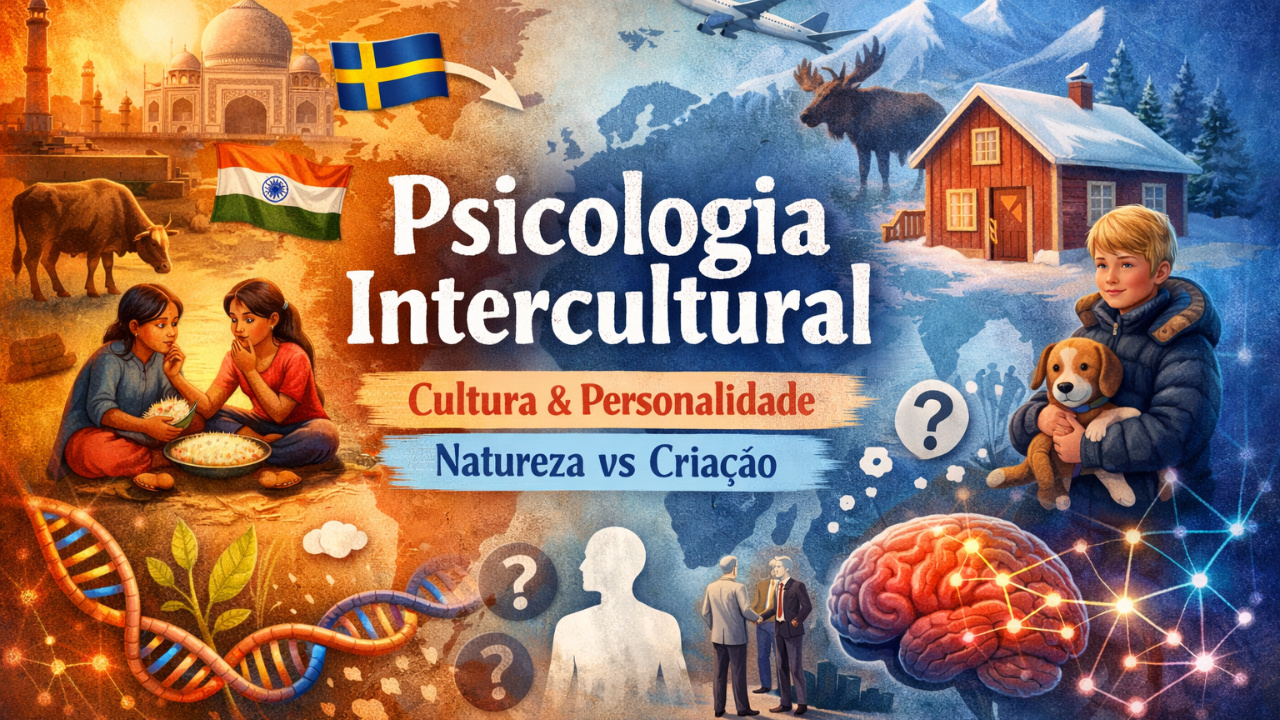
Understand How Intercultural Psychology Explains the Influence of Environment, Culture, and Genetics on the Formation of Human Personality.
The place where a person is born can directly influence their way of thinking, feeling, and acting.
This is what researchers in intercultural psychology point out, a scientific field that investigates how culture and personality develop over a lifetime.
Recent studies conducted by geneticists, psychologists, and philosophers at universities in Europe and Asia show that human identity is the result of the interaction between genetics and environmental influence — and not just DNA.
-
New phone with a giant 8,000 mAh battery, promising up to three days away from the charger and military-grade durability, is launched by Realme in India; meet the Realme 16T.

-
Scientists develop a low-cost alternative to generate green hydrogen on a large scale using an innovative chemical process; discovery could revolutionize energy infrastructure, heavy industry, and sustainable transportation systems around the world.

-
Long before artificial intelligence, ancient civilizations created a gear “computer,” self-healing concrete, a possible battery, glass with nanotechnology, and giant caves that still challenge modern science.

-
Scientists detect the largest ring-shaped warming in the Tropical Pacific in the last 40 years, with the ocean accumulating more heat than it releases in the spring of 2026, and Chinese simulations indicating the risk of a super El Niño at the end of the year.




The debate has involved scientists, behavioral scholars, and thinkers for centuries.
Today, with advancements in neuroscience and comparative analyses between cultures, new evidence is beginning to explain how moral values, social habits, and even emotional traits vary according to the cultural context in which the individual grows up.
The central question is clear: if a person had been born in another country, would they have the same cultural identity and personality?
Nature vs Nurture: The Balance Between Genes and Environmental Influence
The classic discussion between nature vs nurture remains at the center of research.
Although DNA is unique to each individual, experts claim that it does not act alone in defining personality.
Psychiatric geneticist Ziada Ayorech from the University of Oslo highlights the strength of cultural experiences:
“When I think about all the places I have lived and all the ways they have influenced my perspective, I intuitively imagine that there is no way this hasn’t made a difference.”
Studies of identical twins help measure this impact. A global analysis published in 2015, compiling nearly 50 years of data on 17,000 human characteristics, concluded that genetics explains, on average, only 50% of the differences between people.
“It is this combination of nature and nurture that makes us who we are and contributes to our beliefs and cultures,” says Ayorech. “That’s why we couldn’t have exactly the same combination elsewhere.”
Culture and Personality: How the Environment Alters Behaviors
Research indicates that personality traits are about 40% hereditary.
That is, most are strongly influenced by the social environment.
Ayorech recounts her own experience after living in different countries:
“If we compare the version of myself that lives here in Norway with the version that lived in the UK, it’s fair to say that I’m less extroverted today.”
Still, she notes that genetic characteristics remain present:
“We tend to seek environments that are in tune with our genetic traits.”
This phenomenon occurs because neural connections reorganize according to cultural experiences lived.
Intercultural psychologist Ching-Yu Huang explains:
“You would have been a different person if you had grown up in Taiwan.
The brain you have today would be very different if you had been born and raised in Taiwan, even with the same DNA.”
Intercultural Psychology and the Differences Between Societies
Intercultural psychology also compares behavior patterns between countries.
Research shows clear contrasts between Western and Eastern cultures.
In the West, there is a greater appreciation for individualism.
People often define themselves by personal characteristics such as humor or intelligence.
In Asian countries, however, it is common for cultural identity to be linked to social roles, such as child, student, or worker.
Psychologist Vivian Vignoles from the University of Sussex reinforces:
“I think people tend to get overly excited about the genetic side.
Whatever the genes are, a certain environment is needed for them to manifest.”
Brain scans support this difference.
In comparative studies, Westerners activated areas related to self-awareness when thinking about themselves.
Chinese participants, however, activated the same regions when also thinking about their mothers.
Influence of the Environment on Value Formation and Discipline
International surveys broaden this understanding.
A 2022 study involving 22 countries showed that societies with a strong appreciation for self-discipline — such as India, Germany, and China — display a greater sense of duty and organization.
On the other hand, more egalitarian and flexible cultures, such as Canada, Australia, and Norway, report higher levels of openness to new experiences.
Another difference involves the way of perceiving the world.
In visual experiments, Westerners focused on central objects in images.
Japanese participants, however, described the complete context around them.
“There is some evidence that in Western cultures, especially in North America, people tend to attribute behavior to individual characteristics, rather than to the situation,” says Vignoles.
Cultural Identity from the Philosophical Perspective
Besides science, philosophy also debates cultural identity. Some scholars believe that the “self” is biological and unchangeable.
Philip Goff from the University of Durham explains:
“From this perspective, even if your memories were erased, you would still be the same person.”
Others advocate social constructivism — the idea that the environment shapes human essence.
There are also spiritual theories that associate identity with a soul independent of culture.
Goff adds:
“These are just human concepts about what a ‘person’ or a ‘self’ is.
According to him, there is no definitive answer to whether ‘that person in very different circumstances would be me or not.’”
When Culture Defines Who We Become
Personal accounts illustrate this debate.
Experiences lived in different countries show how eating habits, moral values, and worldviews change according to context.
Thus, simple childhood situations — like discussing meat consumption among different cultures — can reveal the weight of environmental influence on belief formation.
Therefore, for those who navigate between multiple cultures, it becomes clear that personality is not born ready. It is constructed.
In the end, although it is impossible to know who we would be in another society, evidence suggests there would be clear differences — even if essential traits remained.
See more at: Genetics and Environment: The Surprising Role of Where We Are Born in Defining Our Personality – BBC News Brasil







-

1 person reacted to this.