






 Portuguese
  Spanish


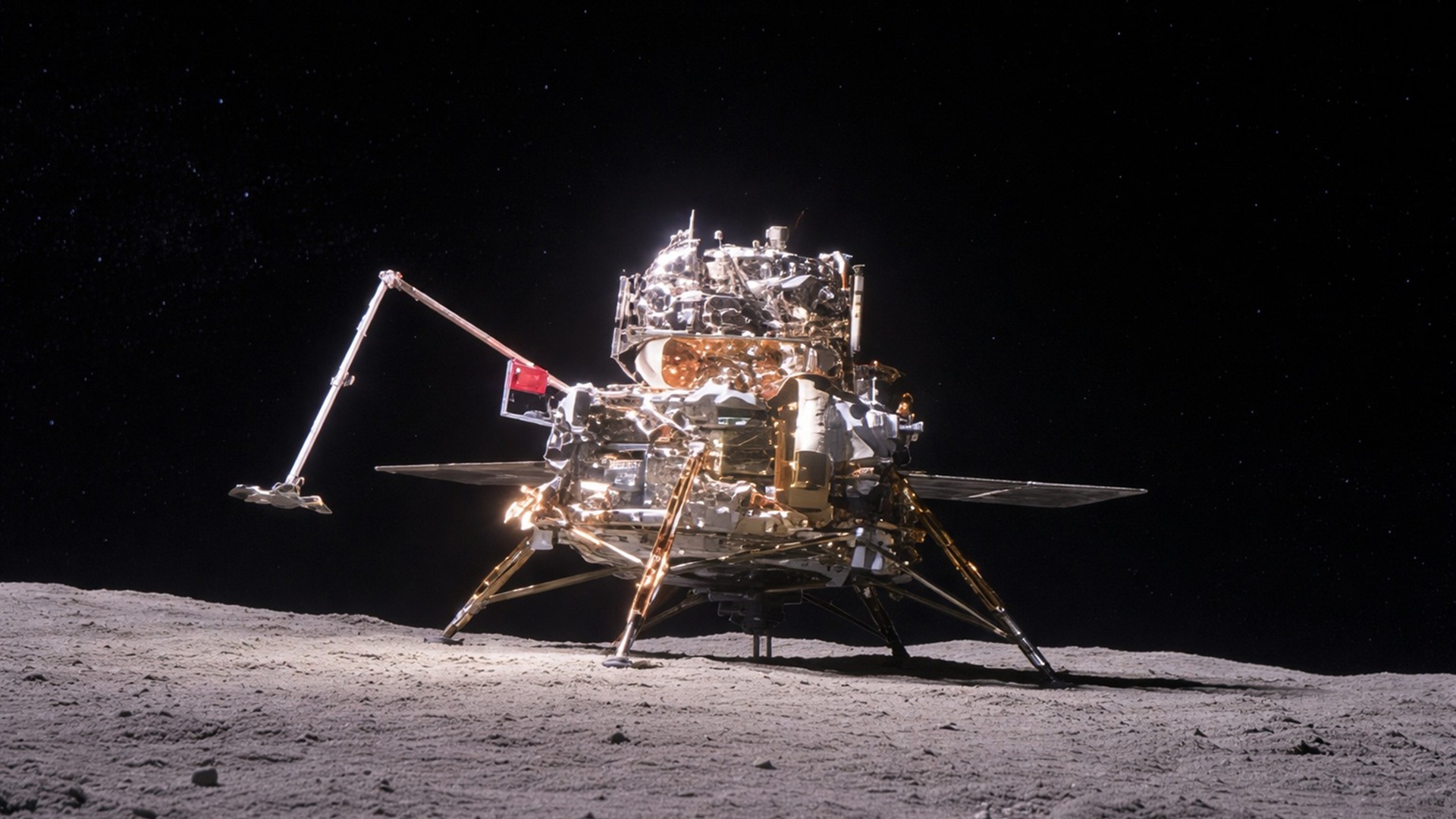


Sample Analysis of the Dark Side of the Moon, Collected by the Chang’e-6 Mission in 2024, Identified Naturally Formed Single-Walled Carbon Nanotubes, Contradicting the Dominant View That These Nanostructures Could Only Arise in Highly Controlled Laboratory Environments and Opening New Perspectives for the Use of Lunar Resources
Researchers from Jilin University identified single-walled carbon nanotubes in soil samples collected from the dark side of the Moon by the Chinese Chang’e-6 mission in 2024, unprecedented evidence that these advanced nanostructures can form naturally in extreme environments.
Unprecedented Evidence in Lunar Samples from the Chang’e-6 Mission on the Dark Side of the Moon
Until this analysis of the dark side of the Moon, it was understood that single-walled carbon nanotubes could only be produced in controlled laboratory environments due to the structural complexity of these cylinders with a thickness of a single atom.
The discovery alters this assumption by demonstrating that natural processes are also capable of generating such structures.
-
China Develops Custom 140-Ton Electric Mining Truck with 770 kWh Swappable Battery, Deploys 290 Units in Xinjiang’s Largest Zinc Mine

-
Meta to Launch Arena, a New Prediction App Targeting 3.56 Billion Users, Competing with Polymarket and Kalshi

-
Scientist Challenges Famous Human Evolution Theory, Argues Homo Sapiens Evolved Gradually Over Thousands of Years
-
15-Year-Old American Builds Ocean Generator with PVC Pipe and 3D-Printed Propeller for $12, Wins National Prize, Presents at White House, and Makes Forbes 30 Under 30 List




The South China Morning Post reported that this is the first definitive evidence that nature can independently construct single-walled carbon nanotubes, which were previously considered unattainable without human intervention.
In the scientific article, the researchers claim that the study presents the first identification of graphite carbon in lunar samples collected by the Chang’E-6 mission, observed by multiple spectroscopy and microscopy techniques in identical locations of the analyzed samples.
Extreme Lunar Conditions and Violent Formation of Nanostructures
Carbon nanotubes were first synthesized in terrestrial laboratories in the 1990s, always associated with highly controlled processes.
On Earth, their creation required vacuum chambers, precise temperature control, and specific metallic catalysts, such as nickel or cobalt.
These materials are known for their high mechanical strength and high electrical conductivity, characteristics that make them essential for advanced technologies, including touch screens and high-efficiency batteries, among other industrial applications.
On the Moon, however, the identified nanotubes formed by a violent and spontaneous process. According to the study, the formation was likely triggered by the intense heat generated by micrometeorite impacts, ancient volcanic activity, and the constant irradiation from solar wind on the lunar surface.
According to the researchers, specifically, the single-walled carbon nanotubes were formed by micrometeorite impacts combined with a catalyst-driven process influenced by iron, associated with early volcanic activity and continuous exposure to solar wind on the lunar surface.
High-Resolution Microscopy and the Role of Micrometeorite Impacts
To achieve the results, scientists used high-resolution microscopy, identifying single-walled carbon nanotubes in extremely small fragments of lunar soil, primarily concentrated around scars left by micrometeorite impacts.
These structures formed when high-speed impacts vaporized carbon from solar wind and meteorites.
During the rapid cooling of this gas, local iron particles acted as catalysts, linking carbon atoms into tubular shapes rather than common soot, as occurs in other contexts.
It was already known that multi-walled carbon nanotubes can occur naturally on Earth, in environments such as coal, ice, and wildfire ashes, formed by rapid cooling. However, it was long believed that their simpler and more delicate single-walled versions were impossible to form without direct human control.
Use of Lunar Resources and Implications for Space Exploration
The presence of these nanotubes in lunar soil demonstrates that extreme space environments can act as true natural nanofactories. This finding paves the way for the use of lunar resources in the production of advanced materials aimed at deep space exploration, reducing dependence on inputs transported from Earth.
If these nanotubes are already naturally available in lunar soil, future colonizers might forgo transporting expensive sensors or battery components, utilizing local materials to build electronic systems in the lunar environment itself, which could reduce mission costs and expand their autonomy.
The authors themselves highlight that the detected carbon and the identified formation mechanism elucidate a potential in situ application of lunar soil, establishing concrete bases for the local resource utilization in long-range space exploration.
According to reports associated with the study, the discovery occurs after the prior identification of lunar graphene by the same team, reinforcing the idea that the Moon’s surface is chemically more dynamic than previously thought.
Furthermore, understanding how nature synthesizes these materials on the dark side of the Moon under adverse conditions may offer engineers new references to develop cheaper and more efficient methods for manufacturing carbon nanotubes on Earth. The complete results were published in the scientific journal Nano Letters.






