Portuguese
  Spanish



Startup Operates Multi-Anode Reactor and Produces First Ton of Steel with Technology That Can Reduce Emissions in Steelmaking
The startup Boston Metal has achieved an important milestone in the development of its technology to produce steel with minimal greenhouse gas emissions. The company successfully operated its largest reactor to date, managing to produce over a ton of metal, according to information from the MIT Technology Review.
This achievement represents a significant step towards the commercialization of Boston Metal’s technology. The developed process uses electricity to produce steel.
Depending on the source of this electricity, the production can be nearly carbon emission-free. Currently, the global steel industry is responsible for about 3 billion metric tons of carbon dioxide each year.
-
Brazil Constructs First Japanese SABO Barrier in Nova Friburgo to Prevent Landslides, a $3 Million Concrete Trap for Rocks, Logs, and Mud

-
Brazilian Navy’s Technology Plays Strategic Role in Future of Small Modular Reactors, Boosting Nuclear Energy Capacity with Innovative Solutions for Power Generation and Industrial Applications

-
China Surpasses U.S. and Russia Combined in Submarine Production
-
Xiaomi Unveils Smart Glasses in Brazil with 12MP Camera, 4K Video, and AI Features, Challenging Ray-Ban Meta


First Ton of Steel Produced
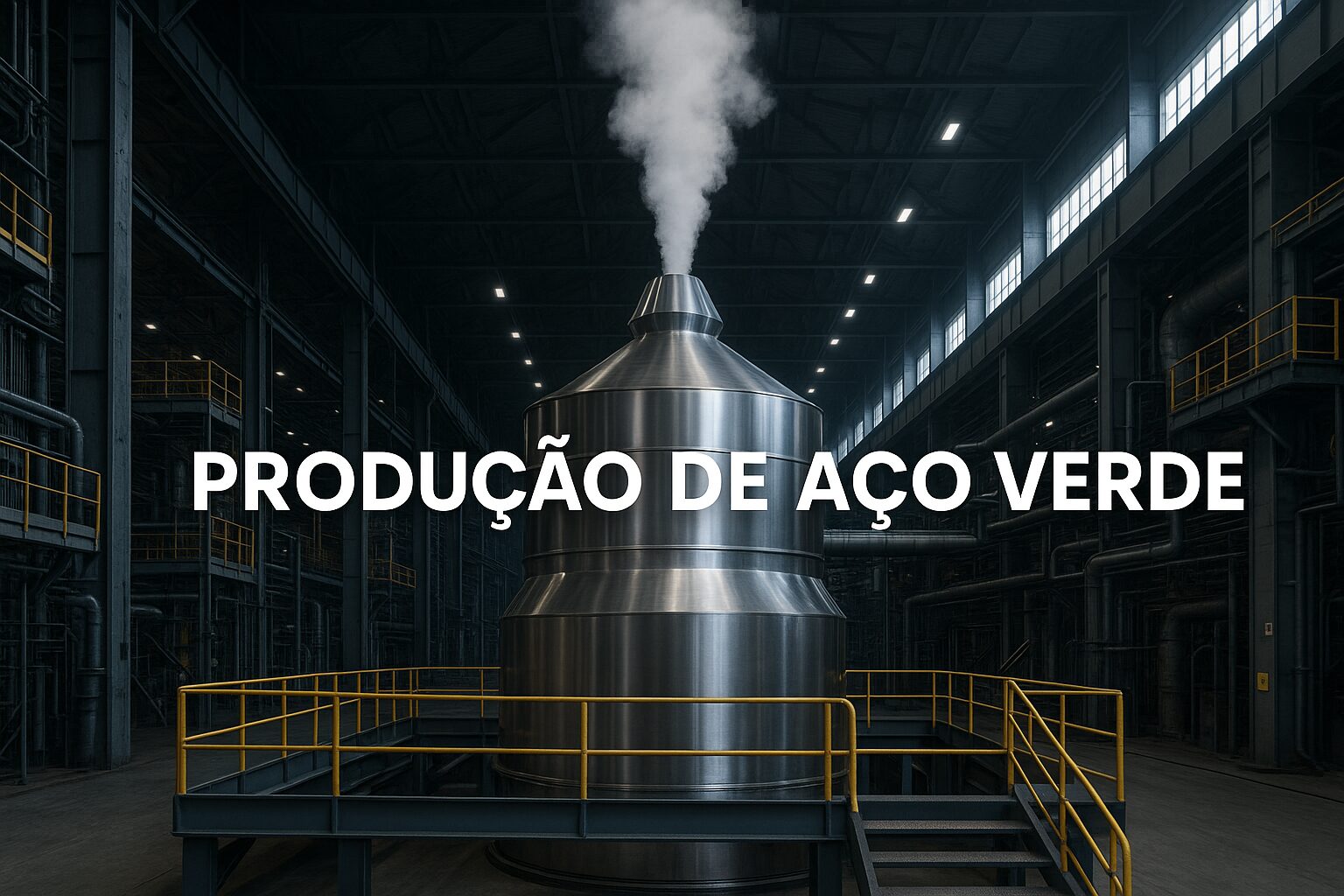
The operation of the new industrial reactor began in January. After several weeks, Boston Metal extracted approximately one ton of material on February 17.
This achievement marks the company’s transition to a scale closer to what is necessary to compete with conventional steel production.
The reactor was installed in Woburn, Massachusetts. Construction of the facility began in 2022.
Since then, the company has tested the equipment with the production of other metals before adapting it for steel manufacturing.
The traditional steel production process uses a blast furnace and coke, a coal-based fuel. The chemical reaction releases large amounts of carbon dioxide.
In contrast, Boston Metal’s method replaces coke with electricity in a process known as molten oxide electrolysis (MOE).
Molten Oxide Electrolysis
In MOE, iron ore is placed in a reactor along with other ingredients. Electricity then heats the mixture to about 1,600 °C.
This triggers the chemical reactions that convert the ore into iron, which can then be turned into steel.
Unlike the traditional process, MOE emits oxygen instead of carbon dioxide. If the electricity used is generated from renewable sources such as solar, wind, or nuclear, the climate impact of steel production can be drastically reduced.
The technology was originally developed at MIT. Boston Metal was founded in 2013 to bring the laboratory method to industrial scale.
In early tests, the reactors were the size of a coffee cup. Now, the company operates reactors that produce tons of metal at a time.
Challenges to Scale Production
According to Adam Rauwerdink, senior vice president of business development at Boston Metal, the scale of the steel industry is gigantic. To be commercially viable, it is necessary to produce very high volumes of steel.
One of the most important technical challenges was the development of inert anodes. These metal pieces conduct electricity in the reactor.
In theory, they should not wear out. However, if the operating conditions are not ideal, they can degrade.
In recent years, the company has made significant progress in the durability of the anodes. Now, the current stage involves using multiple anodes in the same reactor.
In small reactors, a single anode is sufficient. In larger reactors, multiple anodes must be added to maintain the efficiency of the process.
The recent test of the multi-anode reactor demonstrated that Boston Metal’s approach can be scaled up. The goal is to build even larger reactors that operate with several anodes and then integrate multiple reactors within the same industrial plant.
Next Steps for Boston Metal
With the successful operation of the first multi-anode reactor for steel production, Boston Metal is now focused on better understanding the reactions at a larger scale. Another goal is to calculate the actual cost of manufacturing the produced steel.
The plan for the next few years is to build an even larger system. According to Rauwerdink, this new equipment will not fit in the current facility in Boston.
While the current reactor takes about a month to produce one or two tons of metal, the new system will be capable of producing the same amount in just one day.
The demonstration plant is expected to begin construction soon. It is projected to become operational by late 2026 and start production in 2027. In the long term, the company’s strategy is to license the technology to major steelmakers.