






 Portuguese
  Spanish


A group of students from Cuité, Paraíba, developed a reusable rocket to spread seeds in the Caatinga, combining 3D printing, Arduino, and reforestation in a school proposal.
Students from a public school in Cuité, Paraíba, developed a low-cost rocket designed to launch native seeds in areas of the Caatinga.
The project, called Apollo SPX, was created by students from the Escola Estadual Cidadã Integral Técnica Jornalista José Itamar da Rocha Cândido.
The initiative was among the 10 finalists of Solve for Tomorrow Brazil 2025, a Samsung program aimed at high school students from public schools, and was later cited as the Popular Jury winner of the edition.
-
Scientists Discover Ancient Life Marks in 180-Million-Year-Old Moroccan Ocean Rocks

-
Brazilian Students Transform Passion Fruit Peels into Moisture-Retaining Material, Compete at World’s Largest Science Fair

-
Brazilian Student Invents Low-Cost Rainwater Harvesting System Using Recycled Materials, Showcased at World’s Largest Science Fair

-
Italy Considers Next-Gen Nuclear Reactors for Warships, Aiming to Boost Naval Autonomy and Join Elite Maritime Powers




Rocket to Reforest the Caatinga
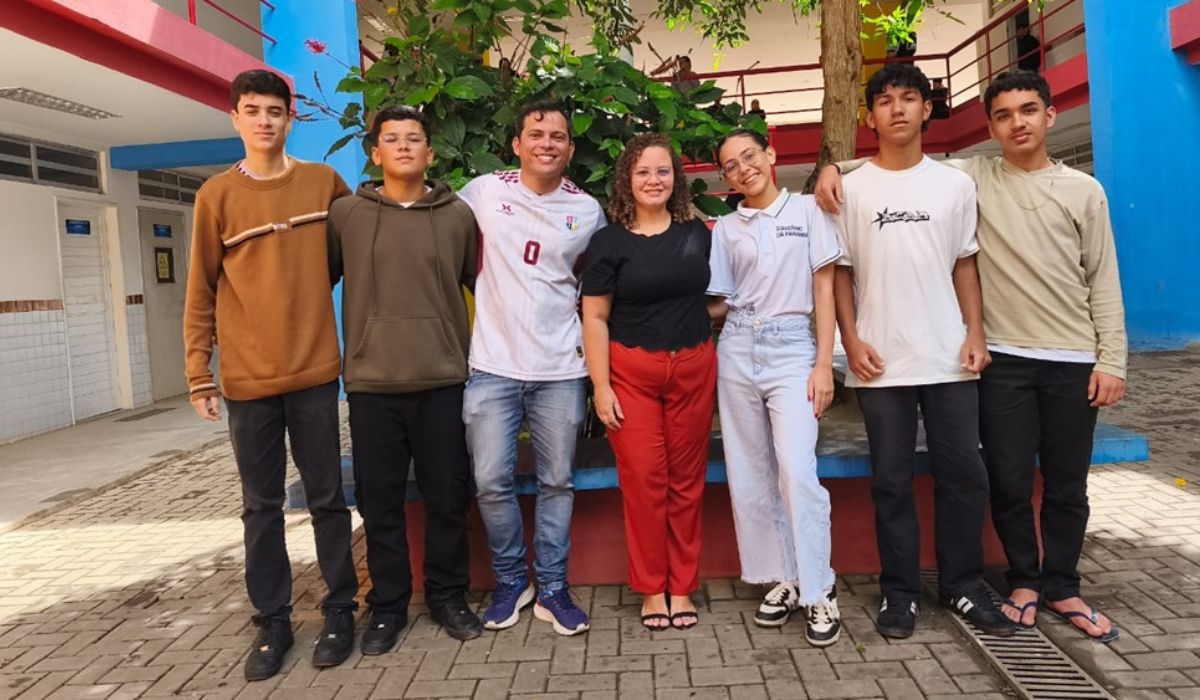
The Apollo SPX, acronym for Solid Propellant Experiment, was developed by four male students and one female student from the 2nd year of high school.
The proposal uses a rocket to disperse seeds on the ground and support reforestation actions in the Caatinga, the predominant biome in the region where the students live.
According to Samsung, the prototype can also be used to support agriculture, as its principle is to transport and spread seeds in specific areas.
The idea draws attention by bringing aerospace technology closer to a local environmental problem.
Instead of treating rockets only as objects related to space, the students applied concepts of launch, stability, payload, and recovery in a solution aimed at the territory where they study.
The goal is not to create a large-scale rocket.
The proposal is in the use of a reusable, relatively low-cost equipment capable of carrying seeds to hard-to-reach places.
This approach helps make science more concrete.
For the students, concepts of physics, electronics, materials, and programming cease to be just school content and become part of a prototype with an environmental function.
3D Printed Motor and Arduino
The prototype described by Samsung has a 3D printed motor, made with fiberglass resin to increase resistance.
The structure also includes a hood with a parachute, controlled by Arduino to open after launch.
The Arduino is a platform used in automation and electronics projects.
Simply put, it functions as a small programmable controller, capable of activating components according to commands defined by developers.
In the students’ rocket, this feature is associated with the control of the parachute.
The opening after launch allows for equipment recovery and reinforces the idea of reuse.
This point is important because the project was not designed as a disposable object.
Once built, the rocket requires refueling and seeds for new operations, as explained by the supervising teacher Priscila da Silva Santos.
“It is a reusable reforestation rocket. The seeds are housed in the body, wrapped in clay and water to adhere to the soil when dispersed. The advantage of being reusable is the cost savings since, once built, the rocket only requires refueling and seed replenishment,” stated the supervisor to Samsung.
Seeds Wrapped in Clay and Water
The operation of the Apollo SPX does not rely solely on the launch.
The seeds also undergo preparation before dispersion.
According to the teacher’s explanation, they are wrapped in clay and water to better adhere to the soil when they fall in the chosen area.
This technique resembles the principle of so-called seed balls, used in some environmental recovery actions.
The clay layer can help protect the seed and facilitate contact with the soil.
In the Paraíba project, this resource is combined with the rocket to extend the reach of dispersion.
The idea is especially interesting in hard-to-access areas.
In degraded regions, uneven terrains, or points where human movement is more complicated, launching seeds from a distance can reduce part of the operational effort.
Still, reforestation does not depend solely on spreading seeds.
The success of such an action involves the appropriate choice of species, planting season, soil conditions, water availability, fire protection, presence of animals, and subsequent monitoring.
Therefore, the Apollo SPX should be understood as an experimental tool within a larger environmental recovery process.
Technology aids in dispersion, but does not replace ecological planning.
Students took local problem to national program
The project reached the finals of Solve for Tomorrow Brazil 2025 in November, when Samsung announced the 10 finalists of the edition.
The program encourages high school students from public schools to identify real problems and develop solutions based on science and technology.
In the case of the students from Cuité, the chosen problem was deforestation and the recovery of Caatinga areas.
The choice is directly related to the territory.
The Caatinga is the local biome and is part of the landscape, economy, and daily life of semi-arid communities.
By working with native seeds, the group connected technological innovation and environmental belonging.
This combination helps explain why the project attracted attention.
The proposal was not limited to the functioning of the rocket.
It also brought a broader question: how can students use technology to respond to environmental challenges in their own region?
Project had an update in 2026
After the final stage, the Apollo SPX continued in development.
In February 2026, ESG Inside reported that the project, pointed out as the Popular Jury winner of the 12th edition of Solve for Tomorrow Brazil, continued advancing with a focus on reforesting the Caatinga.
According to the publication, the students and teachers involved continued working on prototype stages, including launch and result analysis.
The report also stated that the group was studying the creation of a payload that could be applied to the current prototype and future projects.
This type of update shows that the initiative did not end with the presentation for the award.
The project also began to function as a scientific training experience for the students.
Professor Priscila stated, according to ESG Inside, that the team continued modeling the prototype, writing, and planning the next phases.
Student Maria Helena Lopes also reported that participation in the program helped to publicize the project nationally and motivated the group to continue with Apollo SPX.
School Science with Environmental Impact
The Apollo SPX draws attention because it transforms classroom content into a prototype with environmental application.
3D printing allows for the production of custom parts.
The Arduino adds electronic control to the system.
The parachute makes rocket recovery more feasible.
The encapsulated seeds connect the experiment to the restoration of degraded areas.
Each element has a function within the set.
This integration is one of the most relevant parts of the project.
Instead of working on science, technology, and the environment separately, the students combined these fields into a unique solution.
The result is a project that engages with engineering, sustainability, public education, and regional innovation.
There is also an economic component.
By proposing a reusable rocket, the group tries to reduce the cost of use over time.
The replacement of fuel and seeds tends to be cheaper than rebuilding the entire structure with each launch, as explained by the advisor.
Even so, the available text does not present concrete data on total cost, operational range, or seed germination rate after launch.
Therefore, these points should not be presented as proven.
The article can state that the project aims to be low-cost and reusable, but should not invent performance numbers.
What Makes the Apollo SPX Different
The main difference of the project lies in the approach to reforestation.
While many actions rely on manual planting, the Apollo SPX tests an alternative of dispersion by launch.
This proposal does not eliminate traditional methods.
It functions as an experiment to expand possibilities, especially in hard-to-access locations.
The presence of a 3D-printed engine and a system controlled by Arduino also makes the project more aligned with the language of new technologies.
For high school students, building something like this requires research, testing, corrections, and teamwork.
Professor Priscila herself highlighted, in a statement to Samsung, that the mentorships helped the students mature the idea and develop skills to present the project.
“The mentorships help us mature and develop the idea, and in this process, the personal growth of the students was immense. They developed creativity, manual skills, and even the poise to present the project,” she stated.
The statement reinforces another aspect of the initiative.
The project involves not only the final product but also the learning process of the students.
By creating, testing, and explaining the rocket, the group developed technical and communication skills.


