






 Portuguese
  Spanish


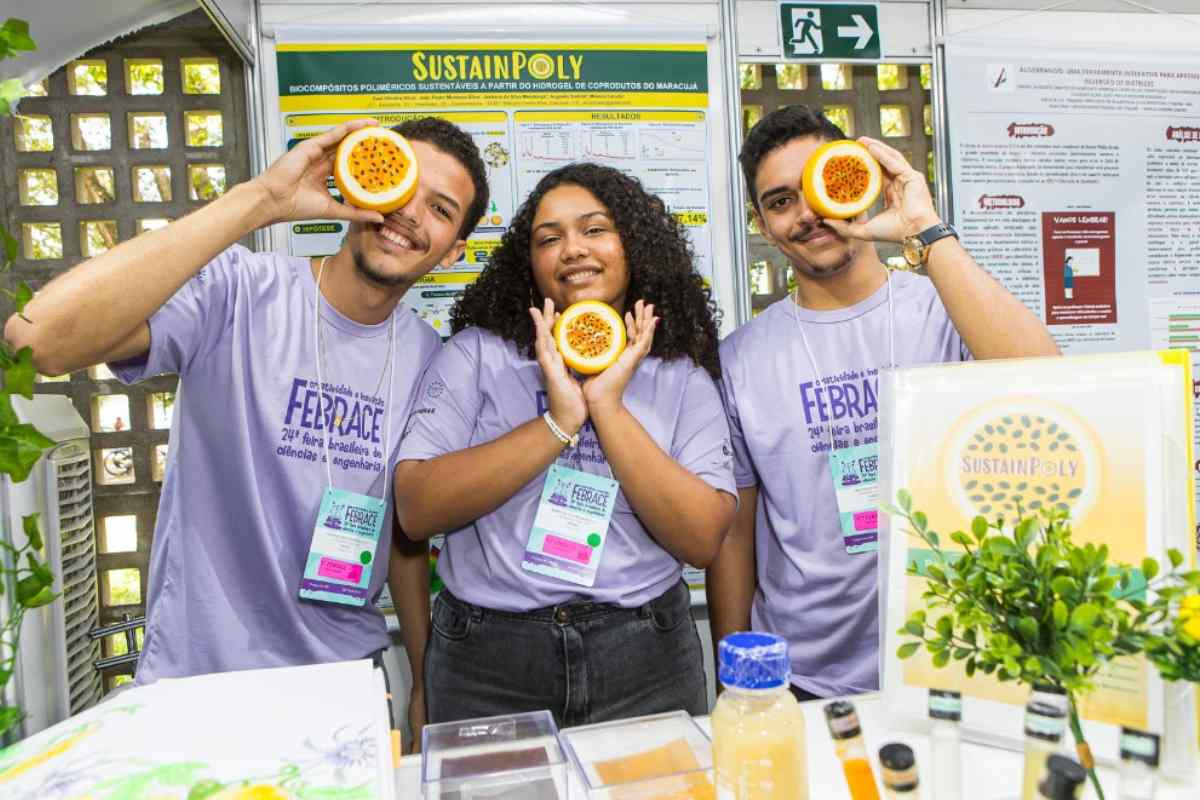

Project created by students from the public network of Ceará uses passion fruit residues in biocomposites tested for moisture retention, weed control, and low-cost agricultural applications.
Three students from the state public network of Ceará developed a biocomposite made from passion fruit residues and presented results of soil moisture retention for up to 21 days.
The project, called Sustainpoly, was created by Davi Oliveira Silva, João Pedro Monteiro Silva, and Jordana da Silva Mendonça, students of E.E.M.T.I. Marconi Coelho Reis, in Cascavel, in the interior of Ceará.
The research was guided by Francisco Augusto Oliveira Santos and co-guided by Mônica Barbosa Canuto.
-
Brazilian Student Invents Low-Cost Rainwater Harvesting System Using Recycled Materials, Showcased at World’s Largest Science Fair

-
Italy Considers Next-Gen Nuclear Reactors for Warships, Aiming to Boost Naval Autonomy and Join Elite Maritime Powers

-
Extreme Heat in Antarctica Sets Record 15.4°C at Esperanza Base in June, Raising Concerns Among Scientists with Temperatures 20°C Above Normal, Rain Instead of Snow, and Unusual Melting Transforming the White Continent’s Landscape
-
UFG’s Innovative Use of Air Conditioner Drip Saves 400 Liters of Water Daily in Brazilian Public Building


According to FEBRACE, the work received a credential for the Regeneron International Science and Engineering Fair, the ISEF 2026, an international science and engineering fair held from May 9 to 15, in Phoenix, Arizona, United States.
At the international stage, Sustainpoly received the 4th place in Environmental Engineering, with a prize of $600, according to the official list of the Society for Science.
The project also won the 1st place in Life Science in the special award from Sigma Xi, The Scientific Research Honor Society, worth $1,200.
Passion Fruit Biocomposite Created in Ceará
Sustainpoly is based on the utilization of passion fruit by-products, especially the mesocarp, a part present in the fruit’s peel.
From this material, the students obtained the mesocarp hydrogel, identified in the technical poster as HMM, used in the production of biocomposites with applications in soil, cultivation, and post-harvest.
The poster presented at the FEBRACE virtual exhibition states that 75% of the total weight of the passion fruit can become waste.
Based on this justification, the students structured the research to transform the fruit’s waste into raw material for two main materials: the polymeric band and the exopolysaccharide biofilm.
The proposal was presented as a multifunctional, biodegradable, and economically viable polymeric platform.
The description is included in the project’s technical material, which compares Sustainpoly to conventional polymers and points out differences related to the material’s origin, cost, and the possibility of use in family farming.
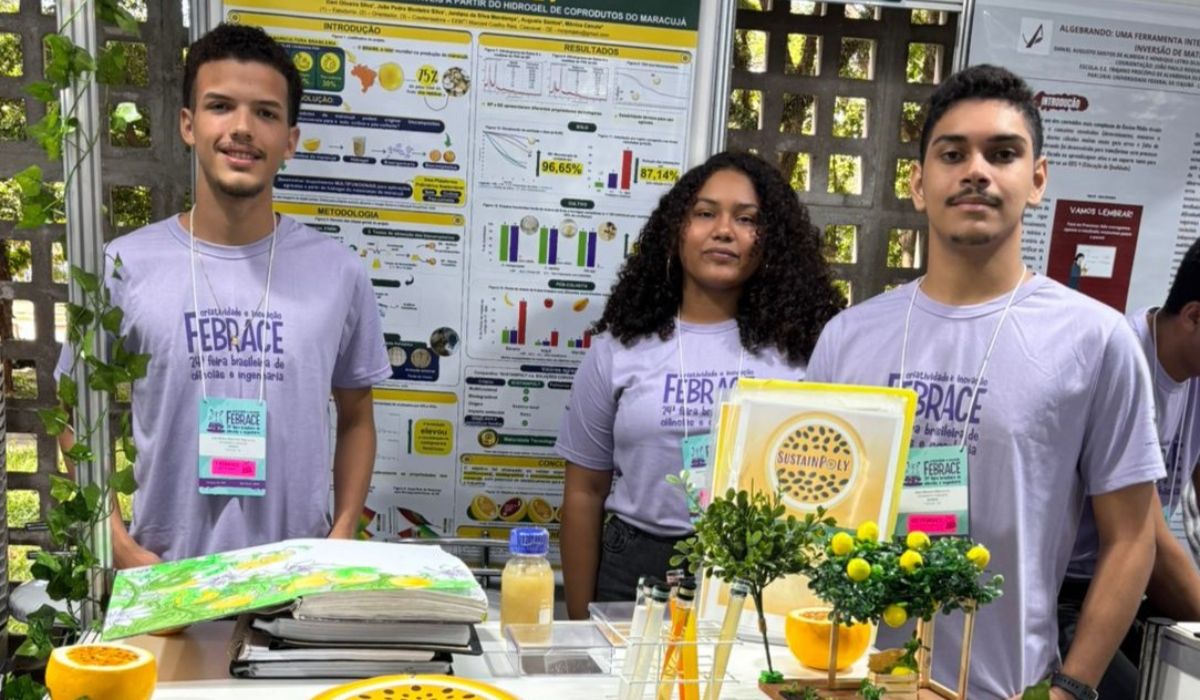
Soil moisture retention for up to 21 days
According to FEBRACE, the materials developed by the students were tested under different conditions and demonstrated soil moisture retention for up to 21 days.
The same text reports a reduction of up to 87% in weed infestation, as well as repellent action against pests.
In the technical poster, the result of moisture maintenance is associated with the exopolysaccharide biofilm, with an index of 96.65%.
The material also records a reduction of 87.14% in burr grass infestation compared to the uncovered area, under the test conditions described by the authors.
The research also evaluated effects related to pest management.
According to the poster, the trials involved fruit flies and leaf-cutting ants, with an insecticidal action of 99.33% and indication of non-toxicity for non-target organisms.
These data refer to the experiments presented at the fair and do not indicate, by themselves, already approved commercial use.
Low cost and family farming
The production cost also appears among the data presented by the students.
According to the FEBRACE poster, the polymeric band had a cost of R$ 0.07 per 200 grams, while the exopolysaccharide biofilm reached R$ 0.17 for the same amount.
The comparison made by the authors classifies Sustainpoly as multifunctional, biodegradable, locally sourced, and viable for family farming.
Conventional polymers, on the other hand, are described in the technical chart as synthetic and with a greater environmental impact, according to the criteria used in the project itself.
With this data, the research was presented as a low-cost alternative for agricultural applications.
The formulation, however, should still be understood within the scope of a student scientific work, with results linked to the tests disclosed at FEBRACE and ISEF.


Sustainpoly at Regeneron ISEF 2026
FEBRACE reported that Sustainpoly received a credential for ISEF 2026 in the list of projects selected to represent Brazil.
The work appears among the projects from Ceará accredited for the fair, authored by three students from Cascavel and guided by Francisco Augusto Oliveira Santos.
The Regeneron ISEF brings together high school students selected by affiliated, national, regional, or local fairs.
In the 2026 edition, the Society for Science announced the main awards on May 15, in Phoenix, and included Sustainpoly among the winners in the Environmental Engineering category.
The special Sigma Xi award was announced in its own ceremony.
In the official list, the project of the Ceará students appears as the 1st place winner in Life Science, with the description in English focused on hydrogel-based biopolymers for the reuse of agro-industrial waste and sustainable agriculture.
Applications in soil, cultivation, and post-harvest
In addition to moisture retention and weed control, Sustainpoly included tests in the post-harvest stage.
According to the technical poster, the fruits treated with the coatings showed a average reduction of 64.1% in mass loss and an increase of up to 350% in shelf life, under the conditions evaluated by the authors.
These results were presented in comparative graphs involving banana, apple, and papaya.
The FEBRACE material states that the averages accompanied by different letters had a significant difference by Tukey’s test, with p<0.05, a statistical criterion used by the authors to evaluate the experiment data.
The research also mentions thermal stability for agricultural use and differences in technological properties among the biocomposites.
These points appear in the technical panel, which organizes the work into three fronts: soil, cultivation, and post-harvest.
Science made by public school students
The authorship of the project was registered by the virtual showcase of FEBRACE in the area of Food Science and Technology.
The official page identifies the three students, the Marconi Coelho Reis school, and the guidance responsible for the work.
In the press release about the international award, FEBRACE stated that students from Ceará were awarded at the Regeneron ISEF 2026 and mentioned Sustainpoly among the recognized projects.
The same publication reports that the international fair took place from May 9 to 15 in Phoenix.
The case shows a school research project built from a concrete agricultural demand: the use of water in the soil, the presence of weeds, and the reuse of passion fruit waste.
The environmental and agricultural relevance of these applications is presented by the project’s own sources and by FEBRACE, with no record of large-scale commercial adoption in the official sources consulted.
By transforming passion fruit peel into biocomposites tested for soil, cultivation, and post-harvest, the students took research developed in the interior of Ceará to an international competition.
Other residues from Brazilian agricultural production can also be studied with a focus on low cost and field application.


